zenpundit.com » Mahdist

Archive for the ‘Mahdist’ Category

Updating the Apocalypse

Tuesday, May 15th, 2012

[ by Charles Cameron — four shifts in apocalyptic thinking, us & them, sacred and secular ]
.


.

Every time something significant happens in Europe or the Middle East, those who have worked out their apocalyptic timelines ahead of time have to make appropriate adjustments.

1.

Today, the Christian apocalyptic writer Joel Richardson took note of recent events in Europe in a piece entitled The Collapse of the Euro = The Collapse of the Euro-Centered End-Time Perspective? and asked:

as the collapse of the Euro monetary unity appears to loom over all of us, how will such an global earthquake affect the popular, but equally collapsing Euro-centered perspective on the end times?

Joel may be onto something, we may be on the verge of a major shift in Christian end times emphasis — away from Europe and towards Joel’s Islamic Antichrist theory, as explored in his book The Islamic Antichrist: The Shocking Truth about the Real Nature of the Beast and his forthcoming Mideast Beast: The Scriptural Case For an Islamic Antichrist.

2.

I’ve put a screen shot at the top of this post from an end times video featuring Europe as the evil empire and the Pope as Antichrist – it’s a brilliant graphic pairing that illustrates the older theory visually and viscerally, and should you so wish, you can watch the whole thing here. Note also the comment from SyriacBoy10 below the video:

In the Bible and the Quran, it is said that the Antichrist will come from Europe which is expected to be in this generation due to the signs and global disasters.

Just what place names in scriptures might refer to just what places or entities in modern or far future times is always a matter of interpretation — as Joel himself neatly demonstrated with a variety of “biblical” maps in his Prophezine post Where is Magog, Meshech and Tubal?

And for that matter, is our Coptic friend speaking of the Antichrist in the Qur’an, or the Dajjal? The two are commonly inflated, which gets a bit confusing after a while…

3.

And here’s Joel on failed predictions of the EU as the pivotal demonic empire of the last days in prophecy:

Nearly 20 years ago, I intently watched as a very popular Christian television prophecy teacher declared, “The present formation of the European Union is literally the fulfillment of Bible prophecy right before our eyes!”

According to this teacher, the creation of the European Union represented a biblically prophesied revived Roman Empire. Because the last-days empire of the Antichrist, as described in the books of Daniel and Revelation, is portrayed as a 10-nation alliance, this teacher confidently declared that when the number of EU member states reached 10, this would signal the imminent return of Jesus Christ.

Soon, the number of EU member states reached the magic number 10, just as this teacher had predicted. Then the number reached 11, and then 12. Soon there were 20. Today there are 27 member states. The teacher’s very confident predictions failed.

4.

As it happens, I correspond with Joel on occasion and like the man, despite our holding very different theological opinions. In particular, I like to quote this passage from his description of an interview he gave on NPR:

I explained to my host that unless a supernatural man bursts forth from the sky in glory, there is absolutely nothing that the world needs to worry about with regard to Christian end-time beliefs. Christians are called to passively await their defender. They are not attempting to usher in His return. Muslims, on the other hand, are actively pursuing the day when their militaristic leader comes to lead them on into victory. Many believe that they can usher in his coming.

I’d be interested to know what GEN Boykin would make of that…

5.

All in all, I see four trends in apocalyptic thinking at the present time.

First, there’s a trend, suggested by Joel Richardson in his articles linked above, away from an earlier Eurocentric focus of end times interpretation, and towards his own view of Islam – and of the Mahdi (awaited by many Muslims) as Antichrist.

Second, there’s a trend noted by another occasional correspondent of mine, Julie Ingersoll, in one of her two recent articles on Kirk Cameron in Religion Dispatches – more precisely, a theological shift:

from the larger premillennialist evangelical world that he depicted in Left Behind to the postmillennialist dominion theology of the Reconstructionists.

Third, It seems to me that there’s a trend away from the “soon expectation” of the Mahdi of President Ahmadinejad in Iran, as the Supreme Jurisprudent, Khamenei, withdraws his support from his President and Ahmadinejad enters his lame duck phase…

And finally, there are mild signs that apocalyptic itself and religious motives more generally are slowly entering the discourse of the strategically minded, including those whose secular worldviews have hitherto all too often led them to dismiss both religious and apocalyptic drivers as irrational and unserious.

Columbia’s upcoming Hertog Global Strategy Initiative with its focus this year on Religious Violence and Apocalyptic Movements, which I mentioned recently, is one such sign – another is the attention paid to Khorasan — a name with strong Mahdist associations — in a post at the Long Wars Journal today.

6.

Luckily, we have Richard Landes‘ massive, brilliant Heaven on Earth: The Varieties of the Millennial Experience to educate us in the bewildering profusion of forms, both secular and sacred, that millennial hopes and fears can take.

And with Israel’s departing Shin Beth chief calling PM Netanyahu “messianic” – using the same term Netanyahu used for Ahmedinajad – it’s about time, too.

Messianic symmetries

Sunday, April 29th, 2012

[ by Charles Cameron — Shin Bet’s Yuval Diskin calles Netanyahu messianic, Netanyahu called Ahmadinejad messianic, and other millenarian parallels and face-offs ]
.

One man’s Christ is another man’s Antichrist:

We’ll get to Diskin and Netanyahu, but first some background.

It is not uncommon to see the face-off between the West and Global Jihad — however you might prefer to name the opposing sides — as both asymmetrical (our kevlar vs their shalwar kameez, so to speak) and symmetrical (our crusaders vs their mujahideen, so to speak).

There are several aspects of these symmetries and asymmetries that interest me:

1.

The first is that the asymmetries are typically quantitative: one side has more firepower than the other, more troops and more sophisticated weaponry, and indeed, the conflict or flurry of conflicts in question does seem to fall under the rubric of asymmetric warfare, and those who write about asymmetries with the deepest understanding are typically those whose “loop” is to observe, orient, decide and act… while by way of contrast, the symmetries are most frequently observed by those whose “loop” is to observe, comprehend, describe and influence, and the symmetries they observe are typically qualitative, operating at the level of ideas.

I’ll get to a couple of examples shortly.

2.

The second is that within the asymmetries, it is not uncommon to find a reversal of polarities by which the lesser outsmarts and defeats the greater force. I’m thinking here of David and Goliath as the archetypal version, and of Nigel Howard, in Confrontation Analysis: how to win operations other than war, writing:

the problem of defense in the modern world is the paradoxical one of finding ways for the strong to defeat the weak.

A different aspect of asymmetry emerges when one can think of Israel as both the powerful high-tech occupier of a poorly-equipped and stateless mass of Palestinians, and a tiny emergent Jewish democracy surrounded on all sides (except the sea) by Arab and or Muslim once and future foes… a Goliath seen one way, a David the other…

What’s intriguing here is that in some ways everybody wants to be David, right?

3.

The third point of interest is the frequency with which the symmetries appear to contain explicit millenarian, messianic or apocalyptic elements.

Here are two examples. The first is from Gilles Kepel, who has been studying Muslim political movements for decades – he wrote The Prophet and the Pharaoh: Islamist movements in Sadat’s Egypt in 1984. In his 2010 Beyond Terror and Martyrdom: The Future of the Middle East, p. 10, he writes:B

ush, Cheney, and the neoconservatives on one hand, Bin Laden, Zawahiri, and Al Qaeda on the other — both sides staked their claim to power on a vision of global rectification through violent means. But the utopian ends that supposedly justified those means — universal democracy or a universal Islamist state — proved impossible to achieve, and in a few short years the opposing dreams of Bush and Bin Laden had devolved into an endless shared nightmare.

And then there’s Arundhati Roy, whose Guardian piece, The algebra of infinite justice, written less than a month after 9/11, asked:

What is Osama bin Laden? He’s America’s family secret. He is the American president’s dark doppelganger. The savage twin of all that purports to be beautiful and civilised. He has been sculpted from the spare rib of a world laid to waste by America’s foreign policy: its gunboat diplomacy, its nuclear arsenal, its vulgarly stated policy of “full-spectrum dominance”, its chilling disregard for non-American lives… Now that the family secret has been spilled, the twins are blurring into one another and gradually becoming interchangeable. … Now Bush and Bin Laden have even begun to borrow each other’s rhetoric. Each refers to the other as “the head of the snake”. Both invoke God and use the loose millenarian currency of good and evil as their terms of reference.

Note here that Kepel’s “vision of global rectification through violent means” and Roy’s “loose millenarian currency of good and evil” both have resonance that falls clearly within Richard Landes’ corpus of “varieties of millennial experience“.

4.

Even more explicitly messianic is the parallelism / opposition observed by Jean-Pierre Filiu, Kepel’s Sciences Po colleague, in his Apocalypse in Islam, where he notes that:

the emergence of al-Qaida has been accompanied by a millenarian rereading of jihadist terrorism that considers the Taliban sanctuary in Afghanistan to be only a first step toward the establishment of a universal caliphate… the Hour is near. The signs are there for all to see.

and writes with reference to Ahmadinejad and his Mahdist cohorts in the next paragraph:

These tragic visionaries share with the most farsighted of American neoconservatives the conviction that an implacable conflict is foretold in prophecy.

concluding (with regard to both, I would imagine):

It is therefor less a clash of civilizations that is now beginning to take shape than a confrontation of millenarianisms.

5.

Tim Furnish has a milder variant on the classic “One man’s Christ is another man’s Antichrist” theme as the opening sentence of his study of Mahdisms, Holiest Wars — he writes:

One man’s messiah is another man’s heretic…

which in turn reminds me of Jorge Luis Borges and his short classic, The Theologians, in which he describes the vicissitudes of two men deeply concerned with the nature of God — the heretic John of Panonia and the heresy-hunter Aurelian, his nemesis: Borges concludes his tale of these two intertwined lives with an extraordinary symmetry:

The end of this story can only be related in metaphors since it takes place in the kingdom of heaven, where there is no time. Perhaps it would be correct to say that Aurelian spoke with God and that He was so little interested in religious differences that He took him for John of Pannonia. This, however, would imply a confusion in the divine mind. It is more correct to say that in Paradise, Aurelian learned that, for the unfathomable divinity, he and John of Pannonia (the orthodox believer and the heretic, the abhorrer and the abhorred, the accuser and the accused) formed one single person.

But let there be no mistake about it, theologies differ. Safar Al-Hawali may use some of Hal Lindsey‘s exegetical devices to elucidate the end times from an Islamic perspective and proclaim “the Messiah = Christ Jesus Son of Mary, Allah’s servant and messenger” — but Islam’s Mahdi is pretty clearly Joel Richardson‘s Antichrist.

6.

What I hope to have accomplished thus far is to show two things: that keeping an eye out for symmetries and antitheses is a powerful tool for exploring conflict, especially at the qualitative and ideological level, and that messianic juxtapositions in particular have great force, and crop up with significant frequency in the literature of the “sacred vs secular war” also known to some as “jihad vs crusade”.

7.

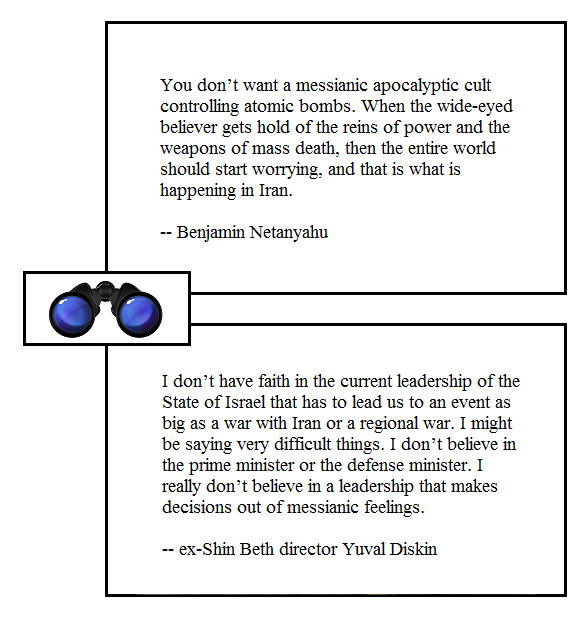
But hey, we came here to talk about Netanyahu and his spy, right? I find the juxtaposition of these two quotes — one from the current Israeli Prime Minister shortly before he was elected, the other just a few days ago by the man who was recently his spy-chief — striking, particularly in the contex provided above:

I try to read carefully. When I first saw the Yuval Diskin quote it was contextualized as suggesting that Benjamin Netanyahu and Ehud Barak were the leaders making “decisions out of messianic feelings” – but then for a moment it occurred to me that Diskin might have been saying “I don’t believe the prime minister’s accusation that the leadership of Iran makes decisions based on messianic feelings is correct – I see them as rational, persuadable actors.”

But no: Yuval Diskin is quite clear that it is Netanyahu and Barak he is talking about in this extended quote from Ha’Aretz:

My major problem is that I have no faith in the current leadership, which must lead us in an event on the scale of war with Iran or a regional war. I don’t believe in either the prime minister or the defense minister. I don’t believe in a leadership that makes decisions based on messianic feelings. They are two messianics – the one from Akirov or the Assuta project and the other from Gaza Street or Caesarea. Believe me, I have observed them from up close… They are not people who I, on a personal level, trust to lead Israel to an event on that scale and carry it off. These are not people who I would want to have holding the wheel in such an event.

Perhaps because I am more than usually sensitive to apocalyptic and messianic fervor, I find the implications of both Netanyahu’s and Diskin’s observations – if accurate as to the respective temperaments of the leaders concerned — quite chilling.

8.

As so often, I’m hoping to raise questions here — to prompt deliberative thinking, not to argue or persuade.

Should I whisper, should I scream? – Abu Musab al-Suri redux, Pt 2

Thursday, March 1st, 2012

[ by Charles Cameron — typology of intelligence failures, analytic blind spot, millennial movements, prophecy as strategy, abu Musab’s end times chronology ]
.

To tie in with the first part of this double-post, let me quote Aaron Zelin again:

I’ll back that up with Jean-Pierre Filiu‘s observation that in Abu-Musab al-Suri’s reading of jihadist history, “events lead on from one another toward the appearance of the Mahdi” — and that in Abu-Musab’s own words, “We shall be alive, then, when Allah’s order comes.”

I’ll give a brief account of the chronology below. Let’s get on with this.

1.

I don’t believe that Richard Landes, my mentor at the Center for Millennial Studies, mentions Abu Musab al-Suri in his Heaven on Earth: The Varieties of the Millennial Experiences (again as with Furnish, I could be wrong) — but if there’s a single book that will convince you of the enormity of our blind spot when it comes to taking millennial movements seriously, it’s this masterwork — simply stunning.

The thrust of his book is that millennial movements have been quite deliberately overlooked twice by the grand narratives of western civilization — first by religious writers who were embarrassed by the repeated cycle of enthusiasm followed by failure of end times prophecies and retroactively marginalized the topic, and more recently by…

secular historians, determined to push religion into the background of their story, [who] were hardly interested in highlighting religious phenomena that even the ecclesiastical historians considered ridiculous.

It is to undo the damage that this two-fold blindedness has caused us that Landes writes his remarkable book, covering in extraordinarily wide-ranging scholarly detail and with insight and wit, that current in human fear and hope he terms “the most protean belief in human history: millennialism.”

2.

In other words, the “the most protean belief in human history” has been consistently disregarded for way too long by academics, pundits and experts.

Put that in the context of this trenchant paragraph from Richards Heuer‘s Psychology of Intelligence Analysis, just recently quoted and indeed highlighted by Clint Watts and John E. Brennan in their paper Capturing the Potential of Outlier Ideas in the Intelligence Community:

Major intelligence failures are usually caused by failures of analysis, not failures of collection. Relevant information is discounted, misinterpreted, ignored, rejected, or overlooked because it fails to fit a prevailing mental model or mind-set.

3.

Rejected and overlooked?

Even the Psalmist (118.22) knows the importance of what’s rejected:

The stone which the builders rejected has become the chief cornerstone.

And just in passing, I’d argue that two of the seven “outlandish, unthinkable, and wholly anomalous” outliers that Watts & Brennan offer as bulleted examples in their paper — the Khomeini and bin Laden events — would have shown up rather more prominently had a subset of analysts been tasked to keep an eye on millenialist and / or specifically mahdist movements.

4.

Very quickly, then, here are some of the recent reports regarding al-Suri from well-informed analysts which seem to pay little mind to the Mahdist strand in his strategic thinking:

  • Raff Pantucci‘s January 26, 2012 post Whither al Suri? focuses on the implications of al-Suri’s release and quotes Brynjar Lia — insightful, but no mention of Mahdism.
  • Aaron Zelin‘s February 3 Foreign Policy post on al-Suri’s release comes closest to mentioning an apocalyptic angle when he writes:

    Additionally, his lore will grow in light of an alleged vision he had this past August, which was relayed by online jihadist Jundi Dawlat al-Islam (“Soldier of the Islamic State”), a member of the important Shamukh al-Islam Arabic Forum. “I have been informed that the Shaykh [Suri] saw in the past days a vision that he will have an important role in Bilad al-Sham (Syria), we ask Allah that it becomes true,” the jihadist wrote. Suri’s release will be seen as a vindication of that vision by his supporters, and no doubt boost his influence.

    The significant role of Shams — “the apocalyptic theater par excellence” — in al-Suri’s narrative is something J-P Filiu emphasized (p. 189).

  • Bill Roggio‘s February 5 piece for Long War Journal is an excellent backgrounder as befits LWJ — but no mention of eschatological strategy there, either.
  • Jarret Brachman‘s February 6 Abu Musab al-Suri Still Matters Online at Chronus Global is a brief note, just a tip-off that al-Suri is still influential…
  • MEMRI‘s February 8, 2012 The Release of Top Al-Qaeda Military Strategist/Ideologue Abu Mus’ab Al-Suri from Syrian Prison – A Looming Threat makes no mention of al-Suri’s eschatological thinking, and neither does their more extensive report on al-Suri, Al-Qaeda Military Strategist Abu Mus’ab Al-Suri’s Teachings on Fourth-Generation Warfare (4GW), Individual Jihad and the Future of Al-Qaeda, to which their February 2012 post links.
  • And the Jamestown Foundation‘s Feb 10 piece by Murad Batal al-Shishani, Syria’s Surprising Release of Jihadi Strategist Abu Mus’ab al-Suri, in their Terrorism Monitor v 10 # 3 doesn’t mention the apocalyptic angle — and Jamestown is where I heard Ali A Allawi speak on Millenarianism, Mahdism and Terrorism: The Case of Iraq back in 2007!

    Curious…

  • Ah well, there’s always Zenpundit [vbg].

    5.

    Okay, it looks to me as though we’re still so focused on the “nizam la tanzim / system not organization” and “lone wolf / leaderless resistance” aspects of al-Suri’s work, significant as they are, that it’s easy to overlook that damned ridiculous “end times” stuff the fellow also considers important, strategically speaking.

    So for the record, here’s the chronology of future events as J-P Filiu recounts it:

    Events will unfold in the following manner: “The Arabian Peninsula will be preserved [from harm] until the destruction of Armenia, Egypt will be preserved until the destruction of the [Arabian] peninsula, Kufa will be preserved until the destruction of Egypt, the city of impiety [mad?nat al-kufr] will be conquered only after the great wars, and the Antichrist will appear only after this conquest.” The concentrically expanding path of apocalyptic devastation will then close in upon Palestine, the sanctuary of Judeo- Crusader “impiety,” where the ultimate confrontation with the Byzantines will take place in and around the city of Acre.

    Well, that’s part of it, but you should read Filiu’s pp 186-191 for a fuller account — and somebody, please send me a reliable translation of those last 100 pages of abu Musab’s Call if you have one!

    Sadly, I don’t read or speak Arabic.

    6.

    Okay, that’s it, I’ve shouted, or whispered or whatever.

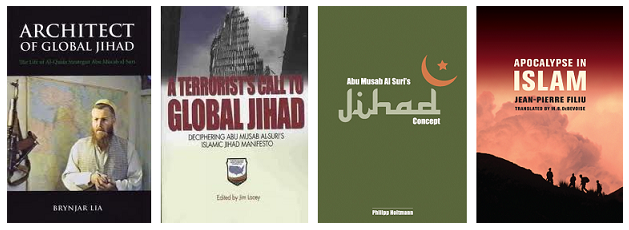
    The books at the top of this post are:

    David Cook, Contemporary Muslim Apocalyptic Literature
    Timothy Furnish, Holiest Wars: Islamic Mahdis, Their Jihads, and Osama bin Laden
    Jean-Pierre Filiu, Apocalypse in Islam
    Richard Landes, Heaven on Earth: The Varieties of the Millennial Experience

    All four are worthy of your consideration.

    Should I whisper, should I scream? – Abu Musab al-Suri redux, Pt 1

    Wednesday, February 29th, 2012

    [ by Charles Cameron — abu Musab al-Suri, analytic blind spot, prophecy as strategy, redux redux redux ]
    .

    Abu Mus’ab al-Suri appears to have been released from prison recently. Speaking of which, we seem to have a blind spot.

    1.

    Here’s how an Egyptian activist who was in prison with Abu Musab in 2005 described their conversations, as reported three days ago in The Arab Digest:

    Abu Musab’s Philosophy in prison was about spreading hope, and what we have to do now to strengthen our connection to Allah; it is the strong power to restore trust in that we will prevail, and that the nation’s projects will not stop at the tyrants’ plans, and the occupation of Afghanistan. The prophet’s prophecies assures the return of Afghanistan and the rise of the black flags army from Khurasan. We will win and continue our role together till victory – May Allah relieve you Abu Musab – these words had a profound effect on our morale, they ended all of our pains in a moment when we foresee a future and our duties.

    As my analyst friend Aaron Zelin, who kindly pointed me to this extract and has himself written on al-Suri for Foreign Policy said:

    Yes indeed — Aaron is exactly right. And just to be clear on this, let me repeat myself:

    Abu Musab al-Suri is the man who “wrote the book” – the 1,500-page book – on jihad. And as you may remember, his book builds to what Jean-Pierre Filiu calls “a hundred-page apocalyptic tract” while also commenting that there is “nothing in the least rhetorical about this exercise in apocalyptic exegesis. It is meant instead as a guide for action.”

    And that black flags army from Khurasan? Those are not just any old black flags, they’re the banners of the “end times army” of the Mahdi.

    2.

    If you wrote a 1500 page book about jihad and devoted the last 100 pages to describing a set of “end times” prophecies that predicted where and in what order various battles would take place, would you have added those last hundred pages in because you had paper to spare and time to kill?

    Or would you have climaxed your book with those hundred pages because those end times prophecies were what the whole business was all about?

    And if, on the other hand, you were in the business of analyzing jihadist strategic literature with a view to understanding the jihadist enemy, would you more or less skip those last hundred pages because they’re just “repetitive theological justification” — because, let’s face it, it’s weird religious stuff?

    3.

    Abu Musab al-Suri is the man who introduced Peter Bergen to bin Laden, and of whom Bergen later wrote:

    He was tough and really smart. He seemed like a real intellectual, very conversant with history, and he had an intense seriousness of purpose. He certainly impressed me more than bin Laden.

    While he was at large prior to his capture in 2005, the FBI offered a $5 million bounty for information as to his whereabouts.

    And Abu Musab al-Suri’s 1,500 page Call to Global Islamic Resistance has been described by counter-terrorist researcher Brynjar Lia as “the most significant written source in the strategic studies literature on al-Qa’ida”.

    A source which has has a 100-page closing section which discusses “end times” hadith…

    WTF? you might well ask — WTF?

    4.

    Here’s one answer to WTT? It comes from Tim Furnish, who (unless I’ve missed it, always a possibility) doesn’t mention al-Suri in his book Holiest Wars: Islamic Mahdis, Their Jihads, and Osama bin Laden, which as you can tell from the subtitle is precisely and exactly about Mahdist warfare — but he does let us know, right in the first paragraph, why Mahdist warfare is important, telling us:

    Muslim messianic movements are to fundamentalist uprisings what nuclear weapons are to conventional ones…”

    Okay, perhaps you think Furnish is screaming — here’s something more like a whisper from J-P Filiu as to what a Mahdist movement might portend:

    An appeal to the imminence of apocalypse would provide it with an instrument of recruitment, a framework for interpreting future developments, and a way of refashioning and consolidating its own identity. In combination, these things could have far-reaching and deadly consequences.

    So. Should I shout, or should I whisper?

    5, 6, 7…

    This is getting too long, I have too much more to say, I want to tie this in with Richards Heuer and Clint Watts and the Psalms of David, so I’ll just list the books illustrated at the head of this post for your convenience now —

    Brynjar Lia, Architect of Global Jihad: The Life of Al Qaeda Strategist Abu Mus’ab al-Suri
    Jim Lacey, A Terrorist’s Call to Global Jihad: Deciphering Abu Musab al-Suri’s Islamic Jihad Manifesto
    Philipp Holltmann, Abu Musab Al-Suri’s Jihad Concept
    J-P Filiu, Apocalypse in Islam

    — and I’ll be back with a follow-up post tomorrow.

    TransApocalyptic UnCreativity

    Saturday, February 11th, 2012

    [ by Charles Cameron — minor stuff — Anwar al-Awlaki an interfaith copycat? ]

    .

    No biggie.

    I ran across an al-Awlaki video today where the sheikh talks about the Mahdi, which as you may know is a topic of interest to me. So I was checking to see how much I’d written previously about al-Awlaki’s apocalyptic views, and a quick search brought me to the End of Time / New Beginning CD set I’d expressed a wish for earlier, and I remembered that back then when I first ran across it, it was unavailable…

    In any case, that little memory jog sent me back to see whether that particular item had been restocked, and apparently no it hasn’t, but I thought I’d better check on eBay in case they might have a copy, and typed up those keywords, “end of time new beginning”…

    and up came a book by Alfred McBride, a Catholic priest of the Praemonstratensian or Norbertine order. So that even the title of the event on which Awlaki’s end times Q & A session was issued was in fact the ripped-off subtitle of a Catholic book published a decade earlier.

    O tempora, o mores! Young people today! : )

    *

    In case you want to see what Anwar al-Awlaki had to say about the Mahdi back in his San Diego days, you can find the video here: www.youtube.com/v/We91CKWQEgg

    But what I really wanted to talk about is the serious Mahdist streak in the thought and writings of the newly released Abu Musab al-Suri, okay? Coming up shortly…


    Switch to our mobile site