zenpundit.com » Patterns

Archive for the ‘Patterns’ Category

Rhythm in Ecclesiastes and CJ Chivers

Friday, October 7th, 2011

[ by Charles Cameron — wars and seasons of wars ]

.

quo-cjchivers.gif

Read the CJ Chivers piece first, for verbal and visual background, then read the New York Times article he mentions, Cease-Fire for Harvests Offers Respite in Afghanistan, which is now online — and quite a read it is, too.

Fouche on Potential and Probable Uses of Power

Friday, October 7th, 2011

My sometime Chicago Boyz colleague, Joseph Fouche, had an interesting if somewhat meandering post on how power is used, not used and possibly abused.

The Chains of the Improbable vs. The Chains of the Impossible

An old Vulcan proverb advises us that only Sulla could march on Rome. This proverb may contradict another ancient proverb that claims that all roads lead to Rome. This seeming contradiction is resolved when you include little used roads, off the beaten track, the roads not taken. Sherlock Holmes once chided John A. Watson, M.D., saying, “How often have I said to you that when you have eliminated the impossible, whatever remains, however improbable, must be the truth?” Some roads to Rome are impossible, leading to the insurmountable. Lucius Cornelius Sulla Felix took a road that, while thought impossible, proved to be merely improbable.

Sulla, consul of Rome for the year 88 B.C., was in camp preparing to take his army east to fight King Mithridates VI of Pontus. Two envoys arrived to tell him that his command had been taken away by the vote of one of the people’s assemblies in Rome. These envoys of the Roman people expected that Sulla would do the only thing possible: lie down there, obedient to their commands, as every Roman army commander before him had done. Unfortunately, what they thought was impossible was only improbable.

Sulla gathered his men, announced what the will of the Roman people was, and asked them what the will of the army was. Sulla’s soldiers answered by stoning the envoys of the Roman people to death, much to the surprise of the envoys of the people. Sulla’s soldiers then petitioned Sulla to take an impossible road, a road never taken, and lead them to Rome to reclaim his Mithridatic command. Sulla, much to the surprise of his own officers, who thought such a course impossible, decided to heed his men and march on Rome. His officers resigned en masse except a happy few. But the poor bloody legionaries of Sulla’s army eagerly began the march on Rome.

Envoys from Rome streamed towards Sulla’s army as it marched north.These envoys were shocked and grew increasingly shocked as they protested to Sulla that surely, surely it was impossible that he wanted to march a Roman army through the city limits and into Rome itself. The law forbade it. The unwritten constitution forbade it. The Republic forbade it. The gods forbade it.

Sulla responded to the effect of, “Go tell the Romans that I don’t lie here obedient to their commands. I’m coming to Rome and hell’s coming with me.” The tone of these envoys’ entreaties and the mood of the people of Rome grew increasingly hysterical as the improbable dawned on them: not only could a Roman army commander march an army on Rome, it was increasingly probable that Sulla would march armed Roman legionaries right into the heart of Rome itself to deal with his political enemies. Indeed, Sulla led his men across the sacred pomerium that divided the “public thing” (res publica) of sacred Roma herself from land that was merely the property of Rome. Sulla’s veteran legionaries easily dispatched the hastily gathered mob of gladiators and other ruffians that his political opponents had thrown together at the last moment in a futile attempt to stop them.

Sulla had revealed that the impossible was merely the improbable.

Sulla spent the rest of his life trying to disguise this state of improbability as a mere state of impossibility.

He failed.

That was merely Fouche’s introduction. The post is well worth reading in full.

The post caught my eye because of Sulla, a Roman who did a monstrous thing but who was himself no monster. Much like a surgeon whose patient’s body is riddled with cancer, Sulla attempted to buy the old Roman Republic time and restore a semblance of political health by ruthlessly cutting out a tumorous faction and ratcheting back a host of constitutional gimmickery that had been welded onto Roman government over the years by ambitious politicians. Older, original rules of the game, or new ones in their spirit, were restored after blood shed in the proscriptions was scrubbed from the forum. Sulla even formally stepped down from the supreme power he held, like Cincinnatus, to further drive home the point to his fellow Romans regarding the sanctity of their traditions – though reportedly Sulla remained, even in a debaucherous retirement, a terrifying figure and stringpuller.

Fouche is correct that Sulla’s extreme measures failed. The underlying structural problems of the Republic were rooted in an increasing concentration of wealth, primarily in land ownership by Patricians and politically favored trading opportunities in “the East”, held mostly by the elite of Rome’s Italian “allied” city states, that left many Roman citizens too impoverished to perform military service or to be active in politics, except as dependent members of a clientela. The Republic’s legions and it’s political virtue had been based on an economically independent smallholding class who were being despoiled by politically powerful Patricians. Sulla’s reforms may have tempred political conflict within the ruling class for a time, but they also aggravated the social grievances that provided the Populares with political support from ordinary Romans and tilted the delicate political balance in the Republic toward extreme oligarchy.

In his retirement, observing the young Julius Caesar, whom Sulla had reluctantly spared, his toga fashionably loosely belted, long sleeved and wearing boots, like the ancient kings of Alba Longa, Sulla remarked “ He contains many Mariuses“. Caesar did. And unlike Marius but like Sulla, Julius Caesar was successful, Sulla having shown him the way to cross a Rubicon.

Power is power but power coupled with legitimacy endures. Sulla to Caesar to Augustus is the continuum.

Arab Spring and apocalyptic dawn

Sunday, October 2nd, 2011

[ by Charles Cameron — Mahdism and the Arab Spring, depth of apocalyptic expectation not limited to militant circles ]

.

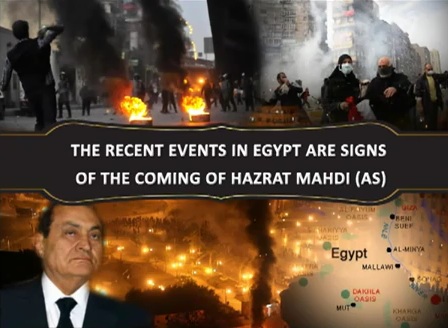
recent-events.jpg

screen-cap from a Feb 2011 video associated with Harun Yahya, see below

I’ve been holding back on posts about Shi’ite apocalypticism, because it seems to me that President Ahmadinejad‘s influence is on the wane for reasons not entirely disconnected from his keen and oft-expressed expectation of the soon coming of the Hidden Imam.

I have posted a couple of times recently on Sunni apocalyptic — but there my focus has been on AQ, Taliban and the black banners of Khorasan, as illuminated recently by the books of Syed Saleem Shahzad and Ali Soufan. My next forays will hopefully concern another strand of militant Sunni apocalyptic– the traditions of jihad against India (Ghazwa-ul-Hind) — and I’d also very much like to turn my attention some more to some of the eschatological issues in current Christian circles in the US.

But first: a quick glimpse of apocalyptic expectation in the Arab Spring.

1.

Under the title Mubarak’s fall spawns End of Times prophecies, Yasmine Fathi recently reported in Egypt’s Al Ahram online:

The idea of Mubarak as Anti-Christ has caught fire on social networking sites, with many users presenting Muslim Hadiths, sayings of the Prophet, in support of the theory. While others dispute the notion, they nevertheless posit Mubarak’s very existence as a sign that the end is indeed nigh.

One website noted that, according to certain Islamic beliefs, doomsday will come after Egypt is ruled by a leader whose first name is “Mohamed” and second name is “Hussein,” of which “Hosni” – Mubarak’s middle name – is a variation. This, say doomsday-watchers, constitutes further proof that his existence – and recent fall – represented a sign that the end of time can be expected any day now.

One theory currently making the rounds on the web suggests that the world will end on 26 September – this Monday – due to massive earthquakes caused by a rare planetary alignment. The quakes, believers say, will make Japan’s recent disaster look like a walk in the park.

Even Egypt’s Coptic Patriarch, Pope Shenouda III, referred to the prediction, joking at the end of his last weekly sermon, “We’ll meet again next Wednesday after the earthquake, God willing.”

After the theory was savaged by local and international scientists, however, the public’s attention has shifted again to the year 2012 – only three months away – which many fatalists fear will be our last year on earth, since the Mayan calendar ends on 21 December of next year.

The first point to note here is that apocalyptic sentiment is alive and thriving in the Arab world — and not just in the militant jihadist circles of AQ and the like — or Hamas — either.

That’s a significant datum — and our cue for another reading of JP Filiu‘s Apocalypse in Islam.

2.

The number and variety of strands converging in these few brief paragraphs is impressive:

social networking
apocalyptic expectation catching fire
Mubarak’s name as a sign
a date certain — a week from now
cross-religious banter from Pope Shenouda

— and there’s even a reference to the “Mayan” chronology with its 2012 end-date — which (though Fathi doesn’t mention it) just happens to coincide with the Saudi dissident Sheikh Safar al-Hawali‘s ETA for the return of Jerusalem to Islam on the final page of his pamphlet, The Day of Wrath.

3.

Let’s go back to Fathi for a more nuanced — and theologically informed — view:

But according to Amena Nosseir, professor of Islamic theology and philosophy at Cairo’s Al-Azhar University, the true date of the “final hour” will never be revealed to mankind.

“God has not bestowed knowledge of the final hour to any of his prophets or worshippers, and there’s a holy wisdom behind his decision to withhold this information,” she said. “God created humans to create life on this planet, so it doesn’t make sense that he would give them the knowledge of when the end of time will be.”

Even al-Hawali qualifies his suggested date thus:

Therefore, the end -or the beginning of the end- will be 1967 + 45 = 2012, or in lunar years 1387 + 45 = 1433.

This is what we hope will happen, but we do not declare it to be absolutely certain, but if the fundamentalists would like to bet with us, as Quraysh did with Abu Bakr concerning the Qur’anic prophecy concerning the Romans, then without doubt they will lose, although we cannot guarantee that it will be that exact year!

Setting a date for time to end may be the most reliable method yet devised for proving oneself unreliable.

4.

There are other stirrings.

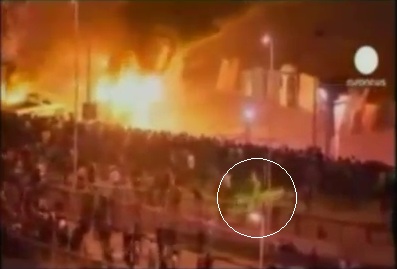
Harun Yahya, an influential Turkish figure, reports that a green horse and rider can be discerned in a recent Cairo video, and proposes that the rider is Khidr — the teacher of Moses in Sura 18 of the Qur’an (which the great scholar Louis Massignon terms “the apocalypse of Islam”) and a mysterious figure of inspiration in Islamic lore…

khidr-in-egyptian-video.jpg

He also “reads” Mubarak as an eschatological figure — the Rook — and indeed, this entire video — only five minutes long and readily available on YouTube — is worth watching, to get a visceral sense of how strong this narrative current is:

BTW: see Halverson, Goodall and Corman‘s Master Narratives of Islamist Extremism for a sense of how significant “narrative” is… and then, yes, reread Filiu!

*

Hat-tip for a hot tip to Bryan Alexander.

The Lion of Judah, Jesus and Jihad

Tuesday, September 27th, 2011

[ by Charles Cameron – a meander from Narnia via Roke and the stars to Jihad –  too religious, perhaps, or too literary — a lightweight post of no significance ]

.
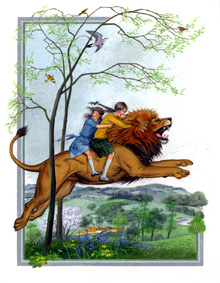
lww-1991-03-small.jpg
illustration credit: Pauline Baynes
.

In my previous post, I quoted the prophet and apostle Bill Harmon:

We are about to move from the dispensation of grace to the dispensation of dominion. We are about to see Jesus, not as the suffering lamb that was slain, but the roaring Lion who is King!

Dominion is a keyword that’s getting a lot of attention right now – it has significantly different meanings for different strands in the theological mix — but as usual I’m at least as interested in the symbols and imagery people use as I am in their doctrinal expressions.

This post, then, will explore the imagery of the Lion.

1.

Having recently written that post with the Harmon quote from 1999, I was struck to read the following account on the Elijah list just yesterday :

I had a profound encounter recently before going to bed. I think it is just like God to get you right before you fall asleep. I had to get out of bed to make a record of this! I felt it important to share with you. We see Jesus in many different expressions in the Scriptures. He is the Good Shepherd, the Lamb of God, the Lord of Hosts, the Angel of the Lord and many other looks. But one night recently He came to me as the Lion who is ready to roar. As you read, ask the Lord to reveal this aspect of His nature in your life.

I had a vision where I found myself on the back of this giant Lion with a huge mane. Then I realized it was the Lord. As the Lion turned His head, I could see His mouth open as if He was getting ready to roar. It is time to ride on the Lion of Judah. It is as if He has been waiting for this season. There is something fresh and new in the air. The breath of His mouth will destroy the enemy.

In this vision I was also running my fingers through the mane of the Lion. This represents the intimacy with God that is the foundation for our authority. Our intimacy is for a purpose – it is to establish the Kingdom of God for the King. The Lion is symbolic in that it is the “King of the Jungle”. The world is that jungle. Jesus is coming as the Lion to rule in the jungle bringing His power to set people free.

The Lord carries us into that jungle with His authority. When we are riding on the Lion we can be assured that we will succeed in all He calls us to do. He is massive, larger than life. He is ready to conquer and demonstrate His power.

In my encounter, I was suddenly on this Lion and He was of full age and postured for action. This will be a time where God will do things suddenly. It will take us by surprise. The sons of the Kingdom will advance the Kingdom for His purposes and with His power.

John Belt, Live In His Presence Ministries

2.

To be honest, it strikes me that that’s straight out of CS Lewis and his wonderful books for children – but without Lewis’ grace as a writer. Compare:

That ride was perhaps the most wonderful thing that happened to them in Narnia. Have you ever had a gallop on a horse? Think of that; and then take away the jingle of the bits and imagine instead the almost noiseless padding of the great paws. Then imagine instead of the black or gray or chestnut back of the horse the soft roughness of golden fur, and the mane flying back in the wind. And then imagine you are going about twice as fast as the fastest racehorse. But this is a mount that doesn’t need to be guided and never grows tired. He rushes on and on, never missing his footing, never hesitating, threading his way with perfect skill between tree trunks, jumping over bush and briar and the smaller streams, wading the larger, swimming the largest of all. And you are riding not on a road nor in a park nor even on the downs, but right across Narnia, in spring, down solemn avenues of beech and across sunny glades of oak, through wild orchards of snow-white cherry trees, past roaring waterfalls and mossy rocks and echoing caverns, up windy slopes alight with gorse bushes, and across the shoulders of heathery mountains and along giddy ridges and down, down, down again into wild valleys and out into acres of blue flowers.

— CS Lewis, The Lion, the Witch and the Wardrobe (illustration above by Pauline Baynes)

That captures the “riding the Lion” idea a great deal more powerfully, and it’s imaginative fiction.

3.

The other idea present in Belt’s narrative is the Lion’s roar. Again, it seems to me that what Belt offers us is a less gracious version of Lewis, who wrote:

The Lion opened his mouth, but no sound came from it; he was breathing out, a long, warm breath; it seemed to sway all the beasts as the wind sways a line of trees. Far overhead from beyond the veil of blue sky which hid them the stars sang again; a pure, cold, difficult music. Then there came a swift flash like fire (but it burnt nobody] either from the sky or from the Lion itself, and every drop of blood tingled in the children’s bodies, and the deepest, wildest voice they had ever heard was saying: “Narnia, Narnia, Narnia. Awake. Love. Think. Speak. Be walking trees. Be talking beasts. Be divine.”

It was of course the Lion’s voice.

— CS Lewis, The Magician’s Nephew

4.

Commenting on Lewis’ version of the Lion’s roar, Paul Ford writes:

This passage is remarkable for the intense breath image and the addition of the fire image (from the first conferral of the Holy Spirit in the New Testament on Pentecost; see the Acts of the Apostles 2:3-4).

— Paul F. Ford, Companion to Narnia

With in turn refers us to this passage:

And suddenly there came a sound from heaven as of a rushing mighty wind, and it filled all the house where they were sitting. And there appeared unto them cloven tongues like as of fire, and it sat upon each of them. And they were all filled with the Holy Ghost, and began to speak with other tongues, as the Spirit gave them utterance.

— Acts 2:3-4

5.

TS Eliot was notably moved by the same passage, and we can see how a poet deals with the same wind and fire in one of the final sections of “Little Gidding”:

The dove descending breaks the air
With flame of incandescent terror
Of which the tongues declare
The one discharge from sin and error.
The only hope, or else despair
Lies in the choice of pyre or pyre —
To be redeemed from fire by fire.

Who then devised the torment? Love.
Love is the unfamiliar Name
Behind the hands that wove
The intolerable shirt of flame
Which human power cannot remove.
We only live, only suspire
Consumed by either fire or fire.

— TS Eliot, “Little Gidding”, Four Quartets

6.

It’s the wind of inspiration that brings tongues of flame here, many tongues, many languages…

The wind bloweth where it listeth, and thou hearest the sound thereof, but canst not tell whence it cometh, and whither it goeth: so is every one that is born of the Spirit.

John 3:8

And the Greek is really quite wonderful here, as Phillip Comfort among others points out

In John 3:8, there is a metaphor which is purposefully polyvalent, in that Jesus was speaking of wind, spirit, and breath at the same time (inasmuch as pneuma can mean all three)

Philip Comfort, Encountering the manuscripts: an introduction to New Testament paleography, p 235

And circling back for a moment to CS Lewis — because there is really only one universe of discourse…

It must always be remembered … that the various senses we take out of an ancient word by analysis existed in it as a unity.

CS Lewis, The Allegory of Love, p 365

7.

I said earlier that CS Lewis’ writing seemed to me to have notably more grace than John Belt’s — and I think that grace has to do with the theological virtue of the same name too, that beauty is an indicator of Grace if you like.

Here’s another author, also writing for children, whose prose is a marvel of purity — describing the music of the stars of which Lewis also spoke — Ursula Le Guin:

It is no secret. All power is one in source and end, I think. Years and distances, stars and candles, water and wind and wizardry, the craft in a man’s hand and the wisdom in a tree’s root: they all arise together. My name, and yours, and the true name of the sun, or a spring of water, or an unborn child, all are syllables of the great word that is very slowly spoken by the shining of the stars. There is no other power. No other name.

Ursula Le Guin, Wizard of Earthsea

Ursula would, I think, describe herself as a Taoist: the traditions may differs, grace is still grace.

8.

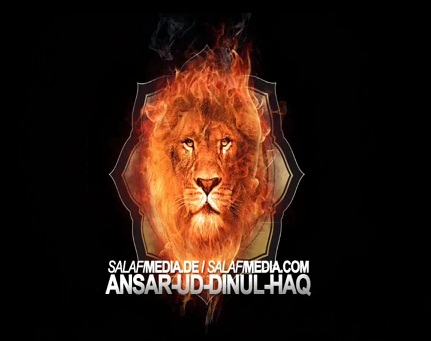
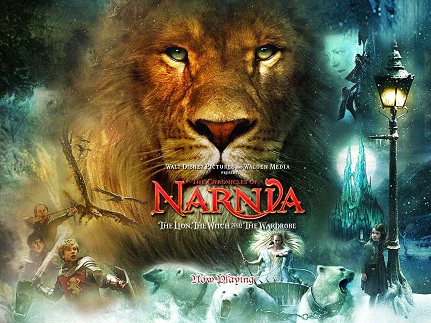
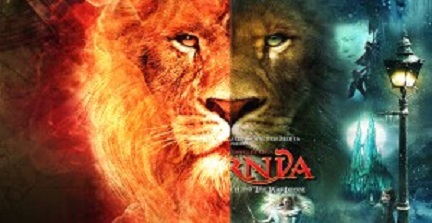
Well, you might not think it would be easy to get from Narnia and CS Lewis to jihad in a single bound, but it has been done, and Jarret Brachman posted the proof a while back…

The jihadist propaganda lion:
screenshot.jpg

was in fact swiped from the Narnia lion:
narnia.jpg

— as Brachman elegantly demonstrated:
composite.jpg

all three images credit: Jarret Brachman, Cronus Global

9

Well, that’s funny — but not uplifting.

So I’ll leave you with another flight — that of the king of the birds this time in the words of Isaiah:

But they that wait upon the LORD shall renew their strength; they shall mount up with wings as eagles; they shall run, and not be weary; and they shall walk, and not faint.

Isaiah 40:31

A bouquet from Breivik

Thursday, September 15th, 2011

[ by Charles Cameron — Breivik, network analysis, graphical presentation, morale and materiel, hard problem in consciousness ]

.

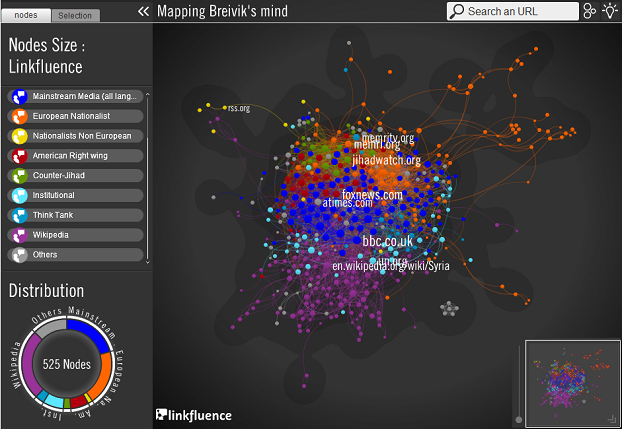
breivik-mind-map.png

If I might wax over-the-top lyrical for just a moment…

Like an early morning bouquet of wildflowers appearing out of the mists —

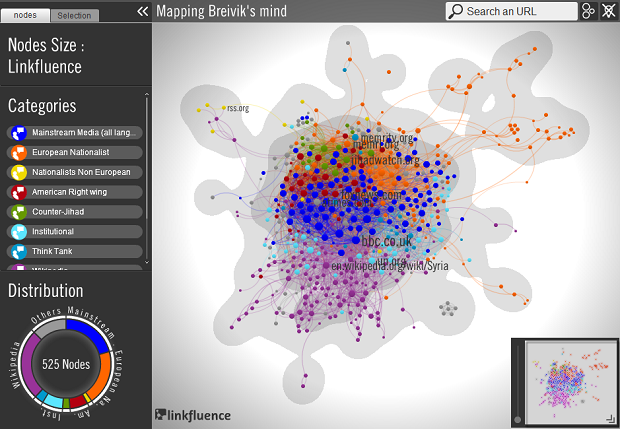
breivik-mind-map-02.png

or like some translucent sea creature perhaps, with galaxies in its veins and tendrils — the mind of Anders Breivik is imaged here by Britain’s Guardian datablog in a graphical mapping of the hyperlinks found in his 1500 page manifesto, and the links between the sites he links to.

Beautiful, no? Like an early morning bouquet?

*

Three things:

  • mapping Breivik’s online links for us is a valuable service.
  • the glamour of high-tech graphical interfaces can be deceptive.
  • there’s no map of the link between concept and act.

That last one, if you ask me, is the real bouquet.

We can know quite a bit about what Breivik read, and even figure out some of how he “connected the dots” – but the move from thinking about to taking action is the one that matters most – and we don’t have much of a handle on it.

It’s not on the map.

*

Such lacunae bother me.

A lot of our maps and models move between one quantity and another, and a lot of our thinking, correspondingly, has to do with materiel rather than morale — but nowhere is there a map or model of how quantity and quality affect each other, or how morale “force multiplies” materiel — even though “real life” moves seamlessly between (subjective, qualitative) mind and (objective, quantifiable) brain.

We have no map to walk us through the hard problem in consciousness — except our own insight.

And x-rays do not an insight make.


Switch to our mobile site