zenpundit.com » Israel

Archive for the ‘Israel’ Category

Of plagues of locusts, then & now?

Tuesday, February 26th, 2013

[ by Charles Cameron — the juxtaposition of sacred and secular worldviews, and what happens where they overlap ]
.

**

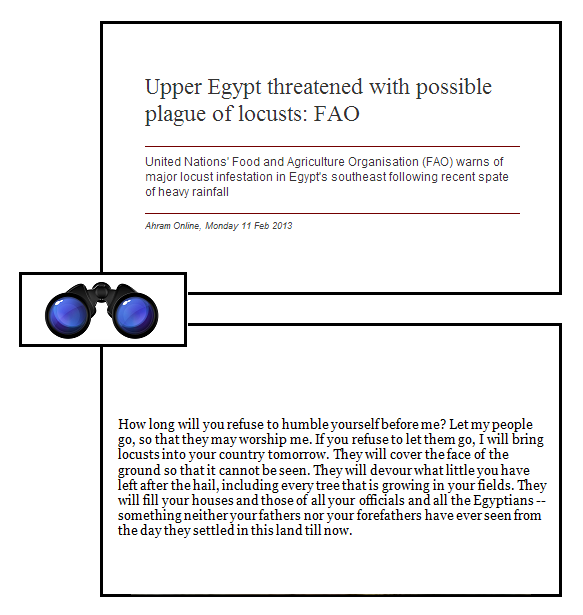
I’m returning here to an old theme of mine, the juxtaposition of worldviews — in this case, accounting for plagues of locusts in Egypt.

Such juxtapositions are like Rorschach blots in some ways — they allow each reader to see the items juxtaposed from within their own worldviews, perhaps applauding one and dismissing another, perhaps seeing some virtue in each or none in either — and perhaps arriving at some meta-level understanding which neither one alone would afford.

Is a plague of locusts in Upper Egypt of which the FAO warns in the upper panel above entirely explained in terms of rainfall? Is it pure mental happenstance that Egypt was the site of a Biblical locust plague at the time of the Israelite Exodus [Ex. 10. 3-6]? Is there, perhaps, a message for Egypt vis-a-vis Israel for our own day?

The answers people give to questions such as these, in which secular and sacred sources address what are putatively similar situations, can influence the way on which they voice themselves and vote — perhaps a good thing, perhaps not.

**

For what it’s worth, the plague of locusts is mentioned in the Qur’an in Sura 7.133:

So We let loose upon them [the Egyptians} the flood and the locusts, the lice and the frogs, the blood, distinct signs; but they waxed proud and were a sinful people.

**

In contemplating matters of this sort, it may be valuable to consider the remarks of the Pontifical Biblical Commission in The Interpretation Of The Bible In The Church, 1993/4:

The basic problem with fundamentalist interpretation of this kind is that, refusing to take into account the historical character of biblical revelation, it makes itself incapable of accepting the full truth of the incarnation itself. As regards relationships with God, fundamentalism seeks to escape any closeness of the divine and the human. It refuses to admit that the inspired word of God has been expressed in human language and that this word has been expressed, under divine inspiration, by human authors possessed of limited capacities and resources. For this reason, it tends to treat the biblical text as if it had been dictated word for word by the Spirit. It fails to recognize that the word of God has been formulated in language and expression conditioned by various periods. It pays no attention to the literary forms and to the human ways of thinking to be found in the biblical texts, many of which are the result of a process extending over long periods of time and bearing the mark of very diverse historical situations.

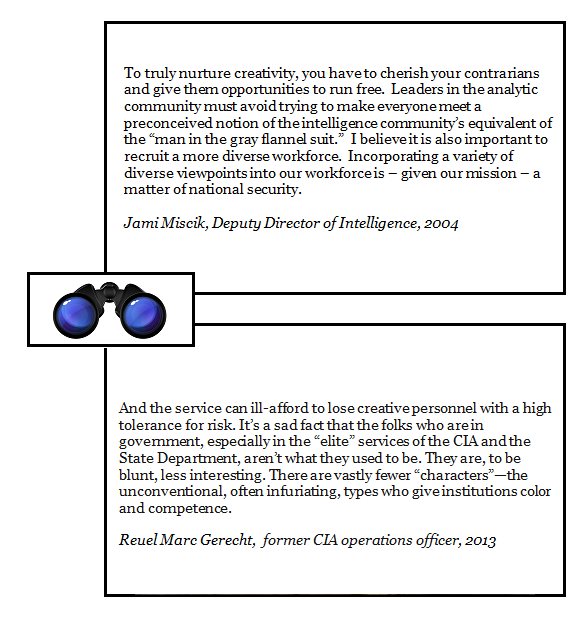
Miscik 2004, Gerecht 2013

Thursday, February 21st, 2013

[ by Charles Cameron — on the exclusion of worldviews not consonant with grey suits and security clearances ]
.

These two persons are likely being polite.

**

I’m wondering how any people at State or in the Agency or wherever know what it feels like to be one of the flagellants in Iran during Muharram, in Qom or Masshad perhaps… or at the Jamkaran mosque, and to believe the Mahdi is waiting close by in the wings… or to be in Afghanistan, Sunni, and expecting his army with black banners will sweep down on Jerusalem from Khorasan in accordance with hadith… or in Palestine, reliant on the hadith of the rocks and the trees, certain that Israel will soon fall… in Pakistan, listening to Syed Zaid Zaman Hamid and mentally preparing for the Ghazwa-e-Hind?

**

I suppose I’ve been struggling to say this for years:

The sanction for extremist violence, even to the point of death, is that the cause is just and right. The sanction for messianic violence is that the cause is not only humanly just and right but divinely so — and final, for the entirety of the cosmos, for all Creation.

**

Sources:

Jami Miscik, tesimony, House Intelligence Cttee
Reuel Marc Gerecht, Spooky Sex

h/t Nada Bakos

Further readings on messianisms:

Mahdi in the wings, Iran
Khorasan, army with black banners, Afghanistan
Hadith of the rocks and the trees, Palestine
Ghazwa-e-Hind, Pakistan

David Cook, Contemporary Islamic Apocalyptic Literature
David Cook, Studies in Islamic Apocalyptic
Timothy Furnish, Holiest Wars
Gershom Gorenberg, The End of Days
Anne-Marie Oliver & Paul Steinberg, The Road to Martyr’s Square
Jean-Pierre Filiu, Apocalypse in Islam
Syed Saleem Shahzad, Inside al-Qaeda and the Taliban
Ali Soufan, The Black Banners
Richard Landes, Heaven on Earth

Concerning the enforcement of morals

Wednesday, January 30th, 2013

[ by Charles Cameron — enforcement of moral codes in the UK, US, Israel and KSA, unofficial and official, worsening, continuing and improving, quite the smörgåsbord ]
.

.

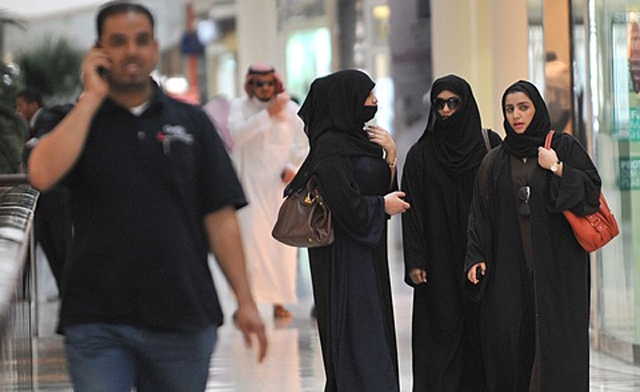
Moral vigilantism appears to be on the rise in parts of London, according to this first-person piece by Jane Kelly, consulting editor of the Salisbury Review, which identifies itself as “seriously right” — ‘I feel like a stranger where I live’ [Telegraph, 29 January 2013]:

“When you go swimming, it’s much healthier to keep your whole body completely covered, you know.” The Muslim lady behind the counter in my local pharmacy has recently started giving me advice like this. It’s kindly meant and I’m always glad to hear her views because she is one of the few people in west London where I live who talks to me.

[ … ]

More worryingly, I feel that public spaces are becoming contested. One food store has recently installed a sign banning alcohol on the premises. Fair enough. But it also says: “No alcohol allowed on the streets near this shop.” I am no fan of street drinking, and rowdy behaviour and loutish individuals are an aspect of modern British ”culture’’ I hate. But I feel uneasy that this shopkeeper wants to control the streets outside his shop. I asked him what he meant by his notice but he just smiled at me wistfully.

Perhaps he and his fellow Muslims want to turn the area into another Tower Hamlets, the east London borough where ”suggestive’’ advertising is banned and last year a woman was refused a job in a pharmacy because she wasn’t veiled.

On the other hand, maybe I should be grateful. At least in Acton there is just a sign in a shop. Since the start of the year there have been several reports from around London of a more aggressive approach. Television news footage last week showed incidents filmed on a mobile phone on a Saturday night, in the borough of Waltham Forest, of men shouting “This is a Muslim area” at white Britons.

The video commentary stated: “From women walking the street dressed like complete naked animals with no self-respect, to drunk people carrying alcohol, we try our best to capture and forbid it all.”

**

It also appears to be present in parts of Brooklyn, according to Modesty in Ultra-Orthodox Brooklyn Is Enforced by Secret Squads, [New York Times, January 29, 2013]:

In the close-knit world of ultra-Orthodox Judaism, community members know the modesty rules as well as Wall Street bankers who show up for work in a Brooks Brothers suit. Women wear long skirts and long-sleeved, high-necked blouses on the street; men do not wear Bermuda shorts in summer. Schools prescribe the color and thickness of girls’ stockings.

The rules are spoken and unspoken, enforced by social pressure but also, in ways that some find increasingly disturbing, by the modesty committees. Their power is evident in the fact that of the half dozen women’s clothing stores along Lee Avenue, only one features mannequins, and those are relatively shapeless, fully clothed torsos.

The groups have long been a part of daily life in the ultra-Orthodox communities that dot Brooklyn and other corners of the Jewish world. But they sprang into public view with the trial of Nechemya Weberman, a prominent member of the Satmar Hasidim in Brooklyn, who last week was sentenced to 103 years in prison after being convicted of sexually abusing a young girl sent to him for counseling.

[… ]

The details were startling: a witness for Mr. Weberman’s defense, Baila Gluck, testified that masked men representing a modesty committee in the Hasidic village of Kiryas Joel, N.Y ., 50 miles northwest of New Y ork City, broke into her bedroom about seven years ago and confiscated her cellphone.

The Brooklyn district attorney, Charles J. Hynes, who prosecuted the Weberman case, has now received allegations that members of a modesty committee forced their way into a home in the borough, confiscating an iPad and computer equipment deemed inappropriate for Orthodox children, officials say.

[ … ]

“They operate like the Mafia,” said Rabbi Allan Nadler, director of the Jewish studies program at Drew University in Madison, N.J.

**

And in Israel — from the same report, although perhaps more widely known? I’ve certainly seen mentions…

In Israel, there have been similar concerns. Though no modesty committee was overtly involved, there has been anger over ultra-Orthodox zealots who spit on and insulted an 8-year-old girl for walking to school through their neighborhood in a dress they considered immodest.

**

Meanwhile, the Saudis seem to be decreasing the scope of their official equivalent, according to Saudi limits powers of the notorious religious police [Al Arabiya, 30 January 2013]:

Saudi Arabia has set new limitations on the powers of its notorious religious police, charged with ensuring compliance with Islamic morality but often accused of abuses, its chief said on Tuesday.

The Commission for the Promotion of Virtue and Prevention of Vice “once had much expanded powers, but with the new system… some of these powers, such as interrogating suspects and pressing charges,” will be restricted to the police and public prosecution, Shaikh Abdul Latif Abdel Aziz Al Shaikh told AFP.

The religious police may still arrest those carrying out “flagrant offences such as harassing women, consuming alcohol and drugs, blackmail and the practice of witchcraft,” Shaikh said of the new law approved by the cabinet.

and:

Relatively moderate Al Shaikh, appointed last year, has raised hopes that a more lenient force will ease draconian social constraints in deeply conservative Islamic country.

Two weeks into his post, Al Shaikh banned volunteers from serving in the commission, which enforces the kingdom’s strict Islamic rules.

H/t John Burgess at Crossroads Arabia.

**

All these articles are worth reading in full, and you’ll be enriched by reading them together, comparatively — food for thought!
Fair and balanced, eh?

Monday, January 21st, 2013

[ by Charles Cameron — Guardian reporting on Gaza and Mali, weighed in the balance and found wanting? — with Fox News for company ]
.

.

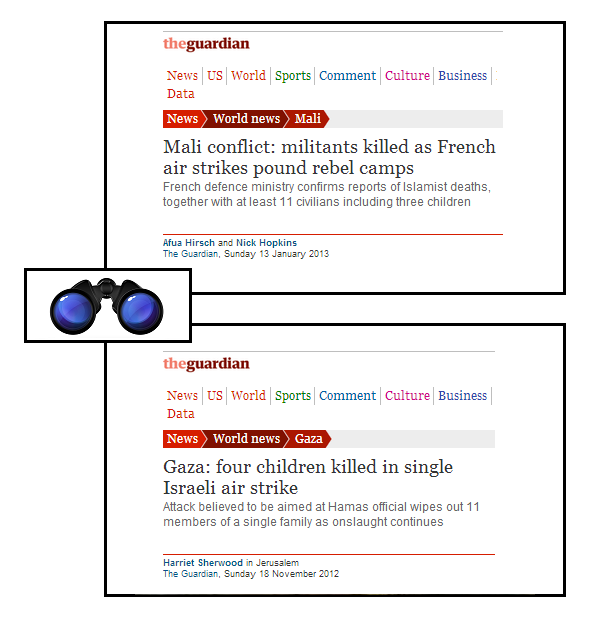
I frankly don’t for a moment buy that Fox News is fair and balanced, but then I don’t know if any news source is, so let me try to be a little even-handed here myself, and take a gander at a couple of recent Guardian headlines, using my SPECS format to display them:

I’m not the first one to juxtapose these two headers — there’s a site called CiF Watch that monitors the Guardian (specifically) for signs of “antisemitism, and the assault on Israel’s legitimacy” and it brought these two Guardian posts together with the comments:

The contrasts in language, tone and narrative focus between a report by Harriet Sherwood on Israel’s November conflict with Hamas and a recent Guardian report on the French war against Islamists in Mali represent an exquisite illustration of the paper’s egregious double standards. …

In Sherwood’s report, the deaths of Palestinian children represent the overwhelming narrative focus. The fact that the IDF was attempting to target Hamas terrorists is only mentioned in the strap line, and even then is qualified with the word “believed”.

In the report by Hirsch and Hopkins, on the other hand, we are informed via the headline that militants are killed, while the deaths of Mali children are only noted at the end of the strap line.

On the one hand, I appreciate this kind of close reading as an analytic technique, while on the other I can’t really expect editors to check previous possibly comparable events to make sure their treatment of breaking news is immune from this kind of criticism.

That’s a quandary, IMO — but not yet a quagmire.

**

Forget the question of whether Fox News is more or less biased than the Guardian — or should I call them Faux News and the Grauniad? — and just think again about our passions, about how they can blind us, and about how that blindness can manifest in emphases, in choice of words or images — in so many conscious and unconscious ways.

We need to deploy considerable mindfulness if we are to explore, read, filter, balance and comprehend the world around us — with anything like the nuance required for making wise (rather than lop-sided) choices…

**

Sources:

  • Mali conflict: militants killed as French air strikes pound rebel camps, Jan. 13, 3012
  • Gaza: four children killed in single Israeli air strike, Nov. 18, 2012
  • Lost and found in translation

    Saturday, December 15th, 2012

    [ by Charles Cameron — first of two quick posts, this one’s about when the same is the same and when it isn’t quite ]
    .

    Dahlia Iyad, a member of Black September in the Thomas Harris novel, Black Sunday, is portrayed (above) in John Frankenheimer‘s 1977 movie of the same name by Marthe Keller. At this point, very early in the movie, Iyad is recording her speech to the Americans, which will accompany the act of terrorism she is master-minding:

    The American people have remained deaf to all the cries of the Palestinian nation. People of America, this situation is unbearable for us. From now on, you will share our suffering. The choice is yours. Salaam aleikum.

    Did you get that? The soundtrack says salaam aleikum, the subtitles read shalom aleichem.

    Either way, in Latin it would be pax vobiscum.

    **

    Peace be upon you.

    My question, of course, has to do with the juxtaposition of the two words in two Semitic languages, sharing the same consonantal roots. Are they the same, or do they mean very different things?

    Obviously they’re the same phrase, obviously the subtitle is mistaken in putting a Hebrew salutation on aa Arab terrorist’s lips.

    But here’s the thing: strung between these two so similar phrases — or between Beit Ha’Mikdosh and Bayt al-Muqaddas — is the entire spectrum of ways in which translation can and cannot carry meaning over from one context into another. And we can locate it, right in the first words a child might learn, the greeting of one to another…

    As the Italians say, traduttore, traditore — translator, traitor.

    **

    But that’s enough foreign for one day — I don’t speak it very well.

    I do have to admit I jumped when I saw that subtitle, though. No big deal — and all the difference in the world.


    Switch to our mobile site