I got up with Stoic fortitude of mind in the cold this morning: but afterwords, in my hot bath, I joined the school of Epicurus. I was a Materialist at breakfast; after that an Idealist; and as I smoked my first cigarette I transcendentally turned the world to vapor. But when I began to read The Times I had no doubt of an externally existing world…
[ by Charles Cameron — the lure of exile, of hijra, in the context of western jihadists going abroad ]
.
Whereas the Prophet’s first visionary reception of the Quran dates to 609-610 CE, and the Prophet himself was born some 40 years earlier, the Islamic reckoning of time (AH, Anno Hegirae) begins with his hijra or migration from Mecca, his home, to Medina — an event of huge Islamic consequence, with echoes in our own times.
One of the questions I have been pondering recently has to do with those echoes. I have been asking myself how strong a part in the decisions of westerners to migrate to Syria and elsewhere to participate in jihad might be played by the concept of hijra — either in the minds of recruits, or in the rhetoric of recruiters.
When I came across the quote from Czeslaw Milosz (above, upper panel), I recognized that I had stumbled upon the expression of a secular equivalent of that yearning — and thus perhaps an opening into our own deeper understanding of hijra (lower panel) — a sacralization and hence an intensification of the same yearning.
[Hearing] that you intend on making hijrah [emigration], I immediately wanted to contact you to tell you that my advice to you was to remainin your current position.
Here, strategic rationalism attempts to prevail over romantic yearning…
[ by Charles Cameron — books, Gitmo and Snowden — signing off with a great clip from Three Days of the Condor exhibiting the benefits of reading ]
.
I’m not entirely sure that Fifty Shades of Grey qualifies as Literature, but I think it can squeeze by as Lit — just as I’m not sure the topic of this post has much to do with National Security, but NatSec seems to fit.
.
And hang in there — there’s a clip from Condor at the very end…
**
From Gitmo, then:
A member of Congress said Tuesday he disclosed the popularity of the erotic sometimes sadomasochistic series Fifty Shades of Grey among Guantánamo’s most prized prisoners not to titillate but to set straight for their global followers that they were not devout holy warriors passing their Ramadan reading the Quran.
“It demystifies them. It exposes them for who they actually are,” said Rep. Jim Moran, D-Va., in a telephone interview that sought to set straight that the captives in the secretive Camp 7 complex are “not exactly holy warriors. Just the opposite. These people are phonies.” [ … ]
What made the disclosure so odd is that, during media visits to the trailers that house the prison camp’s collection of about 18,000 books, many of them religious, the Defense Department contractor in charge, Milton, says he systematically forbids the circulation of books and videos that are either lascivious or exceptionally violent..
The Herald contacted Moran on vacation after a prison camps spokeswoman, Army Capt. Andi Hahn, checked with the Army officer in charge of the detention center library and replied that the Fifty Shades of Grey series is a “prohibited” book. [ … ]
Moran said he has long favored exposing the Pentagon prisoners to great works of Western literature, and had asked the same questions in the less secretive prisons containing the 150 or so other prisoners, 84 of them approved for release or transfer in 2010. In those prison, the troops responded more generically that detainees who broke the rules get to keep just two library books in their cells while cooperative, communal captives get to borrow eight at a time. [ … ]
In February, military spokesman said they were forbidden to elaborate on war court testimony that showed Camp 7’s troops seized as banned a previously approved book by ex-FBI Agent Ali Soufan called Black Banners. [ … ]
Another attorney, Carlos Warner, said while his Camp 7 client, Muhammed Rahim, was interested in American popular culture he couldn’t imagine him reading the Fifty Shades of Grey series sometimes referred to as “mommy porn.”
In March, Warner said, he handed Rahim the bestseller fantasy novel American Gods, about a freed prisoner, now being serialized for HBO — and was fully engaged in it.
Because of his enthusiasm, Warner got a card for Rahim from the book’s author, Neil Gaiman. “I hope you enjoy American Gods. It was written before Guantánamo and all this current madness,” the British novelist wrote Rahim in June at Warner’s behest. The lawyer said he plans to show it to Rahim at their next meeting.
American Gods is not an approved book at the detention center library, the prison spokeswoman, Hahn, said in response to a question Tuesday.
**
Meanwhile, regarding Edward Snowden…
Edward J. Snowden has the time, and now he has the classics. [ … ]
His Russian lawyer earlier this week left him a shopping bag with books by Dostoyevsky, Chekhov and Nikolai Karamzin to help him learn about Russian reality.
According to news accounts, the lawyer, Anatoly Kucherena, gave his client Dostoyevsky’s “Crime and Punishment,” the tale of law, order and redemption, telling him, “You should know who Raskolnikov was.” He added that the Chekhov was “for dessert,” and also provided him with the writings of Karamzin, a historian, for background on the nation’s development.
One has to ask: Is Dostoevsky really the best choice? Raskolnikov could hardly be expected to cheer up Mr. Snowden. Sonia, the girl whose love saves Raskolnikov’s soul, may remind him of Lindsay Mills, the pole-dancing, exhibitionist girlfriend he left behind. [ … ]
Are there better Russian books to help Mr. Snowden get to know the Russian soul? One could do worse than to read Gogol, whose absurdist short story “The Nose” could help Mr. Snowden understand that living in Russia might not make any more sense than living in the United States. And Tolstoy – well, no matter how much time Mr. Snowden has, he may not have enough time for Tolstoy. [ … ]
Why should Mr. Snowden confine himself to the literature of Russia? After all, Edward Everett Hale wrote a book that must absolutely resonate with Mr. Snowden and his plight: “The Man Without a Country,” whose main figure is tried for treason and cries out before the judge, “I wish I may never hear of the United States again!” Walter Kirn’s “Up in the Air” would continue the travel theme. John le Carré’s George Smiley offers glimpses into Russian life that ring with gloomy authenticity.
The French, who gave us the word ennui and sharpened the concept of existentialism, produced the works that may most help Mr. Snowden adjust to his new life, especially those of Jean-Paul Sartre. What masterpiece better describes his situation than “No Exit”?
[ by Charles Cameron — a powerful tale of “de-radicalization” as metanoia ]
.
Munir
.
Munir, by his own account, was drifting under the influence of various radical Muslim clerics, Abu Hamza al-Masri among them. One’s never too sure about the exactness of journo quotes, but here’s one media report to be going on with:
“Look who I ended up with,” he said.
“We had a fantastic relationship. It was a match made in heaven – his anger, my lack of self-esteem.
“He wanted me to die on the battlefield.”
It was, mashallah, not to be — Munir had a change of mind and heart, and now works to offer potentially susceptible British youth alternatives to the “al-Qaeda narrative”.
That little double event — the holding of a spoon, the revelation of its invisible history — I am calling a dark sacrament. I draw the word “sacrament” my own theological background, but also from Joseba Zulaika‘s analysis of Basque terrorism in his fine book Basque Violence: Metaphor and Sacrament, wherein he quotes GB Ladner:
The sacrament is altogether a very different kind of symbol: it not only signifies, but also effects what it symbolizes.
I call this passing of the spoon a dark sacrament in two interwoven but opposite senses. The one who gave Munir the spoon intended it as a gesture making and marking a symbolic connection between Munir himself and its history, a gift of intensification in the dark religion of terror which calls on Islam for its justification.
And yet it was also sacramental in another sense entirely from the one intended: it reached deep enough into that darkness to turn Munir himself towards the light — Islam rediscovered as the struggle of the soul to reorient from ignorance towards the Niche for Lights mentioned in the Verse of Light in the Qur’an, 24.35:
God is the Light of the heavens and the earth; the likeness of His Light is as a niche wherein is a lamp (the lamp in a glass, the glass as it were a glittering star) kindled from a Blessed Tree, an olive that is neither of the East nor of the West whose oil wellnigh would shine, even if no fire touched it; Light upon Light; (God guides to His Light whom He will.) (And God strikes similitudes for men, and God has knowledge of everything.)
Note those two last sentences: God strikes similitudes for men, so that each moment may be a signpost if we do but see it. And God guides to His Light whom He will.
**
Professional writers naturally have an affinity for all kinds of form, from the epic epic via the novel, novella, short story, sestina and sonnet to the haiku, and Twitter has unsurprisngly engaged their imaginations. Thus the New Yorker Fiction account, @NYerFiction, has been running a short story in tweets by Jennifer Eagan, while Teju Cole, more to my taste, has posted Seven short stories about drones in a tweet apiece.
But those are prize-winning professional writers, which as far as I know Munir makes no claim to be: he is simply offering us his personal story, unvarnished — yet his effort effortlessly matches theirs. Here is a signal to myself and to the rest of us who try to understand radicalization, CVE and de-radicalization: that true epiphanies — sacramental signs, sacred moments — unleash a power into the system that no amount of calculation could predict.
[ by Charles Cameron — on the basis, the mathematics, the essence of conflict and resolution ]
.
.
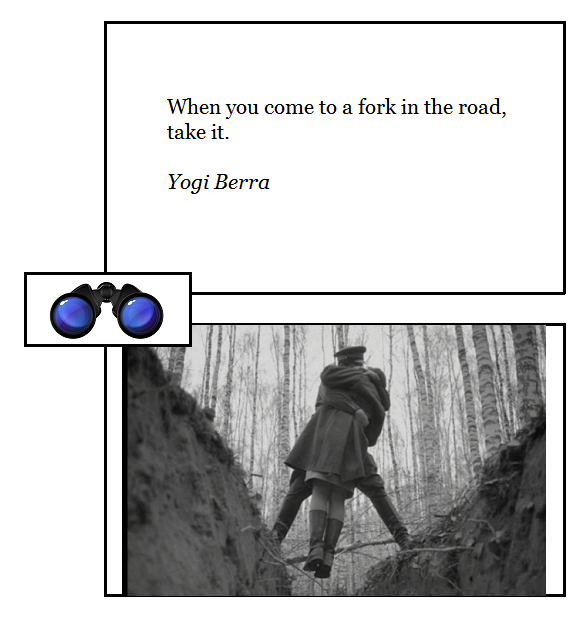
This DoubleQuote features two great masters on duality and the coincidentia oppositorum: the upper quote is Yogi Berra at his best, a koan worthy of a discourse by John Daido Loori, Roshi, while the lower image a still from Andrei Tarkovsky‘s first feature film, Ivan’s Childhood — which I stole from the ever-bountiful Gwarlingo.
Two is one and one is all and evermore shall be so.
**
Two into one won’t go, they told me in my schooldays — though not with nearly as much rigor as I presume is found in this article in Physics B…
Questions of the two and the one are always of interest, because they are played out in the tensions we are faced with in daily life, and specifically in the tug of war with peace.
Thus, from my miscellaneous readings these past few days, they feature everywhere from a headline like Demonizing Edward Snowden: Which Side Are You On? in the New Yorker, who seem to feel that one should take a side, preferably the one with the least guns:
I’m with Snowden — not only for the reasons that Drake enumerated but also because of an old-fashioned and maybe naïve inkling that journalists are meant to stick up for the underdog and irritate the powerful. On its side, the Obama Administration has the courts, the intelligence services, Congress, the diplomatic service, much of the media, and most of the American public. Snowden’s got Greenwald, a woman from Wikileaks, and a dodgy travel document from Ecuador. Which side are you on?
Question: Is marking out the 15th night of Sha’ban (laylat al-nisf min sha’ban) with extra prayers and devotion sanctioned by Islam, or is doing so judged to be a reprehensible innovation (bid’ah)?
Answer: Each year, a fair amount of fussing and fighting takes place over this issue. Yet the truth of the matter is that scholars have long-held this issue to be one over which there is a valid difference of opinion. The first group considered the night to have no specific virtues over and above any other night of the year, and believed that singling the night out for extra acts of worship is unsanctioned. Another group begged to differ and held that the middle night of Sha’ban does possess special merits and should be earmarked for extra prayers and devotion.
All those who hold the shari’ah to lack nuance and variety, incidentally, would do well to note (a) that it is far from exclusively devoted to the chopping off of hands or feet, and (b) combines within itself debates worthy of the Tannaim and Amoraim, or of the medieval scholastics of the Roman church…
**
By way of closure, here’s the koan from Alice in Wonderland that Loori Roshi studies in his discourse:
The caterpillar said, “One side will make you grow bigger, and the other side will make you grow smaller.” “One side of what? The other side of what?” thought Alice to herself. “Of the mushroom,” said the caterpillar. Alice looked at the mushroom, trying to make out which were the two sides of it, as it was perfectly round.
If you love your enemies [Matthew 5.44], Who’s side are you on?
And here’s what the great Cardinal Nicholas Cusanus had to say about dualities and opposites in his Of the Vision of God:
I have learned that the place wherein Thou art found unveiled is girt round with the coincidence of contradictories, and this is the wall of Paradise wherein Thou dost abide
Zenpundit is a blog dedicated to exploring the intersections of foreign policy, history, military theory, national security,strategic thinking, futurism, cognition and a number of other esoteric pursuits.