The Lion of Judah, Jesus and Jihad
Tuesday, September 27th, 2011[ by Charles Cameron – a meander from Narnia via Roke and the stars to Jihad – too religious, perhaps, or too literary — a lightweight post of no significance ]
.
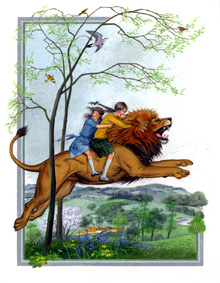
illustration credit: Pauline Baynes
.
In my previous post, I quoted the prophet and apostle Bill Harmon:
We are about to move from the dispensation of grace to the dispensation of dominion. We are about to see Jesus, not as the suffering lamb that was slain, but the roaring Lion who is King!
Dominion is a keyword that’s getting a lot of attention right now – it has significantly different meanings for different strands in the theological mix — but as usual I’m at least as interested in the symbols and imagery people use as I am in their doctrinal expressions.
This post, then, will explore the imagery of the Lion.
1.
Having recently written that post with the Harmon quote from 1999, I was struck to read the following account on the Elijah list just yesterday :
I had a profound encounter recently before going to bed. I think it is just like God to get you right before you fall asleep. I had to get out of bed to make a record of this! I felt it important to share with you. We see Jesus in many different expressions in the Scriptures. He is the Good Shepherd, the Lamb of God, the Lord of Hosts, the Angel of the Lord and many other looks. But one night recently He came to me as the Lion who is ready to roar. As you read, ask the Lord to reveal this aspect of His nature in your life.
I had a vision where I found myself on the back of this giant Lion with a huge mane. Then I realized it was the Lord. As the Lion turned His head, I could see His mouth open as if He was getting ready to roar. It is time to ride on the Lion of Judah. It is as if He has been waiting for this season. There is something fresh and new in the air. The breath of His mouth will destroy the enemy.
In this vision I was also running my fingers through the mane of the Lion. This represents the intimacy with God that is the foundation for our authority. Our intimacy is for a purpose – it is to establish the Kingdom of God for the King. The Lion is symbolic in that it is the “King of the Jungle”. The world is that jungle. Jesus is coming as the Lion to rule in the jungle bringing His power to set people free.
The Lord carries us into that jungle with His authority. When we are riding on the Lion we can be assured that we will succeed in all He calls us to do. He is massive, larger than life. He is ready to conquer and demonstrate His power.
In my encounter, I was suddenly on this Lion and He was of full age and postured for action. This will be a time where God will do things suddenly. It will take us by surprise. The sons of the Kingdom will advance the Kingdom for His purposes and with His power.
— John Belt, Live In His Presence Ministries
2.
To be honest, it strikes me that that’s straight out of CS Lewis and his wonderful books for children – but without Lewis’ grace as a writer. Compare:
That ride was perhaps the most wonderful thing that happened to them in Narnia. Have you ever had a gallop on a horse? Think of that; and then take away the jingle of the bits and imagine instead the almost noiseless padding of the great paws. Then imagine instead of the black or gray or chestnut back of the horse the soft roughness of golden fur, and the mane flying back in the wind. And then imagine you are going about twice as fast as the fastest racehorse. But this is a mount that doesn’t need to be guided and never grows tired. He rushes on and on, never missing his footing, never hesitating, threading his way with perfect skill between tree trunks, jumping over bush and briar and the smaller streams, wading the larger, swimming the largest of all. And you are riding not on a road nor in a park nor even on the downs, but right across Narnia, in spring, down solemn avenues of beech and across sunny glades of oak, through wild orchards of snow-white cherry trees, past roaring waterfalls and mossy rocks and echoing caverns, up windy slopes alight with gorse bushes, and across the shoulders of heathery mountains and along giddy ridges and down, down, down again into wild valleys and out into acres of blue flowers.
— CS Lewis, The Lion, the Witch and the Wardrobe (illustration above by Pauline Baynes)
That captures the “riding the Lion” idea a great deal more powerfully, and it’s imaginative fiction.
3.
The other idea present in Belt’s narrative is the Lion’s roar. Again, it seems to me that what Belt offers us is a less gracious version of Lewis, who wrote:
The Lion opened his mouth, but no sound came from it; he was breathing out, a long, warm breath; it seemed to sway all the beasts as the wind sways a line of trees. Far overhead from beyond the veil of blue sky which hid them the stars sang again; a pure, cold, difficult music. Then there came a swift flash like fire (but it burnt nobody] either from the sky or from the Lion itself, and every drop of blood tingled in the children’s bodies, and the deepest, wildest voice they had ever heard was saying: “Narnia, Narnia, Narnia. Awake. Love. Think. Speak. Be walking trees. Be talking beasts. Be divine.”
It was of course the Lion’s voice.
— CS Lewis, The Magician’s Nephew
4.
Commenting on Lewis’ version of the Lion’s roar, Paul Ford writes:
This passage is remarkable for the intense breath image and the addition of the fire image (from the first conferral of the Holy Spirit in the New Testament on Pentecost; see the Acts of the Apostles 2:3-4).
— Paul F. Ford, Companion to Narnia
With in turn refers us to this passage:
And suddenly there came a sound from heaven as of a rushing mighty wind, and it filled all the house where they were sitting. And there appeared unto them cloven tongues like as of fire, and it sat upon each of them. And they were all filled with the Holy Ghost, and began to speak with other tongues, as the Spirit gave them utterance.
— Acts 2:3-4
5.
TS Eliot was notably moved by the same passage, and we can see how a poet deals with the same wind and fire in one of the final sections of “Little Gidding”:
The dove descending breaks the air
With flame of incandescent terror
Of which the tongues declare
The one discharge from sin and error.
The only hope, or else despair
Lies in the choice of pyre or pyre —
To be redeemed from fire by fire.Who then devised the torment? Love.
Love is the unfamiliar Name
Behind the hands that wove
The intolerable shirt of flame
Which human power cannot remove.
We only live, only suspire
Consumed by either fire or fire.— TS Eliot, “Little Gidding”, Four Quartets
6.
It’s the wind of inspiration that brings tongues of flame here, many tongues, many languages…
The wind bloweth where it listeth, and thou hearest the sound thereof, but canst not tell whence it cometh, and whither it goeth: so is every one that is born of the Spirit.
John 3:8
And the Greek is really quite wonderful here, as Phillip Comfort among others points out
In John 3:8, there is a metaphor which is purposefully polyvalent, in that Jesus was speaking of wind, spirit, and breath at the same time (inasmuch as pneuma can mean all three)
Philip Comfort, Encountering the manuscripts: an introduction to New Testament paleography, p 235
And circling back for a moment to CS Lewis — because there is really only one universe of discourse…
It must always be remembered … that the various senses we take out of an ancient word by analysis existed in it as a unity.
CS Lewis, The Allegory of Love, p 365
7.
I said earlier that CS Lewis’ writing seemed to me to have notably more grace than John Belt’s — and I think that grace has to do with the theological virtue of the same name too, that beauty is an indicator of Grace if you like.
Here’s another author, also writing for children, whose prose is a marvel of purity — describing the music of the stars of which Lewis also spoke — Ursula Le Guin:
It is no secret. All power is one in source and end, I think. Years and distances, stars and candles, water and wind and wizardry, the craft in a man’s hand and the wisdom in a tree’s root: they all arise together. My name, and yours, and the true name of the sun, or a spring of water, or an unborn child, all are syllables of the great word that is very slowly spoken by the shining of the stars. There is no other power. No other name.
Ursula Le Guin, Wizard of Earthsea
Ursula would, I think, describe herself as a Taoist: the traditions may differs, grace is still grace.
8.
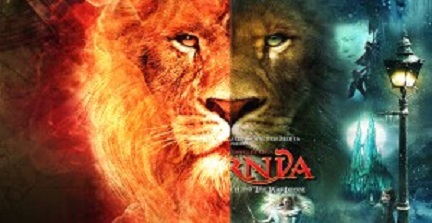
Well, you might not think it would be easy to get from Narnia and CS Lewis to jihad in a single bound, but it has been done, and Jarret Brachman posted the proof a while back…
The jihadist propaganda lion:
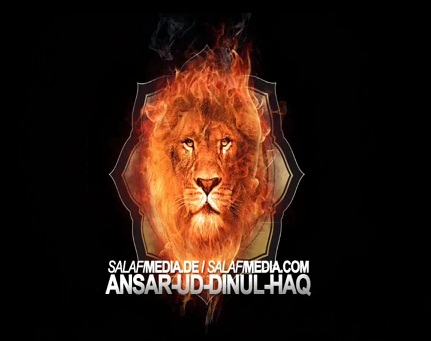
was in fact swiped from the Narnia lion:
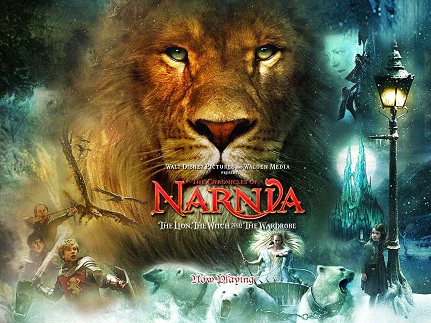
— as Brachman elegantly demonstrated:
all three images credit: Jarret Brachman, Cronus Global
9
Well, that’s funny — but not uplifting.
So I’ll leave you with another flight — that of the king of the birds this time — in the words of Isaiah:
But they that wait upon the LORD shall renew their strength; they shall mount up with wings as eagles; they shall run, and not be weary; and they shall walk, and not faint.
Isaiah 40:31


