zenpundit.com » movies

Archive for the ‘movies’ Category

Blessed are the conflict resolvers II: in dance and song

Tuesday, July 16th, 2013

[ by Charles Cameron — what can these two stunning performances tell us about conflict and / or peace? ]
.

I’m not sure if I’ve said it here before, but conflict resolution is pretty much the same as peace making, hence my title for both parts of this post, Blessed are the conflict resolvers (Matthew 5.9). In the second part of this post, I’d like to shared with you two stunning and highly stylized situations in which peace and conflict are brought together by sheer art.

Battle as dance, from Carlos Saura‘s Carmen — in the aftermath of a gambling disagreement, the jealous rivalry of two men over the young female lead bursts into violent dance:

And …

The battle of songs, from Breuer and Telson‘s Gospel at Colonus. Oedipus, played here by Clarence Fountain and the Blind Boys of Alabama, at the end of his days, wishes to enter the city of Colonus and find rest and the peace prophesied for him at last — the people of Colonus, knowing him accursed, try to resist him:

**

What can we learn from these two examples of conflict circumscribed within the parameters of art?

For comparison, here are two reports of the stylized Beating Retreat ceremony at the Wagah Border crossing, jointly performed each evening by the Indian Border Security Force and Pakistan Rangers and aptly described as a “synchronized display of stomps and shouts” — with some suggestive comments about the rivalry between the two nations in each.

From Michael Palin:

and from Voice of America:

Videos, the counter-nasheed and some dancing girls

Sunday, June 30th, 2013

[ by Charles Cameron — further notes from the frayed edges of what’s significant ]
.

Okay, you all know I’m interested in the graphics of terrorism and their symbolism, and only a day or two ago I posted Of dualities, contradictions and the nonduality on the two into one phenomenon — well, here’s an addendum:

**

The upper image, showing the Jabha al-Nusra logo — Sunni, left — alongside the Hezbollah insignia — Shi’a, right — morphs into the single image in the lower panel, thereby resolving the sectarian conflict in Syria by filmic means.

The video from which these two shots were taken, alas, was the work product of the US Government, as part of an effort of outreach by the little-known Digital Outreach Team at the State Department, who at the time of writing appear to have 193 videos uploaded.

The BBC notes:

According to the Associated Press news agency, the 50-member Digital Outreach Team tweets, posts Facebook updates and uploads video to YouTube in Arabic, Punjabi, Somali and Urdu, in a bid to counter the radical jihadist message. It seems it’s even had exchanges with terror suspects such as US-born militant Omar Hammami, a former member of Somalia’s al-Shabab.

The two images above were taken from a video titled Secret meeting between Hassan Nasrallah and al-Zawahiri, but the Beeb’s article focused on what it termed a “spoof Al-Qaeda video”, which I’ll call Pharaoh Ayman speaks to the dancing girls for want of a better name:

The team’s al-Zawahiri spoof opens with a notice that “fizzy drinks should be consumed while watching this production” – a twist on the usual message at the beginning of al-Qaeda videos saying “it is not permitted to add music to this production … Taking the classic preaching-to-camera format, the three-minute clip features a voiceover in which the Egyptian-born militant repeatedly bungles his speech by saying things like: “The butchers, ahem, sorry, I mean the mujahideen”. In the video – issued by the US State Department’s Digital Outreach Team – al-Zawahiri is backed by punkah-wallahs. The clip then cuts to a shot, as though from behind the speaker, to reveal a troupe of dancers performing in front of him.”

But see for yourselves, punkah-wallas and all:

For your further Sundance consideration, and from the same studios, you might also like the lowest and slowest nasheed ever recorded.

**

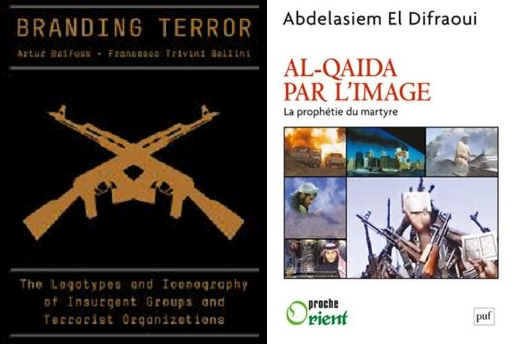
Speaking of graphics — coming up on ZP when I have had a chance to read a little more of El Difraoui, reviews of:

  • Beifuss and Bellini, Branding Terror
  • Abdelasiem El Difraoui, Al-Qaida par l’image. La prophétie du martyre
  • Of dualities, contradictions and the nonduality

    Thursday, June 27th, 2013

    [ by Charles Cameron — on the basis, the mathematics, the essence of conflict and resolution ]
    .


    .

    This DoubleQuote features two great masters on duality and the coincidentia oppositorum: the upper quote is Yogi Berra at his best, a koan worthy of a discourse by John Daido Loori, Roshi, while the lower image a still from Andrei Tarkovsky‘s first feature film, Ivan’s Childhood — which I stole from the ever-bountiful Gwarlingo.

    Two is one and one is all and evermore shall be so.

    **

    Two into one won’t go, they told me in my schooldays — though not with nearly as much rigor as I presume is found in this article in Physics B

    Questions of the two and the one are always of interest, because they are played out in the tensions we are faced with in daily life, and specifically in the tug of war with peace.

    Thus, from my miscellaneous readings these past few days, they feature everywhere from a headline like Demonizing Edward Snowden: Which Side Are You On? in the New Yorker, who seem to feel that one should take a side, preferably the one with the least guns:

    I’m with Snowden — not only for the reasons that Drake enumerated but also because of an old-fashioned and maybe naïve inkling that journalists are meant to stick up for the underdog and irritate the powerful. On its side, the Obama Administration has the courts, the intelligence services, Congress, the diplomatic service, much of the media, and most of the American public. Snowden’s got Greenwald, a woman from Wikileaks, and a dodgy travel document from Ecuador. Which side are you on?

    to some relatively arcane areas of theological debate, in this case Fussing Over the 15th of Sha‘ban:

    Question: Is marking out the 15th night of Sha’ban (laylat al-nisf min sha’ban) with extra prayers and devotion sanctioned by Islam, or is doing so judged to be a reprehensible innovation (bid’ah)?

    Answer: Each year, a fair amount of fussing and fighting takes place over this issue. Yet the truth of the matter is that scholars have long-held this issue to be one over which there is a valid difference of opinion. The first group considered the night to have no specific virtues over and above any other night of the year, and believed that singling the night out for extra acts of worship is unsanctioned. Another group begged to differ and held that the middle night of Sha’ban does possess special merits and should be earmarked for extra prayers and devotion.

    All those who hold the shari’ah to lack nuance and variety, incidentally, would do well to note (a) that it is far from exclusively devoted to the chopping off of hands or feet, and (b) combines within itself debates worthy of the Tannaim and Amoraim, or of the medieval scholastics of the Roman church…

    **

    By way of closure, here’s the koan from Alice in Wonderland that Loori Roshi studies in his discourse:

    The caterpillar said, “One side will make you grow bigger, and the other side will make you grow smaller.” “One side of what? The other side of what?” thought Alice to herself. “Of the mushroom,” said the caterpillar. Alice looked at the mushroom, trying to make out which were the two sides of it, as it was perfectly round.

    If you love your enemies [Matthew 5.44], Who’s side are you on?

    And here’s what the great Cardinal Nicholas Cusanus had to say about dualities and opposites in his Of the Vision of God:

    I have learned that the place wherein Thou art found unveiled is girt round with the coincidence of contradictories, and this is the wall of Paradise wherein Thou dost abide

    Taylor Swift, Sara Mingardo, JS Bach and a quiet WTF

    Thursday, June 27th, 2013

    [ by Charles Cameron — some very beautiful music accompanied by unexpected visuals ]
    .

    I am in full agreement with this tweet today from our co-blogger here on Zenpundit, Scott Shipman:

    Cantata 63, Christen ätzet diesen Tag, is indeed among the five or so works of Bach to which I find myself constantly turning, though not to this particular movement or performance. It is the work that John Eliot Gardiner performed so movingly, and that wonderfully caught for us on DVD — I’ve spoken of it before.

    Today, though, Scott’s post brings us a mystery I’ve been pondering, and preparing to post about, for a few weeks now. It involves a series of videos, as you can see, and videos take time to watch, I know. I can only say that the music of Cantata 63 itself is wonderful, and the mystery really quite a puzzle. I hope you will find both worth your while.

    **

    Without further comment, then, here is Taylor Swift performing Love Story:

    That seems simple enough.

    Here, though, is the same footage used to present Cantata 63, directed by Karl Richter:

    And here is what I take to be the same exact recording, presented with different visuals:

    Remarkable.

    To my mind, those three videos taken together raise all sorts of interesting questions about the sacred and the profane, eros and agape, aesthetics, mixology, you name it…

    **

    Here is Sara Mingardo singing the recitative O Selger Tag from the same Cantata — in the superlative rendering which I mentioned above — and only recently rediscovered on YouTube, and can thus bring you:

    I have listened to a number of versions of this aria — and to my ear, mind, and heart, Mingardo brings a devotion to this “mere” recitative which far outdistances the others.

    **

    Now for the second part of my puzzle:

    The second of those videos, with the glamorous Ms Swift’s imagery accompanying Herr Bach’s cantata, was posted by one “voiceofshariah” whose 117 videos include more Bach with Taylor Swift imagery:

    — quite a glorious Bach organ piece with which I was not already familiar — but also, under the name “afghanistansomalia”, this version of the B Minor Mass, which I discussed here earlier in a post titled Osama and the flute of the devil:

    — which you’ll note is posted after bin Laden‘s death, and — as if to confuse matters even further — this video, again with OBL visuals, of Maurice Jarre‘s soundtrack for the David Lean / Peter O’Toole film, Lawrence of Arabia!

    Whoa! Osama bin Laden and Lawrence of Arabia?

    What one is to make of all this, I can only guess. I desperately want to get back to the simple appreciation of beauty, however, and will do so, I hope, in an upcoming yet related post.

    Two beauties, or how the mind meanders

    Sunday, June 16th, 2013

    [ by Charles Cameron — on the proposition that no topic is more than a link or two away from beauty ]
    .

    I was butting in on a conversation about terrorism between JM Berger and Suzanne Schroeder — JM had said something about me and I chipped in, one link or tweet led to another, and soon we were at these two images —

    The top one is a Magritte-like photo that comes from the mind and eye of Alexandre Parrot, hat tip to El Cid Barett — the second a still from Maya Deren‘s extraordinary film, Meshes of the Afternoon.

    **

    One beauty for the startled mind; one beauty for the ravished heart…


    Switch to our mobile site