In the 1980’s, William Manchester wrote two of three planned volumes on the life of Winston Churchill. He had notes for the final volume but illness prevented him from completing. Instead, he brought in Paul Reid to finish his masterpiece. While it took 25 years, the wait was well worth it; Reid thus far (I’m halfway through) has channelled Manchester’s style and presenting a seamless connection to the first two volumes.
[ by Charles Cameron — prisoner releases in Arab springtime, abu Musab and Dr Fadl; Daveed G-R and Aaron Z; two major rules of expertise: detail and humility ]
.
video edit-bay photo credit http://www.cdmastercopy.com
.
When you watch a well edited movie, the experience is seamless — despite the fact that the film itself was made with hundreds of cuts and splices. Film critics, mavens and the director’s fellow auteurs who make close readings and detailed studies of the film will see and appreciate the juxtapositions and graphic matches, the fine-tuned timing of the edits and the rhythm they give the film — but for the regular viewer, one continuous fabric of story unspools from opening to final credits. The editor’s skill lies in getting the splices right to a degree beyond the perceptual acuity of the audience.
Similarly, a fine carpenter will often want to make joints that are imperceptible to the client, seeking a sensitivity to changes in height that is an order of magnitude greater than that required for the quick, cheap performance of the same task.
True expertise is at least one order of magnitude deeper and more self-critical than it needs to be to satisfy a cursory examination.
**
Thus when Daveed Gartenstein-Ross and Aaron Zelin tackle the important — and easily overlooked — question of How the Arab Spring’s Prisoner Releases Have Helped the Jihadi Cause in the Atlantic, they offer us both far more than we knew we needed to know, and yet less than they themselves know about the topic, let alone the broader current of jihadist movements of which this particular topic is a single strand.
It’s a significant topic, though, as their opening paragraphs neatly show:
The investigation of the devastating Sept. 11 attack on the U.S. consulate in Benghazi, Libya, that killed American ambassador Christopher Stevens — limited as it is by security concerns that hampered the FBI’s access to the site –has begun to focus on a Libya-based Egyptian, Muhammad Jamal (a.k.a. Abu Ahmad al Masri). As a detailed Wall Street Journal report explains, Jamal is notable not only for having fighters under his command and operating militant training camps in the Libyan desert, but also for having recently gotten out of Egyptian prison.
This latter fact makes Jamal part of a trend that has gone largely unremarked upon in the public sphere since the beginning of the “Arab Spring” uprisings: prisons in affected countries have been emptied, inmates scattering after being released or breaking free. In many cases, it is a good thing that prisoners have gone free: the Arab dictatorships were notorious for unjustly incarcerating political prisoners, and abusing them in captivity. But jihadists have also been part of this wave of releases, and we are now beginning to see the fruits of the talent pool that is back on the streets.
I recommend it highly, as does at least one other more knowledgeable than I.
**
A short piece in the Atlantic is just right for an overview, but not the place to lay out the next level of detail, though — and there are three people in particular whose names I am always on the lookout for, names of people who vanished from public view into some form of imprisonment, and who are of considerable interest to me personally — primarily for their theological significance.
The first of these is the Imam Musa al-Sadr, whose “disappearance” in Gaddafi’s Libya at the age of 50 in 1978 deprived the Lebanon of an inspiring leader — in a manner that eerily paralleled the ghayba or “occultation” of the Twelfth Imam of the Ithna ‘ashariyah.
The second would be Sayyed Imam Al-Sharif, aka Dr. Fadl, whose book The Essentials was one of the major works of AQ ideology and the #2 jihadist manual downloaded from the net according to the CTC Atlas (p.10), and who recanted it from Egyptian prison, writing his Rationalizing Jihad in Egypt and the World which so severely critiqued AQ-style jihad that al-Zawahiri felt obliged to pen a 200-page counter-argument. In Dr Fadl’s case, the interest would be to see what he would say if liberated now.
And my third “person of interest”? That would be Mustafa Setmariam Nasar aka Abu Musab al-Suri, whose massive Call to Global Islamic Resistance is a key document that chides bin Laden for “leading them to the abyss”, says “Al Qaeda is not an organization, it is not a group, nor do we want it to be. It is a call, a reference, a methodology”, and calls for “terrorism created by individuals or small autonomous groups (see Lawrence Wright, The Master Plan). Abu Musab, who may have been released from prison in Syria recently, is of interest to others as potentially the jihadi’s foremost strategist — and to me chiefly because of his use of apocalyptic forecasting in his Call.
**
Since their Atlantic piece was a short context-setter rather than a longer analytic paper, I asked Gartenstein-Ross and Zelin — Daveed and Aaron — net acquaintance and friendship is a funny thing, we haven’t worked out the etiquette as yet — about Dr Fadl and Abu Musab, not mentioned in the piece itself but surely not far from their thoughts.
Twitter, of course, is even more drastically reduced than a piece in the Atlantic, so you can think of their tweeted responses as something along the lines of snapshots of footnotes. Nevertheless, they give me, as an inquiring mind, a quick glimpse of what a couple of those at least an order of magnitude deeper into these things know or conjecture about two people whose names and potential activities we should all keep stashed quietly away on some easily accessible mental shelf.
Three things emerge from these tweets — how little we actually know, how important what we don’t know may be, and how honest the best analysts are about the limits of their knowledge. I’d tweeted, congratulating them on their piece and saying:
hipbonegamer: i note no mention of Musab a-S – any idea what’s up with Dr Fadl? Dead? Released? Still held?
And they responded:
Aaron Y. Zelin: Details still too murky on Abu Mus’ab and no info on Dr. Fadl.
D. Gartenstein-Ross: However, I think the question “where is Dr. Fadl, and why haven’t we heard from him?” is important for many reasons.
D. Gartenstein-Ross: But Aaron is right: I haven’t seen any open source info that speaks to his fate.
That’s two things at once: not very much, and a great deal.
**
So if lesson #1 of this post is that True expertise is at least one order of magnitude deeper and more self-critical than it needs to be to satisfy a cursory examination, lesson #2 must be…
True expertise never claims knowledge that is one order of magnitude deeper or more exact than is actually known.
Putting that in other terms: having an accurate mapping of one’s archipelago of knowledges within one’s oceanic ignorance is a highly significant form of meta-knowledge, lacking which one’s knowledges have blurred edges and little definitional value.
And that in turns means — especially in terms of human intelligence — humility.
**
It’s Follow Friday (#FF) on Twitter: @DaveedGR and @azelin are two folks you can follow and trust.
[ by Charles Cameron — on the way not listening sometimes leads to trouble, the importance of ultimate concerns, and a remarkable remark by M. Morsi ]
.
It’s happening again, this time in Pakistan.
Nicholas Kristof‘s NYR op-ed a day or two ago, Exploiting the Prophet, included one particularly interesting little quote that set me thinking – and my friend Bryan Alexander noted it too. Kristof was talking about how people in Muslim countries with little or no tradition of free speech sometimes “have an addled view of how the United States handles blasphemy” and commented, almost as an aside:
A Pakistani imam, Abdul Wahid Qasmi, once told me that President Bill Clinton burned to death scores of Americans for criticizing Jesus. If America can execute blasphemers, he said, why can’t Pakistan?
I challenged him, and he plucked an Urdu-language book off his shelf, thumbed through it, and began reading triumphantly about the 1993 raid on David Koresh’s cult in Waco, Tex.
That’s absurd, preposterous. Perfectly understandable. And dangerous.
**
Here’s a description of how Americans listened to al-Qaida, drawn from Benjamin and Simon’s book, The Age of Sacred Terror, p. 159:
So much of what was heard from al-Qaeda after the attacks sounded to Americans like gibberish that many chords of the apocalypse were missed.
According, that is, to two senior members of President Clinton‘s National Security Council charged with counterterrorism, jihadist “chords of the apocalypse” were missed because they sounded like “gibberish”.
When I read that, I couldn’t help but recall the label given by FBI field agents to attempts by David Koresh to engage them in a discussion of the Book of Revelation, which for him was a roadmap of the very events he was living through — the FBI’s siege of Mount Carmel in Waco, TX.
A frustrating yet persistent aspect for the FBI negotiators was the Davidians’ talk about the Bible and their religious beliefs, what agents dismissively described as ‘Bible babble’.
So:
Does it matter if one group of people persists in misunderstanding the religious positions of another in high-tension disputes?
In the case of Waco, it may indeed have contributed to the tragic outcome.
In this study, we analyze several exchanges between Koresh and one of the FBI agents. The analysis shows how the FBI’s identifying their problem as ‘Bible babble’ contributed to the negotiation failure.
**
There are other parallels that can be drawn between the Branch Davidians and their worldview, and al-Qaida and theirs — parallels that may have significance wherever there is a clash in which the “irrational” religious discourse of an (often apocalyptically inclined) “other” is easily brushed off by our own “more rational” mindset.
According to conflict resolution scholar Jayne Seminaire Docherty, writing in Learning Lessons from Waco (p. 99):
During the Waco negotiations, the Mount Carmel residents invited the FBI negotiators to choose God’s law over man’s law.
Compare al-Qaida, as seen in two excerpts from Michael Scheuer‘s Al-Qaeda’s Completed Warning Cycle – Ready to attack? published by the Jamestown Foundation in Terrorism Focus (v 2 #5, 2005):
After 9/11, bin Laden received sharp criticisms from Islamist scholars that dealt with the al-Qaeda chief’s failure to satisfy several religious requirements pertinent to waging war. The critique focused on three items: (1) insufficient warning; (2) failure to offer Americans a chance to convert to Islam; and (3) inadequate religious authorization to kill so many people. Bin Laden accepted these criticisms and in mid-2002 began a series of speeches and actions to remedy the shortcomings and satisfy his Islamist critics before again attacking in the United States.
…
Parallel to the warnings, bin Laden on two occasions since 2002 asked Americans to convert to Islam as the means of terminating the war al-Qaeda is waging against the United States. “We call you to Islam,” bin Laden said on both occasions, addressing himself to President Bush – as the leader of the American people – and asking him to lead his countrymen to Islam. He also offered to serve as guide and teacher for the American people, urging them to “follow the right path” to Islam. “I am an honest adviser to you.” bin Laden concluded, “I urge you to seek the joy of life and the after life…. I urge you to become Muslims….” (Al-Jazeera 6 Oct 02; Waaqiah.com, 26 Oct 02)
**
The Davidian invitation to the FBI interlocutors to talk Revelation — like the AQ invitation to President Bush and all America to convert to Islam — may seem a foredoomed invitation, but it’s one that at the very least situates one side of the conflict in the territory of “ultimate concerns”. Thus Docherty continues:
The negotiators resisted these invitations as situationally inappropriate conversion efforts. The Branch Davidians, they said, were disrupting the “real” negotiations with their proselytizing. However, for the Mount Carmel residents, proselytizing was the truly important business at hand. With the Second Coming looming on the horizon, all else was trivial by comparison, even the task of peacefully resolving the barricade standoff.
What is ultimate and what is, strictly by comparison, trivial?
One of the most significant answers to that question was given by Muhammad Morsi when he said recently:
To God, the attack on a person to Allah is bigger an attack on the Kaaba.
I still have a post or two in me concerning the ugly video clip and the far uglier riots it triggered, and in one of them I’d like to explore that remarkable remark of Morsi’s — deploring the killing of Ambassador Stevens — and supporting texts from the Qur’an, hadith and the writings of the late Egyptian cleric Sheikh Ghazali.
[ by Charles Cameron — The Last Temptation of Christ troubles, an early warning re the upcoming Jesus of Nazareth movie — the blood libel and more ]
.
American and European Christians, too, can react violently to films they perceive as blasphemous, and this too we should remember as we weigh our own responses to the rioting in Cairo and elsewhere.
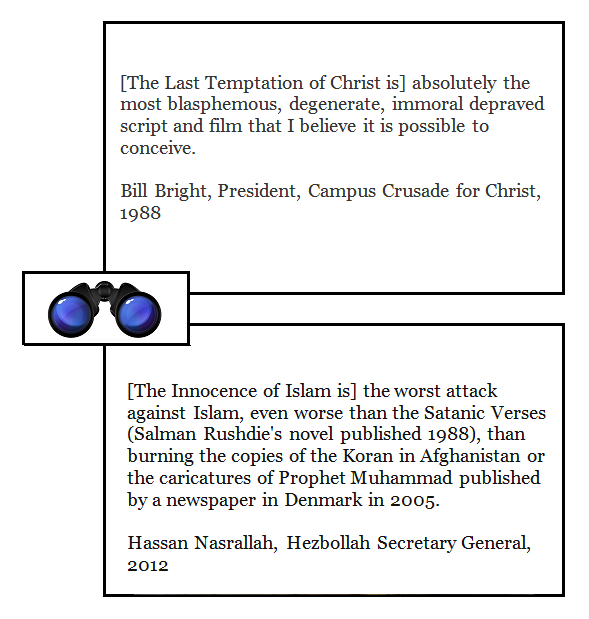
Martin Scorsese‘s Last Temptation of Christ gives us a sense of how modern American and European Christians can react to perceived blasphemy, while the forthcoming Paul Verhoeven movie of his own book Jesus of Nazareth will test the degree to which we’ve learned the lessons of a quarter century ago — and of this last week.
.
**
Martin Scorsese’s The Last Temptation of Christ: stirred strong feelings when it opened. I was in LA at the time, and was following the controversy fairly closely having attended an early screening, and having both literary and theological interests.
The short video clip below is a little choppy, it doesn’t make it particularly clear that the clips you see are from the film Martin Scorsese made of a novel — written by the Nobel laureate Nikos Kazantzakis — which makes no attempt nor pretense to be a historical or religiously orthodox portrayal of Christ. IMO, it is worth watching for the glimpse it gives of just how strong the undercurrents of emotion aroused by Scorsese’s film were at the time:
**
I’m bringing this subject up and attending to it in some detail because NBC World News mentioned Martin Scorsese’s movie on the 13th of this month, in an explanation as to Why films and cartoons of Muhammad spark violence, but without gwetting the picture quite right:
Director Martin Scorsese’s adaptation of a book by the same name showed Jesus struggling with lust, depression and doubt, and engaging in sex — in his imaginings — before snapping back to reality and dying on the cross. That movie was seen as blasphemy by some Christians, who — though not violent — were vocal enough to prevent the film from being shown in many parts of the United States.
There may have been no violence done to humans in the US — but there as certainly damage to property, and some vicious threats made, as The Encyclopedia of Religion and Film records:
At the Cineplex Odeon Showcase Theater in New York City, vandals slashed seats and spray-painted threats aimed at the chairman of MCA: “Lew Wasserman: If you release ‘The Last Temptation of Christ,’ we will wait years and decimate all Universal property. This message is for your insurance company.”
In parts of Europe, the violence was more intense:
Overseas, at the September 28 opening in Paris, demonstrators who had gathered for a prayer vigil threw tear gas canisters at the theater’s entrance. Catholic clergy led rock-throwing and fire-bombing assaults on theaters in many French municipalities. A thousand rioters in Athens trashed the Opera cinema, ripping apart the screen and destroying the projection equipment.
In Paris, specifically, the violence severely injured some human targets. From Wikipedia (with their footnotes removed — you can track the various quotes from the original page):
On October 22, 1988, a French Christian fundamentalist group launched Molotov cocktails inside the Parisian Saint Michel movie theater while it was showing the film. This attack injured thirteen people, four of whom were severely burned. The Saint Michel theater was heavily damaged, and reopened 3 years later after restoration. Following the attack, a representative of the film’s distributor, United International Pictures, said, “The opponents of the film have largely won. They have massacred the film’s success, and they have scared the public.” Jack Lang, France’s Minister of Culture, went to the St.-Michel theater after the fire, and said, “Freedom of speech is threatened, and we must not be intimidated by such acts.”
The Catholic response — from the Cardinal Archbishop of Paris among others — reproved both the blasphemy and the rioting:
The Archbishop of Paris, Jean-Marie Cardinal Lustiger, said “One doesn’t have the right to shock the sensibilities of millions of people for whom Jesus is more important than their father or mother.” After the fire he condemned the attack, saying, “You don’t behave as Christians but as enemies of Christ. From the Christian point of view, one doesn’t defend Christ with arms. Christ himself forbade it.” The leader of Christian Solidarity, a Roman Catholic group that had promised to stop the film from being shown, said, “We will not hesitate to go to prison if it is necessary.”
There was apparently a connection with French far-right politics, too:
The attack was subsequently blamed on a Christian fundamentalist group linked to Bernard Antony, a representative of the far-right National Front to the European Parliament in Strasbourg, and the excommunicated followers of Archbishop Marcel Lefebvre. Lefebvre had been excommunicated from the Catholic Church on July 2, 1988. Similar attacks against theatres included graffiti, setting off tear-gas canisters and stink bombs, and assaulting filmgoers.
There were legal proceedings following the Saint Michel incident, and it’s notable that Fr. Gérard Calvet OSB, founder and Prior of the Benedictine Abbaye Sainte-Madeleine du Barroux, testified at the tribunal on behalf of the convicted youths, describing their motives if not their mode of expression as “noble”. Would that term be equally applicable to protesters of blasphemies against other faiths? We now live in a dense-packed world where such comparisons are easily made.
Let’s pause for a minute over the twinned remarks of the late (and widely respected) Cardinal Lustiger concerning Last Temptation —
Jean-Marie Cardinal Lustiger, said “One doesn’t have the right to shock the sensibilities of millions of people for whom Jesus is more important than their father or mother.” After the fire he condemned the attack, saying, “You don’t behave as Christians but as enemies of Christ. From the Christian point of view, one doesn’t defend Christ with arms. Christ himself forbade it.”
and compare the remarks of a similarly authoritative religious figure in Libya to the Innocence of Muslims video:
Libya’s Grand Mufti, Sheikh Sadeq Al-Ghariani, has issued a fatwa condemning Tuesday’s killing of US Ambassador Chris Stevens along with three other American diplomatic staff and a number of Libya security guards. He said those involved were criminals who were damned by their action.
He also condemned the production of any film, picture or article insulting the Prophet Mohammad or any of the prophets by “extreme fanatics” in the US or elsewhere. The Prophet Muhammad, Ghariani said, had specifically forbidden the killing of ambassadors and envoys.
**
Almost a quarter century has passed since Scorsese’s movie opened, but as I said above, we will soon have an opportunity to show what we have learned from those lamentable events in Paris and the more recent tragedies in Benghazi, Cairo and elsewhere.
Paul Verhoeven — the director of such blockbusters as RoboCop, the original Total Recall, and Basic Instinct — has raised the financing for his upcoming movie Jesus of Nazareth, based on his book of the same name, and scripted by Roger Avary, who shared an Oscar with Quentin Tarrentino for their Pulp Fiction screenplay.
Verhoeven, be it noted, is not only a writer and movie director, but also a member of the Jesus Seminar — a group of scholars which, as Wikipedia nicely puts it, “treats the canonical gospels as historical sources that represent Jesus’ actual words and deeds as well as elaborations of the early Christian community and of the gospel authors” and prepares color-coded editions of the gospels suggesting which sayings of Jesus should be considered original, and which are better understood as later additions.
Deadline reports that the legendary Paul Verhoeven — a guy who, amazingly, only directed three movies in the past fifteen years — has received financing to adapt his own book, Jesus of Nazareth, which discounts every mythical story surrounding Christ and, instead, opts to present him as a simple human figure with a message powerful enough to radiate throughout time. Roger Avary (Tarantino‘s story partner on Pulp Fiction) will write the film, while Muse Productions are doing the proper backing.
Almost any work going against the long-held Biblical grain will get groups up in arms — no, I don’t even need to provide examples — but the claims of Nazareth are, even in this context, still mighty contentious. Most notable is the idea that Jesus is not the son of God, but was actually the product of Mary being raped by a Roman soldier; so, right off the bat, you’re discounting the entire foundation of his story.
I am pointing this out because right now would be a good time for the various churches to begin a general conversation about the film-maker’s right to hold an opinion, write a book and make a movie, the hurt that may be felt by believers, and the importance of responding without hatred or violence when offended.
**
In our concern with matters of Christian and Muslim issues, let us not lose sight of the fact that Jews too have movies made about them that may not only hurt feelings but also represent real threats against them, reminiscent of Nazi and earlier Russian antisemitic propaganda fabrications.
In 2003 a private Syrian film company created a 29-part television series Ash-Shatat (“The Diaspora”). This series originally aired in Lebanon in late 2003 and was broadcast by Al-Manar, a satellite television network owned by Hezbollah. This TV series, based on the antisemitic forgery The Protocols of the Learned Elders of Zion, shows the Jewish people as engaging in a conspiracy to rule the world, and presents Jews as people who murder Christian children, drain their blood and use this blood to bake matzah.
Al-Shatat: Jews Murder A Christian Child and Use His Blood for Passover Matzos. anti Semite Arab propaganda against Jews, Judaism and Israel.
The following is a scene from the Syrian-produced TV series Al-Shatat. Al-Shatat was first aired on Hizbullah’s Al-Manar TV during the month of Ramadan 2003, and then on two Iranian channels during Ramadan 2004. Al-Mamnou’ TV, a new Jordanian channel, is airing Al-Shatat during Ramadan 2005.
It is worth recalling, too, that Mel Gibson‘s film, The Passion of the Christ, was perceived by many Jews, Christians and others as anti-Semitic — and that nonetheless the Orthodox Jew and conservative movie critic Michael Medved wrote:
The possibility of anti-Jewish violence in response to the film has been irresponsibly emphasized and has become, self-fulfilling prophecy. In parts of Europe and the Islamic world, anti-Semitic vandalism and violence occur daily, and hardly need a film by a Hollywood superstar to encourage them. In this context, Jewish denunciations of the movie only increase the likelihood that those who hate us will seize on the movie as an excuse for more of hatred.
**
I trust it is not too late to wish our Jewish readers l’shana tova: may your apples be dipped in honey and all our days bathed in peace.
[ by Charles Cameron — comparative riotology, with sidelong glances at goats and a single mole ]
.
.
It’s not always disrespect for the Prophet that causes people to burn flags and attempt to break into embassies…
This week, the disputed sovereignty of some uninhabited islands has done the trick quite nicely in Beijing, where rioters have attempted to breach the Japanese embassy and burned the Japanese flag (upper image, above) in a manner that’s somehow reminiscent of the breaching of the US embassy and corresponding burning of the US flag (lower image) in Cairo .
I imagine that if one was Japanese or Chinese, one might consider the Beijing protests over the ownership of the Senkaku / Diaoyu / Tiaoyutai Islands to be the primary troubling news-story about embassies, rioting and gross breaches of diplomatic protocol this week.
There’s a strange kind of parallax involved here, I think. Or perhaps: what’s in the foreground depends on where you stand.
But that’s not to say there’s an exact equivalence between the situations, just that bearing one in mind may shed some light on the other.
**
I hope to get into the layers and layers of motivation that feed a riot in a subsequent post, but for now I’d just like to point to one similarity between the two situations. In each case, there’s an undertow of strong feeling that surfaces at a certain point — and astonishes us by its force.
In the case of the disputed islands, it may be Chinese feelings about Japanese behavior towards them in World War II that are triggered by Japanese claims on the islands. As China Daily USA says:
Japan has to recognize China’s sovereignty over the Diaoyu Islands and atone for its past aggressions and atrocities, and take measures to punish those Japanese who deny the country’s violent past, in the way that Germany has been doing for decades. Only if Japan does that will China and other Asian countries see it as a normal country. Otherwise, China should prepare for a long-term struggle.
The dispute with Japan is now part of the legacy of World War II and China claims that under the Potsdam Declaration of 1945, Japan was obligated to return all the territories seized illegally.
The above means that the dispute over the islands is now connected to one of the most highly charged issues in Sino-Japanese history, making it a matter of national honor for the Chinese that is not subject to negotiation.
Note here that the question is expressly one of honor.
It is significant, too, that the Chinese can be described as lenient towards their protesters attaching the sovereign embassy of a sovereign nation, just as the Egyptian government has been described as lenient towards their protesters attacking the sovereign embassy of the United States:
In the interim, China has allowed anti-Japanese demonstrators a relative freehand (“Their feelings are perfectly understandable” explained the Chinese Foreign Ministry) and the Japanese Embassy in Beijing has issued warnings to Japanese citizens and businessmen to take precautionary measures.
**
I strongly believe that undertows, as I am calling them here, are among the most important topics for monitoring and analysis — and that the fact that they so often take us by surprtise is a good reason to pay them closer analytic attention.
They surface in dreams, in graffiti, in conspiracy theories, in all the liminal spaces. And they can have game-changing impact: Great Game Changing impact.
That, btw, is why Cass Sunstein‘s paper on conspiracy theories is one we should consider in detail here on ZP one of these days.
In the 1970s Japanese ultra-rightists took two goats on a 2,000km (1,250-mile) trip southwest from Tokyo to a group of uninhabited rocks near Taiwan called the Senkaku Islands. In the absence of humans willing to live in such a remote outpost, the hardy creatures would be the vanguard of a new push to solidify Japan’s hold over the islets, which are also claimed by China and Taiwan.
Does comparing Beijing 2012 with Cairo 2012 change the emphasis with which you view recent events in Cairo and elsewhere?
Do you find the analogy between Cairo 2012 (upper panel above) and Tehran 1979 (lower panel) more convincing?
Look, I think the making of analogies is one of the chief ways — if not the chief way — in which we make “instinctive” judgments, which we then back up with appropriately selected data and reasoning. If you like, it’s subject to our own mental version of undertow in terms of what analogies we chose and how strongly we then weigh them — unless we take responsibility for the process, and begin to explore how it actually works in our own minds, and in the public mind…
Analogy is an extremely powerful instrument of thought — and it’s about time we understood it as well as we understand linear logic.
Zenpundit is a blog dedicated to exploring the intersections of foreign policy, history, military theory, national security,strategic thinking, futurism, cognition and a number of other esoteric pursuits.