zenpundit.com » Buddhism

Archive for the ‘Buddhism’ Category

Arresting Citizens, part II: Religion

Saturday, March 23rd, 2013

[ by Charles Cameron — on the religious and irreligious attributes of the sovereign citizen movement, with a glance at syncretism and the Grateful Dead ]
.


.
**

There’s something of a question as to whether the US sovereign citizens movement is religious and perhaps apocalyptic, or basically secular in nature. As I said in part I of this double post, its main manifestations haven’t seemed particularly religious, and I have accordingly not been paying them a whole lot of attention.

This sense — that the movement is primarily legal rather than religious in emphasis, is nicely captured in this personal communication from JM Berger:

Very few of the beliefs that we use to define the sovereign citizen movement are by definition religious. The things that most often define a sovereign have to do with interpretations of secular law. Athough those interpretations are sometimes supported by religious concepts, the beliefs themselves are centered on what adherents think is a pragmatic reading of law. So to explain that, most sovereigns wouldn’t refuse to answer a policeman’s questions by citing a religious principle. They would instead cite some secular legal principle they believe is valid. But some sovereigns do mix religion in more aggressively, such as those who follow outgrowths of the old Moorish Science Temple religion. But even they rely on legal arguments.

The most common sovereign how-to materials and recruitment websites tend to be pretty secular and based on a reading of history that, while fanciful, is predicated on a misreading of history rather than on ideas we would normally consider religious. In fact, I think the big challenge in understanding this movement is figuring out how these ideas take such powerful hold having neither a consistent religious dimension nor any evidence — even subjective or anecdotal — that they work on a practical level.

JM is the author of Jihad Joe: Americans Who Go to War in the Name of Islam and of the New America Foundation report, PATCON: The FBI’s Secret War Against the ‘Patriot’ Movement… His views as expressed in the quote above are based on recent research.

**

Jean Rosenfeld is also a researcher with an interest in both foreign and home-grown violent movements. She authored what may have been the first detailed inquiry into Al-Qaida from a religious studies perspective, The `Religion’ of Usamah bin Ladin: Terror As the Hand of God, back in 2001, edited the anthology Terrorism, Identity, and Legitimacy, and was one of the FBI’s advisory scholars during the [“sovereign”] Justus Freemen standoff, see her article The Justus Freemen Standoff: The importance of the analysis of religion in avoiding violent outcomes in Cathy Wessinger, ed., Millennialism, Persecution & Violence.

Also in a private communication, Jean writes:

Sovereign citizen ideology is basically a religious ideology. It is deviant, of course, and is often mixed with Christian Identity religion. It comes out of the same “cultic milieu” as the Posse Comitatus of the 1970s and CSA of the 1980s.

Setting these two opinions regarding the religiosity or otherwise of the sovereign citizens side by side, what strikes me most is the juxtaposition of the Moorish Science Temple in JM’s quote with the Covenant, Sword and Arm of the Lord in Jean’s. Both are “new religious movement” of considerable interest to scholars of such things.

For more on the Moorish Science Temple, see Peter Lamborn Wilson‘s Lost/Found Moorish Time Lines in the Wilderness of North America [part 1 and part 2]. For more on the CSA, see Kerry Noble‘s book, Tabernacle of Hate, with an Introduction by Jean Rosenfeld.

**

Given my interest in the religious imagination — which is manifesting itself these days in a wild profusion perhaps unmatched since the times of Qumran , Nag Hammadi and the Corpus Hermeticum — I was intrigued, in looking a little deeper into the US Sovereign Citizens movement, to find at least one individual with an approach to religion that’s suitably sui generis.

The deliciously named (and I quote) ©H.I.R.M. J.M. Sovereign: Godsent™ is the author of TITLE 4 FLAG SAYS YOU’RE SCHWAG! The Sovereign Citizen’s Handbook (version 3.1), in which we read:

The source of all Sovereignty is God. God holds Absolute Sovereignty, meaning He rules over all He surveys and answers to no-one above Himself, every force in nature including human conduct is His subject and under the control of “The Laws of Nature”. For example, “gravity”.

The author then quotes 1 Chronicles 29:11-12

Yours, O Lord, is the greatness and the power and the glory and the victory and the majesty, for all that is in the heavens and in the earth is yours. Yours is the kingdom, O Lord, and you are exalted as head above all. Both riches and honor come from you, and you rule over all. In your hand are power and might, and in your hand it is to make great and to give strength to all.

and follows this directly with the seal of the “Church of Sovereigns” depicted at the top of this post, right. On the left of the same image is a graphic taken from a video titled Calling the Sheriff 2.1.2012, which, if you recognize it, will give you an immediate and visceral sense of the Deadhead spirit of this particular writer.

Here, by way of confirmation, is his bio:

©H.I.R.M. J.M. Sovereign: Godsent™, a veteran of the 2nd American Civil war, A.K.A the “War on Drugs” was born sovereign and free out of the the love generation but, was cast into slavery at age 5 in the police state of New Mexico, when his parents divorced. Struggling with the contradictions between society and the laws of nature, Godsent spent the next 33 years casting off the shackles of institutional conditioning, with the ultimate triumph of regaining the throne of his very own sovereign nation and setting new standards in the way Sovereign Americans and government employees interface.

Shown the path of ahimsa (non-violence) at an early age, he is a lover of music and art, who has traveled the world to dance with friends at over 400 Grateful Dead shows in 5 countries. Surviving repeated attacks at shows and on the streets, by public employees, and noting the patterns and the damage done, he concluded that the World needed a treatise on Sovereignty and Reservation of Sovereign Rights. With the Investment of 23 years of field research, networking and litigation, and 7 years of writing, he has recently authored the definitive treatise on Reservation of Sovereign Rights. Along with the first automated sovereignty e-course, accompanied by an inspirational soundtrack, network services, a private, third-party document tracking system and educational videos.

A monk of the 9 Sacred paths of Catholic, Buddha Rasta, Tao, Maya, Jain, Shvaite, Vaishnava, and Eckankar, he has traveled the world in search of priceless wisdom, humor, melody and artifacts. He has learned the most confidential knowledge and has been given the keys the Kingdom of God, by the enlightened masters, which he gives entrance to you here, in this book. He has never owned a weapon in his life.

**

I am not totally immune to the charms of the Grateful Dead, and take an interest in Catholicism, Buddhism, Taoism, and Shaiva tantra myself.

But but but… please!! Even Christ recommends we should “render unto Caesar that which is Caesar’s”. And When the Taoist Chuang Tze expresses his lack of interest in governance, he does so not by way of refusing to pay parking tickets or taxes, but by politely refusing an offer of high office [Basic Writings, p 109]:

Once, when Chuang Tzu was fishing in the P’u river, the king of Ch’u sent two officials to go and announce to him: “I would like to trouble you with the administration of my realm.”

Chuang Tzu held onto the fishing pole and, without turning his head, said, “I have heard that there is a sacred tortoise in Ch’u that has been dead for three thousand years. The king keeps it wrapped in cloth and boxed, and stores it in the ancestral temple. Now would this tortoise rather be dead and have its bones left behind and honored? Or would it rather be alive and dragging its tail in the mud?”

“It would rather be alive dragging its tail in the mud,” said the two officials.

Chuang Tzu said, “Go away! I’ll drag my tail in the mud!”

Sherlock Holmes, Hannibal Lector and Simonides

Sunday, March 3rd, 2013

[ by Charles Cameron — the art of memory, with a sidelong glance at swans, typhoid and theodicy ]
.

Thomas Harris (and by extension Hannibal Lector) has been interested in memory palaces for a long time. We can begin to infer this this because Lector describes his hobby in Red Dragon (1981) and again in Silence of the Lambs (1988):

So — church collapses?

**

As you can tell from that last comment in the Silence of the Lambs quote — to my mind the most brilliant presentation of the problem of theodicy for our day — if there’s a God worth defending, it has to be a God who allows sparrows to fall, typhoid to accompany swans in the vast ecology of existence, churches to collapse on worshipers, and “bad things to happen to good people” from time to time.

And such things, specifically including collapses of religious buildings atop worshipers, do indeed happen in fact as well as fiction.

And they don’t only happen to Christians, either… Bon is the shamanistic religious tradition of Tibet, prior to — and later, somewhat assimilated by — Buddhism

**

The thing is, when I read that Hannibal Lector collected church collapses, it not only made me start to take note of them myself, it also made me think of Simonides. As Frances Yates tells us in her book, The Art of Memory:

At a banquet given by a nobleman of Thessaly named Scopas, the poet Simonides of Ceos chanted a lyric poem in honour of his host but including a passage in praise of Castor and Pollux. Scopas meanly told the poet that he would only pay him halfthe sum agreed upon for the panegyric and that he must obtain the balance from the twin gods to whom he had devoted half the poem. A little later, a message was brought in to Simonides that two young men were waiting outside who wished to see him. He rose from the banquet and went out but could find no one. During his absence the roof of the banqueting hall fell in, crushing Scopas and all the guests to death beneath the ruins; the corpses were so mangled that the relatives who came to take them away for burial were unable to identify them. But Simonides remembered the places at which they had been sitting at the table and was therefore able to indicate to the relatives which were their dead. The invisible callers, Castor and Pollux, had handsomely paid for their share in the panegyric by drawing Simonides away from the banquet just before the crash. And this experience suggested to the poet the principles of the art of memory of which he is said to have been the inventor. Noting that it was through his memory of the places at which the guests had been sitting that he had been able to identify the bodies, he realised that orderly arrangement is essential for good memory.

And by way of reinforcing my Lector-Simonides conjecture, Lector certainly had a remarkable interest in memory, as we learn from his dialogue with Clarice Starling:

“Did you do the drawings on your walls, Doctor?”
“Do you think I called in a decorator?”
“The one over the sink is a European city?”
“It’s Florence. That’s the Palazzo Vecchio and the Duomo, seen from the Belvedere.”
“Did you do it from memory, all the detail?”
“Memory, Officer Starling, is what I have instead of a view.”

A belvedere, from the Italian, is “a structure (as a cupola or a summerhouse) designed to command a view” — and a beautiful view at that. Belvedere is also, ironically, the name of the town in Ohio where Buffalo Bill, Lector’s serial killer ex-patient, lives…

**

So it didn’t surprise me to discover that in Hannibal (1999), the book that follows Silence, this brilliant man who as we have seen collects church collapses and has an exquisite memory in place of a view, is revealed as a practitioner of Simonides’ art:

The memory palace was a mnemonic system well known to ancient scholars and much information was preserved in them through the Dark Ages while Vandals burned the books. Like scholars before him, Dr. Lecter stores an enormous amount of information keyed to objects in his thousand rooms, but unlike the ancients, Dr.Lecter has a second purpose for his palace; sometimes he lives there. He has passed years among its exquisite collections, while his body lay bound on a violent ward with screams buzzing the steel bars like hell’s own harp.

Hannibal Lecter’s palace is vast, even by medieval standards. Translated to the tangible world it would rival the Topkapi Palace in Istanbul for size and complexity.

We catch up to him as the swift slippers of his mind pass from the foyer into the Great Hall of the Seasons. The palace is built according to the rules discovered by Simonides of Ceos and elaborated by Cicero four hundred years later; it is airy, high-ceilinged, furnished with objects and tableaux that are vivid, striking, sometimes shocking and absurd, and often beautiful. The displays are well spaced and well lighted like those of a great museum. But the walls are not the neutral colors of museum walls. Like Giotto, Dr. Lecter has frescoed the walls of his mind.

Brilliant. And a delight, years later, to have my hunch connecting the church collapses and prison cell with only memory for a view with Simonides and the Art of Memory confirmed by the third book and film in the series…

You’ll note, btw, that the Lector (caveat lector) of the first two books has now become Lecter in alignment with the films starring Anthony Hopkins.

**

I love symmetries, so let’s move from the most monstrous criminal mind in literature, to the greatest detective…

Sherlock Holmes — in his latest television incarnation — builds memory palaces of a sort, though I’m not sure Simonides would recognize them.

I’m posting the clip from the series here to honor my son Emlyn, with whom I have been watching the series…

**

And then there’s the Jesuit whose use of the Art is explored in Jonathan Spence‘s The Memory Palace of Matteo Ricci:

In 1596 Matteo Ricci taught the Chinese how to build a memory palace. He told them that the size of the palace would depend on how much they wanted to remember: the most ambitious construction would consist of several hundred buildings of all shapes and sizes, “the more there are the better it will be,” said Ricci, thought he added that one did not have to build on a gradiose scale right away. One coul create modest palaces, or one could build less dramatic structures such as a temple compound, a cluster of government offices, a public hostel, or a merchants’s meeting lodge. If one wished to begin on a still smaller scale, then one could erect a simple reception hall, a pavilion, or a studio. And if one wanted an intimate space one could use just the corner of a pavilion, or an altar in a temple, or even such a homely object as a wardrobe or a divan.

You’ll note that in this early example of virtual reality as an pedagogical technology, Ricci doesn’t start with the easy stuff, the single wardrobe or divan — he begins with “the most ambitious construction”…

Enough for now. When I want to talk about in a follow up post is detail… the crucial importance of detail.

Thy game be won?

Wednesday, February 27th, 2013

[ by Charles Cameron — a theology of little things, sports and wars included ]
.

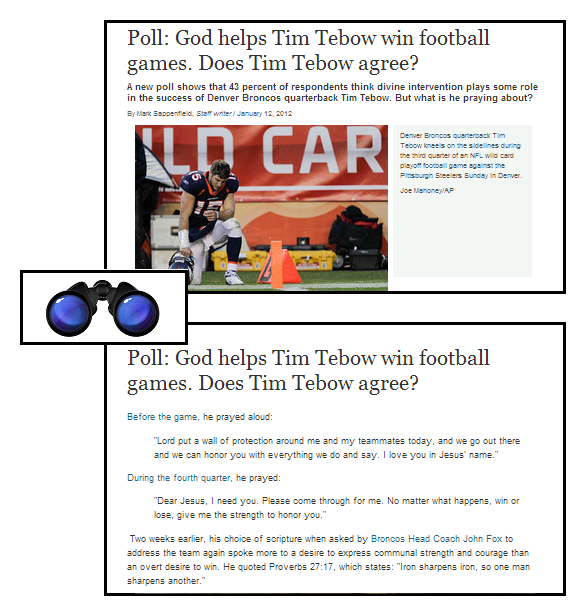
Let’s start with Tim Tebow, and phrase the issue this post raises as a question:

**

The headline of a TMZ post, God Is Saving the Broncos … Says Colorado Pastor, clearly suggests that God takes sides in sporting events.

Pastor Wayne Hanson — who runs Summit Church in Castle Rock, CO where Tim’s dad often speaks — tells TMZ God is actively intervening in Denver Broncos football games … and aiding Tim on the field because of his strong faith.

Hanson tells us, “It’s not luck. Luck isn’t winning 6 games in a row. It’s favor. God’s favor.”

Pastor Hanson adds, “God has blessed his hard work.”

We asked Hanson if Tebow would be winning games if he wasn’t such a strong believer — and the pastor replied, “No, of course not.”

**

Tebow himself, if I’m reading my news correctly, realizes that his God might have as much to teach by having a sports team lose as by having it win, hence his prayer as quoted above — “no matter, win or lose…”

And that level of subtlety would also be present in the sports theology of Notre Dame, if (once again) I’m not mistaken:

The team is unapologetically Catholic. Before every game, the Fighting Irish participate in a Mass overseen by one of the team’s two appointed Catholic priests, a tradition dating back to the 1920s. At the end of that ceremony, each player receives a priest-blessed medal devoted to a Catholic saint—a different saint every game for four years. Also during the pregame Mass, players can kiss a reliquary containing two splinters that Notre Dame believes came from the cross of Jesus. “Most of the non-Catholic players are Christian, so when you tell them these splinters came from the actual cross of Jesus they are humbled to reverence,” Doyle says.

**

I appreciate that combination of prayer for what one hopes and surrender to what happens, it’s way less heavy handed than supposing you can gauge Divine Providence by the results at the end of a game — or a war.

One Huffington Post writer was moved to ask: If Tim Tebow Were Muslim, Would America Still Love Him?

That’s an interesting question, roughly analogous to “If Tim Tebow had a losing streak, would America still love him? And God?

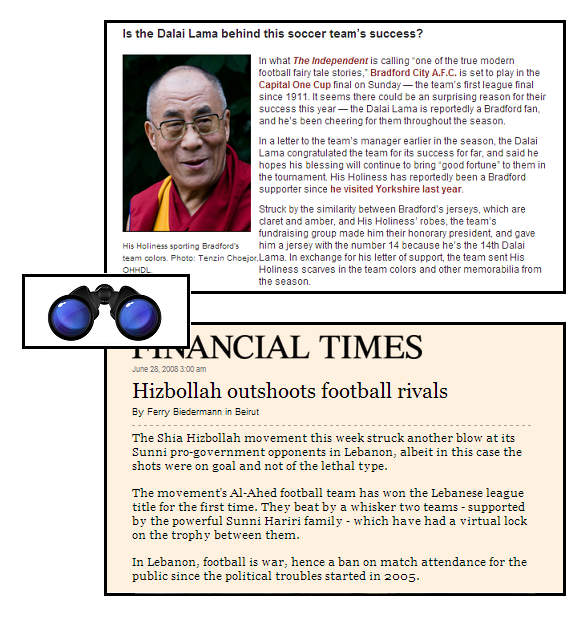
And if God does routinely show preference for one team over another by granting them victory, what are we to make of these two examples?

**

It seems the universe scales quite happily from tens of billions of years (or more) to femtoseconds (or less), and from almost a hundred billion light years (or more) to the Planck length (and I’m not so sure about less) — and my own tiny worm of a lifeline has given me “experiences” of a car rolling over a center divider and landing upside down, some moments of breathtaking beauty, times of bordeom, rapid eruptions of anger, the rock of early electric Dylan and the Baroque of Bach’s Matthew Passion. And I have causally picked my nose, almost without knowing I was doing it.

Who’s to say a God, ground of being, Great Mystery Power, or simple unaided universe can’t “purposefully” do Big Bangs and enormous time lags while gasses and galaxies and solar systems are formed and dissolve, flashes of lightning, inspiration and insemination, reproductions sexual and asexual, lives long and short, painting by El Greco and Vermeer, horrible puns and ugly Oscar ceremonies, mu mesons and mitochondria, prayers answered, hung up on in disgust, or unheard on account of it’s the Lord’s Day of Rest — grasses, feedlots, cows, milk, beef, methane…?

Depending, of course, on your definition of “purposefully” — since the purpose may be no more and no less than the unfolding of what is.

Whatever it is (or isn’t) that encompasses all this, it’s in little things as surely as big ones — and thumb wrestling, too. So there you have it: my theology of little things.

The Oscars, the Conclave and the Chinese

Monday, February 25th, 2013

[ by Charles Cameron — more on the upcoming papal election from a “comparative” perspective ]
.

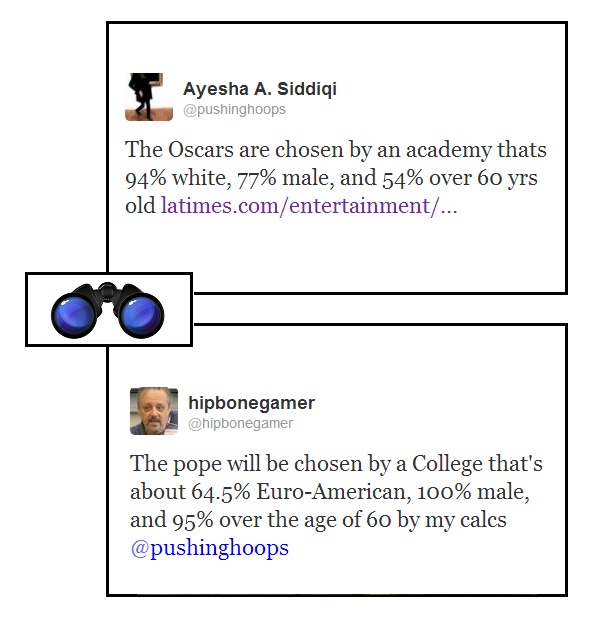
As you know, I noodle around with parallelisms and oppositions quite a bit. Here are two recent pairings that caught my attenion — one of them just in time for the Oscars:

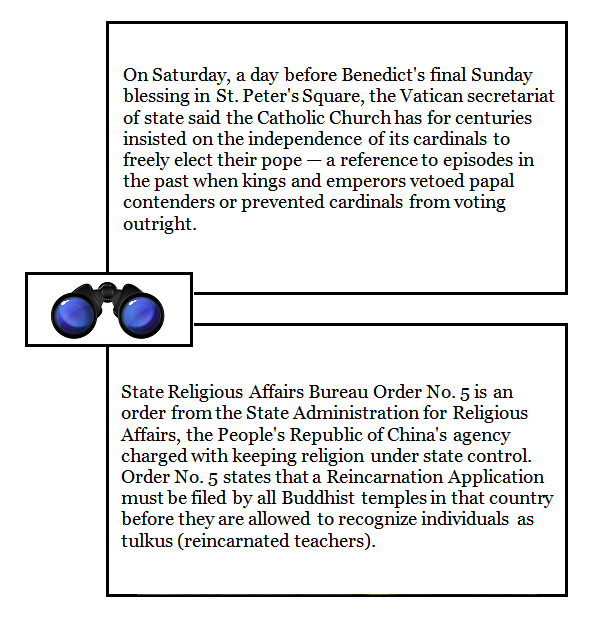
The other concerns political influence on spiritual appointments…

I had the good fortune to meet and befriend a “tulku” while I was at Oxford, so the whole business of the identification and recognition of reincarnated Tibetan lamas has long been an interest of mine.

Social media and religion: from Benedict via Barney to Vajrayana

Friday, January 25th, 2013

[ by Charles Cameron — mostly for the fun of it, though students of social media may want to explore further ]
.


.

Two stories from opposite ends (arguably) of the spectrum:

First, how social media can subvert respect for the “virtue police” in Saudi Arabia (h/t Sana Issa):

A lady in Dammam, the hub of the oil industry on the kingdom’s Gulf coast, tweeted a complaint from a local shopping mall. Agents of the Committee for the Promotion of Virtue and Prevention of Vice (CPVPV), she said, were causing an unpleasant scene. The government-salaried vigilantes, a bearded auxiliary police force familiarly known to Saudis as the Hayaa, had marched officiously into an educational exhibit featuring plaster models of dinosaurs, turned off the lights and ordered everyone out, frightening children and alarming their parents.

[ … ]

Within minutes of the incident, a freshly minted Arabic Twitter hashtag, #Dammam-Hayaa-Closes-Dinosaur-Show, was generating scores of theories about their motives.

  • Perhaps, suggested one, there was a danger that citizens might start worshipping dinosaur statues instead of God.
  • Maybe it was just a temporary measure, said another, until the Hayaa can separate male and female dinosaurs and put them in separate rooms.
  • Surely, declared a third, one of the lady dinosaurs had been caught in public without a male guardian.
  • A fourth announced an all-points police alert for Barney the Dinosaur, while
  • another suggested it was too early to judge until it was clear what the dinosaurs were wearing.
  • There’s more, but I’m too prudish to post it…

    **

    Second, and more seriously – but wittily too, hey! — here’s how social media can impact the egos of “so-called” Vajrayana [ Buddhist tantra ] practitioners, together with sage advice from a noted film-maker Rinpoche, Dzongsar Jamyang Khyentse:

  • Don’t post tantric images: If you think posting provocative tantric images (such as images of deities with multiple arms, animal heads, those in union, and wrathful deities) makes you important, you probably don’t understand their meaning
  • Don’t post mantras and seed syllables: If you think mantras and seed syllables should be posted on Facebook as mood enhancement and self-improvement aids, a makeover or haircut might do a better job.
  • Don’t talk about your empowerments: If you think images from your weekend Vajrayana empowerment are worthy of being posted up next to photos of your cat on Facebook, you should send your cat to Nepal for enthronement.
  • Vajrayana Buddhism? Here’s a quick overview:

    In contrast to the approaches of conventional religion, tantra does not attempt to soothe the turmoil of existence with consoling promises of heaven and salvation. The tantric practitioner chooses to confront the bewildering and chaotic forces of fear, aggression, desire, and pride, and to work with them in such a way that they are channeled into creative expression, loving relationships, and wisely engaged forms of life.

    **

    And then there’s Benedict XVI, tweeting as @pontifex. His 1,458,557-and-counting followers have thus far received 27 tweets from the Holy Father since December 12th — no “Friday Follows” and no “Retweets”.

    He does, however, follow himself in 8 languages besides English.


    Switch to our mobile site