zenpundit.com » Buddhism

Archive for the ‘Buddhism’ Category

Mourning the loss of Monte Cassino

Friday, January 18th, 2013

[ by Charles Cameron — destruction of sacred spaces ]
.

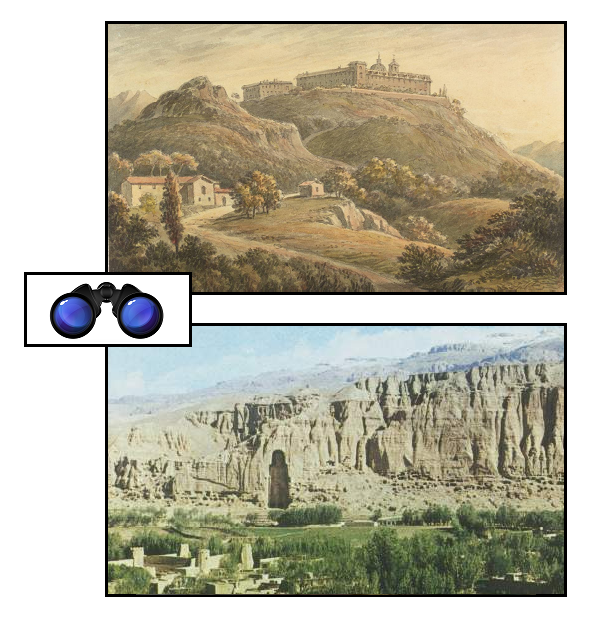
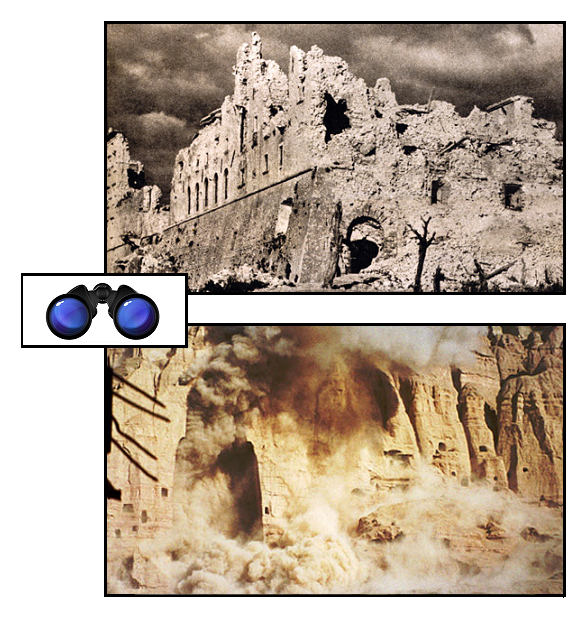
Do we grieve the destruction of the Abbey of Monte Cassino as we grieve the destruction of the Bamiyan Buddhas?

**

With playful and appropriate scholarly tongue-in-cheek, Umberto Eco describes the importance of monasteries — and of the Benedictine Order specifically — in preserving culture, literacy, the arts and sciences through dark ages in his novel, The Name of the Rose:

“Monasterium sine libris,” the abbot recited, pensively, “est sicut civitas sine opibus, castrum sine numeris, coquina sine suppellectili, mensa sine cibis, hortus sine herbis, pratum sine floribus, arbor sine foliis. … And our order, growing up under the double command of work and prayer, was light to the whole known world, depository of knowledge, salvation of an ancient learning that threatened to disappear in fires, sacks, earthquakes, forge of new writing and increase of the ancient. … Mundus senescit. If God has now given our order a mission, it is to oppose this race to the abyss, by preserving, repeating, and defending the treasure of wisdom our fathers entrusted to us.

Monte Cassino is the spiritual home of the Benedictine monastic order. It was here that Saint Benedict of Subiaco built a retreat in 529 CE, here that he wrote his Regula Monachorum or monastic Rule, the central text of western monasticism, and though the monastery had been previously sacked by the Lombards in 585, the Saracens in 884, and the Normans in 1046, it was devastated anew during the Battle of Monte Cassino 1944, an American artillery commander telling his men:

I don’t give a damn about the monastery. I have Catholic gunners in this battery and they’ve already asked me for permission to fire on it…

Harold Bond, in his book Return to Cassino A Memoir of the Fight for Rome, describes the scene as 256 American heavy bombers began dropping 576 tons of munitions on the abbey in waves, in words echoes by the video below:

There was no anti-aircraft fire from the Germans, either, just the drone of the big planes. They were very close now, and the first formation flew in over the abbey, releasing the bombs. We could see them fall, looking at this distance like little black stones, and then the ground all around us shook with gigantic shocks as they exploded. Another formation flew in, and then another, each followed by thunderous detonations. Now where the abbey had been there was only a huge cloud of smoke and dust which concealed the entire hilltop.

**

The bombing appears to have been authorized on the basis of a mistranslation. An intelligence intercept of the question “Ist Abt in Kloster?” — “is the Abbot in the Monastery” — was translated by the US as though Abt was short for Abteil, “Is the HQ in the Abbey?” The recorder answer “Ja” then led to the bombing.

Three days after the bombing, the Abbot was interviewed in person by the commander of XIV Panzer Corps, himself a lay brother of the Benedictine order, and reported:

Until the moment of the destruction of the Monte Cassino abbey there was within the area … neither a German soldier, nor any German weapon, nor any German military installation.

Thankfully, the abbey was restored and reconsecrated in 1964 by Pope Paul VI and remains to this day the mother house of the Order of St. Benedict.

**

I hope to review relevant portions of Peter Caddick-AdamsMonte Cassino: Ten Armies in Hell, available in the UK and due to be released in the US in April 2013, later this year. A review copy has been my source for details of the Battle of Monte Cassino described above.

Image sources, upper pair:

Destruction of the taller Bamiyan Buddha, CNN via Wikipedia
Montecassion destroyed, from Monte Cassino Tour

Image sources, lower pair:

Bamiyan Buddhas, from Random Walks
Monte Cassino by John `Warwick’ Smith, from the Tate

Steady breathing

Tuesday, January 8th, 2013

[ by Charles Cameron — something as simple as spirit, important to special ops & law enforcement — an open question ]
.


.

Let’s begin with a quote from Buddhist monk Thich Nhat Hanh, The Miracle of Mindfulness: An Introduction to the Practice of Meditation:

Breath is the bridge which connects life to consciousness, which unites your body to your thoughts. Whenever your mind becomes scattered, use your breath as the means to take hold of your mind again.

That’s about as basic as you can get. Breath begins with your first gasp (in-spiration) and runs like a silk thread through your life till your last sigh (ex-spiration) and it’s all spirit — which turns out to be beyond the mind-body dichotomy, and a balancing factor for both.

**

Fast forward.

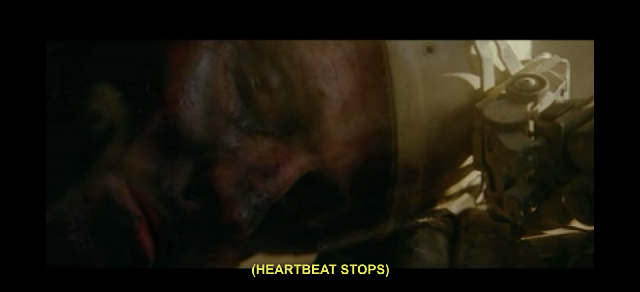
Let’s turn from breath — spiritus in Latin, as in spiritus ubi vult spirat, “breath blows where it wants to”, John 3.8 — to its specific application in “combat breathing” as illustrated by the still from the National Geographic movie Seal Team Six: the Raid on Osama bin Laden at the head of this post.

In “Fear Factor”, his review of Amanda Ripley’s fascinating-sounding The Unthinkable: Who Survives When Disaster Strikes, published in City Journal 21 June 2008, blog-friend John Robb writes:

… in complex disasters, the biological-fear response can slow thinking so severely that it can kill you.

We can counter fear, however. The best method, FBI trainers say, is to get control of your breathing. “Combat breathing” is a simple variant on Lamaze or yoga training — breathe in four counts, hold four counts, exhale four counts, and repeat. It works because breathing is a combination of the somatic (which we control) and the autonomic (which we can’t easily control) nervous systems. Regulation of the autonomic system deescalates the biological-fear response and returns our higher-level brain functions to full capacity. So one of the best ways you can prepare yourself to overcome fear in a crisis is as simple as a meditation, Lamaze, or yoga class.

I find it fascinating and also sensible that yogic / meditative techniques are now taught by members of the special ops and law enforcement communities:

Training under stress also will help officers learn to control their arousal level. As their physiological agitation escalates, so might their susceptibility to perceptual and memory distortions. Thus, learning to control arousal level can help reduce distortions. Therefore, officers should receive training in and regularly practice ways to control arousal levels in high-stress situations. One process, the combat breathing technique, has proven highly effective in this area.

Alexis Artwohl, “Perceptual and memory distortion during officer-involved shootings”, FBI Law Enforcement Bulletin, Oct, 2002

This reminds me of Richard Strozzi Heckler’s In Search of the Warrior Spirit: Teaching Awareness Disciplines to the Green Berets, now in its fourth edition.

**

Breath, spirit, breathing — it’s …

… “right under our noses”, all too easily overlooked, and heart-stoppingly, mind-blowingly important.

Let’s talk a bit about it…

The Battle of Algiers / Black Friday koan

Saturday, November 17th, 2012

[ by Charles Cameron — a tale of two films, two conflicts, two cities ]
.
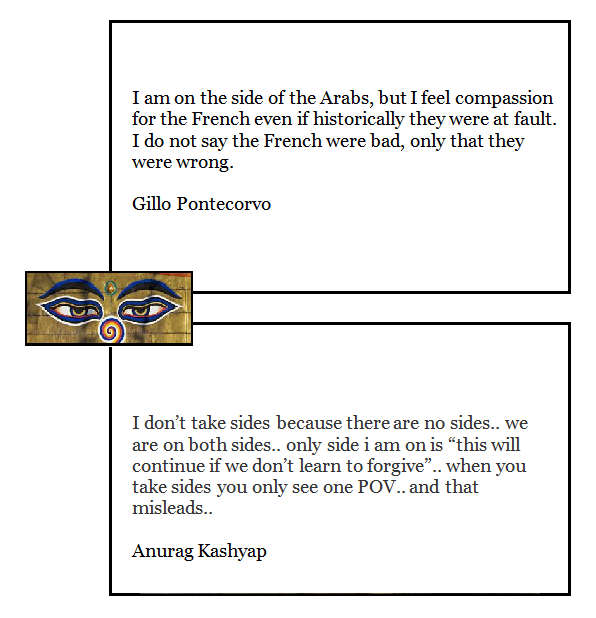
Are these two positions — take one side, take both sides — reconcilable?

That’s the koan, the paradox that’s facing me, after seeing two terrific films by these two directors again, this time back-to-back. The two films their respective directors are discussing are Gillo Pontecorvo‘s Battle of Algiers and Anurag Kashyap‘s Black Friday.

Elie Weisel triggered this set of reflections for me when I saw his stark statement of the “one side” position:

We must always take sides. Neutrality helps the oppressor, never the victim. Silence encourages the tormentor, never the tormented.

Let’s turn to the films.

**

Pontecorvo’s Battle for Algiers is a rightly-celebrated classic, and it’s opening shot confirms the director’s claim to show compassion for both sides:
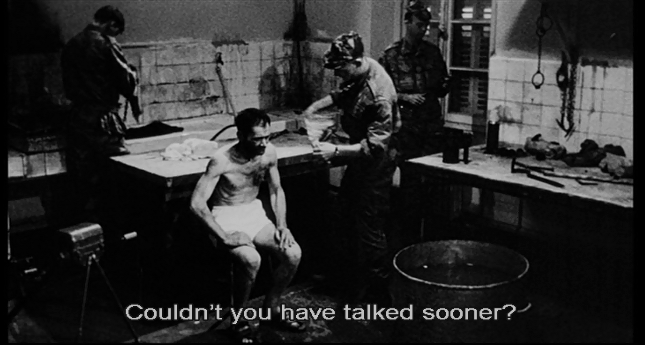
That’s an unexpected question from torturer to the victim he has just “broken”, and speaks volumes about the director’s intent — as does this quote from the french paratroop commander, Col. Mathieu, speaking of Larbi Ben M’Hidi, a leader of the National Liberation Front (FLN) whom he has captured and questioned — and who in “RL” was in fact murdered, though his death was reported at the time as a suicide:

Pour ma part, je peux seulement vous dire que j’ai eu la possibilité d’apprécier la force morale, le courage et la fidélité de Ben M’Hidi en ses propres idéaux. Pour cela, sans oublier l’immense danger qu’il représentait, je me sens le devoir de rendre hommage à sa mémoire.

For my own part, I can only tell you that I had the opportunity to appreciate Ben M’Hidi’s moral strength, his courage and his loyalty to his own ideas. On that account, and without overlooking the immense danger he represented, I feel obliged to salute his memory.

That reads to me as the respect of courage for courage.

The Pentagon, FWIW, held a screening of Battle for Algiers in September 2003, issuing a flyer indicating their reason to be interested in the film:

How to win a battle against terrorism and lose the war of ideas. Children shoot soldiers at point-blank range. Women plant bombs in cafes. Soon the entire Arab population builds to a mad fervor. Sound familiar? The French have a plan. It succeeds tactically, but fails strategically. To understand why, come to a rare showing of this film.

Yes indeed, it does sound a tad familiar.

**

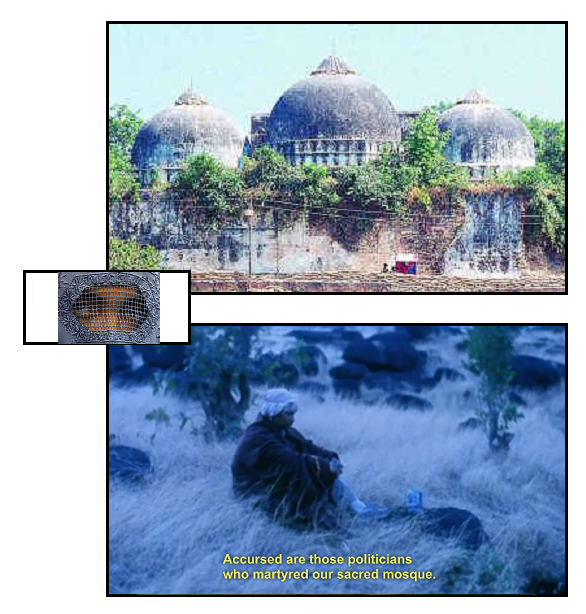
I’ll represent Kashyap’s Black Friday visually with a pair of images, the top one showing the Babri Mosque in Ayodhya / Oudh, which was leveled in December 1992 by an angry Hindu mob who claimed it had been built on the birthplace of Lord Rama, the avatar of Vishnu whose story is told in the Mahabharata

while the lower one represents Muslim rage at that event, making use of voice-over and that remarkable phrase, “martyred our sacred mosque”, to good effect.

Kashyap, then, can understand the feelings behind the horrific series of terrorist bombings that shook Bombay — as well as those of the bombed and terrorized population of that city. As Oorvazi Irani explains in her commentary on the film, Kashyap’s own views are expressed in the voice of DCP Rakesh Maria in the “chapter” on the interrogation of Badshah Khan:

Badshah Khan very proudly takes credit for the bombings and says Muslims have taken the revenge for the atrocities done to their Muslim brothers. That’s when Kay Kay Menon who plays the cop says and speaks in the voice of the director “…Allah was not on your side, on your side was Tiger Memon. He saw your rage and manipulated you. He was gone before the first bomb was even planted. ..he fucked you over. you know why? Because you were begging for it. All in the name of religion. You are a fucking idiot. You are an idiot and so is every Hindu, who murders one of you. Everyone who has nothing better to do … but to fight in the name of religion is a fucking idiot.”

**

Can there be a right side and a wrong side in a game? There can certainly be a winning side and a losing side — but a right side and a wrong side?

I ask, because the connection between wars and games is an ancient one. Can there be a right side and a wrong side in war? Looking at World War II, which was almost certainly the war that Elie Weisel was thinking of, the answer is pretty obviously yes. But what about the reasons given for “our side” being the right side?

Is our cause just because God is on our side? Because might makes right, and the big battalions are on our side? Or simply because it is our side — my country, right or wrong?

And then there is civil war to consider — for all wars are civil wars, when seen within the context of that greater “nationality”, the human race.

Abraham Lincoln, from his Second Inaugural:

Both parties deprecated war, but one of them would make war rather than let the nation survive, and the other would accept war rather than let it perish, and the war came. … Neither party expected for the war the magnitude or the duration which it has already attained. Neither anticipated that the cause of the conflict might cease with or even before the conflict itself should cease. Each looked for an easier triumph, and a result less fundamental and astounding. Both read the same Bible and pray to the same God, and each invokes His aid against the other. … The prayers of both could not be answered. That of neither has been answered fully. The Almighty has His own purposes…

The whole issue of the just war — or of jihad, its Islamic approximate equivalent — revolves around the question of whether there can be a wrong side in war.

**

If there can be a wrong side, it may be shredded. As Mark Twain once prayed:

O Lord our Father, our young patriots, idols of our hearts, go forth to battle — be Thou near them! With them — in spirit — we also go forth from the sweet peace of our beloved firesides to smite the foe. O Lord our God, help us to tear their soldiers to bloody shreds with our shells; help us to cover their smiling fields with the pale forms of their patriot dead; help us to drown the thunder of the guns with the shrieks of their wounded, writhing in pain; help us to lay waste their humble homes with a hurricane of fire; help us to wring the hearts of their unoffending widows with unavailing grief; help us to turn them out roofless with little children to wander unfriended the wastes of their desolated land in rags and hunger and thirst, sports of the sun flames of summer and the icy winds of winter, broken in spirit, worn with travail, imploring Thee for the refuge of the grave and denied it — for our sakes who adore Thee, Lord, blast their hopes, blight their lives, protract their bitter pilgrimage, make heavy their steps, water their way with their tears, stain the white snow with the blood of their wounded feet! We ask it, in the spirit of love, of Him Who is the Source of Love, and Who is the ever-faithful refuge and friend of all that are sore beset and seek His aid with humble and contrite hearts. Amen.

**

There are things to be said for being on the winning side of a conflict: you get to write history. There may be things to be said for being on the losing side: you gain the sympathy that accrues to the underdog. There are things to be said for supporting neither side, for being on the sidelines to pick up the pieces.

Then again, as Buddha observed in the Dhammapada, there are disadvantages to being on either side —

Victory breeds hatred. The defeated live in pain. Happily the peaceful live giving up victory and defeat.

while Christ muddies the simplicity of the whole business with a further contrarian note:

love your enemies.

Peace is not a bad side to be on, but perhaps love is more nuanced.

**

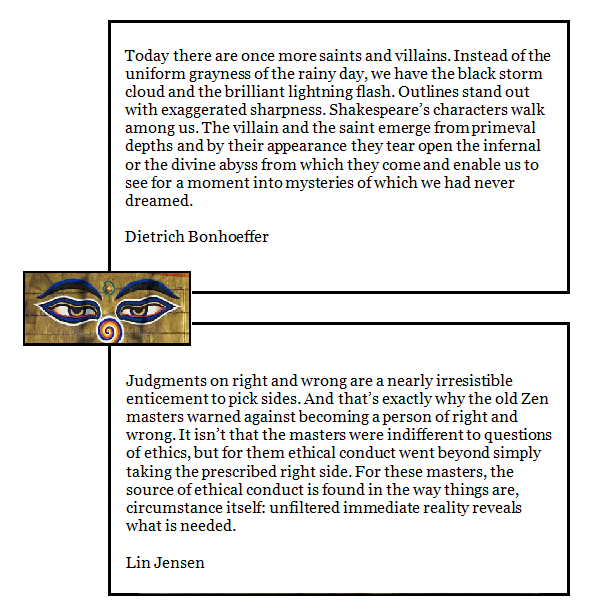
To bring us full circle, here’s another statement of the Elie Weisel position, this time in the words of Dietrich Bonhoeffer, the Lutheran pastor and theologian involved in the plot to assassinate Hitler and executed in one of the concentration camps — together with a response to the question I’ve been posing for myself here which may perhaps providinge some measure of reconciliation, this one from a contemporary Zen Buddhist, someone for whom the appreciation of koans is a way of life:
Noor Inayat Khan, GC

Saturday, November 10th, 2012

[ by Charles Cameron — east, west, music, espionage, pacifism, war, the Resistance, the Nazis, Dachau, and exceptional gallantry ]
.

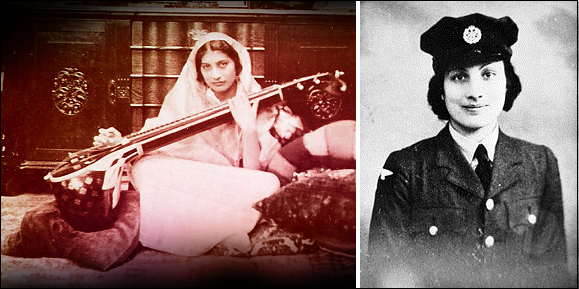
A Muslim woman — born in Moscow of princely Indian paternal descent, her mother an American from Albuquerque, her father a great North Indian classical musician and Sufi master of pacifist leanings…
.


.

Noor Inayat Khan was a student of Western classical music in pre-War Paris under the great Nadia Boulanger, escaped the oncoming Nazis and made it across the channel to England, where she told a British officer during a recruitment interview that she would indeed support Indian independence from Britain after the war — but that defeating Hitler took precedence and she would gladly fight for the British…

She thus became the first female radio operator sent by the British Special Operations Executive into Nazi-occupied France, where she worked courageously as a vital link between the French Resistance and Churchill‘s London until she was finally betrayed, imprisoned, and finally executed by firing squad in Dachau.

After the war, the British awarded her the highest civilian award for bravery, the George Cross, and France the Croix de Guerre.

**

Yesterday’s Guardian reports:

On Thursday afternoon, in a corner of Bloomsbury, Princess Anne unveiled Britain’s first memorial to an Asian woman. The bust is of Noor Inayat Khan, a woman who was a pioneer in so many things: an Indian princess who was also a gifted harpist; a Sufi who wrote Buddhist fables for children; an anti-imperialist who spied for the British empire – and the first female radio operator sent into Nazi-occupied France.

Her Twenty Jataka Tales is available here.
Shrabani Basu‘s biography of Noor Inayat Khan is here.

I raise a virtual toast to Noor Inayat Khan.

**

h/t David Foster at Chicago Boyz.

Details, nuances and blind-spots…

Sunday, November 4th, 2012

[ by Charles Cameron — Zen, Mahdism, and the importance of details ]
.

If you hear the phrase, “Details, details” from time to time, you may have noticed it is often accompanied by a sigh.


.

I’m never quite clear on which came first, the saying “God is in the details” or the saying “the Devil is in the details” — but whichever it is, the details are where you’ll find it.

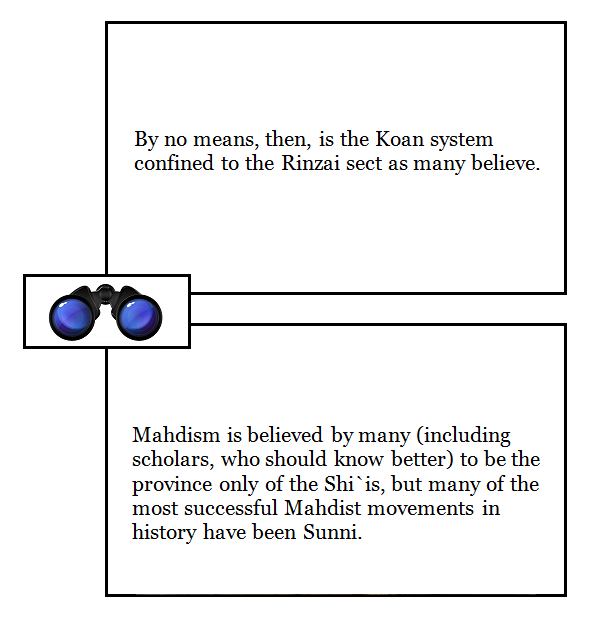
I ran across Philip Kapleau Roshi’s comment on koans (above) in his classic book, The Three Pillars of Zen, the other morning, and it sent me from Zen by rapid mental transit to Mahdism — one of the other termini in my mental system — and to the quote fro m Tim Furnish, one of many to the same effect, which I’ve juxtaposed to it.

If you still think Ahmadinejad (Shiite), and only Ahmadinejad, in terms of Mahdism, then you’ve missed the general point that Furnish is rightly making — and the specific point that Al-Qaeda (Sunni), and not only Al-Qaeda but many Sunnis are also liable to hold strong Mahdist expectations — Abu Musab al-Suri among them.

Because the Whichever-it-is is in the details, the details are the nuances and — when we make decisions without knowing the details, we’re liable to sail right into our blind-spots.

**

Now if you go to a zen master for instruction, you may or may not bee taught shikantaza (“just sitting”) or given a koan (“meditation paradox”) — both descriptions are simplistic; Kapleau Roshi’s book will take you deeper — but one way or another you’ll soon find out, and hopefully you and the master in question can figure things out.

If, on the other hand, you don’t know that Mahdism may be a Sunni as well as a Shiite phenomenon, watch out!

Amplified Mahdist expectation transforms the mental “set” of a jihadist from someone “fighting the good fight” in a generalized way into someone who believes the fight they are fighting is the Culminating War of Good against Evil.

Which, as Furnish’s article’s title, What’s Worse than Violent Jihadists? suggests, is a whole lot more intense.

**

I argued for taking “wide-angle view” at the end of my recent post, Sensitive dependence on initial conditions — here. I’m at the other end of a mental zoom, arguing for precise and nuanced focus on distinctions.

As with Hayakawa‘s Ladder of Abstraction, it pays to be able to work both ends of the spectrum — from the detailed specifics of “my cow Bessie” abstract statistical generalities of “livestock in Colorado” — and beyond.

Ladders will feature one of these days in a “form is insight” post of their own — Hayakawa’s Ladder, and William Blake‘s, and Herman Kahn‘s.

**

Details have their own details, and details are essentially differences — so there’s a lot of zooming in and out to do before you gain clarity. In Gregory Bateson‘s terms, you want to be clear on the differences that make a difference.


Switch to our mobile site