zenpundit.com » Buddhism

Archive for the ‘Buddhism’ Category

Every Day is the Day of Something

Wednesday, August 29th, 2012

[ by Charles Cameron — days, months, years, Saints, Josaphat, Buddha, problems, issues, solutions — I think that about captures it all ]
.

Josaphat, the Bodhisattva Saint

.

Today is the International Day against Nuclear Tests — and since I don’t much like tearing open the fabric of the world I’m living in to witness and geiger-count the radiance it usually hides, I favor the idea. But the Day was already a Festival as far as I’m concerned: I woke up.

**

Look, there are International and National Days, Weeks, Months and Years — this month, for instance, in addition to Spinal Muscular Atrophy Awareness Month was also National Catfish Month. It was Don’t be a Bully Month and National Dirty Harry Month, quite a pair! It was also Never Leave a Child Unattended in a Car Purple Ribbon Month, National Water Quality Month – which needs to be Internationalized – and Win with Civility Month. And there are many more

See — we have enough issues to go around twenty-four slash seven slash three-sixty-five plus one on leap years…

That remarkable fellow Anthony Judge is largely responsible for the Union of international Association’s Encyclopedia of World Problems and Human Potential, which includes:

a World Problems database with 56,000+ entries and 276,000+ links
a Global Strategies and Solutions database with 32,000+ entries and 284,000 links
a Human Values database with 3,200+ entries and 119,000+ links
a Human Development database with 4,800+ entries and 19,000+ links, and
a Patterns and Metaphors database with 1,200+ entries and 4,500+ links.

**

So that’s how many problems we have, and how many solutions, and naturally we can offer prayers about the problems, and perhaps the prayers will be answered by the solutions, or with new ideas…

So it’s also not surprising that there are a vast number of saints who can intercede for us…

And since my birthday happens to fall on November 27, I have a special affection for St Josaphat, whose Feast Day that is.

He’s the fellow preaching in the panel at the top of this post, from a 12th Century Greek manuscript…

**

Josaphat’s story is recounted in Wikipedia:

According to the legend, King Abenner or Avenier in India persecuted the Christian Church in his realm, founded by the Apostle Thomas. When astrologers predicted that his own son would some day become a Christian, Abenner had the young prince Josaphat isolated from external contact. Despite the imprisonment, Josaphat met the hermit Saint Barlaam and converted to Christianity. Josaphat kept his faith even in the face of his father’s anger and persuasion. Eventually Abenner converted, turned over his throne to Josaphat, and retired to the desert to become a hermit. Josaphat himself later abdicated and went into seclusion with his old teacher Barlaam.

A fine tale it is, and curiously reminiscent of that of the young bodhisattva Siddhartha, who was to become known as the Buddha:

Siddhartha Gautama was also a prince whose birth was accompanied with a prophecy that he would become a great holy man but not a king. He was also protected from the outside world by his father but on leaving the palace he also recognised that the world was full of suffering. He sought to pursue an ascetic life and to reach enlightenment but during this process he was subjected to many attempts to deflect him from this path. He was tempted by the demon Mara who sent his three beautiful daughters, Tanha (desire), Raga (lust), and Arati (aversion) to try to seduce him while he sat meditating under a banyan tree. After resisting these temptations, the prince attained Buddhahood at the age of thirty five.

And yes, that would make an excellent DoubleQuote!

**

In fact, stories travel — and the Buddha we know became Josaphat as his story traveled from India via St John Damascene to the farthest west:

Bodhisattva in Sanskrit became rendered as Bodhisav in Persian, then as Budhasaf in Arabic, Iodasaph in Georgian, Ioasaph in Greek and then finally Josaphat in Western Europe

I used to collect books about the kindly teacher Barlaam and his student Saint Josaphat the Boddhisattva: most of them are now in storage, alas.

And you can now see how the Catholic in me feels warmly-disposed towards the Buddhist, while the Buddhist in me is on amicable terms with the Catholic.

**

And i haven’t even begun to talk about the Sufis yet…

Book review: Kay Larson on the zen of Cage

Friday, August 10th, 2012

[ by Charles Cameron ]
.

Kay Larson, Where the Heart Beats: John Cage, Zen Buddhism, and the Inner Life of Artists, Penguin, $29.95

.

Dropping silence into a concert turns things upside down: it brings the solo performer or group of performers into the position of audience, makes listeners of them – and makes keener listeners of the audience — perhaps with a touch of unease or self-consciousness, but with an unusual attentiveness, too.

Dropping John Cage‘s piece of silent music into a book right around the beginning… well, it has a similar impact. And that’s what Kay Larson‘s book Where the Heart Beats does, on the page numbered xiii so you’ll know the book hasn’t even started properly yet. Larsen points you, without giving you the URL, to YouTube, where you can find Cage’s most shocking, and thus his most famous piece, 4’33”, performed by the London Symphony at the Barbican, in three movements, all silent as demanded by the composer’s score – with breaks in between the movements for the usual coughing and fidgeting.

And how to say this? During the silence, you could have heard a pin drop? Or you could hear, as Tom Service said on the BBC, the “very distinct high hum” of the Barbican’s electrical system, and the occasional cough too – “you could cut the atmosphere with a knife, and every cough, every tiny noise was absolutely amplified, made into a massive musical event”.

Listen:

You can tell the audience was delighted – self-satisfied perhaps, too? – from the hearty applause, and they had listened, had presumably taken onboard the idea that pauses – silences – are as much a part of music as sounds.

But what if I said that wine was just as much a part of drinking as glasses, and poured wine for my guests with no glasses to contain it?

The thing about John Cage’s 4’33” is that it straddles the line between the emperor having and not having clothes, between group assent and dissent, between “either” and “or” -– if it turns us from self-obsessed self-expressives into attentive listeners, it has reached into us musicically and carried us beyond the limits of music. And if it’s a bunch of boring minutes while an orchestra gets paid to SFU, it’s plain idiotic.

Which means that John Cage composed it right at the tipping point between the stupid and the profound.

I want to express it that way, and not tell you that Cage composes where the mind is fresh and inspiration flows, because it is stupid as well as fresh and profound.

As Hitler might have said, if he’d been asked…

And we haven’t really begun the book yet.

**

There are three stories here:

There’s the rigorous thread of western classical music, from its origins in the mist via Jewish cantillation and Gregorian chant into Polyphony and the Baroque, Classicism proper, Romanticism and the Modern. The music of Cage is the culmination, here, of this theme.

There’s the circling yet nonexistent circle, drawn as it were on glass with an ink brush dipped in water, of Zen, a “rebirth with neither beginning nor end”…

And there’s the world of the contemporary arts, centering in New York, with Cage a leading light.

They comes together when various characters have what Larson calls “life altering moments” — Larson herself, John Cage, Gary Snyder, Allen Ginsberg, Jack Kerouac in the first few pages alone, with the two Suzukis, DT Suzuki and Shunryu Suzuki Roshi and their experiences hovering in the background.

Zen is the pond, the emptiness, the silence, the stillness waiting into which like so many varied pebbles, the themes are character off the book will drop, in which their ripples will intersect…

Or to put that another way: silence, the stillness, is the pond into which Cage’s life and influence is dipped, and music and the arts the shingle on the beach from which the pebbles are dropped.

**

And Cage played in that shingle, sent notes from “prepared piano” and other instruments… formal and informal… skipping across the silence.

Cage not only invited silence into the concert hall, he also theorized it at length. I’d like to quote here a celebrated passage from his book, aptly named Silence: Lectures and Writings:

What happens to a piece of music when it is purposelessly made? What happens, for instance to silence? That is, how does the mind’s perception of it change?… Silence becomes something else — not silence at all, but sounds, the ambient sounds… Where ears are in connection with a mind that has nothing to do, that mind is free to enter into the act of listening, hearing each sound as it is, not as a phenomenon more or less approximating a preconception.

**

Zen is the simplest thing, it’s human nature. It is also the most difficult — it’s what we instinctively shy away from. And it can take all our resources, as those who “sit while going round in circles” well know — to break from the “boredom” of silence into listening, to dip into the sound stream, to hear the stillness.

Somehow, I’m hoping to nudge you into that kind of awareness, so that you can understand from within the taste of silence, the importance of Cage’s life, and of Kay Larson’s book.

Here’s another nudge, from a different angle — the Scottish poet Edwin Morgan‘s poem in homage to one of John Cage’s sayings:

Opening the Cage: 14 Variations on 14 Words
“I have nothing to say and I am saying it and that is poetry.” — John Cage

I have to say poetry and is that nothing and am I saying it
I am and I have poetry to say and is that nothing saying it
I am nothing and I have poetry to say and that is saying it
I that am saying poetry have nothing and it is I and to say
And I say that I am to have poetry and saying it is nothing
I am poetry and nothing and saying it is to say that I have
To have nothing is poetry and I am saying that and I say it
Poetry is saying I have nothing and I am to say that and it
Saying nothing I am poetry and I have to say that and it is
It is and I am and I have poetry saying say that to nothing
It is saying poetry to nothing and I say I have and am that
Poetry is saying I have it and I am nothing and to say that
And that nothing is poetry I am saying and I have to say it
Saying poetry is nothing and to that I say I am and have it

Edwin Morgan, The Second Life
Edinburgh University Press, 1968

**

In a follow up post on Monday or Tuesday, I shall describe Larson’s book in more conventional terms, and offer you some details from Cage’s intricate life and extraordinary network of friends..

For now, I just want to give you again that taste of silence from which this whole endeavor springs. Here is the pianist David Tudor, for whom the piece was written, playing 4’33”:

Myanmar: the Rohingya and the Buddhists

Tuesday, July 24th, 2012

[ by Charles Cameron — one person’s shrine is another person’s ex-shrine ]
.

I was struck by this sentence in a blog post on Myanmar today:

As for the Muslims, they have been force-converted, their places of worship, as in the case of mosques, transformed into Buddhist temples, and they have been attacked during their religious festivities.

Buddhists? Just like the rest of us? Okay…

**


.

You know how some Muslims must feel when they see a Christian cathedral sprouting right out of the heart of their beautiful Mezquita mosque in Cordoba (above)? Or some Christians, when they see the huge Islamic decals hanging in what was once the great cathedral of Istanbul, Hagia Sophia (below) — now a museum?

.

**

I believe we’re all pretty happy that Aung San Suu Kyi is no longer under house arrest, but even she hasn’t felt at easy commenting on the Rohingya / Muslims in her native Myanmar:

The issue of the Rohingya is so delicate that even Myanmar’s leading defender of human rights and democracy, Daw Aung San Suu Kyi, has been oblique and evasive about the situation. Asked at a news conference on Thursday whether the estimated 800,000 Rohingyas in Myanmar should be given citizenship, Ms. Aung San Suu Kyi was equivocal. “We have to be very clear about what the laws of citizenship are and who are entitled to them,” she said in Geneva, which she was visiting as part of a European tour. “All those who are entitled to citizenship should be treated as full citizens deserving all the rights that must be given to them.”

Since I doubt I could ever be as brave as she has been already, I can’t complain… but maybe, all the same, wish?

**

To backtrack a little, here’s the full paragraph from which that first quote was taken. It’s a two-fisted paragraph, a mind-blower:

To provide another case of discrimination and persecution of minorities and non-Buddhists, probably even less known than the Rohingya, I can mention the Christians amongst the Karen, Karenni, Chin and Kachin ethnic groups. As for the Muslims, they have been force-converted, their places of worship, as in the case of mosques, transformed into Buddhist temples, and they have been attacked during their religious festivities.

Unless, of course, your mind is already blown. Which, given the complexities of the world around us, it probably should be by now.

Of the sacred, III: saliva redux

Friday, July 6th, 2012

[ by Charles Cameron — yet another angle on religious violence ]
.

Religion can be a lot stranger than one might think.
.

Wrathful deity, Tibet


Here, I’m going to tie in my recent post about Iranian clerics claiming Khamenei‘s saliva could cure diseases with the notions of religious danger and religious violence.

Bear with me, this will give us a richer understanding of how religious violence may work with people who are naturally rule-averse — and I’m thinking here of criminals who get into a mix of religion and violence, including criminals who get involved in jihad, but also the cultic side of cartel violence in Mexico.

My aim is not to explicate either of these phenomena specifically, nor to claim they necessarily resemble each other or the punk or Hindu practices I’ll reference, but simply to suggest again, from another angle, how astonishingly diverse, powerful — and frankly surprising, disgusting and on occasion dangerous — religious expressions can be.

**

In my post about Iranian clerics’ claims of virtue for the Ayatollah’s saliva, I drew on other examples in Islamic, Hindu and Christian traditions where the saliva of saints was considered capable of conferring blessings. Marcus Ranum replied with a hilarious, down to earth comment about Chuck Norris‘ saliva, and Derek Robinson then chimed in with a link to a story about punk rockers and spit:

It was the glorious contemptuousness of spitting, of course, that lay behind its enthusiastic adoption by rock stars and others attempting an instant badge of streetwise chic. Spittle’s finest hour came when the activity was adopted as a collective pastime by fans of punk in the 70s, although, according to Jon Savage, the author of England’s Dreaming, a history of the period, the affection for flob may initially have been accidental. “There are various theories as to how it all started but it seems to have originated, with Johnny Rotten blowing his nose on stage when he had a bronchial problem. He may have started the whole thing, unconsciously.” What probably gave the habit legs, he says, was the penchant of the Damned to go to other bands’ gigs and spit at them from the mosh pit as a sign of disapproval.

“The interesting thing about punk spitting was that it was supposed to be friendly, a gesture of solidarity. It was a clever inversion by the punk audience: if you call us disgusting, we’ll show you that we can be disgusting. Bands at the period routinely complained about having to come offstage because they couldn’t play with their hands slipping all over their guitars, however, and if you look at footage of the period – there is some of the Clash in 77 – they are operating in a hail of spit. Completely disgusting.” The power of sputum in punk reached its zenith when Joe Strummer, the band’s lead singer, caught hepatitis after accidentally catching a blob of goo on stage.

What’s clear from this quote, I think, is that the idea behind all this spitting is what some scholars call “transgressive” — there’s a delight here in going beyond accepted boundaries? — and I think FWIW that that’s very much part of what some tantra is about.

**

So we’re in the realm where excitement is generated by doing what’s against the code — moral, legal, social, whether written or unwritten. There’s a frisson of excitement there, in crossing the line, and in religion the technical term for religious practices that explore the crossing of lines and breaking of taboos is “antinomian”.

There are plenty of examples of antinomian behavior in religion. They often crop up when new religious movements are born in defiance of an existing order perceived as unjust, corrupt or hypocritical — as when some medieval heresies held that stealing from wealthy bishops to share food with the poor was more in line with Christ‘s teaching than paying tithes to support the bishop in his splendor.

Perhaps the most interesting example in Christian history is that of the agapetae or subintroductae, who in the early church made the experiment of sleeping together as couples without sex, as if to demonstrate by deed that their love in Christ (agape) was stronger than the love of sexual desire (eros). As Charles Williams noted, the experiment often failed, and the Church Fathers accordingly shut it down.

It’s instructive, I think, that Mahatma Gandhi attempted the same experiment, inviting his 19-year-old grand-niece Manu to share his bed without sexual relations. As Stanley Wolpert put it in Gandhi’s Passion: The Life and Legacy of Mahatma Gandhi (OUP, 2002):

Gandhi was testing the “truth” of his faith in the fire of “experience.” His had always been a practical philosophy, an activist faith. He appears to have hoped that sleeping naked with Manu, without arousing in himself the slightest sexual desire, might help him to douse raging fires of communal hatred in the ocean of India, and so strengthen his body as to allow him to live to 125 in continued service to the world.

I have an extensive set of notes on both the subintroductae and Gandhi’s prayog, prepared as a briefing for a scholar friend’s use in legal proceedings, available on my Forensic Theology blog for further reading. Here, I’d simply note that the breaking of codes and taboos regarding purity, cleanliness and sexuality forms part of the approach to spiritual liberation known as tantra, in which all the energies of human desire, including those normally repressed, may be brought into play under focused, conscious spiritual direction, in the effort to achieve transcendance.

**

Some Tantric practices are not transgressive of any boundaries — forms of meditation focusing on the energy of breath (pranayama) within the seated body, for instance. But some are, as we can see from Loriliai Biernacki‘s book, Renowned Goddess of Desire: Women, Sex, and Speech in Tantra (Oxford UP):

What do we mean when we talk about the “transgressive” in Tantra? The idea of the transgressive gets neatly encapsulated within the Tantric tradition in a simple and pervasive list of words all beginning with the letter m. The “Five Ms,” a list of five substances, including, for instance, liquor and sex, become incorporated within ritual worship of the goddess. The five elements are meat (mamsa), fish (matsya), alcohol (madya), parched grain (mudra), and illicit sexual relations (maithunam). The transgressive ritual that incorporates these substances is designated as “left-handed,” following a nomenclature also prevalent in the West where the right hand is the auspicious and normatively socially acceptable hand and the left represents that which must be repressed and expelled.

The “Five Ms” have elicited a concatenation of emotional Western and Indian appraisals of Tantra ranging from a Victorian repulsion and embarrassed dismissal to ecstatic embrace by contemporary popular culture in the West.

Another aspect of the same tantric strategy consists in arousing and transmuting the energies of disgust by meditating in charnel grounds — the location favored by Lord Siva himself. Mark Taylor has a fascinating and thought-provoking commentary on the cross-cultural role of bones, skulls and skeletons in religious practice in his Cabinet article, Sacred Bones.

**

Now let’s get back to the our starting point: saliva.

Alf Hiltebeitel in his book Criminal Gods and Demon Devotees: Essays on the Guardians of Popular Hinduism (SUNY Press) describes how the god Shiva (Siva) pulled a devotee of his who was a hunter “completely out of the web of conventions that make up the communal life of hunters”. I think you can get the gist even if you don’t know all the technical terms in these paragraphs, but “apna” is love or devotion, and a “linga” is the god Shiva worshiped in the form of a symbolic, stone penis, and the Agamas are scriptures:

When Tinnanar decided to clean his Lord up and to feed him, he did so in complete ignorance of the Agamas and acted as an infatuated Untouchable hunter would. He brought to the linga pig’s meat that he chewed in order to find the tastiest morsels, water that he carried in his mouth, and flowers that he stuck in his hair. He then performed puja in ways that the Agamas rank as defiling. He brushed the linga off with the sandal on his foot, he bathed it by spitting water over it, he dropped the flowers from his head onto Siva’s, and he fed him the saliva-drenched pork. He did this for six days.

In the meantime, Kalattiyappa explained to a Brahman who served the linga while Tinnanar was away hunting why he enjoyed Tinnanar’s abominable ritual, a lengthy explanation summed up by one example: “The water The water that he spits on us from his mouth, because it flows from the vessel made of love called his body, is more pure to us than even the Ganges and all auspicious tlrthas. Anpu is the normal experience we have when our feeling, thinking, and speaking are unified in an attentiveness to another that we call infatuation, but infatuation for Siva may carry one far beyond normal moral boundaries.

**

Humans come in all shapes and sizes, qualities and kinds — and it appears that at least in this Indian example, the divine is prepared to bless the human “where the human is at” — in a manner according with his own nature.

If we can understand this, perhaps we can understand also the curious paradox by which the book Wild at Heart by the Colorado Springs evangelist John Eldredge, becomes part of the “Bible” of La Familia, the Mexican narco-terror group, how the deceased Mexican bandit, now a folk-saint, Jesus Malverde, receives prayers like “Lord Malverde, give your voluntary help to my people in the name of God. Defend me from justice and the jails of those powerful ones” — and how more generally, terror groups with a strong religious ideology can easily number petty criminals and the like among their enthusiastic members, without ceasing to draw on religious motivation.

*****

ADDENDUM regarding the illustration at the top of this post:

A wrathful deity is characteristically wrathful in the sense of Malachi 3.2:

And who can stand when He appears? For He is like a refiner’s fire…

Speaking generally, the purpose of the wrath is purification. It may be helpful to bear this in mind as you contemplate the full image of that wrathful Tibetan deity which heads this post:
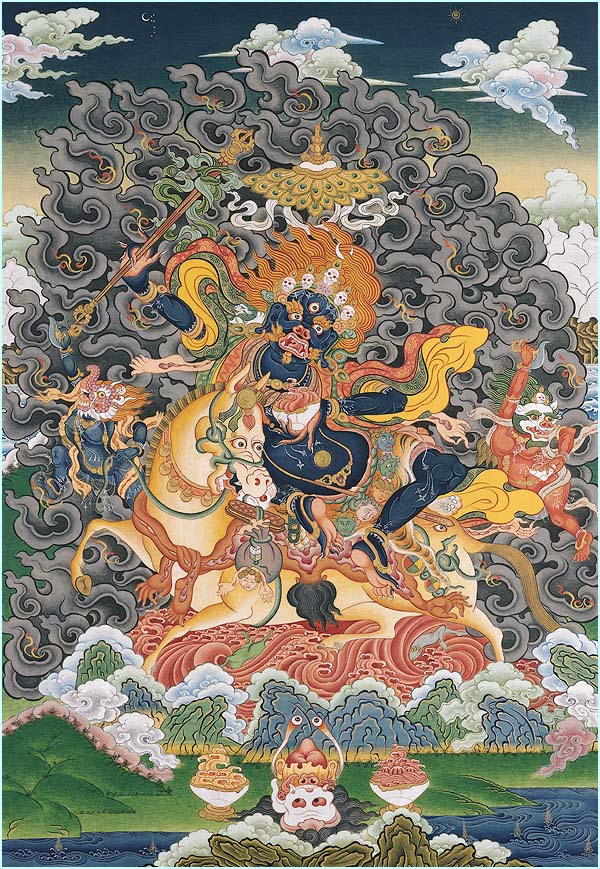
Full image of Tibetan wrathful deity seen above

Mali: a tale of two tweets

Tuesday, July 3rd, 2012

[ by Charles Cameron — Timbuctu, Bamiyan, iconoclasm, dissolution of the monasteries, conceptual mapping, ethics, aesthetics, Venice ]
.

credit: Alidade, see below


.

Zen called the Ansar al-Din “The Taliban of the Mahgreb” today, pointing to an article on the destruction of the Bamiyan Buddhas, and that’s an equation of a sort: destruction of the Sufi shrines in Mali compares with and in some ways equates to destruction of the Buddhas of Bamiyan.

The similarity lies in the destruction by Islamic zealots of images considered idolatrous — and as Curtis reminded us, a Chritian expression of the same concept also motivated the Iconoclastic movement in Orthodoxy.

To some extent, the dissolution of the monasteries in Henry‘s England under Thomas Cromwell carries a similar resonance.

Which brings me to two tweets I received in my Twitterfeed today.

**

Here’s Tweet Number One, as Dr Seuss might have said:

And Tweet Number Two:

**

Between the two of them, and with an eye to Zen’s remark, I get the idea that there’s a style of mental mapping that I can just about see out of the corner of my eye — a mapping that would interest me if I could figure out more about how to take it from being implicit and verbal and make it graphical and visible.

In this mapping, we would lay out the manner in which things presumed equal are treated differently.

I suspect the mapping might initially look something like the graphic at the head of this post — which I’ve borrowed from the materials on an interesting “Co-Revolutionary War Game” devised by Alidade in 2003 or thereabouts.

**

Arguably the publication of blasphemous cartoons of the Prophet upsets many Muslims more than does the destruction of Sufi shrines. Likewise, the publication of Salman Rushdie‘s Satanic Verses upsets many Muslims more than does the fatwa calling for Rushdie’s death. The burning of Qur’ans seems to upset many Afghans more than the deaths of nine Afghan children… And likewise, the loss of human lives in Mali seemingly pales in comparison to the loss of the Timbuctu shrines of saints in the eyes of the western press.

Throw in the Bamiyan Buddhas, and you have a first cluster of data-points that might be mapped in terms of public outrage — Christian, Buddhist, Muslim, cultural, political. the peaks and valleys will differ according to the perspectives chosen, and mapping the differences too would be of considerable interest.

**

The question has become something of a classic among ethicists, I believe: whether to rescue an unknown human child — who may if saved, as they say, grow into a Mao or a Michelangelo — or a great masterpiece of painting, if both are swirling past you in the same Venetian flood…

My instinct is with the child, but oh! — my temptation goes towards the painting…


Switch to our mobile site