zenpundit.com » judaism

Archive for the ‘judaism’ Category

Judaism, Islam and the death penalty

Sunday, August 12th, 2012

[ by Charles Cameron — surprising infrequency of capital punishment, though mandated in Sharia and Torah ]
.

I’m always struck by formal parallelisms, particularly in matters religious — so when I came across this fascinating reference to the infrequency of capital punishment by stoning in the Ottoman Empire in a book review today (upper panel):

I was immediately reminded of a similar Jewish reluctance to use capital punishment — stoning being one of the four choices — as recorded in Tractate Sanhedrin (lower panel)

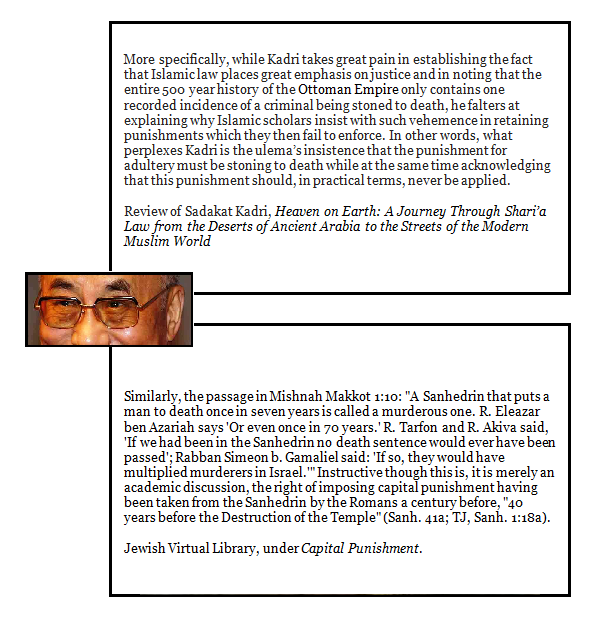
And i thought the Dalai Lama (inset) might like it too…

Of course, there’s more detail and nuance to be had in each case, but the parallelism is nevertheless instructive.

Sources:

Review of Kadri in Pakistan’s Express Tribune
Jewish Virtual Library, Capital Punishment

On a personal note, highly subjective: you gotta love R. Akiva — but you gotta respect R. Simeon, too.

As usual, life is nuanced and — dare I say this? — “systems dynamic”.

Pew on the prevalence of Mahdism — take heed!

Sunday, August 12th, 2012

[ by Charles “told you so” Cameron — Pew figures for Mahdist expectation, also the Second Coming, Israel, and the potential influence of apocalyptic ideation on foreign policy ]
.
The World’s Muslims: Unity and Diversity, p. 65

.

I am Qualit, not Quant by nature, really much more interested in the workings of the imagination that in the aggregates of poll responses, so it’s a bit like pulling teeth for me to report on a Pew report — but in this case I can legitimately say “I told you so”, which massively outweighs the reluctance I might otherwise feel…

**

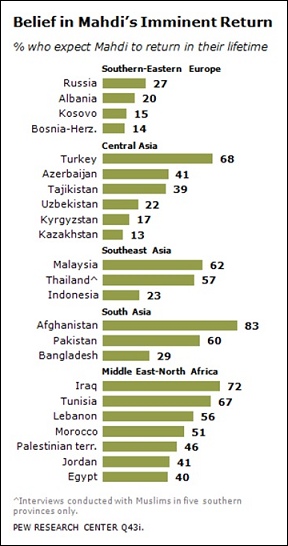
Recently, Pew has been including questions about the expectation of the Mahdi in some of its reports, and even Tim Furnish — who wrote the book on Mahdist movements and has long been saying we neglect them at our peril — even Tim was surprised at how widespread Mahdist expectation is, as reported in their just released The World’s Muslims: Unity and Diversity. In a post aptly titled Don’t Leave a Live (or Occulted) Mahdi Out of Your Calculations, Tim says the report contains “The most notable — indeed, strikingly important — news” in the form of “fascinating — and disturbing — data on belief in the Mahdi’s imminent (in one’s lifetime) return.”

See graphic above.

I recommend you read Tim’s analysis for the full range of his points — I won’t, for instance, be touching on what he says about Turkey — here I am going to select a couple of his key issues, and make just a point or two of my own.

**

Furnish:

Of the 23 countries whose Muslim citizens were polled, nine have majorities which expect the Mahdi in their lifetimes, with the overall average percentage at 41.8% … it is safe to extrapolate this percentage to Islam as a whole; ergo, 42% of 1.6 billion = 672 million Muslims who believe in the Mahdi’s imminent return! This is FAR greater than I had supposed.

Furnish also notes that Iran, the world’s most intensely Shi’ite nation and the one whose President has been speaking openly of Mahdist expectation, is not even included among the 23 countries Pew sampled.

Simply put, we have been blind to a very real phenomenon, and now we have a statistical alarm call to wake us up.

More subtly: there’s a difference between answering yes to the question “do you expect the Coming of X in your lifetime” and being on the edge of your seat, viewing every week as threshhold. Damian Thompson is very good on this in his book, Waiting for the Antichrist, and Stephen O’Leary in Arguing the Apocalypse suggests there’s an optimal “arousal” period — if you believe the Coming is too far away, you won’t be motivated to prepare for it quite yet, and if it’s too close it may be too late for you to do much to spread the word…

So, Pew — next time, ask a question with the opinions “in the next five to ten years” and “in my lifetime” — okay? The distinction is important, and a shift towards the shorter time-span would be highly significant.

**

Furnish again:

Despite the conventional wisdom (repeated even by Pew, in the face of their own data) that Mahdism is primarily the province of Shi`is, note that three of the four countries with the highest percentage expecting the Mahdi are majority-Sunni ones: Afghanistan (83%), Turkey (68%) and Tunisia (67%). This has ramifications, respectively, for: US policy in a country we are currently occupying; the only NATO Muslim-majority nation; and the vanguard state of the “Arab Spring.”

In his Conclusions, Furnish says:

The usual State/Defense departments’ “rational actor” approach to international relations might be quite simply irrelevant, if almost half the world’s Muslims expect the imminent return of their eschatological deliverer.

So there you have it. I discussed the “rational actor” versus Scott Atran‘s “devoted actor” in a recent post. And yes indeed, there are “ramifications for U.S. policy”…

Notably with regard to Afghanistan …

**

Here’s Furnish again:

Afghanistan is so rife with Islamic messianism because the 80% of the population that is Sunni and the 20% that is Shi`i (albeit Sevener/Isma’ili, as well as Twelver) both are in the middle of a war and occupation by a “Christian” power — which tends to ratchet up such expectations …

And again, in his Conclusions:

Afghanistan is a lost cause: over eight in ten of its people expect the Mahdi in their lifetime, and no amount of roads and clinics and girls’ schools built by the infidels will change that.

I don’t want to argue that second point in detail, although I think there’s a great deal more to life that Mahdist expectation for many who would answer “yes” to Pew’s question about expecting the Mahdi in one’s lifetime — see my comment on Damian’s book above. But how can I put it? A background Mahdist expectation can become a passionate involvement in a Mahdist movement if the right trigger comes along.

But what I find most striking here is that Afghanistan should be the country with the strongest Mahdist current out of all those Pew selected. And I’m struck not because Afghanistan has been a battlefield for so much of recent history — indeed, for so much of its history, period. I am struck because, in Al-Qaida’s recruitment narrative, supported by a number of ahadith, Afghanistan as Khorasan is the very locus from which the Mahdi’s victorious army will sweep out to conquer (finally) Jerusalem. And this too I have been posting about, eg in my discussions of Ali Soufan‘s The Black Banners and Syed Saleem Shahzad‘s Inside Al-Qaeda and the Taliban.

So the highest level of Mahdist expectation also happens to be found in an area with a potentially major role to play in an end times scenario…

**

There’s at least one earlier report in which Pew raised the question of Mahdist expectation — this time tied in with both the expectation of the Caliphate, and Christian hope of the Second Coming — their 2010 report Tolerance and Tension: Islam and Christianity in Sub-Saharan Africa.

Here, for instance, we learn:

Both Christians and Muslims believe they are living in a time that will undergo momentous religious events. For example, at least half of Christians in every country with large enough samples of Christians to analyze believe that Jesus will return to earth during their lifetime, including nearly seven-in-ten Christians in the Democratic Republic of the Congo (69%).

And at least half of Muslims in 10 of the 15 countries with large enough Muslim populations to analyze say they believe that the caliphate, the golden era of Islamic rule, will be re-established in their lifetime; this belief is most common among respondents in Mozambique (69%). And in 12 of these 15 countries, roughly six-in-ten or more Muslims believe in the return of the Mahdi, the guided one who will initiate the final period before the day of resurrection and judgment, though the survey did not ask respondents whether they expect this to occur during their lifetime.

And here is the relevant data on sub-Saharan Mahdist belief. In Q51 of this poll, Muslims were asked whether they believe “in the return of the Mahdi, the guided one who will initiate the final period before the Day of Resurrection and Judgment? Here’s the table of responses:

Given the “religious fault line” of mixed conflict and amicable coexistence between Christians and Muslims running across Africa from (so to speak) Nigeria to Somalia, with Boko Haram and Al-Shabaab among the less delightful participants, keeping an eye out for signs of Mahdist “semiotic arousal” would be important here, too.

**

And “semiotic arousal” — that reminds me. Richard Landes, who coined the term, has the definitive, encyclopedic book out about all the many forms of apocalyptic, and why they’re important: Heaven on Earth: The Varieties of the Millennial Experience Essential reading, if you ask me, on a hugely neglected and no less critically important subject.

**

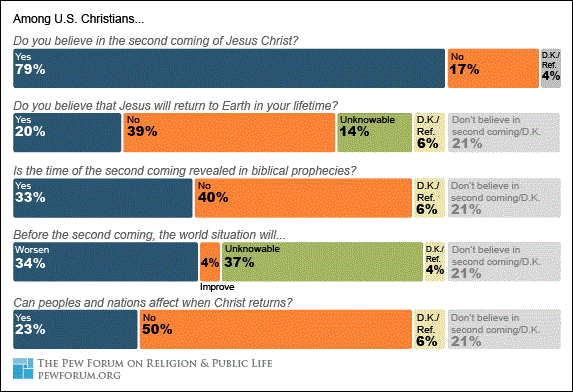
Finally, here’s yet another Pew graphic

— to be viewed in conjunction with this one, illustrating the ways in which belief in the Second Coming of Christ correlate with opinions about scriptures and the State of Israel:
**

Prophecy has impact, both on public opinion and on believing leaders. Jews with an expectation of the Messianic era, Christians expecting the soon Coming of Christ, and Muslims with Mahdist expectations each have their own apocalyptic scenarios, and in each case those scenarios exert some influence on policies relating to the Middle East and the Israeli-Palestinian situation in particular.

The bottom line?

Scriptural interpretation — and prophetic eschatology in particular — can no longer be assumed to be a quiet backwater topic for rabbinic students, seminarians and future mullahs to study, each in terms of their own tradition. It is now a series of conflicting drivers of current affairs — of war and peace.
The most contested piece of real-estate on earth

Friday, July 27th, 2012

[ by Charles Cameron — Jerusalem and apocalyptic sentiment, not at the emergency crash warning level, but still something to keep an eye out for ]
.


.

If you’re interested, as I am, in the ways that end-times theology impacts geopolitics, whether in its Christian, Judaic or Islamic (Sunni or Shi’ite) formulations, then two recent articles in Ha’aretz deserve your attention.

**

The first, published July 27, has Ari Shavit interviewing Gov. Mitt Romney on behalf of Ha’aretz, and asking the following question:

Governor Romney, you’ll be arriving in Jerusalem on Saturday night, on the eve of the day on which we commemorate the destruction of the First and Second Temples. Many Israelis feel that the fate of the ‘Third Temple’ relies on its strong bond with a strong America. Can you assure them that should you be president, you will reverse the trend of American decline? Can you guarantee that both America, and Israel’s bond with America, will be strong once again?

Gov. Romney does not speak to the Third Temple issue in his response, though the rest of the interview will no doubt interest those with a focus on foreign policy – and policy with regard to a nuclear Iran in particular.

**

The second Ha’aretz piece, posted almost a month earlier, gives some context on why the issue of the Third Temple is important – it is part and parcel of Jewish messianic prophecy. The problem here is that the rebuilding of the Temple would presumably take place on the site that’s currently considered the third holiest in Islam – the plateau that Muslims term the Noble Sanctuary and Jews the Temple Mount.

And that could mean trouble:

In 1990, after Muslims became concerned that the Temple Mount Faithful would come to lay the cornerstone for the Third Temple – as they had several times in the past – the muezzin of the Al-Aqsa Mosque on the mount called on the thousands of worshippers there to defend the site against such a move. This led to what became known as the Temple Mount riots, in which 17 Palestinians were killed and several Jewish worshippers at the Western Wall were injured. The riots led to a serious toughening of the police stance regarding the Temple Mount, but it did not stop attempts by the various right-wing organizations to restore a full Jewish presence there.

**

As the navel is set in the centre of the human body,
so is the land of Israel the navel of the world…
situated in the centre of the world,
and Jerusalem in the centre of the land of Israel,
and the sanctuary in the centre of Jerusalem,
and the holy place in the centre of the sanctuary,
and the ark in the centre of the holy place,
and the foundation stone before the holy place,
because from it the world was founded.

— Midrash Tanchuma, Qedoshim.

Tisha B’Av, the day on which Jews mourn the destruction of the First and Second Temples, begins in the evening of Saturday, July 28 this year, and ends in the evening of Sunday, July 29.

**

Gershom Gorenberg calls the plateau “the most contested piece of real-estate on earth” — and his book The End of Days is the definitive text exploring the different apocalyptic expectations asspociated with it in the three Abrahamic religions.

In it, he notes that according to one Jewish source, the fight between Cain and Abel arose over a dispute as to which of them had the better claim to the Temple Mount.

It’s an abomination!

Saturday, July 21st, 2012

[ by Charles Cameron — the perils of adding scriptures to scripture, tearing or burning them — and flags, paper money too ]
.


.

It may be that the last time you used the word abominable it was in relation to a snowman. It’s not a word that’s frequently on my tongue, I have to admit, but an Israeli MK apparently used it — or it’s Hebrew equivalent — to describe the New Testament, which he was in the process of ripping up.
.


.

Shades of Pastor Jones burning a copy of the Quran!

**

The thing is, when you have a sacred scripture it’s delimited, it’s hands-off! And if someone else comes along and adds a slim volume or two, it’s an abomination, almost by definition, sight unseen.

Thus the New Testament is an abomination to Knesset member Michael Ben Ari, according to YNet:

“This abominable book (the New Testament) galvanized the murder of millions of Jews during the Inquisition and during auto da fe instances,” Ben Ari said adding that “Sending the book to MK’s is a provocation. There is no doubt that this book and all it represents belongs in the garbage can of history.”

And please note, I am definitely not suggesting that Ben Ari is representative of all Jews — nor, for that matter, Pastor J. Grant Swank of all Christians. Yet from Swank’s perspective, the Tanakh and New Testament are scriptures, but, and I’m quote him:

Obama’s so-called holy writ is the abominable Koran.

The Qur’an is a later scripture, neh?

And Swank’s tirade gets better. Still speaking of the President of the United States, he continues:

His hope for eternity is unknown; but if he becomes a suicide bomber for Allah, he will be guaranteed pronto a score of virgins for everlasting. His hope for the present seems to be his reliance upon Islam’s Koran furthered by his clandestine support of Islam World Rule via czars and a shadow government given to overthrowing our Republic.

And then on the other side of the political aisle there’s Mitt Romney‘s Latter-day scripture, The Book of Mormon, which bills itself as Another Testament of Jesus Christ. It too has been considered an abomination.

I don’t know if people still use the word much when talking about the Book of Mormon, it’s considerably less controversial these days than the Qur’an — but abominable was what Arthur Cleveland Coxe called it in his 1855 Sermons on doctrine and duty, writing of Joseph Smith:

an obscure and illiterate individual, in our great West, was busily forging the abominable “Book of Mormon,” which, fourteen months later, he foisted into the world…

People really don’t like other people making add-ons to their scriptures, do they?

**

Scriptures — and flags.

Look, I weep for a religion some of whose adherents kill when their scripture is burned or defiled, and I am glad for a religion that condemns such killings. As you might expect, there are tearers and burners in all three Abrahamic religions, and all three religions have those who object to such tearings and burnings.

And yes, the ratios of religiously-provoked modes of destruction vary across religions and across centuries…

**

But what of flags?

I raise the issue because a fellow in Pakistan who manufactures flags for burning, Mamoon-ur-Rasheed, was in the news recently, and made this point:

Isn’t flag burning positive, compared to American atrocities? And also compared to the Taliban? We’re not attacking mosques. … We’re not targeting American embassies. We’re not killing anyone. Nor are we flying drones around, we’re just burning flags, mere pieces of cloth, and then we’re done. It’s over.

Setting aside Rasheed’s political opinion, Matthew Wallin at American Security Project asks the right questions in the security context:

Is it really over after the deed is done? Does anger against the United States dissipate? What do people do after they have gone home after a flag burning?

A key question to answer is: how much of these protests are translating into actual violence? This is an element that must be understood to determine if flag burning is simply a form of protest, or if those involved are planning more sinister actions. We must also seek to understand to what degree these protests endanger traditional diplomacy efforts and the challenges faced by members of the Pakistani government attempting to pursue diplomatic cooperation with the United States. If they are harmless expressions of anger and frustration, we have an obligation to understand this.

But that’s really just the beginning of a much wider-ranging discussion, philosophically speaking, which Rasheed’s comments also address:

what’s the relation of a symbolic object to the reality is symbolizes? If a flag is hurt, does it hurt the United States? If a Bible is burned, does it hurt Christianity? God?

If the word “spider” was an actual, live spider, arachnophobes couldn’t read the rest of this sentence… Is Picasso’s signature on a two dollar check worth as much as his signature on a check for a thousand bucks? Come to that, when paper money goes up in smoke when a house catches fire, where does the value go?

And yet, and yet, we are very attached to our flags, our scriptures — and our money.

**

The poet Coleridge in his Statesman’s Manual suggests:

On the other hand, a Symbol is characterized by a translucence of the Special in the Individual or of the General in the Especial or of the Universal in the General. Above all by the translucence of the Eternal through and in the Temporal. It always partakes of the Reality it renders intelligible; and while it enunciates the whole, abides itself as a living part in that Unity, of which it is the representative.

So. Do we find this translucence in our scriptures, in our flags, in our money, in our fellow humans — in the world around us?

Of the sacred, II: trees

Wednesday, July 4th, 2012

[ by Charles Cameron — more on magical worldviews: following hot on the heels of the curative power of saliva, a breathtakingly beautiful tale a wise man told me ]
.

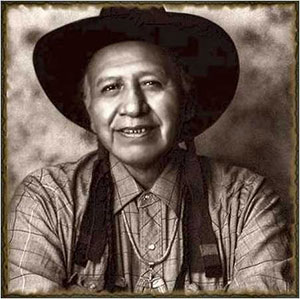
Wallace Black Elk


Look, you may detest saliva, saintly or otherwise, and I’d prefer not to leave you feeling queasy — so let’s follow the saintly saliva trail just a little further, and I think you’ll find it leads to something quite beautiful.

Susan Bayly continues:

Tamil Sufi texts often assert that the founding pir of a particular cult shrine identified his heir and successor by bequeathing him the twig which he used for tooth-cleaning. Such an object would naturally be impregnated with the saint’s saliva and would therefore serve to pass on the pir’s endowment of power and sanctity without involving him in an act of procreation.“ Fakiruddin is portrayed as having received a tooth-brushing twig as a token of spiritual succession from his murshid or preceptor, the Trichy pir Nathar Wali. According to the texts, it is this twig which grew up into the miraculous staff of the Nandi episode. The wooden staff also becomes imbued with the miraculous transforming barakat of the pir. …

Let’s forget saliva, let’s even forget neem-sticks, the organic Indian equivalent of the toothbrush — and consider the miraculous thorn tree that grows at Glastonbury:

After the crucifixion of Jesus lore has it that Joseph of Arimathea (who according to the Bible donated his own tomb for Christ’s interment after the Crucifixion) came to Britain, bearing the Holy Grail — the cup used by Christ at the Last Supper and later by Joseph to catch his blood at the crucifixion.

When Joseph landed on the island of Avalon, he set foot on Wearyall Hill — just below the Tor. Exhausted, he thrust his staff into the ground, and rested. By morning, his staff had taken root — leaving a strange oriental thorn bush – the sacred Glastonbury Thorn.

Lore has it that the thorn would bloom once a year, at Christmas.

**

But virtuous trees, like saintly saliva, can be found in more than one tradition. I had the privilege some while ago of spending a good deal of time in the company of the Lakota shaman, Wallace Black Elk, and would like to offer you one of his stories which I noted down pretty close to his own words.

I should perhaps preface this account by telling you that Wallace once told me he had twelve grandfathers — so the words grandpa and grandma don’t imply lineal descent here as they do in common usage, but function more as a term of respect for one’s elders:

I remember my grandfather, Black Elk. One time when I was very young, he came with my
grandfather Eagle Man to visit my grandmas in the tipi. My mother and my aunt were both young, so they let the old people visit together. “We’re good at cooking, so you just sit down and rest, and visit. We’ll look after the cooking.” And my father went off to take care of the horses, and to haul and chop wood, and left the old people to visit with each other.

That was the way it was. Everybody would eat a big meal, and some of those evenings my grandfathers would sit around telling ghost stories, spirit stories, and I’d listen. And while they were talking, they had a pipe. They would smoke the pipe and talk. So I was maybe seven years old, and I was sitting in the middle between grandma and grandpa, I used to sit there and listen, and watch them smoke the pipe.

My grandpa took the pipe-stem and planted it in the ground. He took a piece of charcoal and lit the fire, sprinkled some tobacco on it, and just puffed a little of that smoke. And that pipe-stem, you know, blossomed. Branches bloomed out of it, leaves bloomed out, and there’s a big red plum there. Red.

So my grandpa took the plum and gave it to his brother, and he ate it, and said: “Washtay, that’s really good.” And then he took the pipe and planted the pipe-stem, did the same thing, and put some tobacco over it, and that pipe-stem…that tree just bloomed, leaves just cropped out all over it, and there was a black cherry hanging there, it was a choke cherry. So my grandpa gave that choke cherry to his brother, and he ate it and blew the pit onto the ground. “Aah, very good.”

My grandmas were watching all this, and one of my grandmas picked up her moccasin and said, “Aaah, want some cherries, do you?” as if my grandpas were doing this to show their powers, and she was telling them, don’t do that! She threw her moccasin on the ground and an owl came up. It hopped around and flew in front of them, and started hooting whu whuwhuu, whu whuu.

My grandfathers looked at one another and said: “Hey, almost like our powers!” And they both started laughing, and that owl jumped down, and puffed itself up, and started hooting. So then my other grandma took her cane, she cried “Heeeeeee!” and threw it on the ground and it came out a rattlesnake. And it wasn’t just kind of a rattlesnake almost: boy, it really was a rattlesnake, and it coiled around the place. Boy, we bailed out.

Then my grandma reached over and took hold of that snake, and she took that cane and grabbed a hold of that owl by the neck, and pulled it back to her, and when it flopped down, when it landed, it was her sister’s moccasin, and she gave her sister her moccasin and put away her cane.

So that was my grandmas and grandpas. They had those powers, they knew that power was there. So I learned then there was a power in that pipe we hold, that the pipe could feed us. And he has been feeding us. There is no starvation, and we needn’t fear. That pipe represents the whole universe, and she can continue to multiply trees and plums and cherries.

That power of the Great Spirit is there, and those creatures can come from that pipe. Grandpa Great Spirit can do these things. From out of nowhere, he can do anything. I realized that.

A white man might think it was a bit of hocus pocus. Like a white man’s magician pulls a poor rabbit out of a hat, or a pigeon. But this is real. A tree comes up, and then it blooms, then it flowers, then it bears fruit. It’s a tree. And we are part of that tree. We absorb that fruit in our system, and we bear children, we bear fruit.

So that is an interpretation of the vision of the Tree of Life. That way my grandpa taught me.

**

Which reminds me (Exodus 7)…

And the LORD spake unto Moses and unto Aaron, saying, When Pharaoh shall speak unto you, saying, Shew a miracle for you: then thou shalt say unto Aaron, Take thy rod, and cast it before Pharaoh, and it shall become a serpent. And Moses and Aaron went in unto Pharaoh, and they did so as the LORD had commanded: and Aaron cast down his rod before Pharaoh, and before his servants, and it became a serpent. Then Pharaoh also called the wise men and the sorcerers: now the magicians of Egypt, they also did in like manner with their enchantments. For they cast down every man his rod, and they became serpents: but Aaron’s rod swallowed up their rods. And he hardened Pharaoh’s heart, that he hearkened not unto them; as the LORD had said.


Switch to our mobile site