zenpundit.com » sports

Archive for the ‘sports’ Category

Of dualities, contradictions and the nonduality

Thursday, June 27th, 2013

[ by Charles Cameron — on the basis, the mathematics, the essence of conflict and resolution ]
.


.

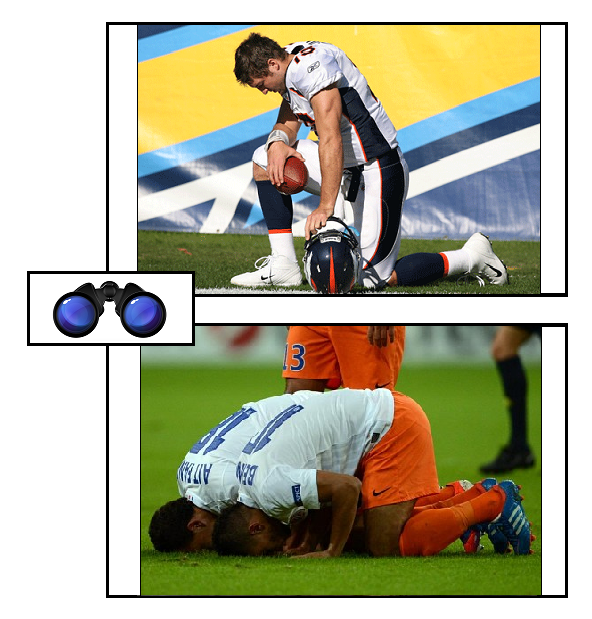
This DoubleQuote features two great masters on duality and the coincidentia oppositorum: the upper quote is Yogi Berra at his best, a koan worthy of a discourse by John Daido Loori, Roshi, while the lower image a still from Andrei Tarkovsky‘s first feature film, Ivan’s Childhood — which I stole from the ever-bountiful Gwarlingo.

Two is one and one is all and evermore shall be so.

**

Two into one won’t go, they told me in my schooldays — though not with nearly as much rigor as I presume is found in this article in Physics B

Questions of the two and the one are always of interest, because they are played out in the tensions we are faced with in daily life, and specifically in the tug of war with peace.

Thus, from my miscellaneous readings these past few days, they feature everywhere from a headline like Demonizing Edward Snowden: Which Side Are You On? in the New Yorker, who seem to feel that one should take a side, preferably the one with the least guns:

I’m with Snowden — not only for the reasons that Drake enumerated but also because of an old-fashioned and maybe naïve inkling that journalists are meant to stick up for the underdog and irritate the powerful. On its side, the Obama Administration has the courts, the intelligence services, Congress, the diplomatic service, much of the media, and most of the American public. Snowden’s got Greenwald, a woman from Wikileaks, and a dodgy travel document from Ecuador. Which side are you on?

to some relatively arcane areas of theological debate, in this case Fussing Over the 15th of Sha‘ban:

Question: Is marking out the 15th night of Sha’ban (laylat al-nisf min sha’ban) with extra prayers and devotion sanctioned by Islam, or is doing so judged to be a reprehensible innovation (bid’ah)?

Answer: Each year, a fair amount of fussing and fighting takes place over this issue. Yet the truth of the matter is that scholars have long-held this issue to be one over which there is a valid difference of opinion. The first group considered the night to have no specific virtues over and above any other night of the year, and believed that singling the night out for extra acts of worship is unsanctioned. Another group begged to differ and held that the middle night of Sha’ban does possess special merits and should be earmarked for extra prayers and devotion.

All those who hold the shari’ah to lack nuance and variety, incidentally, would do well to note (a) that it is far from exclusively devoted to the chopping off of hands or feet, and (b) combines within itself debates worthy of the Tannaim and Amoraim, or of the medieval scholastics of the Roman church…

**

By way of closure, here’s the koan from Alice in Wonderland that Loori Roshi studies in his discourse:

The caterpillar said, “One side will make you grow bigger, and the other side will make you grow smaller.” “One side of what? The other side of what?” thought Alice to herself. “Of the mushroom,” said the caterpillar. Alice looked at the mushroom, trying to make out which were the two sides of it, as it was perfectly round.

If you love your enemies [Matthew 5.44], Who’s side are you on?

And here’s what the great Cardinal Nicholas Cusanus had to say about dualities and opposites in his Of the Vision of God:

I have learned that the place wherein Thou art found unveiled is girt round with the coincidence of contradictories, and this is the wall of Paradise wherein Thou dost abide

Thy game be won?

Wednesday, February 27th, 2013

[ by Charles Cameron — a theology of little things, sports and wars included ]
.

Let’s start with Tim Tebow, and phrase the issue this post raises as a question:

**

The headline of a TMZ post, God Is Saving the Broncos … Says Colorado Pastor, clearly suggests that God takes sides in sporting events.

Pastor Wayne Hanson — who runs Summit Church in Castle Rock, CO where Tim’s dad often speaks — tells TMZ God is actively intervening in Denver Broncos football games … and aiding Tim on the field because of his strong faith.

Hanson tells us, “It’s not luck. Luck isn’t winning 6 games in a row. It’s favor. God’s favor.”

Pastor Hanson adds, “God has blessed his hard work.”

We asked Hanson if Tebow would be winning games if he wasn’t such a strong believer — and the pastor replied, “No, of course not.”

**

Tebow himself, if I’m reading my news correctly, realizes that his God might have as much to teach by having a sports team lose as by having it win, hence his prayer as quoted above — “no matter, win or lose…”

And that level of subtlety would also be present in the sports theology of Notre Dame, if (once again) I’m not mistaken:

The team is unapologetically Catholic. Before every game, the Fighting Irish participate in a Mass overseen by one of the team’s two appointed Catholic priests, a tradition dating back to the 1920s. At the end of that ceremony, each player receives a priest-blessed medal devoted to a Catholic saint—a different saint every game for four years. Also during the pregame Mass, players can kiss a reliquary containing two splinters that Notre Dame believes came from the cross of Jesus. “Most of the non-Catholic players are Christian, so when you tell them these splinters came from the actual cross of Jesus they are humbled to reverence,” Doyle says.

**

I appreciate that combination of prayer for what one hopes and surrender to what happens, it’s way less heavy handed than supposing you can gauge Divine Providence by the results at the end of a game — or a war.

One Huffington Post writer was moved to ask: If Tim Tebow Were Muslim, Would America Still Love Him?

That’s an interesting question, roughly analogous to “If Tim Tebow had a losing streak, would America still love him? And God?

And if God does routinely show preference for one team over another by granting them victory, what are we to make of these two examples?

**

It seems the universe scales quite happily from tens of billions of years (or more) to femtoseconds (or less), and from almost a hundred billion light years (or more) to the Planck length (and I’m not so sure about less) — and my own tiny worm of a lifeline has given me “experiences” of a car rolling over a center divider and landing upside down, some moments of breathtaking beauty, times of bordeom, rapid eruptions of anger, the rock of early electric Dylan and the Baroque of Bach’s Matthew Passion. And I have causally picked my nose, almost without knowing I was doing it.

Who’s to say a God, ground of being, Great Mystery Power, or simple unaided universe can’t “purposefully” do Big Bangs and enormous time lags while gasses and galaxies and solar systems are formed and dissolve, flashes of lightning, inspiration and insemination, reproductions sexual and asexual, lives long and short, painting by El Greco and Vermeer, horrible puns and ugly Oscar ceremonies, mu mesons and mitochondria, prayers answered, hung up on in disgust, or unheard on account of it’s the Lord’s Day of Rest — grasses, feedlots, cows, milk, beef, methane…?

Depending, of course, on your definition of “purposefully” — since the purpose may be no more and no less than the unfolding of what is.

Whatever it is (or isn’t) that encompasses all this, it’s in little things as surely as big ones — and thumb wrestling, too. So there you have it: my theology of little things.

Apocalypse Revisited, not for the last time

Tuesday, October 9th, 2012

[ by Charles Cameron — Tim Tebow and 666, Charlie Fuqua and stoning disobedient children — addenda to two recent posts ]
.

First, the more lighthearted news. Yesterday I featured three footballers prayingTim Tebow was one of them. Today: when prophecy fails on Twitter:
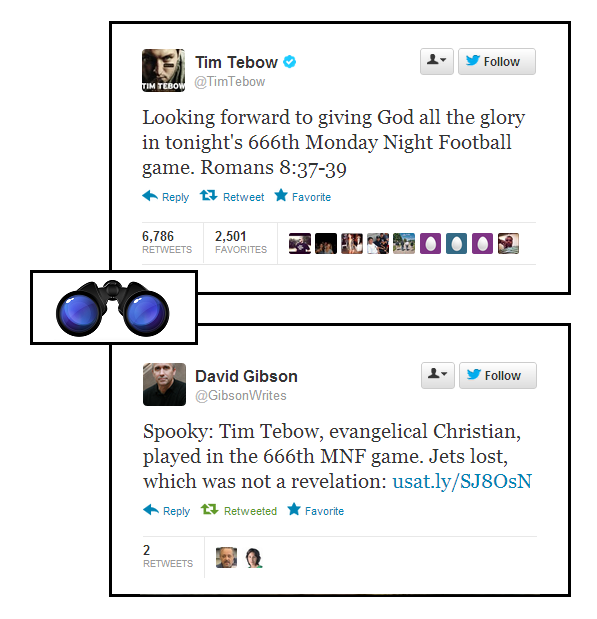
Just look at the retweets for Tebow: his tweet may have been half-tweet, half prediction, half-prayer, all in one forty characters, and his fans were behind it — yet the Jets lost.

At the time of writing, Tebow hasn’t tweeted for 24 hrs.

Permit me an aside, by way of clarification — as someone raised in the UK, I don’t know what “the Jets lost” means, to be honest. My Welsh ex once understood American Football while she was watching a game on hospital TV during a delivery — until the epidural wore off, at which point it went back to being incomprehensible. So that’s as close as I’ve come to understanding it myself — although I played both soccer and rugby in my schooldays.

**

Now onto more serious things. In a comment on another recent post, I mentioned Charlie Fuqua, a Republican candidate for the Arkansas House. I am beginning to think we should have a category to put after the names of such people, as in “candidate Charlie Fuqua (R-Ex)”, to indicate that many on their own team disavow their more extreme pronouncements.

In a post on his Running Chicken blog headed Today in inexplicable religious zealotry, Prof. Ari Kohen quotes the Arkansas Times on Charlie Fuqua, a Republican-side candidate for the Arkansas legislature:

Here’s the key passage from Fuqua’s 2012 book, “God’s Law: The Only Political Solution“:

The maintenance of civil order in society rests on the foundation of family discipline. Therefore, a child who disrespects his parents must be permanently removed from society in a way that gives an example to all other children of the importance of respect for parents. The death penalty for rebellious children is not something to be taken lightly. The guidelines for administering the death penalty to rebellious children are given in Deut 21:18-21:

Deuteronomy 21.18-21 reads:

If a man have a stubborn and rebellious son, which will not obey the voice of his father, or the voice of his mother, and that, when they have chastened him, will not hearken unto them: Then shall his father and his mother lay hold on him, and bring him out unto the elders of his city, and unto the gate of his place; And they shall say unto the elders of his city, This our son is stubborn and rebellious, he will not obey our voice; he is a glutton, and a drunkard. And all the men of his city shall stone him with stones, that he die: so shalt thou put evil away from among you; and all Israel shall hear, and fear.

The Arkansas Times continues:

Fuqua helpfully notes that “This passage does not give parents blanket authority to kill their children.” Rather, parents would have to “follow the proper procedure in order to have the death penalty executed against their children.” Fuqua assures the reader that, in his view, the procedure would “rarely be used.” The threat of death would, however, “be a tremendous incentive for children to give proper respect to their parents.”

**

Here’s where Prof. Kohen, Schlesinger Associate Professor of Political Science and Director of the Forsythe Family Program on Human Rights and Humanitarian Affairs at the University of Nebraska—Lincoln, adds his own informed scholarly input:

The trouble for Fuqua — and anyone else who thinks the Hebrew Bible provides a good template to follow in cases like these — is that he doesn’t actually have any idea what Jewish scholars and religious authorities have been thinking and writing about this particular passage for centuries:

In defining the extent and limitations of the laws of the ben sorer u-moreh, the Talmud (Sanhedrin 71a) states that the child is not considered liable until he has stolen his father’s property in order to acquire a tartimar of meat to eat, and a log of Italian wine to drink. The Halakha places further restrictions upon the ben sorer u-moreh so as to make the application of the law extremely unlikely, if not impossible. The rules only apply with the first three months after the child has reached halakhic manhood; both parents must be living and willing to press charges; neither parent can be deaf, lame, nor missing a limb; they must speak with the same voice and have the same appearance; the boy must steal the meat and wine from his father’s house, yet consume them elsewhere in the company of worthless individuals, in order for him to be convicted. According to the Tosefta Negaim, this law is not in effect in Yerushalayim. (The Meshekh Chokhma suggests that this is due to the continuous eating of so many sacrifices and offerings, as well as ma’aser sheni – the second tithe – within Jerusalem; consumption within the city, since it is performed for mitzva purposes, cannot be considered gluttony.) These are only a few of the numerous restrictions and limitations that apply before a boy can be judged as a ben sorer u-moreh, ensuring that the actual application of the law was extremely rare.

Several Talmudic opinions (Sanhedrin 71), having studied the above limitations, conclude that the case of the ben sorer u-moreh “never occurred and never will occur.” According to them, the sole purpose of having this section in the Torah is to learn the laws and provide a reward for those who do so.

So, in brief, here is my plea to people like Charlie Fuqua:

Stop cherry-picking the Torah to justify all of the terrible things you want people to do to one another; Jews don’t believe that things like this are mandated by the Torah and it’s our book.

**

I very much appreciate Prof. Kohen’s comments, which open a lively window not only on Judaic scripture, interpretation and practice, but also on how scriptures, their literal interpretations by outsiders, and the more skillful and adaptive interpretations of scholars within the traditions can function in the actual shaping of human lives…

When considering the scriptures of any religious tradition, we should bear such examples strongly in mind.

**

Indeed, I have only one qualification to make regarding Prof. Kohen’s post, and offer it as a small gift of thanks.

The one thing I can say that Fuqua is very likely not doing is cherry picking.

It is far more likely that he is a follower of the late RJ Rushdoony, whose massive work The Institutes of Christian Law advocates for the application of what he terms Biblical Law – in its entirety — to American society, and whose Chalcedon Institute published an article in its January 1999 issue on precisely this topic: Rev. William Einwechter‘s Stoning Disobedient Children?:

Deuteronomy 21:18-21 contains what is, perhaps, the most vilified law of the Old Testament. It is widely believed that this law authorizes the stoning of children who disobey their parents. … When this case law, which applies the moral law of the Fifth Commandment to a specific circumstance, is understood it will prove to be “holy, just, and good,” a delight to the heart of God’s true people (Rom. 7:12, 22).

This piece created a bit of a stir, and it was followed shortly thereafter by another Einwechter piece: Stoning Disobedient Children? Revisited.

Both articles seem to have proven unpopular enough that they have been removed from their respective original sites, so I am grateful that the Archive still has them as linked above. I recommend an acquaintance with Rushdoony’s work, and with essays such as these, to anyone interested in the influence of “Biblical Law” on contemporary politics.

**

By way of comparison, the Qur’an, like the Torah, stresses the importance of honoring one’s parents in close conjunction with that of having no god but God. Thus Qur’an 17:23 in the Shakir translation reads:

And your Lord has commanded that you shall not serve (any) but Him, and goodness to your parents. If either or both of them reach old age with you, say not to them (so much as) “Ugh” nor chide them, and speak to them a generous word.

— compare Exodus 20.3-5, 12 — while the hadith reported in Sahih Bukhari, Bk 48, Witness, #822 tells us:

Narrated Abu Bakra:

The Prophet said thrice, “Should I inform you out the greatest of the great sins?” They said, “Yes, O Allah’s Apostle!” He said, “To join others in worship with Allah and to be undutiful to one’s parents.” The Prophet then sat up after he had been reclining (on a pillow) and said, “And I warn you against giving a false witness, and he kept on saying that warning till we thought he would not stop.

To my knowledge, no specific (hudud) punishment for disobedient children is prescribed in the Qur’an.

At Play in the Fields of the Lord

Monday, October 8th, 2012

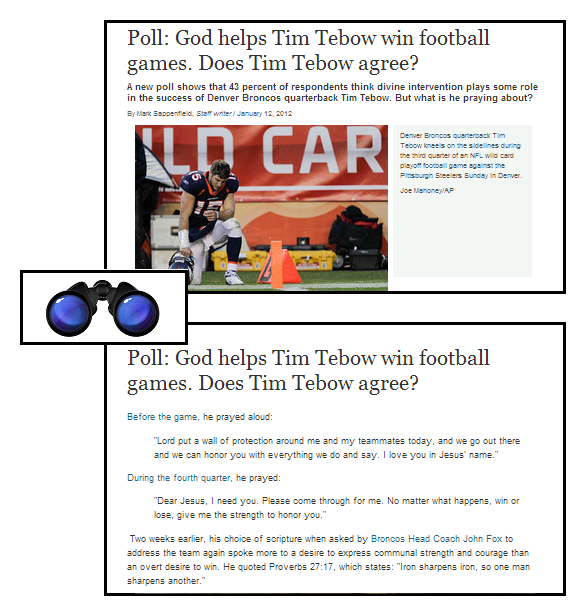
[ by Charles Cameron — two ways of playing football, two faiths ]
.

Image sources:

Tim Tebow: Urban Faith
Karim Ait-Fana and Younes Belhanda: Al Arabiya

The Olympic Truce

Sunday, July 29th, 2012

[ by Charles Cameron — the Truce, great gospel music, and athletes in ads in slomo — a personal view ]
.


.

If there are two things about the Olympics I like, they would be the Olympic Truce, and athletes in slow motion.

Here’s what the IOC’s site has to say about the Truce:

The tradition of the “Truce” or “Ekecheiria” was established in ancient Greece in the 9th century BC by the signature of a treaty between three kings. During the Truce period, the athletes, artists and their families, as well as ordinary pilgrims, could travel in total safety to participate in or attend the Olympic Games and return afterwards to their respective countries

and it’s relevance today:

Taking into account the global context in which sport and the Olympic Games exist, the International Olympic Committee (IOC) decided to revive the ancient concept of the Olympic Truce with the view to protecting, as far as possible, the interests of the athletes and sport in general, and to encourage searching for peaceful and diplomatic solutions to the conflicts around the world.

Through this global and symbolic concept, the IOC aims to :

  • mobilise youth for the promotion of the Olympic ideals;
  • use sport to establish contacts between communities in conflict; and
  • offer humanitarian support in countries at war ; and more generally :
  • to create a window of opportunities for dialogue and reconciliation.

**

To be honest, I don’t care in the least what human runs fastest or jumps highest, and if I did I wouldn’t have a huge investment in what territory he or she comes from or lives in.

The Games are the Games though, they affect people’s lives, and are affected by them. I have, here in my room, a copy of the official book of the 1936 Games which I picked up in a swap meet for a dollar or two:

American Olympic Committee Report, 1936, Games of the XIth Olympiad, Berlin

Somewhere, also, I have the official English playbook for the 1934 Oberammergau Passion Play — two stark reminders of how we are sometimes suborned from the better angels of our nature by the worse…

If I have a minute of silence, then, it is for the Israeli athletes killed at the 1972 Munich Games.

**

breath,
breath

**

Again, corporate sponsorships, banking industries and advertising are not generally among my favored interests, but slow motion is — and while I care little for the athletic record-setting and patriotic rivalrous sides of the Olympics, great athletes are often beautiful, something the Greek sculptors understood, and slomo can capture that beauty for us.

Besides, I have always been a fan of Morgan Freeman, ever since I heard him play the role of the Preacher opposite Clarence Fountain in Gospel at Colonus — undoubtedly the most joyous theatrical experience of my life…

Here to give you a taste is Freeman’s opening sermon:

and perhaps the most audacious musical moment of all, the great battle of the bands as Oedipus attempts to enter Colonus:

**

breath,
breath

**

Here, then, are three VISA ads for the Games this year, accompanied by that unmistakable Freeman voice, and offered here for the beauty, sheer joy and creative excellence they present.

First, the audience speaking to the heart of the athlete — itself a remarkable insight:

Second, the way running itself runs like a thread through the life of Lopez Lomong:

And third, the difference a hundredth of a second makes — and again, the roar of the crowd:

That last clip has Morgan Freeman saying:

A hundredth of a second – it’s faster than the blink of an eye, faster than a flash of lightning – and it was the difference between Michael Phelps winning eight gold medals instead of seven – a hundredth of a second – just think of the cheers if lightning strikes twice!

I know — that’s the speed thing, not the beauty thing. And I’m an ideas man — an aesthetic man, not an athletic man.

So I take my long jumps sideways, in the mind…

**

Wikipedia tells us:

US National Park Ranger Roy Sullivan has the record for being struck by lightning the most times. Sullivan was struck seven times during his 35-year career. He lost the nail on one of his big toes, and suffered multiple injuries to the rest of his body

Again I think of the poet Randall Jarrell, whom I quoted here not so long ago as saying:

A good poet is someone who manages, in a lifetime of standing out in thunderstorms, to be struck by lightning five or six times; a dozen or two dozen times and he is great.

Only the Muse knows what damage that does to the poet’s mind.

**

breath,
breath

**

To sum up:

If I were God — and friends, that’s not in nay way a risk we need to concern ourselves about, flat out impossible — I would be watching the Olympics in slomo from a dozen angles simultaneously, without commentators.

And I’d be praying everyone world-wide would take the Truce as seriously as the Games.


Switch to our mobile site