zenpundit.com » Islam

Archive for the ‘Islam’ Category

A metaphysical trigonometry

Wednesday, January 21st, 2015

[ by Charles Cameron — from [Inkling] Charles Williams via J’lem & Damascus to TS Eliot, iconology and the apophatic & cataphatic paths ]
.

The Second Coming: Orthodox icon and Turkish miniature

The Second Coming: Orthodox icon and Turkish miniature

**

The phrase “metaphysical trigonometry” is from Charles Williams, friend of Tolkien and Lewis, and is drawn from the opening paragraph of his book, The Descent of the Dove: A Short History of the Holy Spirit in the Church.

The beginning of Christendom, is, strictly, at a point out of time. A metphysical trigonometry finds it among the spiritual Secrets, at the meeting of two heavenward lines, one drawn from Bethany along the Ascent of the Messias, the other from Jerusalem against the Descent of the Paraclete. That measurement, the measurement of eternity in operation, of the bright cloud and the rushing wind, is, in effect, theology.

**

Williams mentions Bethany, the geographic lift-off point for the Ascension of Christ — but where is his Second Coming to be witnessed?

Some Christian telecasters, literal-minded and consequently of the opinion that not only living eyes but even the eye of the camera will be able to capture the event, suggest the Mount of Olives:

Thus Christian Broadcasters’ Cameras Trained on Mount of Olives to Capture Christ’s Return:

Two of America’s biggest evangelical Christian broadcasters have stationed cameras on a hill overlooking Jerusalem, ready to cover the return of Jesus Christ from the Mount of Olives as predicted in the Bible, should any such event occur soon.

Texas-based Daystar Television Network was first to install a 24/7 camera from its terrace overlooking the Mount of Olives, and now Costa Mesa-based Trinity Broadcasting Network has bought the building next door, allowing it the same opportunity. The Mount of Olives, a mountain ridge east of Jerusalem, is rooted both in Jewish and Christian traditions, and is where Jesus is said to have preached to his disciples and later ascended to heaven, according to Acts chapter one.

**

I am hoping one of the Latter-day Saint friends of this blog will have more to say on LDS expectation, but have found this reference to Missouri as the site of the New Jerusalem — not quite the same as the place of the Second Coming, but certainly related to some extent:

Building of the New Jerusalem:

Near the time of the coming of Jesus Christ, the faithful Saints will build a righteous city, a city of God, called the New Jerusalem. Jesus Christ Himself will rule there. (See 3 Nephi 21:23–25; Moses 7:62–64; Articles of Faith 1:10.) The Lord said the city will be built in the state of Missouri in the United States (see D&C 84:2–3).

**

And in Islam, Damascus, and specifically the Umayyad mosque is the place of expectation, following the hadith reported in Muhammad Ata Ur-Rahim, Jesus: Prophet of Islam:

At that point, God will send the Messiah, son of Mary, and he will descend to the white minaret in the east of Damascus, wearing two garments dyed with saffron, placing his hands on the wings of two angels. When he lowers his head, beads of perspiration will fall from it, and when he raises his head, beads like pearls will scatter from it. Every disbeliever who smells his fragrance will die, and his breath will reach as far as he can see. He will search for the Dajjal until he finds him at the gate of Ludd (the biblical Lydda, now known as Lod), where he will kill him.

**

It has been argued that the thrust of Hinduism as of Buddhism is vertically upwards, towards transcendance of this world in moksha, liberation, whereas that of Christianity is downwards, towards immanence, in the Incarnation, indeed in what Henri Nouwen calls “downward mobility”.

In reality, however, the god Vishnu descends into human form in his avatars Narsingh, Rama, Krishna, Kalki — to play lila within creation, while the yogi’s path leads upowards to moksha — and the Christ who descends into time and human circumstance is also the ascended and eternal Christ whose celestial marriage feast is celebrated in each Eucharist…

In short, paths of both ascent and descent are to be found, as perhaps we might have learned from the story of Jacob’s Ladder (Genesis 28,12):

and behold a ladder set up on the earth, and the top of it reached to heaven: and behold the angels of God ascending and descending on it.

Or as TS Eliot puts it in Four Quartets, variously echoing Heraclitus, Dante, John of the Cross:

And the way up is the way down, the way forward is the way back.

and:

Shall I say it again? In order to arrive there,
To arrive where you are, to get from where you are not,
You must go by a way wherein there is no ecstasy.
In order to arrive at what you do not know
You must go by a way which is the way of ignorance.
In order to possess what you do not possess
You must go by the way of dispossession.
In order to arrive at what you are not
You must go through the way in which you are not.
And what you do not know is the only thing you know
And what you own is what you do not own
And where you are is where you are not.

**

Going a step further, Cleo McNelly Kearns writes:

The way down is the way of asceticism and abstraction, while the way up is the way of erotic experience, metaphor and imagination. The negative way seeks, through a process of progressive elimination of the partial, to attain a posture of complete humility and self-erasure before the void; the positive way calls for escalating degrees of recognition and self-affirmation proceeding from like to like to a place commensurate with contemplation of the whole. Likewise, the negative way, or way down, seeks to move the consciousness beyond the body and its images, while the affirmative way, or way up, seeks to move it more deeply into them.

The negative, apophatic way, avoids affirmative statements and images because they might be mistaken for idols and worshipped, while the affirmative, cataphatic way uses affirmations and images as icons and symbols through which the unseen may be glimpsed.

And we’re into a whole new areea of discourse.

Hipbonegamer on the Art of Future Warfare

Wednesday, January 21st, 2015

[ by Charles Cameron — writing in a very different mode this time — I’m chuffed ]
.

Today a quasi-science-fictional scenario I wrote for The Atlantic Council’s Art of Future Warfare proect was posted as a “featured entry” in their “Great War” war-art challenge. You may recall my commenting on the challenge in an earlier post, Art of Future War? August Cole, who is running the project, encouraged me in a comment to write up an entry for the challenge, which I did.

My entry begins like this:

Flashing across my sub-eyes and a few dozen others today, those tiny edge of vision thunderclouds that when my saccade leaps to them indicate increasing war chance – lit by a single bolt of miniscule lightning. As my transport turns itself into its parkplace, too far from the Ed’s for me to throat her a quick morning buzz, I flipvision up and “Temple” appears in yellow and red across the sub-world, and an accompanying jolt from the adrenals gets me out of the comfort of my now stationary pod, through visual check-in and up to my console where I can dig into deets.

I was the key-chooser of “Temple” for an accelerated, amplified and psychenhanced notification, having back in the day read Gorenberg on Temple Mount as the “most hotly contested piece of real estate on earth” – a phrase which haunts me still, since the clashing “end times” beliefs of the three relevant belief systems – all three messianic, one mahdist into the bargain – are undercurrents I track “out of the corner of my subs” on the principle that we shouldn’t overlook what seems vaguely irrational to us, when it’s passionately real to others. That way lies blindsiding, never a pleasant outcome.

In out-reality, which my in-reality strives to keep accurately mapped and understood — though that’s a clear impossibility in practice… in out-reality, then, attempts to wipe one holy place off another’s sacred site are standard fare in crisis sparks, have been since the Ayodhya riots, hey, maybe since Hagia Sophia became a mosque or the Mezquita in Cordoba sprouted a cathedral. I could go back into antiquity, if any of my throatees are interested.

And so on — you can read the whole thing on their site under the title News Enhancement In An Info Overloaded Age. I had me a great time writing this, and long time Zenpundit readers will recognize many familiar strands of my thinking, under cover of some fun futuristic jargon..

**

Overall project description:

The Atlantic Council’s Art of Future Warfare project is driven by the Scowcroft Center on International Security’s mandate to advance thinking and planning for the future of warfare. The project’s core mission is to cultivate a community of interest in works and ideas arising from the intersection of creativity and expectations about how emerging antagonists, disruptive technologies, and novel warfighting concepts may animate tomorrow’s conflicts.

The “Great War” challenge winning entry:

  • Nikolas Katsimpras, Coffee, Wi-Fi and the Moon
  • Other featured entries posted to date:

  • Ashley Henley, Dec. 8, 2041: Another Day of Infamy
  • Sydney J. Freedberg, Jr., Tallinn Is Burning
  • Matt Cavanaugh, Fear Paralyzes Pacific As Army Major Awaits Hearing
  • Saku, Pacific Plunged Into The Abyss!
  • **

    They’re inviting artist, writers and other creative thinkers to spin out ideas in the general direction of future preparedness — in their own way, approaching some of the same territory as the Office of Naval Research and Naval Postgraduate School‘s MMOWGLI (“Massive Multiplayer Online Wargame Leveraging the Internet”) — which Im also thinking about, and will probably dip my toes in..

    All of which is forcing me to think a whole lot about boxes and assumptions — how to recognize our assumptions and think outside our boxes — questions that are never too far from my mind in any case.

    Stay tuned, there’s more to come.

    Not Paris, much nearer home

    Sunday, January 18th, 2015

    [ by Charles Cameron — religious satire USA, plus two Charlie Hebdo resources ]
    .

    Jesus dinosaur detail 602

    **

    I hadn’t realized that comic book satire had entered the religion vs science debate — foolish of me, it’s an obvious medium for the task:

    jesus-and-darwin 602

    And here for total impact is the full page of Jesus riding the dinosaur (detail above), text included:

    jesusdinosaur large

    I have to say, neither these nor the Charlie Hebdo and Jyllands-Posten cartoons disturb me personally — but in our discussions of free speech and blasphemy, I think the voices of those who may be offended deserve a hearing.

    **

    Sources and Resources:

  • Popperfont, Did Jesus ride on a dinosaur?
  • Beliefnet, Jesus and Darwin fight
  • Daily Beast, 16 most ‘shocking’ Charlie Hebdo covers
  • Understanding Charlie Hebdo, Charlie Hebdo’s satire
  • Of morale, angels and Spartans

    Saturday, January 17th, 2015

    [ by Charles Cameron — how sky differs from heaven, and what that means for morale and jihad ]
    .

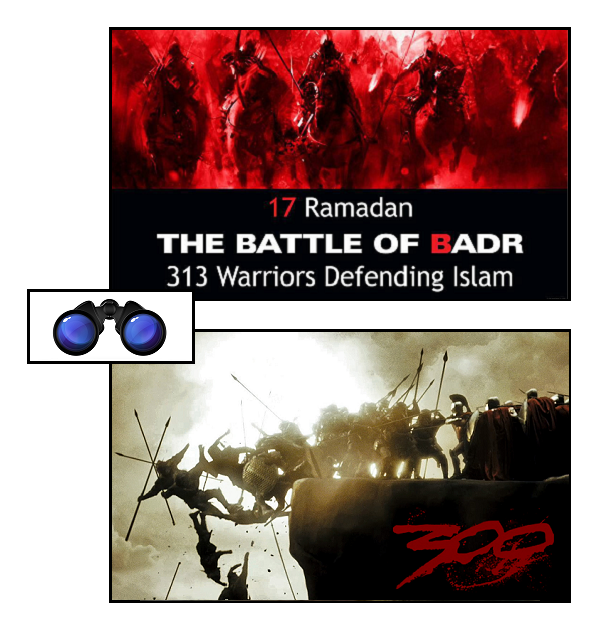
    SPEC Badr & Spartans

    **

    Okay, that Spartans / Battle of Badr DoubleQuote above is just a teaser, locating us in the general zone of morale..

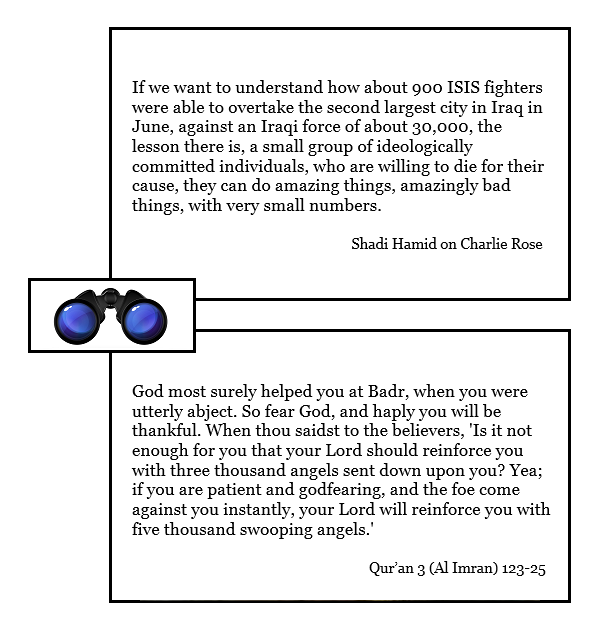
    What I’d really like to offer you here is another Badr-related DoubleQuote, of which the first part comes from Shadi Hamid, speaking about half way through the Charlie Rose show, A conversation about Islam and politics with Reza Aslan, Will McCants, Michael Hanna and Shadi Hamid, which aired on the 14th of this month (full video at the bottom of this post). He said:

    We have to take religion seriously, but I worry sometimes, if we focus too much on religion we forget that there’s a political context. That if we want to understand the rise of Isis we can’t understand that without looking at the political vacuum that emerged in Syria. That didn’t happen by itself; there’s a series of policy decisions from the international community that helped contribute to the rise of ISIS.

    So I guess the interesting question then is, How does religion interact with these political factors. So we have to bring those different variables into focus and I think we lose some of that, we lose that complexity if we’re just saying Islam is the problem. On the other hand, though .. these terrorists and extremists, they believe that what they’re doing, they’re going to be granted direct entry into Paradise, and that inspiration, motivation, is a very powerful thing that we shouldn’t underestimate. And ideology in this sense is a sort of force multiplier on the battlefield.

    All of that seems relevant to me, but it’s his next few phrases I want to DoubleQuote (upper panel, below):

    SPEC DQ Shadi Hamid & Quran

    And whereas Hamid’s explanation, as befits a Brookings Fellow refers to a belief about Paradise, the Qur’an, as befits sacred scripture, treats the world as though it is thronged not with beliefs but with angels..

    **

    The comparison and contrast between our conntemporary, post-Enlightenment view of “the sky” (in which birds, planes, helicopters, missiles and drones may be found, but no angels, jinn, apsarases or faeries) and that of the world’s various scriptural and mythological “heavens” (in which helicopters and parachutes are generally absent, though angels, demons, gandharvas, apsarases and the rest abound) is one that has long fascinated me — but the two are usually kept distinct. Albrecht Durer will show you angels and demons just above the rural countryside in “heaven” — but you won’t find them in military aviations journals..

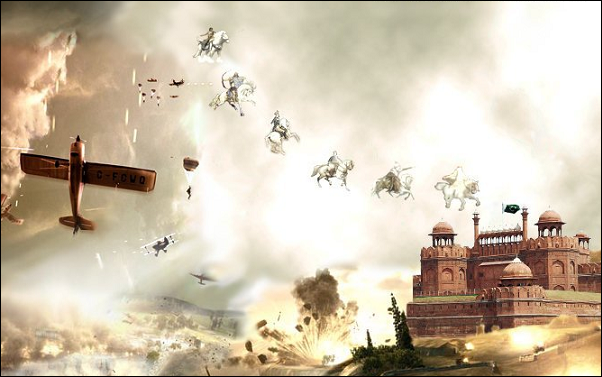
    It is against that background that I find this piece of artwork about the Ghazwa e-Hind so interesting — it appears to envision both “sky” with its various planes and parachutist (most of the planes a little dated, alas), and “heaven” with its celestial cavalry, occupying the same visual space:

    Great Ghazwa Sky meets Heaven

    **

    All this leads me to the question — which would seem to become ever more urgent as we move from textual to visually enhanced modes of communication —

    How does one graphically depict morale or esprit de corps?

    That’s my question for the day.

    ** ** **

    Here, for those who would like to view it in its entirety, is the Charlie Rose show from which Shadi Hamid’s quote above was taken:

    Sisi followup: two publications of significant interest

    Friday, January 16th, 2015

    [ by Charles Cameron — SH Nasr’s The Study Quran and the Diyanet collection of ahadith ]
    .

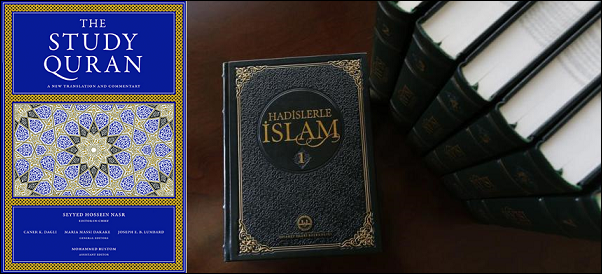
    Quran & Ahadith

    **

    In a recent post I quoted President Sisi‘s speech calling for “a revolution” in Islamic thinking about “that corpus of texts and ideas that we have sacralized over the centuries” and which is now “antagonizing the entire world”. I would like to bring your attenbtion here to two publications which may well provide support for such a rethinking: SH Nasr’s The Study Quran and the Diyanet collection of ahadith

    **

    The Study Quran:

    I have seen some of the proofs of this Quran, and it strikes me that once it is published (in Fall this year) it is likely to be the resource of record for anyone lacking in depth Arabic language skills and knowledge of Islamic thought across history. Superb, and very auspiciously timed.

    From their prospectus:

    In The Study Quran, renowned Islamic scholar Seyyed Hossein Nasr and a team of editors address the deeper spiritual meaning of the Quran, the grammar of difficult passages, legal and ritual teachings, ethics, theology, sacred history, and the place of various passages of the Quran in Muslim life.

    For the first time, both Muslims and scholars will have a clear and reliable resource for looking up the history of interpretation for any passage in the Quran—together with a new, accurate English translation.

    From the book itself:

    The Quran is the constant companion of Muslims in the journey of life. Its verses are the first sounds recited into the ear of the newborn child. It is recited during the marriage ceremony, and its verses are usually the last words that a Muslim hears upon the approach of death. In traditional Islamic society, the sound of the recitation of the Quran was ubiquitous, and it determined the space in which men and women lived their daily lives; this is still true to a large extent in many places even today. As for the Quran as a book, it is found in nearly every Muslim home and is carried or worn in various forms and sizes by men and women for protection as they go about their daily activities. In many parts of the Islamic world it is held up for one to pass under when beginning a journey, and there are still today traditional Islamic cities whose gates contain the Quran, under which everyone entering or exiting the city passes. The Quran is an ever present source of blessing or grace (barakah) deeply experienced by Muslims as permeating all of life.

    Inasmuch as the Quran is the central, sacred, revealed reality for Muslims, The Study Quran addresses it as such and does not limit it to a work of merely historical, social, or linguistic interest divorced from its sacred and revealed character. To this end, the focus of The Study Quran is on the Quran’s reception and interpretation within the Muslim intellectual and spiritual tradition, although this does not mean that Muslims are the only intended audience, since the work is meant to be of use to various scholars, teachers, students, and general readers. It is with this Book, whose recitation brings Muslims from Sumatra to Senegal to tears, and not simply with a text important for the study of Semitic philology or the social conditions of first/seventh-century Arabia, that this study deals.

    **

    The other publishing venture of great interest in this context is Turkey’s Diyanet project for a contemporary selected edition of the Hadith.

    Emran El-Badawi, co-director of the newly formed International Qur’anic Studies Association, told the Christian Science Monitor in 2013:

    Change is certain to come to the Islamic world, not just to the streets of Cairo or Istanbul but deep within Islam’s religious tradition as well. The Turkish Directorate of Religious Affairs, called the Diyanet, recognizes this with its seven-volume revision of the Hadith – which is the source of Sharia law and second only to the Quran.

    Thousands of the prophet’s sayings and traditions were circulated and eventually collected in the centuries after his death in 632. The sheer size of Hadith collections and their archaic 7th century Arabian context have made the texts too intractable for many Muslims today. This is the challenge which the six-year Turkish Hadith project, with its selections and interpretive essays, seeks to overcome.

    The central issue surrounding the Hadith, as with other foundational religious works such as the Bible, is whether it should be read literally or in a historical context and for its inspired message. A literal reading, for instance, may seek to justify medieval practices like severing the hands of thieves or allowing underage marriage. An inspired interpretation would see them as historical practices absent the kind of rule of law that democracies like Turkey have today.

    The question for Turkey’s new multi-volume set is whether its contemporary interpretations can be widely appreciated by the Islamic community, or whether they will be considered too avant-garde – the fate of previous modern interpretations.

    Elie Elhadj, in his post A Turkish Martin Luther: Can Hadith be Revised? on on Joshua Landis‘ Syria Comment blog wrote in 2010:

    The Indian Islamic thinker Muhammad Ashraf observed that it is curious that no caliph or companion found the need to collect and write down the Hadith traditions for more than two centuries after the death of the Prophet (Guillaume, Islam, 1990, 165). Ignaz Goldziher concludes “it is not surprising that, among the hotly debated controversial issues of Islam, whether political or doctrinal, there is none in which the champions of the various views are unable to cite a number of traditions, all equipped with imposing Isnads” (Goldziher, Muslim Studies, 1890, Vol. II., 44). John Burton observes, “the ascription of mutually irreconcilable sayings to several contemporaries of the Prophet, or of wholly incompatible declarations to one and the same contemporary, together strain the belief of the modern reader in the authenticity of the reports as a whole” (Burton, An introduction to the Hadith, 1994, xi).

    Leaders of Turkey’s Hadith project say successive generations have embellished the text, attributing their political aims to the Prophet Muhammad (BBC, February 26, 2008).

    And Tom Heneghan, Religion Editor for Reuters noted in 2013:

    The collection is the first by Turkey’s “Ankara School” of theologians who in recent decades have reread Islamic scriptures to extract their timeless religious message from the context of 7th-century Arab culture in which they arose.

    Unlike many traditional Muslim scholars, these theologians work in modern university faculties and many have studied abroad to learn how Christians analyse the Bible critically.

    They subscribe to what they call “conservative modernity,” a Sunni Islam true to the faith’s core doctrines but without the strictly literal views that ultra-orthodox Muslims have been promoting in other parts of the Islamic world.

    As to its likely influence, in Egypt and thus (I infer) on Sisi’s project, Heneghan offers this hint:

    “Among intellectuals in Egypt, there is a welcome for this new interpretation which they think is very important for the Arab world to be exposed to,” said Ibrahim Negm, advisor to Egypt’s grand mufti, the highest Islamic legal authority there.

    **

    I haven’t seen any reference as yet to the preparation of an English translation.


    Switch to our mobile site