zenpundit.com » will mccants

Archive for the ‘will mccants’ Category

Givenchy makes me think Pantone was right about tangerine

Sunday, March 22nd, 2015

[ by Charles Cameron — I know I like strange juxtapositions, but Jihadica and Givenchy? This is beyond! ]
.

The excellent Jihadica site continues to be hacked:

SPEC Jihadica Givenchy

First it was shoes — “Bottega Veneta mixes green paper and purple snakeskin and somehow, it works” — now it’s bags — “Givenchy makes me think that Pantone was right about tangerine”.

What’s next?

**

Sources:

  • Jihadica, salvatore ferragamo mens wallet | salvatore ferragamo shoes
  • Jihadica, ferragamo belt for men | ferragamo mens shoes
  • Jihadica, ferragamo belts on sale | salvatore ferragamo perfume
  • Purseblog, Givenchy makes me think that Pantone was right about tangerine
  • On fire

    Wednesday, February 4th, 2015

    [ by Charles Cameron — there’s rather more going on in the burning of the Jordanian pilot than I can handle — here are some of today’s relevant highlights ]
    .

    I’ll start and close with JM Berger, who has two of the wisest contextual comments of the day to offer us:

    That’s the context as I see it, though you’ll note that Tim Furnish differs, later in this post.

    **

    Two tweets give us Qur’anic justification for and against the use of fire in punishment:

    and:

    The Quranic verse Zaid Benjamin quotes is given in English in his tweet. The first seven verses of Sura 85, quoted by Will McCants, read in the Arberry translation:

    By heaven of the constellations, by the promised day, by the witness and the witnessed, slain were the Men of the Pit, the fire abounding in fuel, when they were seated over it and were themselves witnesses of what they did with the believers.

    I would really like to see a detailed scholarly post commenting on McCants’ reading of Qur’an 85.1-7, with or without notes on related ahadith and tafsir.

    **

    Two tweets offer ahadith related to the case:

    and:

    **

    Two from Tim Furnish:

    and:

    Here is Tim Furnish’s commentary, from MahdiWatch:

    ISIS gruesomely burned alive Jordanian Air Force officer Mu`adh al-Kasabeh not simply to horrify or intimidate, but rather in order to exact retribution for the “Crusaders” and their Coalition allies dropping bombs and launching missiles that consumed Muslims (especially, allegedly, children) in flames. The Islamic doctrine of shifa’ al-sudur (the name of the video, note) was derived from Sura al-Baqarah [II]:179 and its idea of “legal retribution” which is supposed to lead to reconciliation between Muslims once scores have been settled in like fashion—between, presumably, ISIS and the Muslim nations (Jordan, UAE, KSA, Kuwait, Qatar, Oman, Bahrain and Oman) named in the video as helping the “Crusaders.” So, in this mindset, al-Kasabeh had to burn–not simply be decapitated. Lex talionis according to Allah.

    ISIS also adduces a saying from the famous Sunni cleric Ibn Taymiyya (d. 1328) that desecrating bodies is allowable if it horrifies (unbelieving) enemies into ceasing their aggression against Muslims—or, in this case, against the Islamic State proper.

    So, just as with beheadings and enslavement of “pagan” women, ISIS is acting in a supremely, albeit brutally, atavistic Islamic fashion (not a nihilistic one, as the President keeps saying). Only when we admit that will we (Westerners and Muslims) be on the path to refuting and eradicating ISIS.

    **

    Mark Safranski, my gracious host and the publisher of this blog, refers us to the ICRC:

    Mr Orange suggests there have been previous burnings by ISI, the predecessor to IS / Daesh:

    It seems to me there’s room for plenty of research as between international lawyers and experts in the history of Islamic exegesis…

    **

    Three tweets regarding the Jordanian response:

    and:

    **

    Common sense: this, from Daveed Gartenstein-Ross:

    and John Horgan:

    in light of which, let me add by way of requiescat:

    **

    I’ll close as I began, with JM Berger:

    Let’s not feed the flames.

    The learning is looped

    Thursday, January 29th, 2015

    [ by Charles Cameron — Ts learn from CTs learn from Ts learn fro.. ]
    .

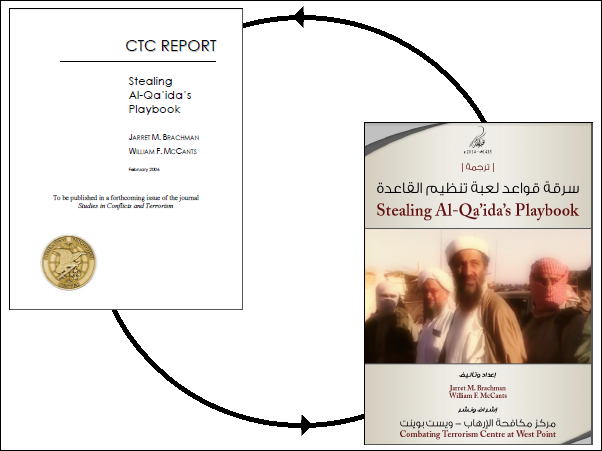
    DQ Stealing
    btw, this is a special format doublequote, yeah?

    **

    Brachman and McCants note in the conclusion to Stealing Al-Qa’ida’s Playbook:

    Jihadi ideologues closely follow Western thought and U.S. strategic planning for insights that can be used against the United States and its allies.

    and acknowledge their own borrowing, not only in the title, but also in the earliest pages of their work:

    Although we would like to claim credit for the approach described in the introductory paragraphs, it is modeled after a similar approach used by Abu Bakr Naji, a rising star in the jihadi movement. In his 2004 work, The Management of Barbarism,* Naji urges fellow jihadis to study Western works on management, military principles, political theory, and sociology in order to borrow strategies that have worked for Western governments and to discern their weaknesses.

    **

    And here’s Naji, in The Management of Savagery (which Will McCants translated) on borrowing from non-Muslim sources of military expertise:

    Wisdom is the goal of the believer, and even if we generally follow in the footsteps of the Prophet (may the peace and blessings of God be upon him) and his Companions (may God be pleased with them), we only accept that our policies in any jihadi action are Sharia policies, unless the Sharia permits us to use the plans and military principles of non-Muslims in which there is no sin.

    [ .. ]

    Following the time-tested principles of military combat will shorten for us the long years in which we might suffer the corrupting influences of rigidity and random behavior. Truly, abandoning random behavior and adopting intellectual, academic methods and experimental military principles and actually implementing them and applying military science will facilitate our achievement of the goals without complication and enable us to develop and improve the execution (of our plans), by the permission of God.

    **

    In practice, the loop is in fact a spiral, with each side learning, both on the battleield and on the mindfield, from the other.

    The Brachman / McCants paper was published in 2006. I only learned of the Arabic translation today. For those interested in OODA loop timing, that looks to be an almost decade-long time-lapse, eh?

    Or am I the slow one?

    Of morale, angels and Spartans

    Saturday, January 17th, 2015

    [ by Charles Cameron — how sky differs from heaven, and what that means for morale and jihad ]
    .

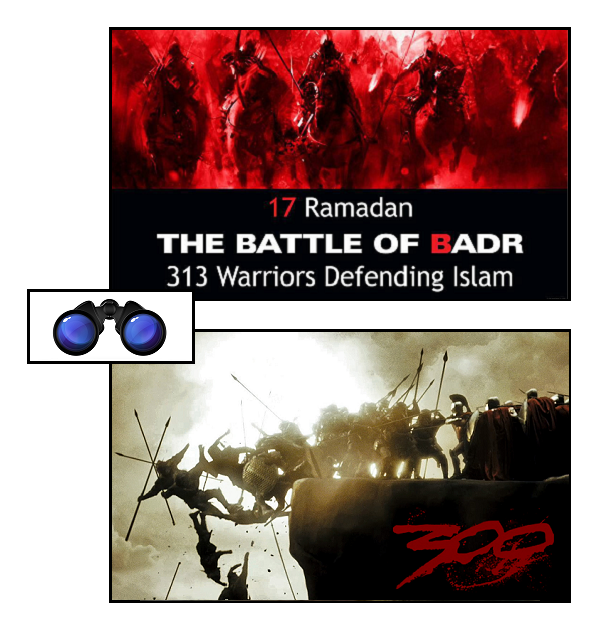
    SPEC Badr & Spartans

    **

    Okay, that Spartans / Battle of Badr DoubleQuote above is just a teaser, locating us in the general zone of morale..

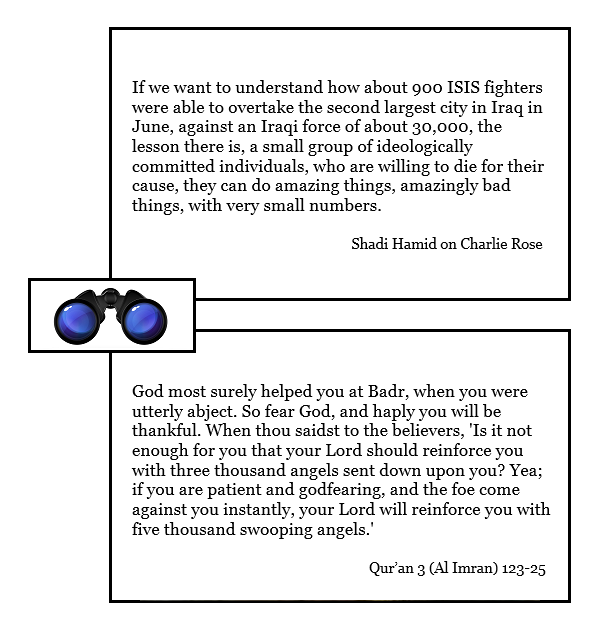
    What I’d really like to offer you here is another Badr-related DoubleQuote, of which the first part comes from Shadi Hamid, speaking about half way through the Charlie Rose show, A conversation about Islam and politics with Reza Aslan, Will McCants, Michael Hanna and Shadi Hamid, which aired on the 14th of this month (full video at the bottom of this post). He said:

    We have to take religion seriously, but I worry sometimes, if we focus too much on religion we forget that there’s a political context. That if we want to understand the rise of Isis we can’t understand that without looking at the political vacuum that emerged in Syria. That didn’t happen by itself; there’s a series of policy decisions from the international community that helped contribute to the rise of ISIS.

    So I guess the interesting question then is, How does religion interact with these political factors. So we have to bring those different variables into focus and I think we lose some of that, we lose that complexity if we’re just saying Islam is the problem. On the other hand, though .. these terrorists and extremists, they believe that what they’re doing, they’re going to be granted direct entry into Paradise, and that inspiration, motivation, is a very powerful thing that we shouldn’t underestimate. And ideology in this sense is a sort of force multiplier on the battlefield.

    All of that seems relevant to me, but it’s his next few phrases I want to DoubleQuote (upper panel, below):

    SPEC DQ Shadi Hamid & Quran

    And whereas Hamid’s explanation, as befits a Brookings Fellow refers to a belief about Paradise, the Qur’an, as befits sacred scripture, treats the world as though it is thronged not with beliefs but with angels..

    **

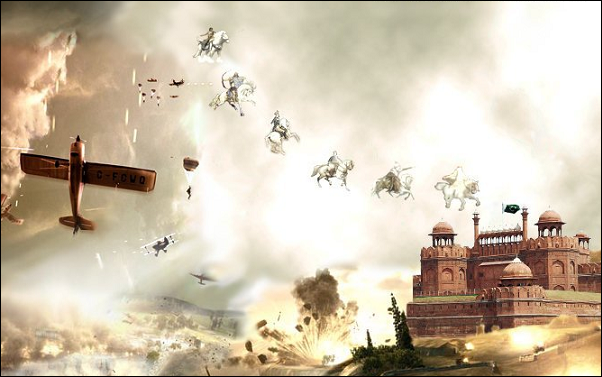
    The comparison and contrast between our conntemporary, post-Enlightenment view of “the sky” (in which birds, planes, helicopters, missiles and drones may be found, but no angels, jinn, apsarases or faeries) and that of the world’s various scriptural and mythological “heavens” (in which helicopters and parachutes are generally absent, though angels, demons, gandharvas, apsarases and the rest abound) is one that has long fascinated me — but the two are usually kept distinct. Albrecht Durer will show you angels and demons just above the rural countryside in “heaven” — but you won’t find them in military aviations journals..

    It is against that background that I find this piece of artwork about the Ghazwa e-Hind so interesting — it appears to envision both “sky” with its various planes and parachutist (most of the planes a little dated, alas), and “heaven” with its celestial cavalry, occupying the same visual space:

    Great Ghazwa Sky meets Heaven

    **

    All this leads me to the question — which would seem to become ever more urgent as we move from textual to visually enhanced modes of communication —

    How does one graphically depict morale or esprit de corps?

    That’s my question for the day.

    ** ** **

    Here, for those who would like to view it in its entirety, is the Charlie Rose show from which Shadi Hamid’s quote above was taken:

    Paris: best resources

    Wednesday, January 7th, 2015

    [ by Charles Cameron — where I’m finding clarity in the fog, and grateful for it ]
    .

    From my point of view, the most calm-headed and significant tweet thus far today must be Will McCants‘ offering of scholarly context:

    With any luck I’ll get back to this.

    **

    IMO, these tweets offer links to the two best resources thus far for thinking about the perpetrators:

    **

    Back soon.


    Switch to our mobile site