As you all know, I am fascinated by the intersection of the poetic (sacramental, irrational, magical, pre-scientific) and the prosaic (secular, rational, mundane, scientific) worldviews, so ably captured by John Donne with the four words “round earth’s imagin’d corners” in one of his Holy Sonnets:
At the round earth’s imagin’d corners, blow
Your trumpets, angels, and arise, arise
From death, you numberless infinities
Of souls, and to your scatter’d bodies go…
One such intersection comes where prophecy meets prediction.
**
I was accordingly interested when Erin Cunningham pointed us to these two remarkable tweets, the first from earlier today:
As Mubarak lands at the Maadi hospital I’ll just leave this 17 day old tweet here: https://t.co/WfaWoWSMuu
I believe that second tweet permits photographer David Degner the (secular) rank of Prophet — but it would take, in my view, an entity with the secular rank of Angel, Recording Angel to be precise, to give us an accurate and complete timeline of mental, communications and physical events here, from the first stirring of an idea in the mind of some Egyptian judge, general or staffer through multiple discussions, decisions and levels of implementation, to today’s outcome.
One might even say that the IC with its all source intel aspires to, but will never quite obtain, such an angelic function… while for those of us wholly reliant on open source intelligence, observation and intelligent extrapolation (in the case of Degner) and keeping one’s eye on appropriate parts of the twitterstream (for the rest of us) seems to be the way to go.
[ by Charles Cameron — further notes from the frayed edges of what’s significant ]
.
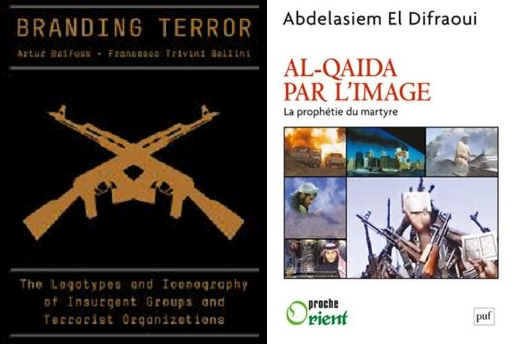
Okay, you all know I’m interested in the graphics of terrorism and their symbolism, and only a day or two ago I posted Of dualities, contradictions and the nonduality on the two into one phenomenon — well, here’s an addendum:
**
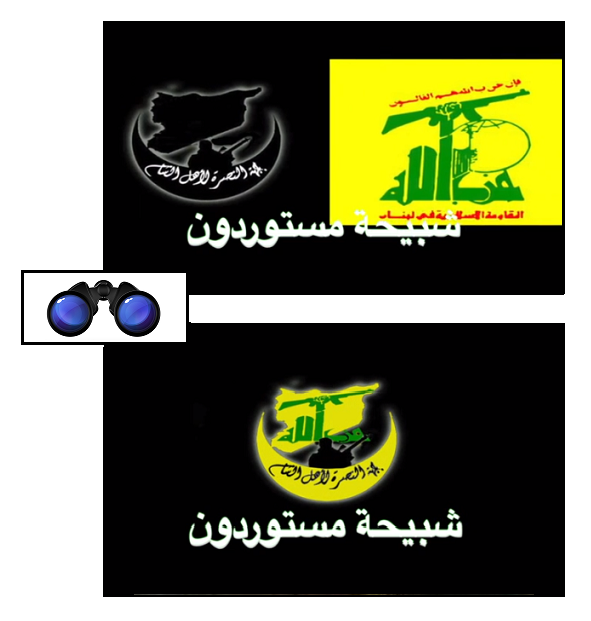
The upper image, showing the Jabha al-Nusra logo — Sunni, left — alongside the Hezbollah insignia — Shi’a, right — morphs into the single image in the lower panel, thereby resolving the sectarian conflict in Syria by filmic means.
The video from which these two shots were taken, alas, was the work product of the US Government, as part of an effort of outreach by the little-known Digital Outreach Team at the State Department, who at the time of writing appear to have 193 videos uploaded.
According to the Associated Press news agency, the 50-member Digital Outreach Team tweets, posts Facebook updates and uploads video to YouTube in Arabic, Punjabi, Somali and Urdu, in a bid to counter the radical jihadist message. It seems it’s even had exchanges with terror suspects such as US-born militant Omar Hammami, a former member of Somalia’s al-Shabab.
The team’s al-Zawahiri spoof opens with a notice that “fizzy drinks should be consumed while watching this production” – a twist on the usual message at the beginning of al-Qaeda videos saying “it is not permitted to add music to this production … Taking the classic preaching-to-camera format, the three-minute clip features a voiceover in which the Egyptian-born militant repeatedly bungles his speech by saying things like: “The butchers, ahem, sorry, I mean the mujahideen”. In the video – issued by the US State Department’s Digital Outreach Team – al-Zawahiri is backed by punkah-wallahs. The clip then cuts to a shot, as though from behind the speaker, to reveal a troupe of dancers performing in front of him.”
But see for yourselves, punkah-wallas and all:
For your further Sundance consideration, and from the same studios, you might also like the lowest and slowest nasheed ever recorded.
**
Speaking of graphics — coming up on ZP when I have had a chance to read a little more of El Difraoui, reviews of:
[ by Charles Cameron — possibility of Mahdist belief or sympathies on the part of one of the Boston bombers surfaces, with some details of the relevant video ]
.
I’m not alone in noticing this video [1, 2, 3], but I may have more interest in it than many others, because I believe Mahdism — and “end times” excitement in general — is a volatile conceptual additive and should be handled with considerable caution.
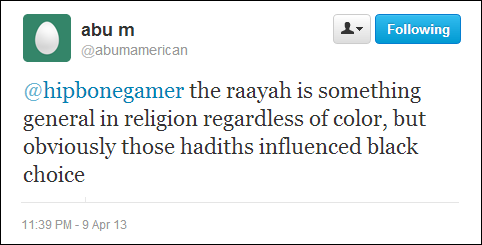
In particular, I would note that the “black banners of Khorasan” ahadith, cited in the video, have been widely used in AQ recruitment as reported by ex-FBI agent Ali Soufan and Syed Saleem Shahzad in their respective books [1, 2], although the ahadith are of probable Abbasid origin as suggested by David Cook [Contemporary Muslim Apocalyptic Literature, Chapter 8, Apocalyptic Predictions concerning Afghanistan and the Taliban, pp. 172 ff.] — and indeed, I’d recently asked the tweeting American mujahid Abu Mansoor Al-Amriki (Omar Hammami):
to which he’d responded:
[ I started to tweet occasional theological questions to Abu M after he instructed his followers to read Zenpundit, here and more emphatically here — I believe the post he was specifically referring to was this one ]
**
Okay.
This account of the Mahdist video would make a long post, and if you can watch the video and make out most of what it is saying in the title cards (intertitles) that form, along with the occasional voice over, the through-line of the movie, you won’t need most of the rest — I’m mostly going to offer transcriptions of those portions that aren’t too fuzzy for me to read.
Three things you might find worth noting, however, are:
the quotes from Imran Nazar Hosein, whom I’ve discussed before eg: 1, 2, 3, 4], starting in this section
the section on the supposedly Jewish origins of the Afghan people [which I discussed in some detail here], in part 2 of this post, and
the short clip from Mel Gibson‘s The Passion of the Christ which has been slipped into the video with dramatic effect, in part 3.
**
For those of you who feel like following along — and there’s plenty of detail of interest — I’ve broken the thing into parts, and my account of the video begins here…
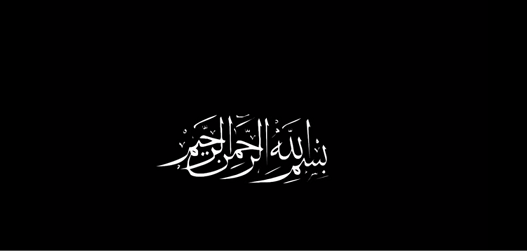
After the Bismillah:
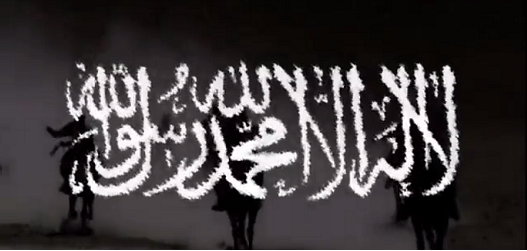
… followed by a card proclaiming it to be the work of T.R.U.E.E. Productions [00.07], the video begins with the “black banner” itself [00.21], in this form:
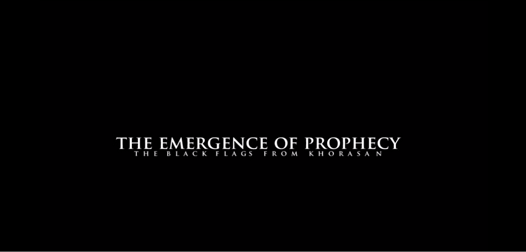
This serves as the opening title of the video, which is presented on YouTube and a minute into the video with the title “The Emergence of Prophecy: The Black Flags From Khorasan“. The banner fades slightly to show present-day horsemen, presumably from Afghanistan:
There are others — I’m thinking of Chris Anzalone and Aaron Zelin — who could tell you the origins of the various video clips and anasheed that are used throughout the video, but I’ll confine myself to the text cards and voice overs.
Over the last of the horsemen, the voice of Imran Nazar Hosein speaks [00.46]:
The prophet said, “When you see the black flags coming from the direction of Khorasan, go and join that army.” That army has already started its [march). They know it. And that’s why they demonize as a terrorist anyone, anyone who supports that army. They know it. And that’s why they demonize as a terrorist anyone, anyone who supports that army.
That’s the end of the Intro, after which the title in English appears [01.16]:
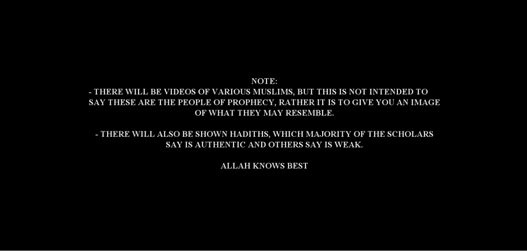
For a bit of flash and excitement, there’s a count-down [01.23 – 01.32] — we’re approaching zero hour, I’m guessing — and the first major text card shows up [01.38]. It is the first of several “notes”:
The caution exhibited here is interesting — someone doesn’t want to be caught out in an error by theologically more sophisticated viewers, hence the admission that some scholars view the black banners of Khorasan ahadith as weak… and the always welcome admission:
Allah knows best.
At [01.56] a hadith is introduced over black and white visuals of war by night:
I’ve magnified this one a little for easier reading [02.09]:
The citation in red is hard to make out, but I believe it references “Sunan Ibn Majah Hadith 971 Volume 3”.
The statement, “their weapon will be the weapon of Emaan (Faith)” is of interest, compare in the New Testament Ephesians 6.13-17 —
Wherefore take unto you the whole armour of God, that ye may be able to withstand in the evil day, and having done all, to stand. Stand therefore, having your loins girt about with truth, and having on the breastplate of righteousness; And your feet shod with the preparation of the gospel of peace; Above all, taking the shield of faith, wherewith ye shall be able to quench all the fiery darts of the wicked. And take the helmet of salvation, and the sword of the Spirit, which is the word of God.
as is the reference to the conquest of Constantinople “without materialistic weapons”. But all that’s fodder for another post on another day.
At [02.36] we get:
The text in red here — compare with the use of white and red print against a black background in the screen-grab by JM Berger from an As-Sahab Media video at the top of this post — reads fairly clearly:
Saheeh Muslim Book Hadith 2896, page 1904, volume 3
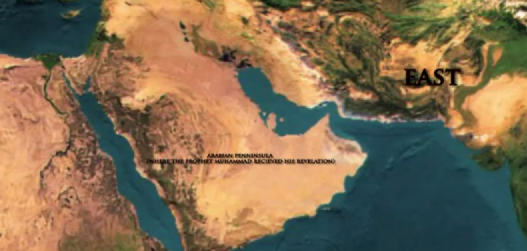
There’s a brief flash of the world map, then this map with its central text in small print and the word EAST quite large by comparison [02.54]:
That central text reads:
Arabian Penninsula
(Where the Prophet Muhammad received his Revelation)
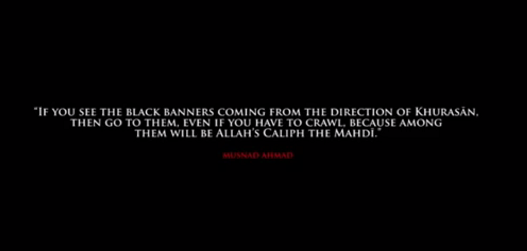
Next coes another hadith [02.59]:
Here the only reference is “Musnad Ahmad”.
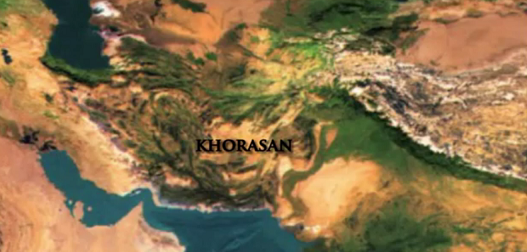
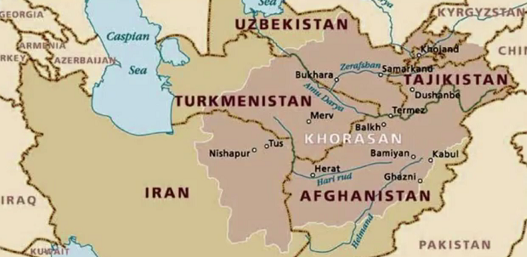
Then two maps identifying Khorasan [03.04 and 03.07]:
So that’s the set-up.
Things get pretty intriguing around here, as a question is posed as to the race or races of those who will follow the black banners, and the comments on Afghanistan and the Lost Tribes of Israel begin…
[ by Charles Cameron — expecting the unexpected — transcribing Bill Roggio on “something that everyone is overlooking” and Ambassador Haqqani on “one of the unwritten books it has been my desire to write” ]
.
I’ve talked about the “Black Banners” hadith and the Mahdi‘s victorious army marching from (roughly) Afghanistan to Jerusalem more than once, and perhaps less frequently, the other prong of the jihad, the Ghazwa-e-Hind, which flows from Pakistan into India. In the video that follows, Bill Roggio of the Long War Journal talks with Husain Haqqani, one-time Pakistani Ambassador to the US — and both have some striking things to say.
We pick up the conversation close to the end of the first half of a two-tape session at the Foundation for the Defense of Democracies — and I’ve provided a transcript after the video, for easier quotation and annotation.
**
BILL ROGGIO:
One of Al-Qaida’s propaganda since it took a beating in Iraq was, that they made the Khorasan, which is an old Islamic empire basically in central Asia and South Asia, they said that this is where we are going to beat them, and once we win in the Khorasan, we’re going to move towards the Levant. So this has become a key part of AQ’s propaganda. What do we think is going to happen when we lose in Afghanistan, when the second superpower loses? That is going to be a huge recruiting boom for foreign terrorists operating in Afghanistan. I think this is something that everyone is overlooking as we’re running for the doors in Afghanistan.
That’s a pretty powerful prediction, though prediction itself is a high risk enterprise. And it bears repeating that the Khorasan hadith is explicitly an “end times” prophecy. Ambassador Haqqani then doubles up on Bill Roggio’s concern, adding in the Ghazwa-e-Hind, which he describes as both “famous” and “the final, biggest war between good and evil and between Islam and kufr”…
A lot of people make fun of the Pakistani analyst and Youtube personality, Zaid Hamid, who seems to be the main public proponent of the Ghazwa — take a look here to see a wild sampler! — which is why I find Ambassador Haqqani’s response particularly impactful.
HUSAIN HAQQANI:
You know, there are days when I think I should have stayed in the scholarship business and written some of that stuff I was writing at that time. This was one of the things, even before Iraq, I had pointed out. For example, bin Laden had given a statement at that time about Americans being the new Mongols, and nobody could understand what he was talking about, and I said he’s talking about the 1258 conquest of Baghdad, and he’s playing on Islamic history and Islamic mythology.
And so Khorasan was an important element in that because, if you remember, the Abbasids rose to power through Khorasan, because that was an important element, they overthrew the Umayyads based on the argument that there is a hadith – which in my opinion is of relatively weak significance, but I am taking off my hat of a theologian since I never completed my religious training – but anyway, they used that, that there is a hadith, that the people from Khorasan will come and save the people of the Levant or whatever. And so that was used, and that was used again, and that has been part of the Al-Qaeda thing.
And then the other part is this famous Ghazwa-e-Hind, and the Pakistani groups use it – actually, just as jihad is the war, a holy war or war for religious purposes, ghazwa is a battle — and there is ostensibly a saying of prophet Muhammad that before the end times, the final, biggest war between good and evil and between Islam and kufr is going to take place in Hind, which is India, which is the land east of the river Indus.
So Khorasan takes care of what is today Afghanistan and some parts of central Asia, and all of that – it means a lot to people who believe in it, these end times prophecies etcetera. So one of the unwritten books it has been my desire to write, I wrote a piece on it once, an article I think, which said, that, you know, Americans pay a lot of attention to their own end time prophecies, but getting into that whole theater, they have totally neglected this.
And so far as recruitment is concerned I am totally agreeing with you, that failure in Afghanistan is going to be a big boon for both. The TTP — the Tehrik-i-Taliban Pakistan — and the Pakistani groups are going to start saying, Right, now is the time to start recruiting, and fighting in that famous Ghazwa-e-Hind –let’s get ready for that. And the Arab groups are going to say, Ah, salvation is coming by joining up with the folks who are fighting in Khorasan.
And both those fronts are going to be a source of a lot of problems.
Increased jihadist recruitment, and India as a second major front for the jihad — that’s quite a left lead and right cross combo…
**
Do you recall the opening of Aldous Huxley‘s final novel, Island?
“Attention,” a voice began to call, and it was as though an oboe had suddenly become articulate. “Attention,” it repeated in the same high, nasal monotone. “Attention.”
[ by Charles Cameron — the juxtaposition of sacred and secular worldviews, and what happens where they overlap ]
.
**
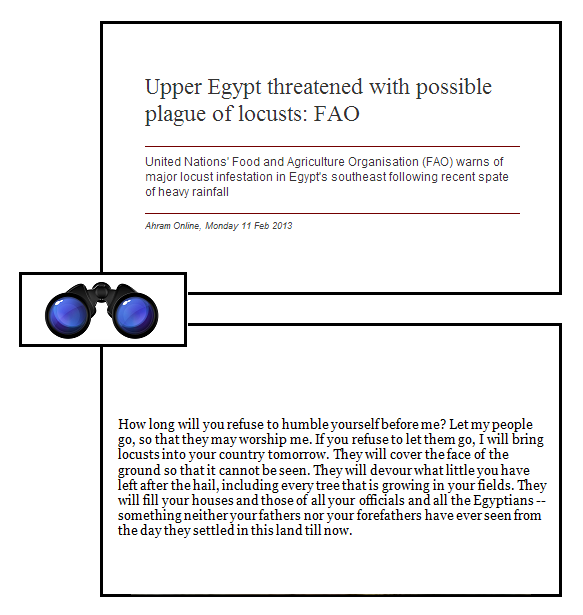
I’m returning here to an old theme of mine, the juxtaposition of worldviews — in this case, accounting for plagues of locusts in Egypt.
Such juxtapositions are like Rorschach blots in some ways — they allow each reader to see the items juxtaposed from within their own worldviews, perhaps applauding one and dismissing another, perhaps seeing some virtue in each or none in either — and perhaps arriving at some meta-level understanding which neither one alone would afford.
Is a plague of locusts in Upper Egypt of which the FAO warns in the upper panel above entirely explained in terms of rainfall? Is it pure mental happenstance that Egypt was the site of a Biblical locust plague at the time of the Israelite Exodus [Ex. 10. 3-6]? Is there, perhaps, a message for Egypt vis-a-vis Israel for our own day?
The answers people give to questions such as these, in which secular and sacred sources address what are putatively similar situations, can influence the way on which they voice themselves and vote — perhaps a good thing, perhaps not.
**
For what it’s worth, the plague of locusts is mentioned in the Qur’an in Sura 7.133:
So We let loose upon them [the Egyptians} the flood and the locusts, the lice and the frogs, the blood, distinct signs; but they waxed proud and were a sinful people.
The basic problem with fundamentalist interpretation of this kind is that, refusing to take into account the historical character of biblical revelation, it makes itself incapable of accepting the full truth of the incarnation itself. As regards relationships with God, fundamentalism seeks to escape any closeness of the divine and the human. It refuses to admit that the inspired word of God has been expressed in human language and that this word has been expressed, under divine inspiration, by human authors possessed of limited capacities and resources. For this reason, it tends to treat the biblical text as if it had been dictated word for word by the Spirit. It fails to recognize that the word of God has been formulated in language and expression conditioned by various periods. It pays no attention to the literary forms and to the human ways of thinking to be found in the biblical texts, many of which are the result of a process extending over long periods of time and bearing the mark of very diverse historical situations.
Zenpundit is a blog dedicated to exploring the intersections of foreign policy, history, military theory, national security,strategic thinking, futurism, cognition and a number of other esoteric pursuits.