Hard to believe that this was an amateur production. For film making, this is akin to what the first great blogs were to publishing, a tipping point moment toward mass amateurization:
I watched the full 40 minute film a few days ago on my computer at The Hunt for Gollumwebsite, it was impressive. Incidentally, the creators had permission from the Tolkien Estate to proceed as a non-profit venture and gave J.R.R. Tolkien’s vision, mostly culled from extant writings, notes and appendixes, a respectful treatment.
I recommend that you check out CounterStories, particularly readers interested in futurism, 5GW, IO and strategic thinking.
Edited by journalist, think tanker and long time blogfriend Paul Kretkowski, CounterStories develops scenarios for purposes of alternative analysis, counterintuitive thinking exercises, predictive futurism and good old fashioned fun. Scenarios are a very helpful complement to more quantitative futurist methodologies.
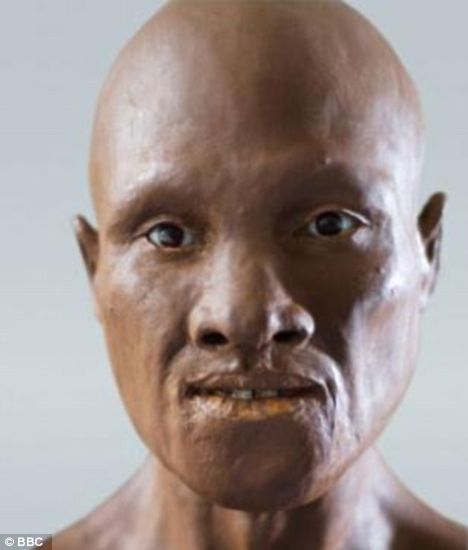
THE FIRST EUROPEAN – NOT ENTIRELY HOMO SAPIENS SAPIENS – 35,000 BC
A British forensic scientist, Dr. Richard Neaves, has recreated the head of one of the earliest modern human ( some differences in brain case and teeth) hunter-gathers from fossil remains, in the same manner of reconstructing the identity of homicide victims.
His recreation offers a tantalising glimpse into life before the dawn of civilisation. It also shows the close links between the first European settlers and their immediate African ancestors. To sculpt the head, Mr Neave called on his years of experience recreating the appearance of murder victims as well as using careful measurements of bone. It was made for the BBC2 series The Incredible Human Journey. This will follow the evolution of humans from the cradle of Africa to the waves of migrations that saw Homo sapiens colonise the globe.
….’Richard creates skulls of much more recent humans and he’s used to looking at differences between populations. ‘He said the skull doesn’t look European or Asian or African. It looks like a mixture of all of them. ‘That’s probably what you’d expect of someone among the earliest populations to come to Europe
As with the example of Kennewick Man, efforts at forensic paleo-anthropogy shatter modern racial assumptions regarding our earliest ancestors, regardless of whether those assumptions emanate from archaic stereotypes or modern PC ideology. Kennewick Man bore little or no resemblance to Amerinidian tribal groups that he long preceded, and Native American activists responded to the startling archaeological find by attempting to have the remains seized, scientific analysis of them banned and the site bulldozed. The “First European”in turn, looks nothing like the Aryan mythology of the Nazis or 19th century European racialist agitators. Instead, he appears somewhat like an Africanized Yul Brynner.
These reconstructions demolish our casual, self-referentially anachronistic, projections of our own demographic groups backward in time. We want to see ourselves in the people “back then” just like we wish to imagine that kind of continuity in a far-flung future. I’m dubous that we will look like “us” 100,00 or 250,00 years in the future and wonder if sucha peoplewill even acknowledge their kinship with us any more than we do with Homo Habilis.
….Bousquet opens with and ultimately answers the question of “does network-centric warfare (NCW) work?” To reach his conclusion, he proposes four “regimes” in the application of science to modern warfare:
Mechanism, whose “key technology” was the clock, whose scientific framework was Newtonian, and whose military format was what we’d call first generation warfare — line, column, conformance, regularity
Thermodynamics, characterized by engines, whose framework included entropy, energy, and probability, and whose military paradigm was 2GW (Bousquet does not use the generations of war model)
Cybernetics — computers — whose scientific concepts included “negentropy,” negative feedback, homeostasis and whose military model would be modern 2GW, with heavy top-down, real time command and control
Chaoplexity, where networks reign, whose framework is built upon the new sciences of non-linearity, complexity, chaos, and self-organization, and where warfare is conducted by decentralized cells, teams, or swarms — what we would call both 3GW and 4GW (p. 30)
Subsequent chapters take the reader on a tour of these ideas in turn, exploring their evolution as scientific patterns and their influence on the warfare of their, and subsequent, eras. So the chapter on mechanistic warfare introduces Vauban, close-order drill, and culminates in Frederick the Great’s Clockwork Army. The next chapter, Thermodynamic Warfare, concludes with Clausewitz, which is a stretch, of course, since the great Prussian died in 1831, some 20 years before the first publications in that discipline. But with liberal interpretation of the massive text of On War, passages can be found that seem like precursors of the Second Law. Bousquet does point out that these interpretations were not made in Clausewitz’s day but were retrofitted by later analysts and generals, including as he also notes, John Boyd.
Zenpundit is a blog dedicated to exploring the intersections of foreign policy, history, military theory, national security,strategic thinking, futurism, cognition and a number of other esoteric pursuits.

 of Africa to the waves of migrations that saw Homo sapiens colonise the globe.
 .
.



