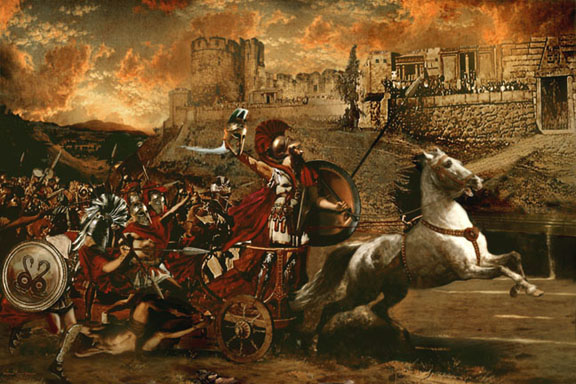
3) You will recognize some recurrent patterns in history. Thucydides will help one develop a better appreciation for life in 5th century BC, but it will really help one develop an appreciation for the aspects of human nature that are unchanged through time.
For exhibit A, consider this recent Kindred Winecoff post with respect to American soldiers, war crimes, and nativism. The relevant section…
Agreed. Human nature has not changed much since 400 BC nor has politics become more nuanced than in the days of the polis. I am also dubious that America, or most nations, for that matter, have produced leaders recently who were of the caliber of Pericles or Lysander. On the other hand, Nicias, Alcibiades, Hyperbolus, Critias and various bumbling Spartan Navarchs, the world appears to enjoy in spades.
It is often said that history is philosophy from examples, but in Thucydides, history is also strategy from examples. I agree with Professor Drezner that Thucydides belongs on the shortlist of books military officers should read; I’d feel a lot better when the next international crisis erupted, if our politicians read him too. If our elected officials could at least internalize “honor, fear and interest”, it would make our foreign policy debates markedly less stupid and public expectations of policy more realistic.
Dr. Chet Richards has passed along information that there will be an upcoming BOYD CONFERENCE at Quantico on October 15th and 16th at the Al Gray Research Center. The organizer of the conference is LTC. Stan Coerr, and he is busy assembling a line-up of presenters who include LTG Paul Van Riper,Robert Coram, GI Wilson,Don Vandergriff,Fred Lelandand others.
I can’t really give out Col. Coerr’s email without the gentleman’s permission but for those readers who are seriously interested in attending, either send me your email address or leave it in the comments and I will coallate them and send them on. I am not sure yet if I will be attending as it depends heavily on my work commitments, but I’d like to be there.
….This symposium goes beyond Boyd’s Work. His influence on other professions and individuals making efforts to more effective outcomes in their perspective fields will be the focus of the Boyd and Beyond symposium. Topics discussed will focus not only on important military issues but will, as well, take Boyd’s theories into the different professions and realms of conflict these professions deal with. How Boyd’s theories apply and what they have done to make all more effective at solving problems via the observation. orientation, decision and action cycles.
Understanding the OODA Loop, and the effects; Interaction, Insight, Imagination, and Initiative, Command and Influence (LEADERSHIP) have on the constant repetitive nature of the decision making cycle can when leveraged, lead to gaining the advantage or as COL John Boyd stated; the essence of winning and losing;
“The essence of winning and losing is in learning how to shape or influence events so that we not only magnify our spirit and strength but also influence potential adversaries as well as the uncommitted so that they are drawn toward our philosophy and are empathetic towards our success.”
Law Enforcement, Homeland Security Professionals, Colleges and University Safety and Security, Hospital Security, Hotel Security and private business looking to keep their workplace safe, will benefit from the lessons learned and applied at this symposium. Developing better strategies, tactics and methods and operational art to make your organization more effective in all that it does, is the type of learning that will take place at the Boyd and Beyond Symposium
Sean Meade, in addition to being my good friend, is the Web Editor for Aviation Week’s defense and space content and is the former longtime webmaster/editorial assistant/right-hand of Dr. Thomas P.M. Barnett. Sean blogs at ARES for Aviation Week and at his personal blog, Interact:
ON THE ILLIAD
by Sean Meade
What makes ‘The Iliad’ a classic? Why is it classic?
I think the primary answer is simple: it’s the characters. If you can hang tough through all of the idiosyncratic flourishes and ornaments and repetitions, the characters are compelling: Achilleus, his anger and character; the comparative nobility of Hektor and Patroklos (both of whom we know are doomed); the vagaries of the gods and their adolescent machinations; the supporting cast of Agamemnon, Menelaos the wronged, two very different men named Aias (Ajax), Diomedes, Aeneas, Odysseus, Nestor, Paris, Helen and Priam. Take these characters and others and mix them with an interesting story and you have a classic that reaches out to us from about the eighth century BC (when it was likely ‘composed’ (with heavy use of previous, oral sources) by Homer), maybe from as far back as the 12th century BC (maybe the original setting of what has come down to us as The Trojan War). ‘The Iliad’ still resonates with us today.
One reason ‘The Iliad’ can still move us is that Homer has done a masterful job of relating the ‘accidents’ of life. ‘Time and chance happen to all men’, and people who lived 3000 year ago couldn’t deceive themselves about their ability to control life the way we ‘modern’ people do. Human experience and emotions are often inscrutable. ‘Love’ (baldly called ‘lust’ by Homer) can easily destroy. When it occurs in the most influential levels of society, it can draw whole nations into its whirling vortex. Even the love between men in ‘The Iliad’ can seem illogical (no matter where you come down on the homosexuality question): why does noble Patroklos honor Achilleus literally to the death?
‘The Iliad’, of course, focuses a lot on war in ways that have become shockingly remote for most of us. Nothing is so susceptible to ‘luck’ as war. One ‘good’ soldier gets hit by stray friendly fire and dies instantly. Another ‘bad’ soldier comes through the whole war unscathed. Consider the hazards of love, life and war in ‘The Iliad’. Consider them in our own experience. It makes more sense than many theories to conclude that arbitrary and capricious gods can powerfully affect us.
My final guess (for the purposes of this mini-review) at why ‘The Iliad’ is a classic is that the poetry is timeless. This is, of course, nearly impossible to take in from one read-through in translation. My friend, Jason, listened to the abridged version and talked about its power. The commentators discuss it quite a bit, from what I can tell. Most of us (who aren’t going to pay the price to really test it) are going to have to take this on faith and rate it as we will. Poetry is a dying art, and poetry appreciation is probably in an even worse state.
I wonder what role foreknowledge plays in ‘The Iliad’. Many of us know the broad outline of the story going in. If we don’t, Homer spills it in short order. Does knowing Achilleus dies shortly after this episode in The Trojan War change our view of him? Do we cut him more slack? How does knowing that Hektor and Patroklos die within the bounds of this story affect us? Or that Odysseus lives? Or that Agamemnon will be murdered in his bath by his wife (he had it coming ;-)?
Something else that stands out about ‘The Iliad’ is the graphic war imagery. Homer’s descriptions almost seem gratuitous when he goes into detail about how one soldier killed another, where the spear penetrated and where it came out, what muscles were severed, what happened to the bowels, teeth or brain. It’s probably distasteful to many of us in the 21st century, but I think we can just chalk that up to cultural differences.
My second big question is: what does ‘The Iliad’ mean? I’m very snobbish about exegesis, especially concerning the Bible (my training, as a former pastor), but including any suitably worthy literature (with concomitant training in British Lit and Analytic Philosophy). Exegesis, in principle, is simple: what was the author trying to communicate to the audience? (So why is good exegesis so hard to find? 😉 If we are to make any meaningful connection to the original work, this is where we have to begin. You can deploy your Reader Response Theory on ‘Twilight’ or some such drivel, but keep it off my Homer (I told you I’m a snob ;-).
We come to ‘The Iliad’ at a loss because Homer’s values are very different from ours. His presuppositions are vastly different from ours. I have touched on some of these already. The gods can show up at any time and throw any wrench in the works for almost any imaginable reason. We have to take the role of the gods seriously to take Homer seriously. What did their role say about the responsibility of people? Humans retain some responsibility, almost paradoxically. Helen isn’t completely off the hook for running away with Paris. Achilleus does not get a complete pass for his anger that causes the deaths of so many Achaean comrades. Agamemnon is not excused for his overbearing pride that contributed to the disagreement with Achilleus. And even noble Hektor faces bouts of inaction and cowardice for which he is not wholly exonerated.
Another value we find hard to understand is the ancient Greek concept of nobility. It’s just born there. If you’re a shepherd who’s not the natural-born son of King Priam and Queen Hekabe, that’s all you’ll ever be: a shepherd. The main characters are noble; many are first-generation half-deities and most (all?) have divinity in their bloodline somewhere. From our standpoint, Achilleus behaves like a monster, especially in his repeated attempted-desecration of Hektor’s body (the gods protect Hektor’s body and Achilleus’ ultimate honor by preserving Hektor’s corpse inviolate in almost the perfect proverbial deus ex machina). He’s sacrificed any claim to nobility as far as we’re concerned. Not so for Homer and the ancient Greeks; Achilleus retains his nobility, though it is clouded by sins. He receives partial pardons and rationalizations. From our perspective, we view him as maybe the original anti-hero. Homer’s view is much less ambivalent, and Achilleus gets away with things for which lesser men would go straight to Tartaros without passing ‘Go’. It’s a far cry from our 21st century Western concept of nobility and our love of ‘rags to riches’ fables. It’s only riches to riches here (though maybe no one knew through the rags that you were really rich).
So what is Homer’s message? The conclusion of my barely-better-than-cursory reading is: Given that nobility and greatness are natural, almost literally gifts of fate (the Fates); and that humans are subject to the whims of the gods; it is best to be brave and seek glory (within reason–with a glance forward to Aristotle’s middle-way ethic). How’s that going to help you with your job or family? Not much. It’s fodder for thinking about societal values and a long way from whether or not to stick it out in your mediocre, going-nowhere job. (It might possibly apply to whether or not you should run away with your neighbor’s spouse.)
For most of us, ‘The Iliad’ is probably a test in proper exegesis more than someplace we should or will go to look for meaning. But maybe that’s just my soap box 😉
Charles Cameron is the regular guest-blogger at Zenpundit, and has also posted at Small Wars Journal, All Things Counterterrorism, for the Chicago Boyz Afghanistan 2050 roundtable and elsewhere. Charles read Theology at Christ Church, Oxford, under AE Harvey, and was at one time a Principal Researcher with Boston University’s Center for Millennial Studies and the Senior Analyst with theArlington Institute:
In a Time of Religious Arousal
by Charles Cameron
We live in times of considerable religious arousal – witness the Manhattan mosque and cultural center controversy, the on-again, off-again Florida Quran burning, last week’s Glenn Beck rally at the Lincoln Memorial,Hindutva violence against Muslims in India, Muslim violence against Christians, the wars ongoing or drawing to an end in Afghanistan and Iraq, the threat of an Israeli or American attack on Iran, the Palestinian-Israeli conflict and peace process… In each of these instances, religious arousal has a role to play.
It would require considerable care, research, and craftsmanship to produce a nuanced and appropriately balanced view of human nature, the current state of the world, American, European and Islamic popular, polite and political opinions, the global admixture of peoples and approaches that characterize Islam, the history of violence, religious and otherwise, the braiding in different times and places of religion with politics, the roots of violence, the roots of peace and its meanings both as a state of cessation of conflict and as a state of contemplative calm…
Such a presentation would require at least a book-length treatment, and cannot be trotted out every time some new spark emerges from the ancient fires… but perhaps I can lay out some of my own considerations about the topic here, in somewhat condensed form.
The teachings of Jesus appear to have been directed towards an audience that included regular folk: fishermen, members of an occupying military force, radical zealots, a tax-collector, a physician, a prostitute, religious scholars… a fair cross-section of human kind…
Every religion of any real “size” will have followers who are intellectuals, fearful followers, angry and reactive followers, contemplative followers – followers who are skilled in the various businesses of crime prevention, defense, contemplation, literature, the sex trade, theft, medicine, art, bargaining, diplomacy, music, architecture, investigativejournalism, yellow journalism, inspirational writing, poetry…
It will of necessity address, and over time retain traces, of all their concerns.
Every religion of any real “size” will also have begun in a particular time, place and cultural setting, and will carry considerable parts of that setting with it, although it may also contain elements of a more profound or elevated spirit…
Every religion and scripture will, I suggest, promise a garden / paradise / city which is both attainable “outside” life, in a “there” which is hard to put into words, and “within” us, a similarly difficult concept to verbalize, in the moment, here. It will also contain what I call “landmines in the garden” – verses or narratives that offer sanction to what we today might regard as abhorrent violence against the innocent “other”.
Thus in Numbers 25 in the Jewish Tanakh and Christian Bible, the Lord offers to Phineas / Pinchas a “covenant of priesthood”, because he recognized that his Lord did not appreciate an Israelite and a woman of the Midianitescopulating, and skewered the pair of them in flagrante through their conjoined parts with his spear — without first seeking the approval of the High Priest.
One of the most radical Christian Identity theorists is Richard Kelly Hoskins, who in 1990 invented the notion of the “Phineas Priest,” built around the concept of the biblical Phinehas, who used a spear to slay an Israelite and a Midianite who had lain together. Phineas Priests believe themselves modern day Phinehases, with a self-appointed mission to strike out in the most violent and ruthless way against race mixers, abortionists, homosexuals, Jews, and other perceived enemies.
It seems highly probable that Byron de la Beckwith, killer of civil rights leader Medgar Evers, considered himself a Phineas Priest, see Reed Massengill, Portrait of a Racist: The Man who Killed Medgar Evers, pp 303-305. Similarly, it appears that Rev. Paul Hill, convicted of abortion clinic murders, was considered by his friends, and may have considered himself, a Phineas Priest. Likewise Yigal Amir, assassin of Yitzak Rabin, seems to have had the Phineas story in mind when deciding, without rabbinic support, to go ahead and kill the Israeli PM.
For an example of a recent meeting of rabbis — in Jerusalem’s Ramada Renaissance hotel– to promote the permissibility under halachic law of the killing of goyim / gentiles, see this article by Max Blumenthal and the accompanying video:
Individuals, small sects or powerful movements will on occasion seize on these “landmine” texts within a religious tradition, and use them to justify acts of violence, large and small.
The Crusades, for instance, did this on behalf of Christianity and against Islam, notwithstanding which St Francis was able to approach Saladdin’s nephew, the Sultan Malik al-Kamil, across the battle lines, coming in peace, discussing matters of devotion, and departing in peace. The Islam of al-Andalus was for centuries, in comparison to the Christendom of its time, a model of scholarship and tolerance – though not without aspects of the pre-eminence of Islam, dhimmi status for People of the Book, the jizya, etc.
Mark Juergensmeyer, author of Terror in the Mind of God and currently our finest analyst of religious terrorism, recently co-edited a book on Buddhist Warfare (obligatory, cautionary note: Juergensmeyer and I are both contributors to Michael W Wilson and Natalie Zimmerman’s book, A Kingdom at Any Cost: Right-wing Visions of Apocalypse in America). The world of Zen has been rattled by controversy regarding the support of leading roshis for the Japanese imperial war effort — and there are apocalyptic references to a future war between Buddhists and the mleccha (presumably Islam) in the text ofwhat the Dalai Lama has termed an “initiation for world peace” — the Kalachakra tantra.
Alexander Berzin, who has translated for the Dalai Lama on numerous occasions when this teaching was given, comments:
A careful examination of the Buddhist texts, however, particularlyThe Kalachakra Tantraliterature, reveals both external and internal levels of battle that could easily be called “holy wars.” An unbiased study of Islam reveals the same. In both religions, leaders may exploit the external dimensions of holy war for political, economic, or personal gain, by using it to rouse their troops to battle. Historical examples regarding Islam are well known; but one must not be rosy-eyed about Buddhism and think that it has been immune to this phenomenon. Nevertheless, in both religions, the main emphasis is on the internal spiritual battle against one’s own ignorance and destructive ways.
Any and all religions can be used to justify internal struggle, external violence, external peace-making and inner peace: the question is how these various threads are interwoven in individual cultures and histories, and in our own times.
That is, I’d suggest, a matter for legitimate dispute – but not one with an easy one sentence or even single paragraph answer.
In my view, the most powerful response to the current global “jihadist” movement will come not from advocates of democracy (whether backed up or not by military force or threat of force) who will naturally appear to be interfering in affairs between the soul and its God that do not concern them – but from people within the jihadists’ own religious tradition.
Noman Benotman, one-time leader of the Libyan Islamic Fighting Group and colleague of bin Laden and Zawahiri, wrote an open letter to bin Laden dated 10 September 2010 / 1 Shawwal 1431 AH, which the Quilliam Foundation just released under the title “Al-Qaeda: Your Armed Struggle is Over“.
Benotman’s letter opens with an invocationfrom Qur’an57:16:
Is it not time for believers to humble their hearts to the remembrance of God and the Truth that has been revealed.
The text of Benotman’s message is only four pages long, and I recommend reading the whole of it – but have selected this single passage as representative of his critique:
What has the 11th September brought to the world except mass killings, occupations, destruction, hatred of Muslims, humiliation of Islam, and a tighter grip on the lives of ordinary Muslims by the authoritarian regimes that control Arab and Muslim states? I warned you then, in summer 2000, of how your actions would bring US forces into the Middle East and into Afghanistan, leading to mass unrest and loss of life. You believed I was wrong. Time has proved me right
Benotman closes:
In urging you to halt your violence and re-consider your aims and strategy, I believe I am merely expressing the views of the vast majority of Muslims who wish to see their religion regain the respect it has lost and who long to carry the name of “Muslim” with pride.
For those who are concerned at the influence of Anwar al-Awlaki on English-speaking youth, there’s a detailed 130-page critique of his approach to global jihad from a strict Salafist perspective available on the web:
On the topic of suicide bombing / martyrdom operations viewed from an Islamic perspective, I’d suggest reading the Ihsanic Intelligence “Hijacked Caravan“:
To me religious belief in Islam is, as Sufi Muslims put it, “love of God,” not a political ideology of hatred. … In my heart, therefore, I am a Sufi, but in my mind I subscribe to ‘aql/”reason”, and in this I follow the Islamic rationalism of Ibn Rushd/Averroes. Moreover, I read Islamic scripture, as any other, in the light of history, a practice I learned from the work of the great Islamic philosopher of history IbnKhaldun. The Islamic source most pertinent to the intellectual framework of this book is the ideal of al-madina al-fadila/”the perfect state”, as outlined in the great thought of the Islamic political philosopher al-Farabi.
Lexington Green is politically conservative, but he and others at Chicago Boyz have been willing to put up with me; I respect them, too, because they think out what they’re about. I think they actually listen to me, too, even as we disagree.
So when Green’s post was endorsed by Glenn Beck, I realized that this might be a way to get into his admirers’ minds. Green begins with a John Boyd hierarchy that I haven’t spent much time with; this is another of my departures from my friends at Chicago Boyz. But I suspect that that part can be skipped with little loss. He’s saying that Beck is taking a broad view, going up a couple of levels.
But I don’t feel like I get the rest of it. I can do a sentence-by-sentence exegesis, but that wouldn’t be quite right. I’m trying to get into Green’s and Beck’s heads, not dispute them. But there are barriers. Since I wrote that, Green has added another update, which makes some things clearer. I’ll get to the update later.
One is that so much of what Beck offers is factually flawed. Green is an intelligent person; how can he miss that? Perhaps because the bigger things he talks about in the post are more important to him. But those factual flaws are a barrier to me. A lack of fact is a poor foundation for anything to come after.
What Green likes is Beck’s creation of a large narrative.
Beck is building solidarity and cultural confidence in America, its Constitution, its military heritage, its freedom…
Beck is creating positive themes of unity and patriotism and freedom and independence which are above mere political or policy choices, but not irrelevant to them.
This sort of narrative is indeed attractive; I have wished for a vision that can unite Americans, that would provide a solidarity that we can rest on, a positive vision.
But there is a double-mindedness to Green’s analysis that is another barrier to me. I agree that we need unifying themes for us as Americans. Period. Unfortunately, it’s easy to unify around an enemy, and, while talking about solidarity and unity, Green develops an enemy, “the Overlords”, and a sense of aggrievedness. Since “the Overlords” are Americans too, that sense cannot be the basis for unity. But that duality is in Beck’s words too: he condemns President Obama for a cult of victimization, and then tells his followers how victimized they’ve been. And for him and for Palin, there are very definitely an “us” and a “them.” Apparently I am one of “them.”
Zenpundit is a blog dedicated to exploring the intersections of foreign policy, history, military theory, national security,strategic thinking, futurism, cognition and a number of other esoteric pursuits.


life in 5th century BC, but it will really help one develop an appreciation for the aspects of human nature that are unchanged through time.