zenpundit.com » saudi arabia

Archive for the ‘saudi arabia’ Category

Reading a partisan cartoon: the parable of a dog’s ears and teeth

Friday, November 16th, 2012

[ by Charles Cameron — on the difficulties that may be posed when “reading” graphics ]
.
**

The question I want to ask in this post is: how much can you safely read into a political cartoon?

Here is the particular cartoon I have in mind:
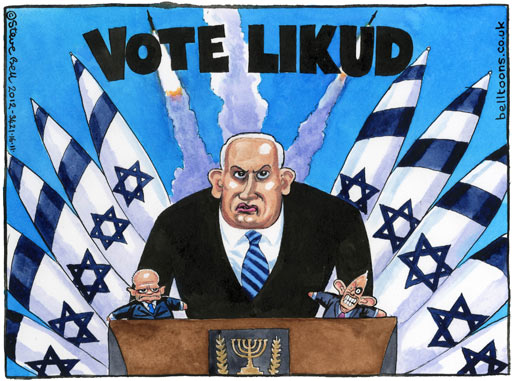
It was published in The Guardian (UK) yesterday, and as you may be able to see, it portrays Israeli PM Benjamin Netanyahu as a puppet-master, with British politicians Tony Blair and William Hague as his puppets, and was published to illustrate the cartoonist’s view of British reaction to the Gaza situation.

How much can we read into it?

**

If you are used to seeing cartoons such as these —
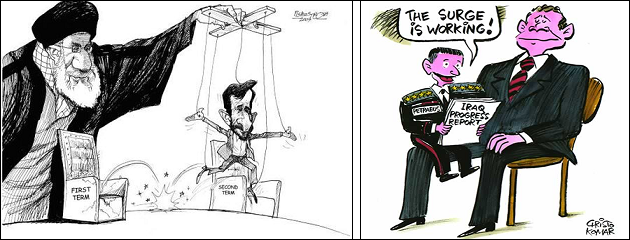
showing Khamenei pulling Ahmadinejad‘s strings and Petraeus as a puppet of GW Bush, when you come across the Netanyahu cartoon in the Guardian, you may well view it as another in a long series of political cartoons suggesting that someone is running someone else’s show behind the scenes. It’s the old idea of the eminence grise, in other words, expressed in cartoon form.

**

If, on the other hand, you’ve been exposed way too often to cartoons like these —

the one portraying Churchill, FDR and Stalin as Jewish puppets, taken from a 1942 issue of the Nazi paper, Fliegende Blätter, or the one depicting McCain and Obama as Israeli puppets, taken from a 2008 issue of the Saudi paper, Al-Watan… you may well see the same cartoon in a very different — and distinctly antisemitic — light.

**

The last two graphics, at least, are extremely offensive, and I would like to offer another graphic here — one which also uses our “puppet master” theme — as a visual equivalent of offering a glass of water to cleanse the palate:

I’ll be addressing this My Fair Lady poster from a very different angle, in a later post in my “form is insight” series — this one on “dolls within dolls”, the “world stage which we have dotted with stages of our own devising” and “turtles all the way down”…

**

Having hopefully reduced the emotional freight which some of the cartoons above must surely have carried with them, I would now like to offer you some background which seems relevant to me. Characteristically, perhaps, it comes from a very different field of knowledge.

EC Zeeman‘s April 1976 article Catastrophe Theory in the Scientific American was my introduction to the mathematician Rene Thom’s remarkable body of work, an introduction which sailed mostly over my head — but one of Zeeman’s points, which he illustrated with the graphic below, made perfect sense to me.
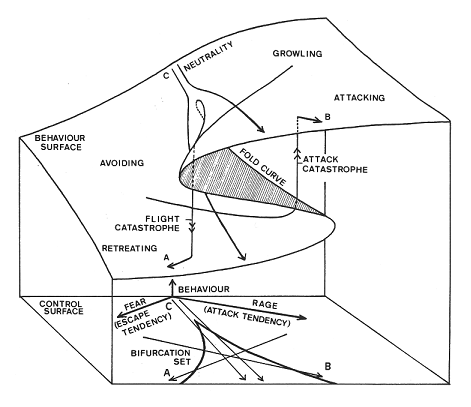
The annotation to this illustration read in part:

If an angry dog is made more fearful, its mood follow* the trajectory ‘A’ on the control surface. The corresponding path on the behaviour surface moves to the left on the top sheet until it reaches the fold curve; the top sheet then vanishes, and the path must jump abruptly to the bottom sheet. Thus the dog abandons its attack and suddenly flees. Similarly, a frightened dog that is angered followes the trajectory ‘B’. The dog remains on the bottom sheet until that sheet disappears, then as it jumps to the top sheet it stops cowering and suddenly attacks.

My translation:

A dog that reaches the point where its ears are fully pinned back, indicating full-on fear, and its teeth are also fully bared, indicating full on rage, will behave differently depending on whether its fear level or its rage level was the first to be raised to “full”.

Just as a dog’s reaction to a full on mix of rage and fear may depend on which stimulus came first, so — I am suggesting — our own reaction to the cartoon in question — inherently antisemitic, or merely critical of a particular Israeli operation — may depend on our previous exposure to cartoons, politics, the Israeli-Palestinian conflict, or antisemitism.

**

We now have several levels of ease or difficulty in reading graphics. The Zeeman graphics are hard to read because they’re too small to be legible — but put them in the context of Zeeman’s article, and view them full size as originally published, and the only problem might be in following Zeeman’s text, itself a popularization and simplification of Rene Thom‘s work.

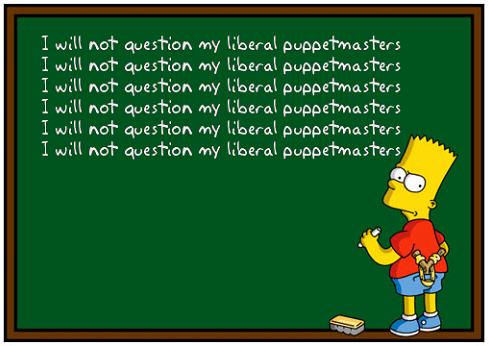
The Bart Simpson graphic is fairly straight forward, and regular viewers of the show would “read” it in line with hundreds of similar frames in which Bart writes repeated lines on a classroom chalkboard, from Season 1 episode 2’s “I will not waste chalk” to Season 23’s “There’s no proven link between raisins and boogers”.

And then there’s the disputed Netanyahu graphic… which can be “read” differently, depending on what previous “puppet master” associations the viewer beings to the task. Here, it seems to me, the task of interpretation can be viewed in one of two ways: (i) as an exploration of how it is likely to be read, which I’m suggesting will depend on previous association, and (ii) as an exploration of what “must have been” in the cartoonist’s heart.

**

Assessing the cartoon’s probable impact on segments of the public is one thing — knowing what the cartoonist intended, even though we tend to conflate the two, is quite another. Not for nothing does St Paul in I Corinthians 2.11 ask (in my own translation)

Who knows the qualities of a man but the spirit of that man within him?
An army in Sham, an army in Yemen, and an army in Iraq

Thursday, November 1st, 2012

[ by Charles Cameron — uh-oh, it’s Mahdi time again.. giving a little wide-angle context, then passing along a hadith of possible current interest — also an aside about an end-times Shiite trinity ]
.

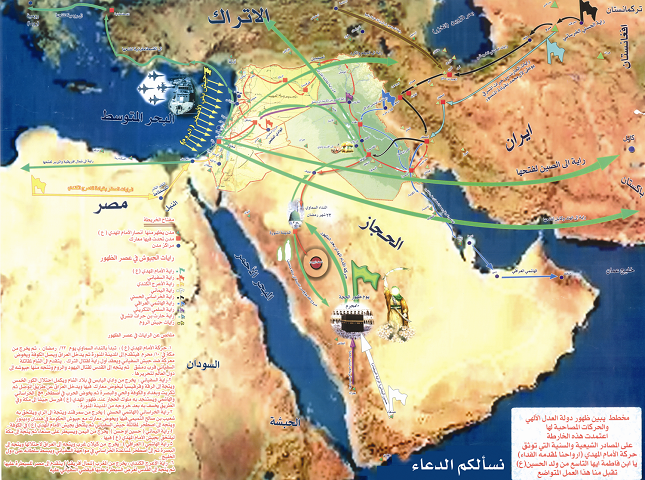
a ShiaChat map of one end times scenario: the Sufyani will attack Iran, black banners come from Khorasan

.

We live, as everyone pretty much agrees, in some place called “here” (although that shifts) at a particular moment called “now” (although that shifts too) in a medium often called “spacetime” in honor of Albert Einstein.

The Game-changing Coming Ones of many religions and sects – and even their secular variants, the Game-changing Coming Ideologies and Leaders) – are situated in another area of the same “spacetime” continuum for their respective believers: next up after “wars and rumors of wars” or “come the revolution” or “when the Mayan Calendar runs out” or “next year in Jerusalem”…
.

When:

My old friend Stephen O’Leary suggests there’s a shifting “window of opportunity” for people who preach “soon comings” – if you warn people that the world will end in a couple of thousand years, or with the heat death of the sun, or even that sea levels are liable to rise precipitously over the next few decades unless remedial action is taken, the view is long-range enough to seriously diminish your impact. Conversely, if you announce the end of the world will occur three minutes from now, nobody has time to get scared or prepared – or to propagate your message.

So “soon coming expectations” generally predict the coming is a little ways around the corner, close enough to matter but no close enough to sell all that you possess and climb Mt Ararat this week.
.

Where:

The “where” is interesting, though. We have news cameras focused 24/7 on the Mount of Olives to catch the Second Coming of Christ, although most observant Jews won’t be expecting that Christianity will be finally vindicated as the true inheritor of Judaism’s mantle there any time soon, and many Muslims expect he’ll descend at one of the minarets of the Umayyad Mosque in Damascus.

And the Mahdi? Two popular points of anticipated arrival are beside the Kaaba in Mecca, or out of the well behind the Jamkaran mosque, not too many miles from Qom.

But Islamic apocalyptic geography doesn’t end with either place – it extends, minimally, from Khorasan (Iran or Afghanistan) to Jerusalem, with a possible side-expedition to India (the Ghazwa-eh-Hind) and with possible tributaries from Africa and who knows where else… and in at least some Shia strands of apocalyptic thinking, the city of Kufa in Iraq will be the Mahdi’s seat of government.
.

And now, the hadith:

All this is simply to provide some context for a specific hadith that my friend Aaron Zelin pointed to me today, as recorded yesterday on the Kavkaz Center webpage:

Hadith about Syria, Iraq and Yemen

Publication time:
30 October 2012, 14:58

Sham – the territory of Syria, Palestine, Jordan and Lebanon

Abdullah ibn Hawalah [Allah's blessings be on him] narrated from the Messenger of Allah (pbuh) that he said:

"Matters will run their course until you become three armies: an army in Sham, an army in Yemen, and an army in Iraq".

Ibn Hawalah said:

"Choose for me, O Messenger of Allah! in case I live to see that day".

The Messenger of Allah (pbuh) said:

"You should go to Sham, for it is the best of Allah's lands, and the best of His slaves will be drawn there!

And if you refuse, then you should go to the Yemen and drink from its wells. For Allah has guaranteed me that He will look after Sham and its people!"

(Imam Ahmad 4/110, Abu Dawud 2483. Authenticated by Imam Abu Hatim, Imam ad-Diya al-Maqdisi, Sheikh al-Albani and Sheikh Shu'aib Al-Arnaut).

Department of Monitoring
Kavkaz Center

.
Further reading:

For more on this, see especially J-P Filiu‘s Apocalypse in Islam, noting in particular his account of “the revelation of Abu Musab al-Suri” (pp. 186-193), including specifically his discussion of “Sham” in a paragraph on p. 189.

*****

And an intriguing aside:

And since were talking Yemen and the greater Sham here, it may be worth noting as an aside, the presence in Islamic apocalyptic traditions of a figure known as the Yemeni — sometimes identified in Iranian Shia apocalyptic as Hezbollah’s Hasan Nasrallah. Filiu writes (p.156) of:

Shaykh Nazrallah’s transformation into the apocalyptic figure of the Yemeni, completing a very political trinity in which Ayatollah Khamenei served as the standard bearer of the Mahdi and Ahmadinejad as the commander of his armies.

Filiu’s book was published in France in 2008, but the same trinity can also be found in the fairly recent video The Coming is Upon Us attributed by Reza Kahlili to circles around Ahmadinejad. I’ve taken this account of the video and the trinity as it reports it from the Counter Jihad Report, because their version succinctly draws together the strands that most concern me here:

A little-noticed documentary titled “The Coming is Upon Us” was produced by Ahmadinejad’s office last year and it lays out the regime’s beliefs and planned path forward, much like Mein Kampf did. And it debunks the notion that the U.S.S.R. and the Iranian regime are equivalent. The film makes the case that the regime’s leaders are the incarnations of specific End Times figures foretold in Islamic eschatology.

Iran is the “nation from the East” that paves the way for the Mahdi’s appearance. Supreme Leader Khamenei is Seyed Khorasani, “the preparer” who comes from Khorasan Province with a black flag and a distinct feature in his right hand. Khamenei’s right hand is paralyzed from an assassination attempt. Khorasani’s commander-in-chief is Shoeib-Ebne Saleh, who the film says is President Ahmadinejad. Hezbollah chief Hassan Nasrallah is the incarnation of Yamani, a commander with a Yemeni ancestry who leads the Mahdi’s army into Mecca.

These three “preparers” wage war against the Antichrist and “the Imposters”-the U.S., Israel and the West’s Arab allies. The film also mentions that a figure named Sofiani will side with Islam’s enemies. Former Iranian Revolutionary Guards officer Reza Kahlili, who leaked the film, told me that the full-length version identifies him as Jordanian King Abdullah II.

The film lists various End Times prophecies that have been fulfilled to argue that the Mahdi’s appearance is near. The 1979 Islamic Revolution in Iran; the invasion of Iraq from the south and subsequent sectarian violence and death of Saddam Hussein; the Houthi rebellion in Yemen; the fall of Egyptian President Hosni Mubarak and the increasing amount of open homosexuality, cross-dressing, adultery and women taking off the hijab are correlated to specific Islamic prophecies.

As to the video’s authenticity and provenance, I can only express my ignorance and keen interest — but whatever the case, it seems likely that the split between Khamenei and Ahmadinejad, together with the latter’s “soon going” from office, renders that particular strain of prophecy moot.

Particular prophetic timelines may fail, and indeed do so repeatedly — the apparatus of apocalyptic hope simply incorporates new figures and events into its calculations, and moves its sense of urgency a little further up along the timeline…

Of quantity and intensity: the case of the Sufiyan

Sunday, October 28th, 2012

[ by Charles Cameron — catching the apocalyptic mention in a broad sectarian overview ]
.


.

I’d like to discuss the last four paragraphs of a recent NYT piece on the influx of Iraqi Shiites to Syria:

Iraqi Shiites did not initially take sides in Syria. Many Shiites here despise Mr. Assad for his affiliation with the Baath Party, the party of Saddam Hussein, and the support he gave foreign Sunni fighters during the Iraq war.

But as the uprising became an armed rebellion that began to attract Sunni extremists, many Shiites came to see the war in existential terms. Devout Shiites in Iraq often describe the Syrian conflict as the beginning of the fulfillment of a Shiite prophecy that presages the end of time by predicting that an army, headed by a devil-like figure named Sufyani, will rise in Syria and then conquer Iraq’s Shiites.

It was the bombing of an important shrine in Samarra in 2006 that escalated Iraq’s sectarian civil war, and many Iraqis see the events in Syria as replicating their own recent bloody history, but with even greater potential consequences.

Hassan al-Rubaie, a Shiite cleric from Baquba, the capital of Diyala Province, said, “The destruction of the shrine of Sayyida Zeinab in Syria will mean the start of sectarian civil war in Iraq, Syria, Lebanon, Bahrain and Saudi Arabia.”

**

There’s a lot going on there, and I just want to point you to the little diagram I posted above, which features what I consider one very significant point that jumped out at me on this occasion from the “larger picture”.

It’s my impression that the name Sufiyan will be far less familiar to most readers than the names Iraq, Syria, Lebanon, Bahrain and Saudi Arabia. Furthermore, Iraq, Syria and so on are nations — real geopolitical entities with territories, wealth, militaries, populations, factions, fighting and so forth. The Sufyani, by contrast, is a single person, perhaps a figure of legend.

For the contemporary western mind, therefore, it is easy to read those last four paragraphs and be struck by the breadth, the sheer physical extent of the potential conflict described there – and after noting the basic concept of sectarian rivalry between Sunnis and Shiites, that may in fact be the major “takeaway” from the article: this thing could be huge.

I want to suggest there’s a more significant, and less studied takeaway – that Sufyani is the key word here, because Sufyani is a figure in a specifically end-times narrative, a precursor to and noted adversary of the Mahdi.

**

That’s my bottom line here – that this individual the Sufyan may be less known and less impressive-sounding than a swathe of nations between the Mediterranean, the Red Sea and the Persian Gulf – but he represents the power of end-times belief, and the intensity that inevitably accompanies the final showdown between good and evil, with heaven and hell the only possible outcomes of one’s chance and choice to participate.

**

There is not a whole lot of documentation in English regarding the Sufyani, especially as viewed in Shiite eschatology, but this quick excerpt archived from an Iranian state media site will give us a basic overview:

According to narrations Sofyani, a descendant of the Prophet’s archenemy Abu Sofyan will seize Syria and attack Iraq and the Hejaz with the ferocity of a beast. The Sofyani will commit great crimes against humanity in Iraq slaughtering people bearing the names of the infallible Imams, and his army will lay siege to the city of Kufa and to Holy Najaf. Of course, many incidents take place in this line and finally Imam Mahdi sends troops who kill the Sofyani in Beit ol-Moqaddas, the Islamic holy city in Palestine that is currently under occupation of the Zionists. Soon a pious person from the progeny of Imam Hasan Mojtaba (AS) meets with the Imam. He is a venerable God-fearing individual from Iran. Before the Imam’s appearance he fights oppression and corruption and enters Iraq to lift the siege of Kufa and holy Najaf and to defeat the forces of Sofyani in Iraq. He then pledges allegiance to Imam Mahdi.

The Rice University scholar David Cook gives a worthwhile account of the Sufiyani in Shiite perspective, in his Hudson Institute paper Messianism in the Shiite Crescent [CC note: this paragraph added about an hour after first posting]:

First among the major omens connected with the belief in the Mahdi’s imminent return is the appearance of his apocalyptic opponent, the Sufyani. Mainstream tradition tells that the Sufyani will be a tyrannical Arab Muslim ruler who will hail from the region of Syria and who will brutally oppress the Shiite peoples. Before the 2003 collapse of the Saddam Hussein regime in Iraq, many messianic writers in both the Sunni and Shiite traditions identified Saddam Hussein as the Sufyani. Since 2004, however, there has been a tendency to gloss over the classical belief in the Sufyani’s Syrian-Muslim identity and to identify him instead with the United States (as many Iraqis hold the U.S. responsible for the slaughters in their country.) Another recent trend within Shiite messianism has been to identify the Sufyani with prominent Sunni radicals such as Abu Musab al-Zarqawi (killed June 2006), who was virulently anti-Shiite. From the perspective of the classical sources, Zarqawi would have indeed been an excellent candidate, because his hometown in Jordan is extremely close to where the Sufyani is supposed to come from.

It’s worth noting, perhaps, that the Sufyani also features in the (Sunni AQ strategist) Abu Musab al-Suri‘s work, the Call to Global Islamic Resistance. As Jean-Paul Filiu reports:

Abu Musab al-Suri looks with favor upon a hadith that speaks of the restoration of Islam by an armed force “coming from the east.” This will be the vanguard of the Mahdi, known by its black banners and led by Shuaib ibn Saleh, whom every believer will join “even [if it means] marching in the snow.” The Sufyani, whose face is scarred by smallpox, will rise up against it in Damascus and ravage Palestine, Egypt, and Hijaz, proceeding as far as Mecca, where he will kill the “Pure Soul.” Yet it is also at Mecca that the Mahdi will appear, and he will reconquer Damascus after eighteen years…

Meanwhile, out there on the wild profusion of the net, there’s naturally controversy as to who the Sufyani might be – suggestions I’ve seen include Bashar al-Assad of Syria and Abdullah II of Jordan – in much the same way that the identity of the Antichrist is debated in Christian eschatological circles, with candidates ranging from the Emperor Nero to Ronald Reagan and more recently Oprah Winfrey [link is to an amazing video clip which also features President Obama and Louis Farrakhan].

**

So?

So. Rather than – or in addition to – considering the sheer extent of geopolitical space referenced in the NYT piece, I’d suggest we should pay attention to the intensity factor signaled by the mention of the Sufyani. Following that tack, after all, we will also be considering a wide swathe of territory —

in Abu Musab al Suri’s terms, from Syria via Palestine, Egypt, and the Hijaz, to Mecca – but with the added intensity that apocalyptic war brings with it.

Lang, Francona et socii on an Israeli strike

Sunday, September 23rd, 2012

[ by Charles Cameron — a quick recap of Col. Lang & Lt. Col. Francona on the realities of an Israeli strike on Iranian facilities, 2006-2012 — and the recent WaPo trilogy ]
.

Nuclear and missile sites, 2008, credit: Stratfor

.
I posted here a while ago about what happens when “religious leaders talk of wiping nations off the map” — quoting the Iranian Ayatollah Khamenei and the Shas Rabbi Ovaida Yosef — and unobtrusively included the question:

Do the logistics back the rhetoric up?

Or so I thought.

**

Srikanth R of the Takshashila Cyber Strategy Studies team picked up on that supposedly unobtrusive question, though, so maybe it wasn’t so unobtrusive.

The thing is, it’s a solid, material, practical, down to earth realist’s question… and behind it, behind my dropping it into that post, is a memory of Col. Pat Lang, the blogger at Sic Semper Tyrannis, pointing his readers to that question quite a while back, in the form of a post by his one-time DIA deputy, Rick Francona back in 2006. Any “intelligence” in my question is strictly theirs.

I thought then, and I think now, that logistical considerations are as important as potential messianic-mahdist echo-chambers or statements by Israeli intelligence figures or American Chairman of the Joint Chiefs to bear in mind when considering the potential for an Israeli attack on Iran.

This is not an area that I consider myself informed about, so I thought I’d check back and see what Lang and Francona have had to say on the issue over the intervening years…

**

Rick Francona: flight routes, 2006

**

Here are a bunch of other places where Lang, Francona et socii discuss such matters, in what I believe is a sequence by date:

http://francona.blogspot.com/2006/03/iran-israels-air-strike-options.html
http://francona.blogspot.com/2008/06/iran-israels-air-strike-options-update.html
http://turcopolier.typepad.com/sic_semper_tyrannis/2008/06/overflight-clea.html
http://turcopolier.typepad.com/sic_semper_tyrannis/2008/09/ask-the-iraqi-g.html
http://turcopolier.typepad.com/sic_semper_tyrannis/2009/05/sounds-like-a-plan-iranisrael.html
http://turcopolier.typepad.com/sic_semper_tyrannis/2009/05/haaretz-article-on-iranian-realities.html
http://turcopolier.typepad.com/sic_semper_tyrannis/2010/11/israeli-planning-considerations-harper.html
http://turcopolier.typepad.com/sic_semper_tyrannis/2012/02/can_israel_stri.html
http://turcopolier.typepad.com/sic_semper_tyrannis/2012/04/an-israeli-iran-war-what-would-it-look-like-by-richard-sale.html
http://turcopolier.typepad.com/sic_semper_tyrannis/2012/08/yaalon.html

**

From that last URL, here’s the most recent map in the series:

**

And is that all?

Over the last few days the Washington Post has published a three-part “essay” on an Israeli strike on Iranian nuclear facilities. I’ve already quoted from David Ignatius‘ contribution in a comment on ZP, but that was about a different aspect of the thing. Here are links to the three parts:

Azadeh Moaveni, What if Israel bombed Iran? The view from Tehran
Anat Berko, If Israel bombed Iran, what would life in Tel Aviv be like?
David Ignatius, Lessons from an Iranian war game

**

Again, let me emphasize that I don’t know about logistics, but that I suspect Col. Lang does. You might think three points of view was enough to get a decent overview of the situation. You might believe that a war game conducted by a cluster of intelligent specialists would be enough…

Just for the record, Col. Lang obviously still thinks we’re missing the point. This is from his Sic Semper Tyrannis blog, today:

A general defect of the thing is the complete ignorance reflected of the actual limitations of distances, weapons, numbers of aircraft and missiles, Iranian air defenses, the lack of any recovery air fields between Israeli bases and the targets or SAR capability for the attacking Israeli force. Basic military knowledge of the situation is ignored in the manner common in politico-military strategic war games. In these “games” any reference to actual limitations are airily waved off as not germane. In this essay it is suggested that one option is for the US to “shoot down’ the attacking Israeli force before it passes beyond Iraq. The Joe Biden character angrily says that this is not an option. He is correct but not for the reason implied. In fact, since the completion of the US withdrawal from Iraq the US has no ability to do such a thing and neither do the Iraqis. The nearest USAF assets are in the Gulf or Turkey and the nearest US Navy assets are where the carriers may be. Look at the distances.

**

Comments?

Of a fault line, and of the Qibla

Tuesday, August 28th, 2012

[ by Charles Cameron — Sunni and Shia, Mecca and Qom, Saudi and Iran and the balances between them, with special attention to Mecca — and sideways comparisons with Las Vegas and Somoza’s Nicaragua ]
.

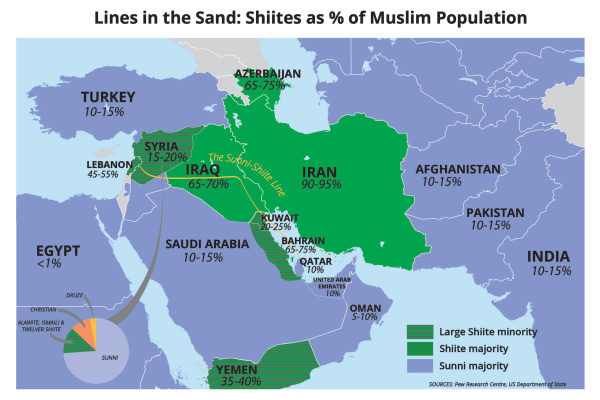
Consider this map:


.

It was ZenMeister who pointed me today, via Notes from Thermopylae, to Stephen Crittenden and his Global Mail piece, The Clash Within Civilisations: How The Sunni-Shiite Divide Cleaves The Middle East, from which the map above is taken. Crittenden writes:

There is a dangerous 2,000-kilometre fault line running through the Middle East between Beirut and Bahrain via Damascus and Baghdad, which marks the present line of demarcation between the two main branches of Islam, Sunni and Shiite.

The 1,300-year-old schism between Sunnis and Shiites was caused not by a theological dispute (those came later), but by rival clans in Muhammad’s tribe, the Quraysh, squabbling over the succession after his death in 632 AD.

Mostly the “Sunni-Shia Line” lies dormant, and ordinary Sunnis and Shiites live out their separate lives, side-by-side in relative harmony. In Lebanon and Iraq it has not been uncommon for Sunnis and Shiites to intermarry. But the Line is still always there, just below the surface, and it has recently re-emerged as the most significant factor reshaping geopolitical relationships in the Middle East, a region where religion and politics are always inextricably intertwined.

**

Suppose it, at least for now. And in that context, consider as a counterweight to all the talk about Iran, two fascinating pieces by the Pakistani novelist Maniza Naqvi.

Naqvi’s piece The Remit of Fear in 3 Quarks Daily today is worth reading — you may be interested in any one or more of her various critiques of the House of Saud:

I fear the perverse purchase of petrodollars from Saudi Arabia: the twin ideologies of Salafism and Islamophobia. …

[ … ]

I fear to imagine a county which produces no art, film, theater, song or dance. Yet such is the country created by the State of Saudi Arabia. I fear the reasons which cause 16 million citizens most of whom are not Saud in Saudi Arabia to remain silently compliant. The bulk of this population is under the age of 25 and disempowered and is ruled absolutely by old men who do not tolerate dissent or diversity of opinion. I fear the mindset that treats women as blots and clots to be erased or managed.

There’s plenty of food for thought there, not least about Pakistan:

I fear that the people unlearned and illiterate impressed by influence and the purchasing power of Saudi Arabia might be confused and unable to distinguish the House of Saud as being apart from the origin and the authors of Islam. I fear that this may be the case for Pakistan where matters are so far gone that if the father of the Nation, Mohammad Ali Jinnah were alive today he would not be able to go about freely for fear of being shot to death for being a Shi’a.

My own interest, as usual, draws me to the religious drivers at work and their impact:

I fear that after thirty years of petrodollar bonanzas and propaganda, Muslims are unable to delink Islam from the House of Saud. There are 5000 Saud and in comparison there are 1.2 billion Muslims all over the world. A majority of whom, for a myriad of reasons including illiteracy, poverty and sudden wealth are unable to resist or protest against the Saudi influence upon them. I fear that the populations of the world are unable to resist, protest and fight against the privatization of all that is their sacred to them: their lands where they grow their food, to the places where they congregate and live, to their own thoughts and even their bodies.

**

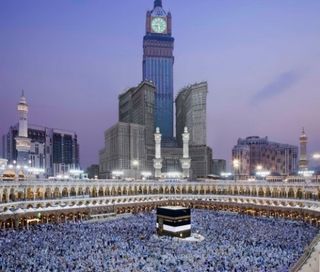
But you should read too her linked critique of the remaking of Mecca, The Architects of the War on Islam, from August 6th:

This is addressed to Muslims who think that Islam is under attack: They are right. Just take a look at the images of the House that Abraham built, the Ka’aba and see how progresses that ancient attack. Just look at the transformation of the environs of the Ka’aba and the Haram Shareef into a garish resort rivaling Las Vegas or Atlantic City.

Just look, at the transformation of the sacred environs of the Haram Shareef into a shopping mall and Disney world–to understand the war on Islam and who is responsible for waging it. Just look at this and see how Islam has been trafficked as though it were a bonded slave, dressed up in bells and baubles to be whipped and sold in the marketplace.

**

Note finally her remarks, in today’s piece, on fear and silence:

Much is at stake if people are not silent. Much is at stake if people remain silent.

[ … ]

I fear that Haj and the Ka’aba, a central principal of Islam, sacred to 1.2 billion people have been privatized, by an estimated 5000 people belonging to one family. Why? How is the privatization of the Ka’aba different from the wholesale seizure and privatization of the commons and public lands and spaces all over the world? I fear that the Ka’aba and the Haram Shareef which is sacred to 1.2 billion people has been privatized and occupied by the members of one family and that this is the same as what is happening to the entire world and its public goods and commons and public space which have been eroded and literally stolen from the people.

And now you can see, too, why I am reminded of Somoza and his farm, Nicaragua:

With this profound difference: that the Ka’aba is the Qibla, the point of orientation to which all Muslim prayer turns, as others orient their prayers towards Jerusalem.


Switch to our mobile site