zenpundit.com » putin

Archive for the ‘putin’ Category

The hands, the tie, the watch, the game of van Riper

Friday, February 6th, 2015

[ by Charles Cameron — because the subtler games are more interesting ]
.

van riper

**

It’s the mind that plays the game that interests me.

Why? Because what little I know of van Riper has to do with the war game he more or less closed down by sending a flotilla of tiny “red team” craft up against a US expeditionary fleet in the Persian Gulf:

Van Riper had at his disposal a computer-generated flotilla of small boats and planes, many of them civilian, which he kept buzzing around the virtual Persian Gulf in circles as the game was about to get under way. As the US fleet entered the Gulf, Van Riper gave a signal – not in a radio transmission that might have been intercepted, but in a coded message broadcast from the minarets of mosques at the call to prayer. The seemingly harmless pleasure craft and propeller planes suddenly turned deadly, ramming into Blue boats and airfields along the Gulf in scores of al-Qaida-style suicide attacks. Meanwhile, Chinese Silkworm-type cruise missiles fired from some of the small boats sank the US fleet’s only aircraft carrier and two marine helicopter carriers. The tactics were reminiscent of the al-Qaida attack on the USS Cole in Yemen two years ago, but the Blue fleet did not seem prepared. Sixteen ships were sunk altogether, along with thousands of marines. If it had really happened, it would have been the worst naval disaster since Pearl Harbor.

He may be a chess player, but that’s a whole lot subtler than chess.

**

As is this:

That’s a chewable.

John Schindler 3: his latest

Wednesday, January 21st, 2015

[ by Charles Cameron — third of three, almost caught up ]
.

Schindler a few days back:

Schindler’s latest:

**

Today’s John Schindler post, The West, Islam, and the Last Stand of the WEIRD, is another blockbuster must-read, but for my purposes in this series I’ll just quote a short excerpt. It’s the middle paragraph here that’s key, but I’ll give you a little before and after for context:

While Christian Europe of the last century still had some common ground with believing Muslims, the gap today between our societal values and those of most Muslims is vast and cannot be overcome without huge changes, perhaps on both sides, that seem unlikely to happen without bloodshed.

To make matters worse, the only European country that is making an effort to appeal to normal people of faith in dangerous times is Vladimir Putin’s Russia. In the aftermath of the Paris attacks, the Kremlin, speaking through its religious mouthpieces, has staked out a clear position that terrorism is unacceptable, but so is intentionally offending religious people with blasphemy. In this formulation, Russia — and Russia alone — offers a welcoming home to Christians and Muslims alike, while driving extremists of all sorts, whether they be jihadists or Communist cartoonists, out of the public square. Religion is not the problem, Russia makes clear, and its support for traditional religions here is consistent — extremism is.

WEIRDos in the West naturally find all this a tad comedic, and they were mightily surprised when Pope Francis (“One cannot provoke; one cannot insult other people’s faith; one cannot make fun of faith”) came alarmingly close to towing the Kremlin line about Charlie Hebdo. Yet again, post-moderns were distressed to discover that the Pope of Rome is actually a Catholic. You have to be part of the WEIRD demographic to find it “shocking” when traditional religion stands up against aggressive blasphemy.

**

I still haven’t quite figured out how almost everybody comes to have an opinion about almost everything: I know enough about a small archipelago of topics to have a sense of how much I don’t know, even in my areas of interest, in between my islands — and I am vividly aware that my chosen archipelago is only one of many, many, many — oh, why don’t I just quote Newton, and let him speak for us all:

I seem to have been only like a boy playing on the sea-shore, and diverting myself in now and then finding a smoother pebble or a prettier shell than ordinary, whilst the great ocean of truth lay all undiscovered before me.

There are areas of knowledge that John explores, in this post in particular, that I don’t know enough about to trust my own opinions on, but one point he keeps making keeps on shining through: that the western secular mindset has a blind spot wherever religious intensity appears.

And by religious intensity I don’t necessarily mean piety, or deep theological knowledge — which are the criteria that pollsters use to judge such things. The disciples of Christ were fishermen, he talked with prostitutes and (oy!) centurions among others, they were his peeps. The test, then, is not mosque, church or synagogue attendance, nor dietary behavior: religion happens, first and foremost, to humans, and that’s something John captures neatly, as it applies to Muslims, in this para about the majority of Muslims world-wide:

They try, they fail, they keep trying. They usually make an effort during Ramadan, at least, and if a life crisis appears, they will pray and seek the comfort of the mosque; the rest of the time their lived faith is rather hit-or-miss. In other words, they are completely normal human beings.

Human beings, that is, with an available transcendant perspective that can be activated by crisis, by global dissonance, by perceived injustice — as the supreme justification for brutality among those so disposed, and as the supreme invitation to good works among the likes of Nobel laureate Muhammad Yunus, and many less known but no less generous souls.

Heaven and Hell, no less than East and West, are present in human reality, as John Milton knew. We should permit them, with caution and understanding, into our minds and models, and onto our maps. First, though, we should understand and sense what they mean, within human hearts and minds — no easy task.

John Schindler 2: Putin’s Orthodox Jihad

Wednesday, January 21st, 2015

[ by Charles Cameron — second and central of three posts, this one concerning a very powerful JS post ]
.

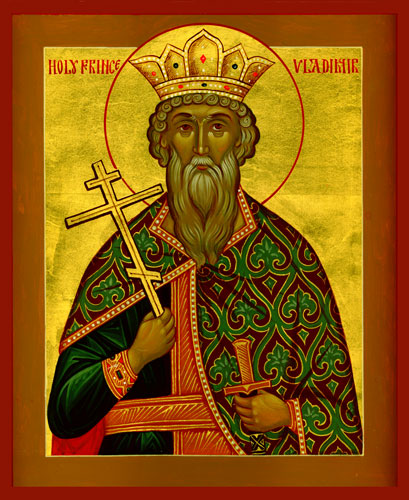
Vladimir the Holy Prince
Saint Vladimir

**

John Schindler‘s piece, Putin’s Orthodox Jihad, as I told him, answers so many of my unspoken questions that even thinking about it almost hurts my eyes. IMO, he is right on the mark indeed when he writes:

Nearly all Western experts, being mostly secularists when not atheists, paid no attention

As Zenpundit regulars know, this has been my own constant refrain here on the topic of global jihad, but John’s turf here is Vladimir Putin‘s once and future Greater Russia — it’s not exactly encouraging to note that the problem seems to be global.

**

In this post, John mentions Putin’s “fire-breathing speech to the Duma” in March 2014, in which Putin laid out his vision:

Everything in Crimea speaks of our shared history and pride. This is the location of ancient Khersones, where Prince Vladimir was baptised. His spiritual feat of adopting Orthodoxy predetermined the overall basis of the culture, civilisation and human values that unite the peoples of Russia, Ukraine and Belarus. The graves of Russian soldiers whose bravery brought Crimea into the Russian empire are also in Crimea. This is also Sevastopol – a legendary city with an outstanding history, a fortress that serves as the birthplace of Russia’s Black Sea Fleet. Crimea is Balaklava and Kerch, Malakhov Kurgan and Sapun Ridge. Each one of these places is dear to our hearts, symbolising Russian military glory and outstanding valour.

Everything except the reference to Temple Mount is already present in this speech, which predates the one I discussed in my previous post by eight months.

And as John notes of this seminal speech:

Putin included not just venerable KGB classics like warnings about the Western Fifth Column and “national traitors,” but also paeans to explicit Russian ethnic nationalism buttressed by Orthodox mysticism, with citations of saints from millennia past.

**

Two more points:

The late Russian philosopher Ivan Ilyin, whom Putin greatly admires, gave us this succinct and powerful account of how the cross and the sword can be accommodated together in a single theological perspective — again, I’m quoting John’s post:

In calling to love our enemies, Christ had in mind personal enemies of man, not God’s enemies, and not blaspheming molesters, for them drowning with a millstone around their neck was recommended. Urging to forgive injuries, Christ was referring to personal insults to a person, not all possible crimes; no one has the right to forgive the offenses suffered by others or provide for the villains to offend the weak, corrupt children, desecrate churches and destroy the Fatherland. So therefore a Christian is called not only to forgive offenses, but to fight the enemies of God’s work on earth. The evangelical commandment of “non-resistance to evil” teaches humility and generosity in personal matters, and not limpness of will, not cowardice, not treachery and not obedience to evildoers.

That’s quite a statement in and of itself. And furthermore:

This idea is more than a single man, more than a feat of one hero. This idea is great as Russia and the sacred as her religion. This is the idea of the Orthodox sword.

The second (further) point is one that John himself suggests:

We perhaps should be grateful that the Orthodox Jihad rejects suicide bombings. In the 1930’s, Romania’s fascist Legionary Movement, led by the charismatic Orthodox revolutionary Corneliu Zelea Codreanu, toyed with what terrorism mavens today might term “martyrdom operations,” but these never really caught on. Orthodoxy frowns on suicide, even in a just cause.

I read, live and learn.

**

Okay: let me say it again:

  • John Schindler‘s piece Putin’s Orthodox Jihad answers so many of my unspoken questions that even thinking about it almost hurts my eyes. Highly recommended indeed!
  • Of related interest:

  • Mark R. Elliott, Why Russia’s Evangelicals Thank God for Putin
  • John Schindler 1: Putin, Gorenberg, Jerusalem

    Wednesday, January 21st, 2015

    [ by Charles Cameron — Putin: the other fellow’s Ukraine is this fellow’s Temple Mount ]
    .

    It is hard to keep up with John Schindler [@20committee]: his writings flow fast and sure enough that I feel a bit like Alice, running fast to keep still, as I try to think through enough of what he writes to make meaningful comments. In this series of posts, I’ll try to come close to catching up.

    **

    St Putin icon & gas

    **

    First, as backdrop and just for the record, here are Vladimir Putin‘s comments on the spiritual relationship between Russia and the Ukraine, in which he compared the Ukraine to the Temple Mount in Jerusalem, from a transcript of his December 2014 Presidential Address to the Federal Assembly:

    Of course, we will talk about this year’s landmark events. You know that a referendum was held in Crimea in March, at which its residents clearly expressed their desire to join Russia. After that, the Crimean parliament – it should be stressed that it was a legitimate parliament that was elected back in 2010 – adopted a resolution on sovereignty. And then we saw the historical reunification of Crimea and Sevastopol with Russia.

    It was an event of special significance for the country and the people, because Crimea is where our people live, and the peninsula is of strategic importance for Russia as the spiritual source of the development of a multifaceted but solid Russian nation and a centralised Russian state. It was in Crimea, in the ancient city of Chersonesus or Korsun, as ancient Russian chroniclers called it, that Grand Prince Vladimir was baptised before bringing Christianity to Rus.

    In addition to ethnic similarity, a common language, common elements of their material culture, a common territory, even though its borders were not marked then, and a nascent common economy and government, Christianity was a powerful spiritual unifying force that helped involve various tribes and tribal unions of the vast Eastern Slavic world in the creation of a Russian nation and Russian state. It was thanks to this spiritual unity that our forefathers for the first time and forevermore saw themselves as a united nation. All of this allows us to say that Crimea, the ancient Korsun or Chersonesus, and Sevastopol have invaluable civilisational and even sacral importance for Russia, like the Temple Mount in Jerusalem for the followers of Islam and Judaism.

    And this is how we will always consider it.

    **

    How serious is this?

    End times, apocalypse-serious in three religions, driest kindling for a global wildfire in our drought-ridden world. All it would take is a single spark, and there are those who play with matches:

    Israel indicts Livvix Aqsa

    To me, that’s nightmare scenario number 1, number two having to do with Pakistani nukes..

    **

    Gershom Gorenberg, whose book The End of Days is still the best guide to the clashing of rival apocalypses on the Temple Mount aka the Noble Sanctuary — writes of that “thirty-five-acre not-quite-rectangular enclosure on the souther-east corner of the Old City of Jerusalem” that it is “the most contested piece of real estate on earth”.

    Everyone, from the Lord on down, surely knows that the center of the earth is Jerusalem — even the maps tell us so:

    462_medieval-mapJerusalemCenterC1250

    As Rabbi Nachman of Bratslav says:

    Wherever I go, I go to Jerusalem.

    — and we can zoom further in:

    As the navel is set in the centre of the human body,
    so is the land of Israel the navel of the world…
    situated in the centre of the world,
    and Jerusalem in the centre of the land of Israel,
    and the sanctuary in the centre of Jerusalem,
    and the holy place in the centre of the sanctuary,
    and the ark in the centre of the holy place,
    and the foundation stone before the holy place,
    because from it the world was founded…

    **

    Given the centrality of the Temple Mount, then, what are the prospects should someone, not unlike Adam Everett Livvix perhaps, motivated by desire to see the Temple rebuilt and Moshiach or Christ make his presence felt, attempt to destroy the mosques atop the Mount — as has already been attempted more than once?

    Jeffrey Goldberg‘s interview with Gershon Salomon, leader of the Temple Mount Faithful movement, published in the New York Times just before the turn of the millennium, included this fascinating and to my mind alarming exchange:

    I ask him how he would feel if someone blew up the Dome of the Rock.
    “The question is, Why did they build their mosque on our holy mountain, anyway? Who gave them permission? God didn’t.”
    Would you be saddened if the destruction of the Dome of the Rock led to war?
    “I don’t think it will come to that. The Muslims know in their heart that this belongs to us.”
    “But what if it did lead to war?”
    Salomon smiled. “The Temple will be a reality. God has promised it.”
    But what about war?
    “O.K.,” he said impatiently, “so we’ll have a war.”

    **

    Quite how far into the parallelism between the Temple Mount and Ukraine Putin wants to go is an unknown — but my sense is that John Schindler would come closer to the answer than most.

    This was the first of three posts.
    The Holy Ghost & the Machine?

    Monday, December 8th, 2014

    [ by Charles Cameron — because throwing holy water at a computer is foolish and beautiful, a combo I rather like ]
    .

    Arthur Koestler‘s book title, The Ghost in the Machine, came to mind a day or so ago when I saw this tweet:

    **

    A memory stirred: I had seen something similar before.

    Back in 1999 — when programmers were putting in overtime to remediate or work around the so-called Y2K bug, CEOs were concerned as to the potential ripple-through effects of Y2K computer failures on just-in-time acquisition and distribution channels, and I was monitoring the possible social impact if, for instance, fear of bank failures led to bank failures, or terrorists saw a massive vulnerability and ran with it — a curious document came across my desk.

    You might say, Mammon gave a sermon.

    **

    The sermon was actually written for and distributed by the American Bankers Association to its members, for them to pass along to their pastors, rabbis and imams as what we might call sermon-fodder — a seldom mentioned sub-category of the public relations genre that gives us that handy shortcut to avoid actual thought, the press release.

    The Washington Post highlighted this quote:

    “Prepare as best you can,” advises the sermon, written by an ABA speechwriter and made available to local bankers earlier this month. “Then trust God for the rest”

    Also known as “trust in God, but first tie your camel”.

    **

    Here’s a link to the suggested sermon, plus a paragraph or two of text, in case at this late date you are still worried about bank failure, or indeed are worried now for the first time — the fall of the rouble, too, I suppose, has potential ripple-through impact on the global economy, though I know less than nothing about such things myself.

    Sermon Title: Thinking about Y2K: Moses, Orson Welles and Bill Gates

    You’ve heard the dire warnings, the off-the-wall forecasts and the downright silly predictions. Life insurance companies, they say, could bill us for coverage for the past 100 years. Airplanes won’t get off the ground. And that could be the good news. Our bank accounts will show zero. Our mortgages will require another 100 years of payments. Hospital monitoring equipment will stop monitoring. The lights will go out. The phones will fail. We’ll be plunged into a deep, cold winter without heat, electricity, money or — worst of all, pizza delivery.

    And yes, some of us will report actually seeing a fire on the horizon.

    Grovers Mill all over again. Orson Welles would be pleased.

    Quite a few jokes have been made about Y2K as well. Perhaps you’ve heard that Bill Gates has just announced the official release date for the new Windows 2000 software.

    It’s to be the second quarter of 1901.

    [ .. ]

    Most important, we should understand what Y2K really means. It’s a computer headache that experts are working to fix right now, not an alien invasion of New Jersey. And not the end of the world. As members of God’s community, we can and should play a leadership role in helping our own families, friends and community prepare for Y2K. By understanding it. And by not being afraid. We want to go into the next Century as God intended, with hope, knowledge and the promise of a bright future.

    **

    I imagine it must have been quite fun writing that — and in the event, banks didn’t fail, and we went into the next century, and indeed millennium, pretty much as divinely intended.

    But forget Y2K, forget the rouble’s present troubles: what’s the proper relationship between God and Mammon, spirituality and survival, the Ghost and the Machine?

    I’m not convinced we’ve figured that one out as yet.


    Switch to our mobile site