zenpundit.com » black banner

Archive for the ‘black banner’ Category

Raqqa, Syria: the Stations of the Cross

Saturday, September 28th, 2013

[ by Charles Cameron — a small devotional exercise for our sometimes too-secular world ]
.

In the upper image of the pair above, a crowd in Raqqa, Syria, is protesting the desecration of a church by Islamist enthusiasts who had pulled down the cross atop a church. The people of Raqaa took to the streets in protest, chanting:

Syria belongs to Muslims & Christians.

The Roman Catholic devotion known as the Stations of the Cross involves a prayerful mini-pilgrimage around fourteen “stations” representing stages in the passion and crucifixion of Christ — each of which is traditionally marked with an image of the “station” in question. In the case illustrated in the lower panel above, the station is that of Simon of Cyrene, who was pressganged into bearing the weight of the cross on his shoulders for part of the way, to give the agonized Christ some relief.

The good people of Raqqa are thus enacting, informally, with courage and grace, the Station in which Simon of Cyrene is made to bear the cross. And there’s an echo here, too, of Christ’s injunction recorded at Luke 9.23:

And he said to them all, If any man will come after me, let him deny himself, and take up his cross daily, and follow me.

There’s a spontaneous beauty that crosses the lines between two world religions — and secularism — in all this.

**

But the cross itself also suffers its indignities, and thus the two images of the pair that follows can also be considered Stations of the Cross.

In the upper image (below), the cross is removed by State of Iraq and al-Sham militants from its proper station atop the church, to be replaced with their black banner one of their number is holding, while in the lower image we see another screen cap of the townspeople, who have retrieved the cross and are carrying it through the streets to safety:
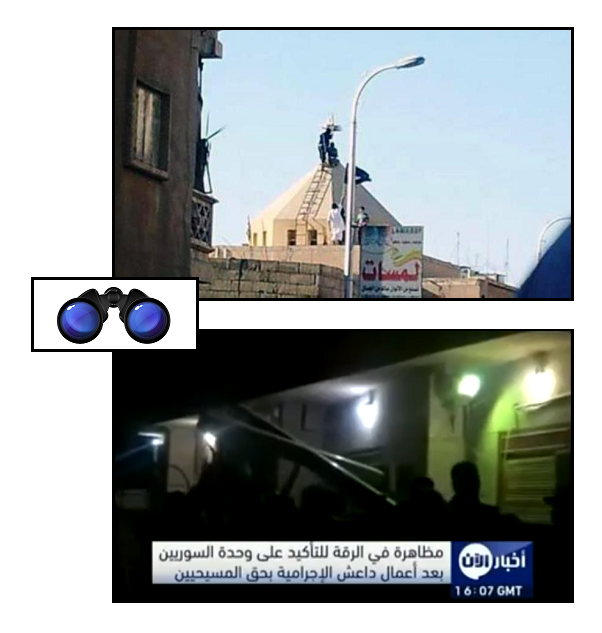
The people are chanting:

Syria belongs to Muslims & Christians.
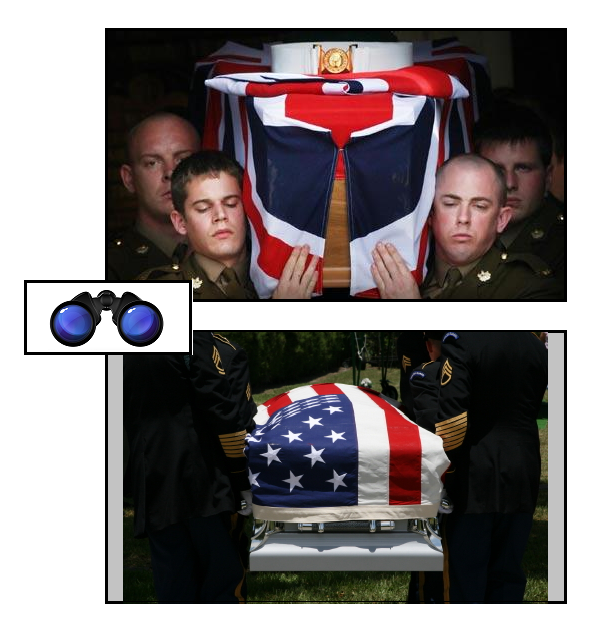
Flags, shrouds, martyrs and the Fallen

Saturday, August 17th, 2013

[ by Charles Cameron — burial flags, shrouds on the unknown, and the black banner seen from a new angle ]
.

I feel grief.

**

We are, by now, all too well aware of the cost of war in lives. Sometimes those lives are of unknown souls, perhaps belligerents, perhaps partisans, perhaps peace-makers, perhaps simple souls caught in the cross-fire…

Caitlin Fit Gerald has a suitable memorial for those recently dead in Egypt, which I won’t reproduce here because I would make her already scaled-down images even smaller and less impressive if I did — click through to The Dead, When The Dying Is Done, then click again to see the images at better scale.

**

Sometimes the dead are our foes.

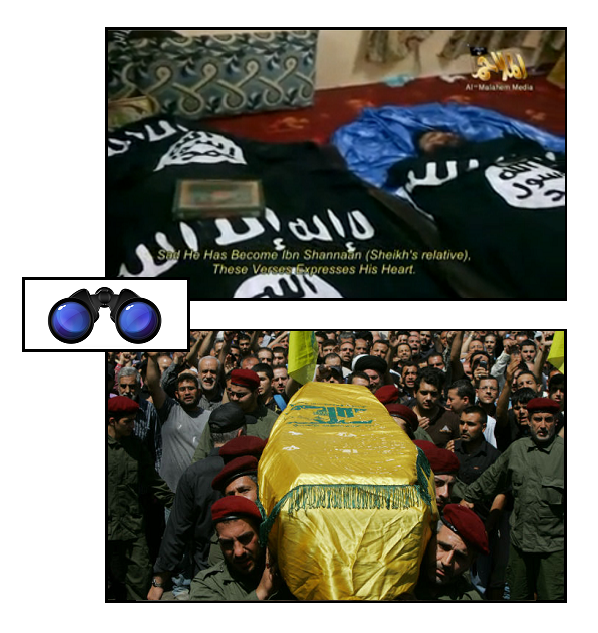
What interests me particularly on this occasion is seeing the Sunni Islamist black banner in what is for me a new context — draped like the Shi’ite flag of Islamist Hezballah on the martyrs of their faith.

**

It raises for me another question: Hezbollah and the Salafi jihadists alike term their dead “martyrs”. We honor ours no less, wrapping them in symbols of that greater cause for which they gave their lives — “country” — and call them “patriots” to distinguish their cause, and “heroes” to salute their courage.

Yet they gave their lives. To indicate and honor this, we call them “the Fallen” — and perhaps in its quiet way it is enough.

Of the arm, fist and rifle

Thursday, July 25th, 2013

[ by Charles Cameron — product from a neat, brief convo with Ibn Siqilli aka Chris Anzalone ]
.

I found the upper image in the same Visual References post from Chris Anzalone that I recommended recently in two comments here [figs 2, 3, 3B] and here. If you look closely — or is just my poor eyesight? — you’ll see the arm, fist and rifle to the left of the black banner in the upper half of the upper image.

Black banner? Did I just say black banner?

That upper image is the “logo of the Brigade of the Awaited Savior (Katibat al-Mahdi al-Muntazar)” according to Chris, and the text below reads, “O’ One Who Arises (al-Qa’im) [from] the family of Muhammad.”

So there you have Mahdism (the titles al-Muntazar and al-Qa’im are both indicators of the same returning great one as the term al-Mahdi itself) along with the well-known banner…

**

What follows I have taken from a post on the Lebanese Expatriate blog, with some minor format changes to give the contents better graphical integration with the rest of the post:

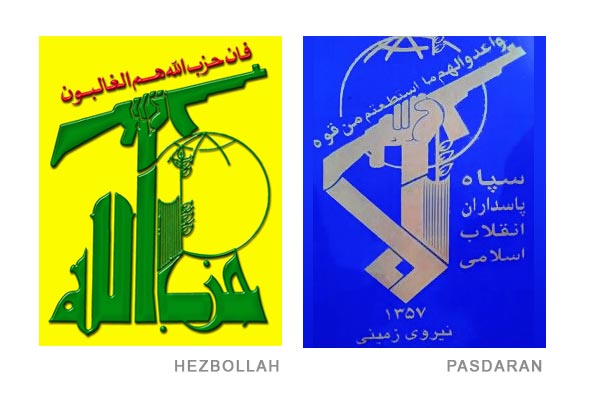
For those with the slightest knowledge about Hezbollah and the Middle East, I am not sharing with you something new, but for those who receive this information as a revelation, check out the resemblance between the emblem of Hezbollah and that of the Pasdaran, a.k.a Army of the Guardians of the Islamic Revolution.

.

— Hezbollah emblem to the left in yellow. Pasdaran emblem to the right in blue.
.

So what’s new? Why am I shedding light on what is already obvious? Why target Hezbollah today, out of all the parties that have been selling Lebanon?

Today, more than ever, Hezbollah and Iran owe Lebanon an explanation. Take a look at the 10 Riyal postage stamp that is circulated in Iran.


Iranian 10 Riyal postage stamp showing the emblem of Hezbollah covering the whole map of Lebanon. A clear symbol of the hidden intentions and a direct breach for the sovereignty of Lebanon’s independence as a nation.

The stamp commemorates the martyrs of Hezbollah in Lebanon. Isn’t this an obvious breach of Lebanon’s sovereignty as a nation? I understand the bff relationship between Iran and Hezbollah, but why does Iran need to have Hezbollah’s emblem covering the Lebanese territories instead of the Lebanese flag? Why does Iran need to commemorate the Lebanese martyrs in the first place?

What does Hezbollah have to say about this in the first place? How can Hezbollah justify such a demeaning document? What can its big-bellied, tie-less MPs and representatives say to logically justify this? Will they even attempt to justify it, or consider it normal and not even worth concealing with the whole world’s knowledge of its non-matrimonial marriage to Iran.

As a Lebanese, I ask my government (which is controlled by Hezbollah) to question the Iranian ambassador about the motives of this stamp and ban its circulation.

As a Lebanese, I ask Hezbollah to denounce the usage and circulation of this stamp in Iran and ask the Iranian state for an apology to the Lebanese people and its government.

That’s taken from a post made in January, but I think it is no less relevant today, and adds to the general picture I’m painting.

**

I put this post together as the result of an exchange with Chris in which I asked him whether a raised arm with slanted rifle was now a characteristic motif across many or all Shi’a jihadist movements, to which he responded:

Those groups influenced by Hizbullah &, by extension, Iranian Gov’t, seem to favor it, likely b/c it’s used by the Pasdaran.

I then asked whether he’d say Hizbollah got the motif from the Pasdaran or vice versa, to which he replied:

The former.

I stumbled across the DoubleQuote image and accompanying Lebanese Expatriate post myself, searching for the best image of a Pasdaran flag or logo while following up on Chris’ pointer to the Pasdaran — and that gave me yet another use of DoubleQuotes in the wild!

Hat-tip, #FF and thanks, Chris!

**

Quiet note to self: compare the arm, fist and rifle motif here with the name of the Covenant, Sword, and Arm of the Lord group in 1970s Arkansas. Most interesting, the way we display value systems in titles and images…

Those black banners / AQ flags, revisited

Tuesday, July 9th, 2013

[ by Charles Cameron — don’t let’s go overboard, eh? ]
.

I’d like to note up front that Liz Sly was talking about a pro-Morsi rally, and Leah very possibly about an anti-Morsi event…

In any case, these two tweets between them remind me that my own interpretation of “black banners” in terms of the army from Khorasan may well be due for retirement except when specifically indicated.

**

I’ve been writing here for a while about the black banners of Khorasan and their apocalyptic resonance, especially for those in Afghanistan and recruiting for AQ: today I’d like to suggest two qualifications.

The first is that there are a variety of black flags flown in various parts of the world for various purposes, and have been since the Prophet first flew his black flag, the Raya. It seems plausible that the Khorasan ahadith originated with the ‘Abbasids, in support of their own miltary activities, and certainly black banners taken together with those ahadith have been a powerful recruiting tool for AQ, as illuuminated in their respective books by Ali Soufan and Syed Saleem Shahzad.

But there are black flags and black flags, some plain black, some bearing the shahada, some with what looks to be a replica of the Prophet’s seal — and the one that is most commonly called “the Al-Qaida flag” is the one that originated with the Islamic State of Iraq — see Aaron Zelin‘s post on the matterr at al-Wasat. That post, btw, is likely the one that seeded my thoughts here.

My second point, then? A problem arises when we begin to think that any black flag seen, photographed, or reported in any Islamist context is “the AQ flag” — or indeed that any of the varieties of black flag reported hither and yon would qualify for that appellation.

In Iraq, the flag with seal, okay. A black flag with shahada in a Khorasan / Mahdist context — yes, and with Mahdist overtones. Otherwise — maybe, or maybe not so much.

So could we be a little more cautious, and more specific?

As for Cairo — I wasn’t there, and haven’t see a Liz Sly photo, so I don’t know which black flag or flags she saw. And yes, she was at a pro-Morsi rally. But as Leah notes, in recent days black flags have been less prominent, and Egyptian flags more in evidence — as indeed, this photo from an anti-Morsi rally on July 3 this year suggests:

If my guess is any good, then, black flags showing up in Egypt now presumably indicate MB or Islamist but not necessarily by any means AQ sympathies, while Egyptian flags would appear to indicate dissatisfaction with Morsi and his Islamist cohorts, combined with strong nationalist sentiment and pride.

**

Corrections, amplifications etc are welcome… This is a test post, really: a big question mark. I’ve an inquisitive mind to be sure — but as you’ll have seen in my previous post, I also admit to ignorance.

Oh —

And now I’m totally confused, too — El Cid just pointed me to Arch Enemy‘s Under Black Flags We March video. Eh?

Sisyphus on the treadmill of memes

Thursday, May 9th, 2013

[ by Charles Cameron — Khorasan, black banners, the Ghazwa-e-Hind — when will the updating ever stop? ]
.

**

It looks as though I first realized that “the black banners of Khorasan” was a meme I should be “eyes out” for was in July 2007, when John Robb pointed us to a piece by Syed Saleem Shahzad on events at the Red Mosque

For the al-Qaeda leadership sitting in the tribal areas, the situation is fast evolving into the promised battle of Khorasan. This includes parts of Iran, Pakistan, Afghanistan and Tajikistan from where the Prophet Mohammed promised the “end of time” battle would start.

That reference to Khorasan in turn led me back to a slightly earlier Washington Post piece where the Khorasan / black banners motif was clearly set forth, along with a pointed comment from Andrew Black, co-founder of Thistle Intelligence Group:

The battles today, like those against the Soviet occupiers, are also fought with religious verve. The Taliban and al-Qaida fight under a black flag connoting the participation of Islam’s prophet in their battle for Khorasan, the ancient name for the region centered around Afghanistan.

Khorasan increasingly features in the militants’ videos and the name was taped to the leg of a suicide bomber who killed 24 people in Pakistan’s Northwest Province this spring.

“One should not underestimate the theological importance of Khorasan to aspiring mujahedeen; particularly those who are only able to initially view the conflict through the Internet,” said Black.

Hamid Gul was in Shahzad’s piece too, talking about the Red Mosque and the Red Fort — and here, too, I likely made my first acquaintance with the motif of the Ghazwa-e-Hind, symbolized by the wish to plant Pakistan’s flag on Delhi’s Red Fort:

It is a pity that our army was preparing youths to seize Lal Qala [the Red Fort of Delhi] and they ended up seizing the Lal Masjid,” Gul said.

Both these memes have been around longer than I have, but back then they didn’t seem to be attracting much attention in the west.

Now they’re cropping up all over — and I’m (to switch metaphors in mid-stream) paddling hard to keep up.

**

The black flags are alive and well this week, as shown in this video of the graduation of a new batch of the Free Army fighters in Syria:

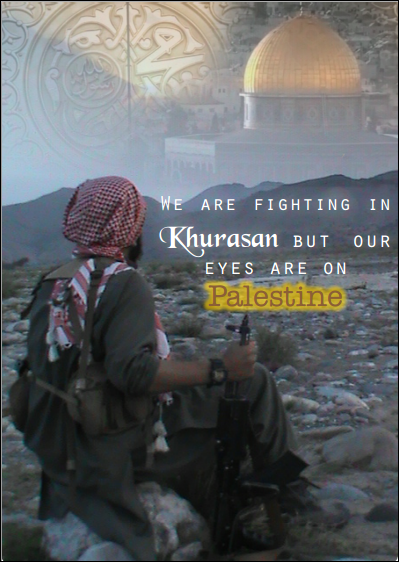
Khorasan too, as seen in the image from the new magazine Azan at the top of this post — but where does Azan itself come from?

B Raman writes:

It is not yet clear who has started “Azan”. One suspect is the Tehrik-e-Taliban Pakistan (TTP), which is the Pakistani Taliban. The other suspect is Al Qaeda headquarters in the South Waziristan area of Pakistan.

I’m interested in this question, because Azan had an overview of the various fronts of contemporary jihad, and an image that invokes both Khorasan and Jerusalem isn’t exactly “local” in focus. And that brings me to that other meme of interest here — the Ghazwa-e-Hind — which as I pointed out recently ius also mentioned in Azan, though not a huge focus there.

But if Azan is indeed a TTP product, then this info from Mr Orange:

would indicate they find the Ghazwa of more than passing interest…


Switch to our mobile site