zenpundit.com » iran

Archive for the ‘iran’ Category

Ayatollah Khameini: Crony Capitalist and Slumlord

Wednesday, November 13th, 2013

[by Mark Safranski, a.k.a. “zen“]

Reuters has begun a remarkable series on the economic dealings of Iran’s Supreme Leader, Ayatollah Khameini who controls a staggering fortune of $ 95 billion dollars through a secretive fund Setad that expropriates the property of poor Iranians and religious minorities. This would put the venerable theocrat in the same superclass as Bill Gates, Carlos Slim, Warren Buffet and the Sultan of Brunei .

Up until now, former Iranian president Rafsanjani has always been the face of financial corruption in Iran’s clerical hierarchy, but to paraphrase John D. Rockefeller’s comment about J.P. Morgan, compared to Khameini ” he’s not even a rich man”:

Khamenei controls massive financial empire built on property seizures 

The 82-year-old Iranian woman keeps the documents that upended her life in an old suitcase near her bed. She removes them carefully and peers at the tiny Persian script.

There’s the court order authorizing the takeover of her children’s three Tehran apartments in a multi-story building the family had owned for years. There’s the letter announcing the sale of one of the units. And there’s the notice demanding she pay rent on her own apartment on the top floor.

Pari Vahdat-e-Hagh ultimately lost her property. It was taken by an organization that is controlled by the most powerful man in Iran: Supreme LeaderAyatollah Ali Khamenei. She now lives alone in a cramped, three-room apartment in Europe, thousands of miles from Tehran.

….But Setad has empowered him. Through Setad,Khamenei has at his disposal financial resources whose value rivals the holdings of the shah, the Western-backed monarch who was overthrown in 1979.

How Setad came into those assets also mirrors how the deposed monarchy obtained much of its fortune – by confiscating real estate. A six-month Reuters investigation has found that Setad built its empire on the systematic seizure of thousands of properties belonging to ordinary Iranians: members of religious minorities like Vahdat-e-Hagh, who is Baha’i, as well as Shi’ite Muslims, business people and Iranians living abroad.

Setad has amassed a giant portfolio of real estate by claiming in Iranian courts, sometimes falsely, that the properties are abandoned. The organization now holds a court-ordered monopoly on taking property in the name of the supreme leader, and regularly sells the seized properties at auction or seeks to extract payments from the original owners.

The supreme leader also oversaw the creation of a body of legal rulings and executive orders that enabled and safeguarded Setad’s asset acquisitions. “No supervisory organization can question its property,” said Naghi Mahmoudi, an Iranian lawyer who left Iran in 2010 and now lives in Germany.

The Persian name of the organization that hounded her for years is “Setad Ejraiye Farmane Hazrate Emam” – Headquarters for Executing the Order of the Imam. The name refers to an edict signed by the Islamic Republic’s first leader, Ayatollah Ruhollah Khomeini, shortly before his death in 1989. His order spawned a new entity to manage and sell properties abandoned in the chaotic years after the 1979 Islamic Revolution.

It used to be said back in the 70’s by Western intellectuals of the tweedy, social democratic, Left variety that the future would be a merging of Communism and Capitalism into a “Third Way”, perhaps, it was optimistically suggested, of the gentle Scandinavian variety with, democracy, universal free child care and quaint, bicycle-riding, constitutional monarchs. I doubt anyone thinks that today. If there is any emerging universal model at all it is that of nasty authoritarian governments being run, sometimes under a facade of elections, by a bareknuckle, crony capitalist Oligarchy that hollowed out the state.

Sometimes,the crony capitalists are merely the junior partners to the mandarins, siloviki and mullahs and at other times you could look “….from pig to man, and from man to pig, and from pig to man again” and be hard pressed to tell the difference.

Khamenei’s conglomerate thrived as sanctions squeezed Iran 

….The ayatollah’s organization would go on to acquire stakes in a major bank by 2007 and in Iran’s largest telecommunications company in 2009. Among dozens of other investments, it took over a giant holding company in 2010.

An organizational chart labeled “SETAD at a Glance,” prepared in 2010 by one of Setad’s companies and seen by Reuters, illustrates how big it had grown. The document shows holdings in major banks, a brokerage, an insurance company, power plants, energy and construction firms, a refinery, a cement company and soft drinks manufacturing.

Today, Setad’s vast operations provide an independent source of revenue and patronage for Supreme Leader Khamenei, even as the West squeezes the Iranian economy harder with sanctions in an attempt to end the nuclear-development program he controls.

“He has a huge sum at his disposal that he can spend,” says Mohsen Sazegara, a co-founder of the powerful Islamic Revolutionary Guard Corps military force, who is now living in exile in the United States. “When you have this much money, that’s power itself.” 

Indeed. It insulates Khameini’s core supporters from external financial pressure and allows Khameini to have an arsenal of carrots, not just sticks in dealing with other members of the Iranian ruling elite.

It is often overlooked how frequently dictators, even those who were known for ruling through terror like Hitler, Stalin and Mao, could be lavishly generous with gifts and financial rewards or indulged the blatant corruption of powerful subordinates like Goering, Abukumov or Kang Sheng. Every Grand Ayatollah and Marja in Shia Islam maintains a charitable trust to which their pious followers donate. I would be extremely surprised if Khameini, whose scholarly credentials share similarities with Leonid Brezhnev’s military decorations, had not made arrangements for substantial contributions over the years from Setad to the trusts of Iran’s most respected senior clerics.

Baksheesh is an older faith in Iran than is Islam.

Now, about taklif, and about parawar?

Tuesday, October 15th, 2013

[ by Charles Cameron — two learnings about Hezbollah, in process and with one question each ]
.


.

The trouble with this internet thing is that it offers nonstop opportunities for learning.

I hope my readers here at Zenpundit know by now that I’m an amateur (a lover) of the topics that I write about, learning as I go. I have long thought fard ‘ayn or individual obligation was the key phrase in religious recruitment to the jihad, conveying as it does divine sanction for the deeds properly committed under that license. I believe I first encountered the phrase in the context of Muhammad Abd al-Salam Faraj and his book, The Neglected Duty. It’s my (strictly amateur) hunch that the neglected (pun intended) Faraj should be the object of as much of our study as the far better known Sayyid Qutb.

**

Just yesterday Phillip Smyth posted an extended piece on the Brown Moses blog, Hizballah Executing Syrian Prisoners? – Analyzing the Video, which in turn introduced me to the concept of taklif al-sharii. The key paras read:

In a June USA Today article which covered Hizballah’s involvement in Syria, a Hizballah fighter noted, “Everyone who is sent to fight in Syria has received a ‘Taklif Sharii'”. USA Today added the taklif sharii is “a religious command that means he will go to heaven if killed.” Nevertheless, the taklif sharii is more than just a religious edict which guarantees a martyred fighter’s spot in heavenly paradise. It is a religious obligation put forth by a cleric and must be followed. In fact, it is a form of religious ruling which underpins the Khomeinist ideology guiding Iran, Hizballah, and all of the main Iraqi Shia organizations sending militiamen to Syria.

Augustus Richard Norton noted that Hizballah’s adherence to taklif sharii is a theological legal ruling, “as though commanded by Allah”. According to Mohammed Sherri, an Al-Manar (Hizballah’s official TV channel) commentator, “once a taklif is issued, violating it is similar to any sin, like murder or adultery, or not praying or fasting.” In traditional Shi’ism, the taklif sharii was rarely issued and normally did not deal with political issues. The concept was actually revived as an important Shia idea by the father of Iran’s Revolution, Grand Ayatollah Khomeini and as an important support for his form of clerical rule, Wilayat al-Faqih (in Persian it’s known as Velayat e-Faqih). In effect, the issuing of a taklif sharii by a high ranking Shia cleric, in this case Iranian Supreme Leader Ayatollah Khamenei—The “Spiritual leader” of Hizballah and the other Iraqi Shia groups, is a direct order coming from Allah.

So — here are my amateur — still learning — questions: does taklif sharii serve the same function among Shia jihadists as fard ‘ayn does among Sunnis? Are both terms used in both communities? The parallel between the two terms, and the differences between the kinds of authorities who control Sunni and Shiite discourses in matters such as these, would make for an interesting exploration I think.

Okay, that’s the “About taklif” section of this post.

**

As you might imagine, though, Smyth’s post set me reading Augustus Richard Norton‘s piece, and there I discovered another interesting snippet, on another topic entirely:

From the Israeli withdrawal of May 2000 until the eruption of war in July 2006, there was aggressive patrolling, heated rhetoric and periodic episodes of violence by both sides. Most of the armed attacks were in the disputed Shebaa farms. By historical standards, however, this was a relatively quiet period. In general, clashes respected “rules of the game”, which had been codified in writing in 1996 and specified that Israel would not attack civilians in Lebanon and Hezbollah would not attack Israel. As Daniel Sobelman notes, the rules were so well established that officials were sometimes quoted as saying that such and such skirmish was ‘‘within the rules’’.

The Sobelman reference points us to:

Sobelman, D. New Rules of the Game: Israel and Hizballah after the Withdrawal from Lebanon. Tel Aviv: Jaffee Center for Strategic Studies, Tel Aviv University, 2004, pp. 67–82.

Okay, here’s second my question, the one about “parawar”. What’s the Clausewitzian term for something of this kind, far beyond politics, “within the rules” yet still not quite war — parawar? The duel comes to mind, too.

So: is there a word for such things?

Quick one: Death to America is not in the Quran

Monday, September 30th, 2013

[ by Charles Cameron — a sign of the times? ]
.

Definitely of interest, implications to be discovered:

Excellent theology, that, at the very least!

DoubleQuoting ReTweets

Saturday, September 28th, 2013

[ by Charles Cameron — of tweets, and telephones, and terminal points with teletype equipment ]
.

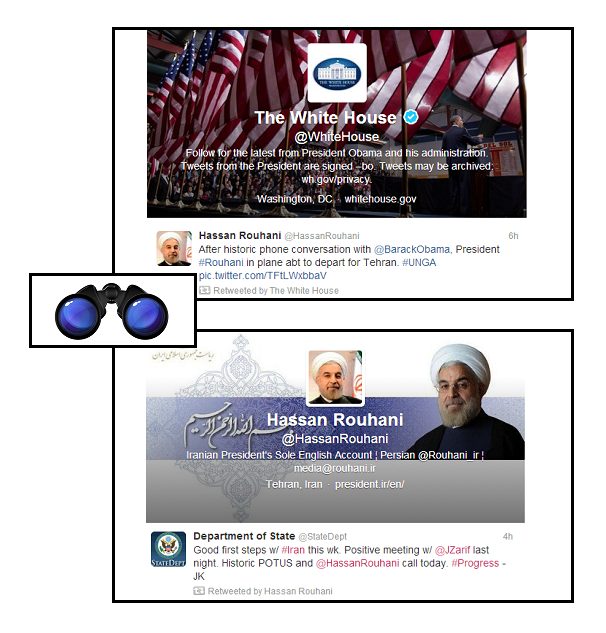
The White House RTs Rouhani, Rouhani RTs State.

Is this a “sign of the times”?

Was any bookmaker offering odds on this happening?

**

Would I have been excited enough to want to write it up if I’d just found out, fifty years ago, that the White House had a “red telephone” that connected directly to the Kremlin?

I doubt it — but this article from the Smithsonian, There Never Was Such a Thing as a Red Phone in the White House informs us that it wasn’t a question of telephones either — it was…

two terminal points with teletype equipment, a full-time duplex wire telegraph circuit and a full-time radiotelegraph circuit.

Now — why am I feeling just a tad saddened by that tidbit of lifelong learning?

Obama mentions Khamenei “nuclear fatwa”

Tuesday, September 24th, 2013

[ by Charles Cameron — I believe this is the first time a US President — perhaps even a senior US official — has affirmed the existence of Ayatollah’s Khamanei’s previously disputed so-called “nuclear fatwa” ]
.

Here, from the Washington Post‘s full transcript of President Obama‘s address to the UN General Assembly, is the relevant section — I’ve emphasized his reference to the fatwa in red:

Since I took office, I’ve made it clear in letters to the supreme leader in Iran and more recently to President Rouhani that America prefers to resolve our concerns over Iran’s nuclear program peacefully — although we are determined to prevent Iran from developing a nuclear weapon. We are not seeking regime change, and we respect the right of the Iranian people to access peaceful nuclear energy. Instead, we insist that the Iranian government meet its responsibilities under the Nuclear Non-proliferation treaty and U.N. Security Council resolutions.

Meanwhile, the supreme leader has issued a fatwah against the development of nuclear weapons. And President Rouhani has just recently reiterated that the Islamic republic will never develop a nuclear weapon. So these statements made by our respective governments should offer the basis for a meaningful agreement. We should be able to achieve a resolution that respects the rights of the Iranian people while giving the world confidence that the Iranian program is peaceful. But to succeed, conciliatory words will have to be matched by actions that are transparent and verifiable.

**

Further reading:

I believe we tend to underestimate the significance of religious and apocalyptic influences in international affairs, since the development of Iranian nuclear weaponry is a potential casus belli, and since the use of nuclear weapons has a distinctly apocalyptic aura, I’ve tried to take an interest — here’s my lengthy overview of “religion and nukes” in religion and myth worldwide, from 2008.

  • I catalogued my own understandings about the fatwa here on Zenpundit in a 2011 post, Striking Iran — response to Cheryl. I lack access to both Iranian language and classified sources, however, so that post represented a best effort to corral what I could find, but kis far from definitive.

  • Cheryl Rofer has also been following this discussion with interest, and her two posts for Nuclear Diner, The Fatwa Against Nuclear Weapons of January this year and The Nuclear Fatwa of March present her latest understandings — Cheryl, please correct me if you have written anything more recent or more comprehensive.

  • Selfscholar claims to be a “portal for unique, pertinent research on law and human rights in the Middle East”. I cannot speak to the particular interests, influences, credentials or biases of those who posts there, but the materials on our topic, that I have found there — in English but with extensive citations of original texts — will surely provide any researcher who possesses the appropriate language skills with many further pointers to track down… My starting point would be a search of the site for the keywords “nuclear fatwa”. The most recent post there would be Radioactive Fatwas: The Growing Islamist Legitimization of Nuclear Weapons from the 17th of this month. And Go, Learn About Atoms: Iranian Discourse on Nuclear Weapons, 1962-Present, at 32 pp. and posted in June 2013, would appear to offer a detailed historical presentation.

  • **

    And for further context:

  • Yesterday’s Financial Times brought us a piece by Najmeh Bozorgmehr titled Words of seventh-century imam signal Iran’s change of approach, which begins:

    The Iranian regime’s sudden focus on a seventh-century Shia imam may be the strongest indicator yet that Tehran is serious about negotiating on its nuclear programme. Imam Hassan, grandchild of the Prophet Mohammed and the second of 12 Shia imams, is famous for negotiating a peace treaty with those opposed to the principle that only descendants of the prophet could rule over Muslims. In Shia texts, his actions are defended as a compromise for the greater good of the religion, rather than a defeat.

    When Ayatollah Ali Khamenei, Iran’s top decision maker, called last week for “heroic flexibility” in talks over the nuclear programme, he was echoing the title of a religious text about Imam Hassan that he translated decades ago: Imam Hassan’s Peace: the Most Glorious Heroic Flexibility in History. The comment boosted hopes in Iran and the west of a possible nuclear deal, even though the ayatollah added that any flexibility was simply a tactic, presumably to deal with a difficult period and head off more economic sanctions or the possible threat of military confrontation with Israel or the US.

  • **

    I’d particularly welcome a post or comment from Selfscholar responding to Pres. Obama’s remarks today, and informed commentary on the Selfscholar site from those with appropriate skills to set it in religious, political, and scholarly context — as well as the usual fine interplay of views in the ZP comments section.


    Switch to our mobile site