zenpundit.com » iran

Archive for the ‘iran’ Category

Rhetoric, intent — logistics — and who went first?

Monday, August 27th, 2012

[ by Charles Cameron — when religious leaders talk of wiping nations off the map ]
.

-Two bearded religious figures face of with what seems like parallel but opposite rhetoric:

______________________________________________________________________________________________

______________________________________________________________________________________________

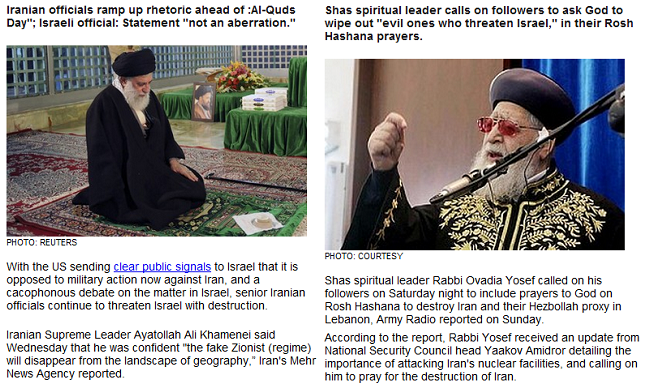
The Ayatollah Khamenei, left, is the Supreme Jurisprudent of Iran — not merely a senior cleric but Iran’s final authority. Rabbi Ovaida Yosef, right, is the leader of the Shas movement in Israel and a cleric who swings enough power that Prime Ninister Netanyahu consults him and Foreign Minister Avigdor Lieberman, briefs him — an influence, then, something akin to an eminence grise perhaps, but by no means the final authority.

You may, loathe one of them you may loathe both of them: I doubt there are many people who admire both. But I’m not here to stir your animosities, I’m here to see what we can learn from comparing and contrasting them by catching them in similar circumstances. Perhaps it will make their differences stand out in high relief — perhaps it will reinforce their similarities.

The two men are both religious clerics, both political players, both getting on in years, both grey-bearded — and both seem to be comfortable using the same rhetoric at this point.

My aim here is to learn from this juxtaposition.

*

So I have two sorts of questions that I’d like to explore here, calmly and with appropriate documentation if you please…

One sort of question probes the differences in position and pouvoir of the two men:

Who has the higher position? Whose side has the most potent weapons? Whose side started this — or is that a moot question?

The second sort is subtler, since it has to do with motives hidden in the hearts and minds of men — and with the differences that sometimes exist between between rhetoric and intent.

Is is an entire people, or simply a regime that they would like to see an end to?

Is either one of them bluffing?

And of course my own favorite: is either one of them, the rabbi or the ayatollah, saying what he’s saying because of an “end times” (Messianic or Mahdist) expectation?

**

Hitler‘s rhetoric in Mein Kampf was pretty clear, and the actions of his Dritte Reich did not belie his rhetoric. Considerable planning was involved, there was documentation.

What, beyond rhetoric, do we know about Israeli planning to take down the Iranian nuclear program? What, beyond rhetoric, do we know about Iranian planing to respond to an Israeli strike — or to defeat and destroy Israel more generally?

Do the logistics back the rhetoric up?

What happens when the word “fire” is itself a match? What happens in an echo chamber, in a hall of mirrors?

So many browser tabs, so little time

Thursday, August 16th, 2012

[ by Charles Cameron — Hindutva vs Ghazwa-e-Hind, India vs Pakistan, battle of the girl orators, flags flying in the other guy’s capital, Zaid Hamid, erased from the map, what have I missed? ]
.

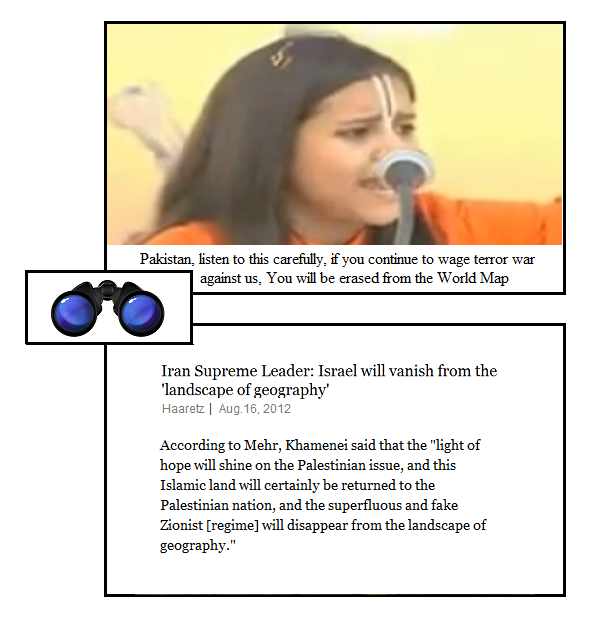
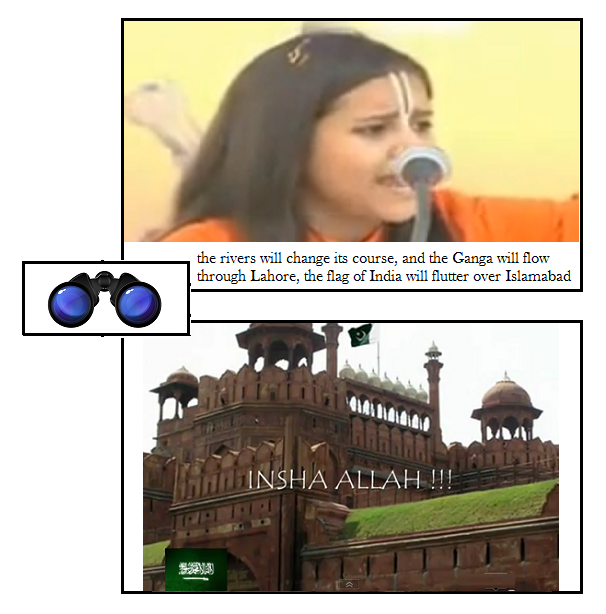
For starters, when I saw the blurry headlines under 13-year-old Sadhwi Balika Saraswati‘s speech to a Vishwa Hindu Parishad gathering, I wasn’t sure whether to pair her speech with Zaid Hamid‘s image of the Pakistani flag flying over Delhi’s Red Fort:

or with the Ayatollah Khamenei‘s recent statement about the “fake” Zionist regime disappearing from the “landscape of geography”:

I mean, there are parallels there, and differences, in each case.

**

And then, when I did a little more digging, all hell broke metaphorically loose, and I couldn’t get enough tabs on my browser to hold all the videos I seemed to want to check out.

I’ve combed through my history and sorted things out now, so I can point you, for starters, to:

13 yr old Hindu girl speaks out against Anti-India forces at a VHP rally — a Youtube video of the relevant part of her speech with English subtitles. You can read a transcript of the speech — missing all the excitement — here. And to give you an idea of its (relative) popularity, one YouTube version of this speech without subtitles, has had 410,535 views, with 1,503 likes and 1,589 dislikes, while another has had 200,964 views, with 801 likes and 491 dislikes… Bear in mind, though, that the Indian population exceeds one billion.

A Pakistani girl replies to 13 yr old Hindu girl who spoke against pakistan — sadly, no subtitles here, but at least it’s a response from someone of roughly equivalent age..

Reply to bajrangdal’s girl by Zaid Hamid which is also interesting, as he’s the spokes-guy for the Ghazwa-e-Hind idea…

**

Which in turn brought me back to thinking once again about the Ghazwa, and:

Ghazwa-e-Hind is our destiny — Zaid Hamid himself addressing the topic (posted this month) — “and we invite the Muslims from Afghanistan, Iran, Turkey and the rest of the Muslim world to come and join us in the fulfilment of this most fascinating destiny which awaits us now: recapturing of India.”

Ghazwa-e-Hind Hadith Explaination — the picture is very blurry , is that our old friend Sheikh Imran Hosein, perhaps? — and

Ghazwa-e-Hind By Dr Israr Ahmed

**

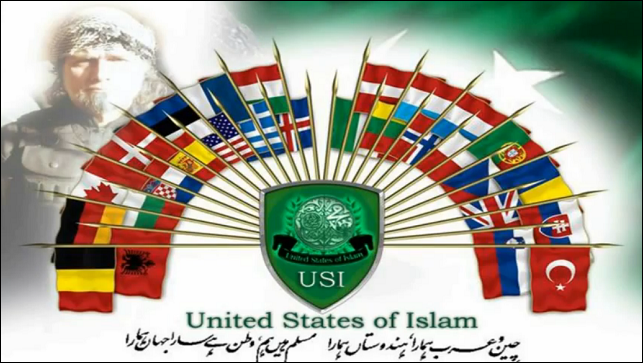
I’m afraid Zaid Hamid wouldn’t be satisfied with India alone, though:

That’s him, top left, overseeing everything.

Oh, and for good measure, here’s a humorous response to Hamid, zaid hamid latest about india — featuring a barking dog.

**

Look, I don’t think Pakistan is about to capture India, or vice versa, any time soon.

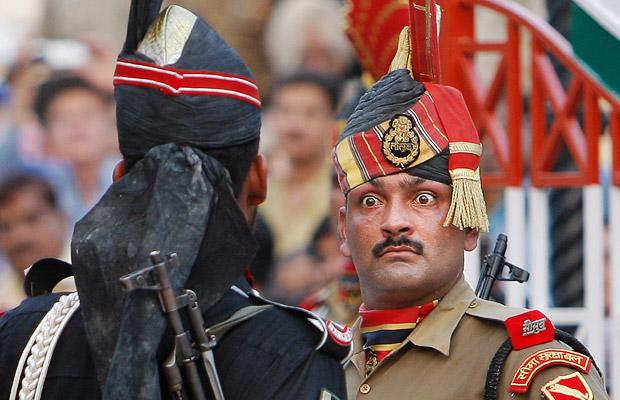
If the two countries feel the need to face off, I hope they will limit themselves to a little ritual drama and some fierce stares, and they do every day in the border ceremonial at Wagah:

Beyond that, I’m an advocate for conflict-resolution and peace-making.

What I do think is that undercurrents of the kind found in the incendiary rhetoric of both sides are worth the attention of analysts.

Pew on the prevalence of Mahdism — take heed!

Sunday, August 12th, 2012

[ by Charles “told you so” Cameron — Pew figures for Mahdist expectation, also the Second Coming, Israel, and the potential influence of apocalyptic ideation on foreign policy ]
.
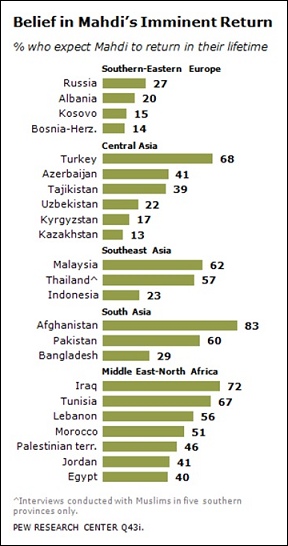
The World’s Muslims: Unity and Diversity, p. 65

.

I am Qualit, not Quant by nature, really much more interested in the workings of the imagination that in the aggregates of poll responses, so it’s a bit like pulling teeth for me to report on a Pew report — but in this case I can legitimately say “I told you so”, which massively outweighs the reluctance I might otherwise feel…

**

Recently, Pew has been including questions about the expectation of the Mahdi in some of its reports, and even Tim Furnish — who wrote the book on Mahdist movements and has long been saying we neglect them at our peril — even Tim was surprised at how widespread Mahdist expectation is, as reported in their just released The World’s Muslims: Unity and Diversity. In a post aptly titled Don’t Leave a Live (or Occulted) Mahdi Out of Your Calculations, Tim says the report contains “The most notable — indeed, strikingly important — news” in the form of “fascinating — and disturbing — data on belief in the Mahdi’s imminent (in one’s lifetime) return.”

See graphic above.

I recommend you read Tim’s analysis for the full range of his points — I won’t, for instance, be touching on what he says about Turkey — here I am going to select a couple of his key issues, and make just a point or two of my own.

**

Furnish:

Of the 23 countries whose Muslim citizens were polled, nine have majorities which expect the Mahdi in their lifetimes, with the overall average percentage at 41.8% … it is safe to extrapolate this percentage to Islam as a whole; ergo, 42% of 1.6 billion = 672 million Muslims who believe in the Mahdi’s imminent return! This is FAR greater than I had supposed.

Furnish also notes that Iran, the world’s most intensely Shi’ite nation and the one whose President has been speaking openly of Mahdist expectation, is not even included among the 23 countries Pew sampled.

Simply put, we have been blind to a very real phenomenon, and now we have a statistical alarm call to wake us up.

More subtly: there’s a difference between answering yes to the question “do you expect the Coming of X in your lifetime” and being on the edge of your seat, viewing every week as threshhold. Damian Thompson is very good on this in his book, Waiting for the Antichrist, and Stephen O’Leary in Arguing the Apocalypse suggests there’s an optimal “arousal” period — if you believe the Coming is too far away, you won’t be motivated to prepare for it quite yet, and if it’s too close it may be too late for you to do much to spread the word…

So, Pew — next time, ask a question with the opinions “in the next five to ten years” and “in my lifetime” — okay? The distinction is important, and a shift towards the shorter time-span would be highly significant.

**

Furnish again:

Despite the conventional wisdom (repeated even by Pew, in the face of their own data) that Mahdism is primarily the province of Shi`is, note that three of the four countries with the highest percentage expecting the Mahdi are majority-Sunni ones: Afghanistan (83%), Turkey (68%) and Tunisia (67%). This has ramifications, respectively, for: US policy in a country we are currently occupying; the only NATO Muslim-majority nation; and the vanguard state of the “Arab Spring.”

In his Conclusions, Furnish says:

The usual State/Defense departments’ “rational actor” approach to international relations might be quite simply irrelevant, if almost half the world’s Muslims expect the imminent return of their eschatological deliverer.

So there you have it. I discussed the “rational actor” versus Scott Atran‘s “devoted actor” in a recent post. And yes indeed, there are “ramifications for U.S. policy”…

Notably with regard to Afghanistan …

**

Here’s Furnish again:

Afghanistan is so rife with Islamic messianism because the 80% of the population that is Sunni and the 20% that is Shi`i (albeit Sevener/Isma’ili, as well as Twelver) both are in the middle of a war and occupation by a “Christian” power — which tends to ratchet up such expectations …

And again, in his Conclusions:

Afghanistan is a lost cause: over eight in ten of its people expect the Mahdi in their lifetime, and no amount of roads and clinics and girls’ schools built by the infidels will change that.

I don’t want to argue that second point in detail, although I think there’s a great deal more to life that Mahdist expectation for many who would answer “yes” to Pew’s question about expecting the Mahdi in one’s lifetime — see my comment on Damian’s book above. But how can I put it? A background Mahdist expectation can become a passionate involvement in a Mahdist movement if the right trigger comes along.

But what I find most striking here is that Afghanistan should be the country with the strongest Mahdist current out of all those Pew selected. And I’m struck not because Afghanistan has been a battlefield for so much of recent history — indeed, for so much of its history, period. I am struck because, in Al-Qaida’s recruitment narrative, supported by a number of ahadith, Afghanistan as Khorasan is the very locus from which the Mahdi’s victorious army will sweep out to conquer (finally) Jerusalem. And this too I have been posting about, eg in my discussions of Ali Soufan‘s The Black Banners and Syed Saleem Shahzad‘s Inside Al-Qaeda and the Taliban.

So the highest level of Mahdist expectation also happens to be found in an area with a potentially major role to play in an end times scenario…

**

There’s at least one earlier report in which Pew raised the question of Mahdist expectation — this time tied in with both the expectation of the Caliphate, and Christian hope of the Second Coming — their 2010 report Tolerance and Tension: Islam and Christianity in Sub-Saharan Africa.

Here, for instance, we learn:

Both Christians and Muslims believe they are living in a time that will undergo momentous religious events. For example, at least half of Christians in every country with large enough samples of Christians to analyze believe that Jesus will return to earth during their lifetime, including nearly seven-in-ten Christians in the Democratic Republic of the Congo (69%).

And at least half of Muslims in 10 of the 15 countries with large enough Muslim populations to analyze say they believe that the caliphate, the golden era of Islamic rule, will be re-established in their lifetime; this belief is most common among respondents in Mozambique (69%). And in 12 of these 15 countries, roughly six-in-ten or more Muslims believe in the return of the Mahdi, the guided one who will initiate the final period before the day of resurrection and judgment, though the survey did not ask respondents whether they expect this to occur during their lifetime.

And here is the relevant data on sub-Saharan Mahdist belief. In Q51 of this poll, Muslims were asked whether they believe “in the return of the Mahdi, the guided one who will initiate the final period before the Day of Resurrection and Judgment? Here’s the table of responses:

Given the “religious fault line” of mixed conflict and amicable coexistence between Christians and Muslims running across Africa from (so to speak) Nigeria to Somalia, with Boko Haram and Al-Shabaab among the less delightful participants, keeping an eye out for signs of Mahdist “semiotic arousal” would be important here, too.

**

And “semiotic arousal” — that reminds me. Richard Landes, who coined the term, has the definitive, encyclopedic book out about all the many forms of apocalyptic, and why they’re important: Heaven on Earth: The Varieties of the Millennial Experience Essential reading, if you ask me, on a hugely neglected and no less critically important subject.

**

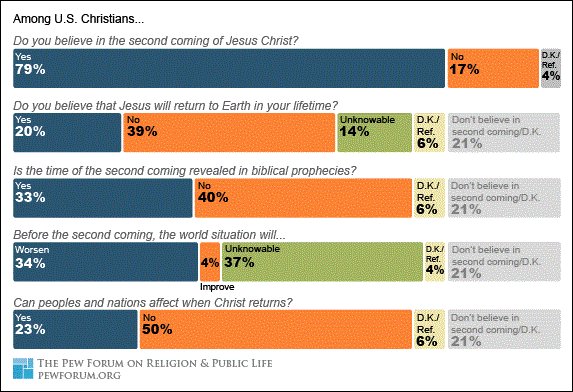
Finally, here’s yet another Pew graphic

— to be viewed in conjunction with this one, illustrating the ways in which belief in the Second Coming of Christ correlate with opinions about scriptures and the State of Israel:
**

Prophecy has impact, both on public opinion and on believing leaders. Jews with an expectation of the Messianic era, Christians expecting the soon Coming of Christ, and Muslims with Mahdist expectations each have their own apocalyptic scenarios, and in each case those scenarios exert some influence on policies relating to the Middle East and the Israeli-Palestinian situation in particular.

The bottom line?

Scriptural interpretation — and prophetic eschatology in particular — can no longer be assumed to be a quiet backwater topic for rabbinic students, seminarians and future mullahs to study, each in terms of their own tradition. It is now a series of conflicting drivers of current affairs — of war and peace.
The Twilight War—a review

Monday, July 23rd, 2012

[by J. Scott Shipman]

The Twilight War, The Secret History of America’s Thirty-year Conflict with Iran, by David Crist

When President Obama made a heartfelt opening, a smug Iranian leadership viewed it as a ruse or the gesture of a weak leader. Iran spurned him. Obama fell back on sanctions and CENTCOM; Iran fell back into its comfortable bed of terrorism and warmongering. Soon it may no longer be twilight; the light is dimming, and night may well be approaching at long last. [emphasis added]

Thus concludes senior government historian David Crist’s The Twilight War, and be assured Crist’s language is not hyperbole. Crist masterfully details the tumult of U.S.-Iranian relations from the Carter administration to present day. Using recently released and unclassified archived data from principals directly involved in shaping and making American foreign policy, Crist provides the reader an up-front view of “how the sausage is made;” and, as with sausage, the view often isn’t pretty for either side. Crist’s access wasn’t limited to U.S. policy makers, as he conducted interviews with principles on the other side as well, for instance, he had secret meetings/interviews with pro-Iranian Lebanese officials in south Beirut. In all, Crist estimated he interviewed over “four hundred individuals in the United States and overseas.”

Crist begins his story with the Shah of Iran in the last days of his leadership, as popular sentiment was turning against both his regime, as well as his American enablers. He reveals the Carter administration’s fleeting notion of military intervention following the fall of the Shah, and includes details how the clerics reigned in professional Iranian military members, purging the “unreconstructed royalists.” From the start, the U.S. learned how difficult, if indeed impossible, relations were going to be with the new Iranian leadership. One State Department report summed up the situation:

It is clear that we are dealing with an outlook that differs fundamentally from our own, and a chaotic internal situation. Our character, our society are based on optimism—a long history of strength and success, the possibility of equality, the protection of institutions, enshrined in a constitution, the belief in our ability to control our own destiny. Iran, on the other hand has a long and painful history of foreign invasions, occupations, and domination. Their outlook is a function of this history and the solace most Iranians have found in Shi’a Islam. They place a premium on survival. They are manipulative, fatalistic, suspicious, and xenophobic.

While I am certain the writer of this report was not intending to be prophetic, as it turns out this paragraph captures the essence of our conflict. Each American president has thought himself equal to the challenge and each has thus far failed.

The Twilight War includes the birth of Hezbollah, accounts of the Marine barracks bombing in 1983 (from the men who were there), and the details of the Kuwaiti request for American protection of their tanker fleet from the Iranians. From this decision, the U.S. committed military force to protect Middle East oil—a difficult and at times, contentious decision. This decision resulted in continued sporadic confrontations between the U.S. and Iranian forces in the Persian Gulf.

Crist’s book is an illustration writ-large of a book previously reviewed here at Zenpundit.com; Derek Leebaert’s Magic and Mayhem, The Delusions of American Foreign Policy—as both “magic” and “mayhem” figure large in our on-going relationship with Iran. Most U.S. administrations when dealing with Iran came to rely on the “magic, ” and often divorced, or worse, ignored the realities.

At 572 pages, the fast paced narrative is a must read for anyone wanting insight into the origins and issues that remain in the ongoing U.S.-Iran conflict. The Twilight War is exhaustively sourced.  Crist says in the Notes his book was twenty-years in the making and it shows. Further, this book comes with excellent maps, so keeping up with the geography is made easier.

Tom Ricks said, “this is the foreign policy book of the year, perhaps many years,” and Ricks may be right. The Twilight War is an important and timely book on a vital topic, and comes with my strongest recommendation.

Postscript:

A copy of The Twilight War was provided to this reviewer by the publisher.

Recommended Reading: dessert

Sunday, July 22nd, 2012

[ by Charles Cameron — of the Naked Breasts of Justice and the Verse of the Sword ]
.

Two more quick notes on the Gunpowder & Lead / Bernard Finel discussion:

The first concerns similarities between a figure — not in this case, Rick Santorum — on the American Christian right and his Iranian counterparts:

These two instances — which if I recall correctly, were reported within a month of one another between Dec 2001 and Feb 2002 — can be used as indicators to illuminate both the similarity and the difference between religiously-influenced thinking as between two nations and two religions. The similarity — a common Puritanism, to give it a name — is immediately apparent: but the difference — that the Christian Ashcroft merely veils the statue, whereas the Iranians grind off the figure’s breasts — surely speaks to a deeper intensity on the part of the Iranian authorities.

**

My second point is by way of counterpoint to my discussion of RJ Rushdoony in Recommended Reading: salad.

A recent COMOPS paper, How Islamic Extremists Quote the Qur’an [.pdf], explores a substantial body of jihadist materials:

Islamist extremists make heavy use of the Qur’an (Islam’s most sacred text) in their strategic communication. This study analyzed the most frequently cited or quoted verses in the Center for Strategic Communication’s database of over 2,000 extremist texts. The texts date from the years 1998 to 2011, and originate primarily from the Middle East and North Africa. Taking this data as a starting point, we provide a qualitative analysis of the historical contexts and core narrative components of the cited passages.

and notes:

The most surprising is the near absence of the well-known “Verse of the Sword” (9:5) from the extremist texts. Widely regarded as the most militant or violent passage of the Qur’an, it is treated as a divine call for offensive warfare on a global scale. It is also regarded as a verse which supersedes over one hundred other verses of the Qur’an that counsel patience, tolerance, and forgiveness.

We conclude that verses extremists cite from the Qur’an do not suggest an aggressive offensive foe seeking domination and conquest of unbelievers, as is commonly assumed. Instead they deal with themes of victimization, dishonor, and retribution. This shows close integration with the rhetorical vision of Islamist extremists.

Based on this analysis we recommend that the West abandon claims that Islamist extremists seek world domination, focus on counteracting or addressing claims of victimage, emphasize alternative means of deliverance, and work to undermine the “champion” image sought by extremists.

That’s a significant insight to chew on. And since we are still in “recommended reading” mode, let me also point you to the COMOPS Qur’an Verses Study: A Response to Our Critics. Different people — as the discussion between Mark Jacobsen and Tim Mathews illustrates — will have different reasons for and levels of interest in these documents, but it is good to have serious scholarship challenging some of our easy (and dubious) assumptions.


Switch to our mobile site