zenpundit.com » 2010

Archive for 2010

Recommended Reading and Viewing

Monday, July 5th, 2010

Top Billing! Steven Pressfield –  General Hal Moore

Steve interviews General Hal Moore who fought the Battle of Ia Drang and wrote the bestselling, We Were Soldiers Once….And Young:

SP: Of all the people I’ve had the honor to meet, you are without a doubt the one who knows the most about thinking creatively under fire-literally. Many of the readers of this series are artists and entrepreneurs, who are fighting their own wars every day. Bullets and bombs might not be flying, but the enemy (usually interior) can be pretty real just the same. That’s one reason why I wanted to talk to you, Gen. Moore-to see if we can cross-pollinate a little, from real war to the “war of art.”

One of the axioms you’re famous for is this:

“There is always one more thing you can do to increase your odds of success.”

What would you share with civilians (and active-duty service members) about increasing success? In your years of service, what was it that you did to increase the odds?

HM: I learned early on there’s always one more thing an officer can do to increase the chances of accomplishing his mission and getting his men back alive. In fact, it’s incumbent upon any commander leading men into harm’s way to beat his brains out, ahead of time, to figure out that one thing-and every other element he can come up with, too. I instinctively think ahead. I run scenarios before things happen. I plan ahead for things I know are coming-and, more important, for what I don’t know is coming. Surprises. When you’ve rehearsed for multiple contingencies, even if it’s only in your imagination, you can deal with crises when they happen (and they always do) with a higher degree of calm, which in turn keeps everyone around you in a problem-solving mode and not a panic mode. I’m a great believer in reading. A military commander should know as much of the history of warfare as he can, so sudden reversals don’t catch him by surprise. There’s nothing new under the sun. Everything that happens to you and me under fire has happened already to Hannibal, Napoleon, Alexander, you name it.

Committee of Public Safety –  Worth Reading: Special Operations and Strategy: From World War II to the War on Terrorism

….What politicians really want is a giant red button they can push and, voila, victory is had, quick, easy, cheap, and bloodless. The best way to win a bigger slice of the power that the politicians are dishing out is to take your tactical solution and present it as a strategic (and therefore political) solution: the Easy Button. Macgregor’s particular Easy Button is Armor and, unlike many aspiring Easy Button advocates, Macgregor was actually allowed to push his Easy Button. His operational concept was the kernel around which the plan for the second invasion of Iraq in 2003 congealed. Unfortunately, his preferred solution was similar to Bernard Finel’s “repetitive raiding“: speed into Iraq, destroy Iraq’s government, set up a new Iraq government, and withdraw to avoid irritating the natives.

Macgregor was outraged when his preferred strategy was ignored in favor of whatever strategy it was that guided the American occupation of Iraq from 2003-2007. In his eyes, like Finel’s, an occupation would lead to a quagmire. Even worse, it would open a window of opportunity for Macgregor’s Light Infantry opponents, especially that irritating David Petraeus. Macgregor left the Army in disgust and Light Infantry was able to defeat Armor in a long war of attrition between 2003 and 2007.

Joseph Fouche is giving the War Nerd a run for his money as the Satirist-in-Residence of the .mil/strategy blogosphere.

Howard Bloom at Kurzweilai.net – Is the iPad the New Guillotine?

….Most people mean well when they go to work. Most want to do good. So how did the bureaucratic system become vicious? The cruelty of bureaucracy comes from the isolation of bureaucrats among their peers, the isolation of bureaucrats from the people they serve. Those who never have to face their customers and their constituents can treat their clients with savage indifference. On the other hand, those who know the people they serve as human beings are far more likely to respond with care, creativity, and empathy. And thanks to Google, private databases remotely available via laptop, and IM, text messages, and cell phone calls, bureaucrats no longer need to be isolated in cubbyholes attached to endless corridors filled with other bureaucrats. They can go out among the fellow humans to whom their services have been marketed and promised

The anti-bureaucratic jihad of Howard Bloom. 

Insurgent ConsciousnessMexican Bandhs

….Greg and Jan may be correct that government  forces are winning tactically.  Nonetheless, tactical military superiority will not necessarily produce strategic success.  

Consider the Zetas’ attempt to free their boss described above.  If we look narrowly at this operation, it looks like a Zeta failure; the Mexican Army convoy carrying El Tory managed to escape the Zetas’ blockade.  Nonetheless, if we conceive of the blockade as a bandh, and not merely as an effort to free the boss, the Zetas’ chances for continued success in this city increase.  The Zetas have used such blockades for this purpose before.

RECOMMENDED VIEWING:

3-D Map of the Universe

Edward Luttwak on “The Grand strategy of the Byzantine Empire”

That’s it!

RESTREPO Review II. : Lexington Green

Saturday, July 3rd, 2010

An excellent review at Chicago Boyz by my comrade Lex:

Restrepo

First, the cryptic title. It looks like an acronym, but it is in fact the last name of a young soldier killed in Afghanistan, in the fighting which is recounted in the film. His name was Juan S. Restrepo.. His comrades in arms called him “doc.” His name is pronounced with an accent on the second syllable, reh-STREP-po.

The film was made by the noted author Sebastian Junger, and the photographer Tim Hetherington. (Junger wrote a book entitled simply War about his experiences being embedded with the troops, which Zen reviewed here. James McCormick reviewed Junger’s book on CB, here.)

The movie covers the hard fighting endured by a platoon of American troops in a 15 month deployement to the Korengal Valley in Afghanistan. It intercuts footage of the troops in the Valley with interviews after they left Afghanistan. The overall feel of the film is grim. The sense projected by the movie is that the troops who were not physically wounded have been psychologically damaged by their exposure to combat. The movie makes clear that their goal became survival and leaving Afghanistan alive. Other than the platoon commander, who was making a superhuman effort to carry out a counterinsurgency program, there was no sense that the troops perceived any achievable mission to carry out.   

The movie depicts the troops as facing an insurmountable task, trying to conduct a counter-insurgency campaign where they are bottled up in firebases and cannot come out to provide security for the population. The Taliban rule the countryside. The Americans can foray out, and bring down heavy firepower when they encounter the Taliban, but the fundamental mismatch between what the troops have been asked to do and the means provided to do it is apparent throughout….

Read the rest here.

Following up on the Strategy Links with….More Strategy! And a Few Comments

Friday, July 2nd, 2010

Wiggins  at Opposed Systems Design responds to Kenneth Payne at CI/ KoW:

On Strategists

….Strategy – thinking about how to achieve goals with one’s given resources (in the face of an opponent), which generally requires one to find asymmetric advantages to exploit because one’s resources are finite – is a distinct activity from managing military operations or storming a building. National security strategy requires a familiarity with the nature of military operations and power, but it is not a simple extrapolation from these activities. It is a distinct skill (perhaps, as Watts argues, at least partially an innate skill that can be developed but not completely taught) and the way the U.S. military is currently structured, civilians may be better positioned to cultivate strategic expertise. To go back to Biddle’s example. He compared his career trajectory to that of a military officer. If he’d been a career officer, Biddle was about the age of an O-6, meaning that he’d have – at best – spent a few years in graduate school and perhaps a tour teaching at a service academy. Let’s say roughly six years where one’s primary task was to think, write and read about the elements of strategy. Much of his time would have been spent in managing increasingly large groupings of military force. Biddle, on the other hand, had spent the entirety of his career studying these dynamics.

I find myself largely in agreement with the salient points of my Wohlstetterian amigo, Wiggins. Or, as Herman Kahn once said ” How many nuclear wars have YOU fought, general?”

I am not knocking military expertise with that quote. Civilian appointees, politicians, newspaper editors, political activists or bloggers who have never heard a shot fired in anger have no business telling active duty military personnel which tactical response they should make in the heat of battle or much of the day to day, nuts and bolts, operational business of planning or running a military campaign. That’s why we have military professionals, unlike civilians, they know what the hell they are doing.

Strategy, in the sense of national objectives is quite another matter.

Military expertise, like all forms of expertise, is by definition, narrowly focused. Military people, from the most part, look at strategy from the perspective of how well a proposed strategy fits with the military’s capabilities and operational/doctrinal/cultural preferences and as they move further away from things military into other aspects of the DIME spectrum, their knowledge becomes less certain, their awareness of geopolitical opportunities and costs more vague or prone to error. I find this to be the case especially with economic implications, which are a crucial component of national power.  Strategy is not supposed to be about what the institutional military likes or understands best, but it is difficult for such a systemic bias not to creep in if a nation leaves its formulation of strategy exclusively to dudes in uniform with stars on their shoulders. Nor is that how a democratic system is supposed to work when existential questions are being entertained.

Strategy, unlike expertise, is broad . It applies to more forms of conflict and competition than war alone and requires an ability to connect a panoramic vision with the drill-down focus of application. More than likely, on average, the best strategists will have some expertise in more than just one narrow field and will know a fair amount about many things and have spent a long time thinking matters through from all angles prior to acting. As a consequence, they will be able to shift cognitive perspectives more easily, a fundamental characteristic of strategic thinking.

The costs of a poorly conceived strategy are likewise broad. If tactics are bad, the soldiers on the batlefield will pay the price; if the strategy is bad, we all may pay the price.

Some Recommended Reading on Strategy

Thursday, July 1st, 2010

From this corner of the blogosphere…..

Armchair Generalist –  Declining Competency in Crafting Strategy

Via the blog “War, the military, COIN and stuff,” we learn of Andrew Krepenivich’s latest portrait of strategic thinking and what’s wrong with the Obama administration’s National Security Strategy. In short, the problem is that it isn’t really a strategy. It’s a wish list.

….Fortunately, there are more than two ways (increasing funding and creating efficiencies) to resolve a mismatch between the defense program and the resources available to sustain it. They involve strategy, which can be simply defined as how a state’s resources are best employed to achieve the ends it seeks. The better the strategy, the more that can be accomplished with a given set of resources.

Strategy necessarily involves setting priorities and taking risks. This is because no state, however powerful relative to other states, has ever had sufficient resources to eliminate all risks to its security and well-being. Thus two ways of dealing with the problem of having to work with a relative decline in resources are to reduce the objectives to be achieved; or to accept greater risk that they may not be accomplished.

Not sure I agree that the US needs to go all Julian Corbett but the strategy deficit definitely needs to be addressed and that will help maximize capabilities on declining budget dollars.

Current Intelligence ( Kenneth Payne)« The Strategists »

….Rather than riffing off a month’s worth of posts, I thought I’d home in on the one post that has generated more comments than any other we’ve done so far. Thomas Rid wanted to know why there were so few American strategists compared to those from Europe.  First problem, who is a strategist? Thomas distinguished between historians and strategists, but not between practitioners and theorists – so George Marshall and Bernard Brodie both count, and both, of course, are Americans too. In the discussion that followed, this question of man of letters versus man of action came up repeatedly. To be sure, it’s difficult to make hard and fast distinctions between thinkers and doers – Clausewitz would count as both theorist and practitioner, and something of a historian too; even a civilian like Thomas Schelling could lay claim to a certain practitioner status, in shaping the practice of US deterrence. My own view is close to Brodie – strategy certainly need not be an activity done by the military, even if it requires a firm grasp of military detail. In fact, a civilian strategist, with years of mulling the whys and wherefores of strategic behaviour, may be better placed than a general whose career has largely been spent wrestling with tactical and operational issues, away from the intersection of politics and violence. More than that, in both low intensity and nuclear strategy, the aggressive traits of a proven battlefield winner may actually prove disadvantageous. Don’t believe me? Take a quick flick through the transcripts of the Cuban missile crisis.

The Russian decision making process in the Cuban Missile Crisis is equally interesting and non-strategic, being partially a byproduct of Khrushchev’s political struggles over Soviet domestic policy in the Presidium.

Inkspots (Gulliver) – The foundational flaw of our Afghanistan strategy, universally ignored by its proponents

Can 400,000 ANSF deny sanctuary to al-Qaeda? Can 400,000 ANSF ensure that America won’t be attacked by individuals who train or plan their attacks from Afghan territory? (We already know they can’t do anything about the AQ folks on the other side of the Hindu Kush, but again, we’re going to leave that aside for now.) Can 400,000 ANSF do the job that 130,000 ISAF troops plus ~245,000 ANSF are currently doing? So, basically, what’s the time frame on which we can expect ANSF to effect a one-for-one, straight-up capability match with the ISAF troops who will be departing the country?

Seriously: is there anyone who thinks this can be done in a decade?

And if not, then why is this our strategic concept? Why aren’t we working on some other plan to mitigate the nearly certain shortfalls that will exist when U.S. troops pull chocks and head home?

SchmedlapIs Afghanistan an Arena?

I am not sure what we are going to do now. Will we start from the objectives that we seek to achieve in Afghanistan and then mold our response accordingly? Will we start from a set of tactics that we have been sold and attempt to mold our response to fit those tactics? Or will we attempt to mold our approach in order to facilitate a withdrawal timeline?

I’m not sure either. The Senate confiirmation hearings for General Petraeus made it clear that the Democrats consider the withdrawal timetable to be a sacred objective in isolation from everything else and the Republicans want it to be clear that this idea is Barack Obama’s. In other words momentary political “wins” occupy the minds of our elected officials and their interest in strategy – or the effects of not having one – is approximately zero.

New Books…..

Wednesday, June 30th, 2010


Framing the Sixties by Bernard von Bothmer

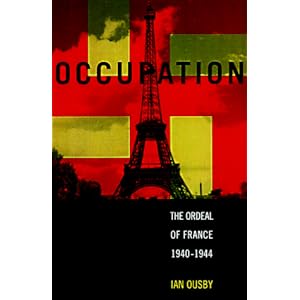
Occupation:The Ordeal of France 1940-1944 by Ian Ousby

How Wars are Won: the 13 Rules of War by Bevin Alexander

The first, which is an an analysis of how our historical memory of “the Sixties” have been wielded in cultural and political wars was sent as a review copy by Julie at FSB Associates. The next two were a gift from my regular guest-blogger,  Charles Cameron. Bevin Alexander is probably a familiar writer to many readers here. I’m adding them to my summer reading list.

The book pile towers ominously 🙂


Switch to our mobile site