zenpundit.com » 2011 » October

Archive for October, 2011

Fouche on Potential and Probable Uses of Power

Friday, October 7th, 2011

My sometime Chicago Boyz colleague, Joseph Fouche, had an interesting if somewhat meandering post on how power is used, not used and possibly abused.

The Chains of the Improbable vs. The Chains of the Impossible

An old Vulcan proverb advises us that only Sulla could march on Rome. This proverb may contradict another ancient proverb that claims that all roads lead to Rome. This seeming contradiction is resolved when you include little used roads, off the beaten track, the roads not taken. Sherlock Holmes once chided John A. Watson, M.D., saying, “How often have I said to you that when you have eliminated the impossible, whatever remains, however improbable, must be the truth?” Some roads to Rome are impossible, leading to the insurmountable. Lucius Cornelius Sulla Felix took a road that, while thought impossible, proved to be merely improbable.

Sulla, consul of Rome for the year 88 B.C., was in camp preparing to take his army east to fight King Mithridates VI of Pontus. Two envoys arrived to tell him that his command had been taken away by the vote of one of the people’s assemblies in Rome. These envoys of the Roman people expected that Sulla would do the only thing possible: lie down there, obedient to their commands, as every Roman army commander before him had done. Unfortunately, what they thought was impossible was only improbable.

Sulla gathered his men, announced what the will of the Roman people was, and asked them what the will of the army was. Sulla’s soldiers answered by stoning the envoys of the Roman people to death, much to the surprise of the envoys of the people. Sulla’s soldiers then petitioned Sulla to take an impossible road, a road never taken, and lead them to Rome to reclaim his Mithridatic command. Sulla, much to the surprise of his own officers, who thought such a course impossible, decided to heed his men and march on Rome. His officers resigned en masse except a happy few. But the poor bloody legionaries of Sulla’s army eagerly began the march on Rome.

Envoys from Rome streamed towards Sulla’s army as it marched north.These envoys were shocked and grew increasingly shocked as they protested to Sulla that surely, surely it was impossible that he wanted to march a Roman army through the city limits and into Rome itself. The law forbade it. The unwritten constitution forbade it. The Republic forbade it. The gods forbade it.

Sulla responded to the effect of, “Go tell the Romans that I don’t lie here obedient to their commands. I’m coming to Rome and hell’s coming with me.” The tone of these envoys’ entreaties and the mood of the people of Rome grew increasingly hysterical as the improbable dawned on them: not only could a Roman army commander march an army on Rome, it was increasingly probable that Sulla would march armed Roman legionaries right into the heart of Rome itself to deal with his political enemies. Indeed, Sulla led his men across the sacred pomerium that divided the “public thing” (res publica) of sacred Roma herself from land that was merely the property of Rome. Sulla’s veteran legionaries easily dispatched the hastily gathered mob of gladiators and other ruffians that his political opponents had thrown together at the last moment in a futile attempt to stop them.

Sulla had revealed that the impossible was merely the improbable.

Sulla spent the rest of his life trying to disguise this state of improbability as a mere state of impossibility.

He failed.

That was merely Fouche’s introduction. The post is well worth reading in full.

The post caught my eye because of Sulla, a Roman who did a monstrous thing but who was himself no monster. Much like a surgeon whose patient’s body is riddled with cancer, Sulla attempted to buy the old Roman Republic time and restore a semblance of political health by ruthlessly cutting out a tumorous faction and ratcheting back a host of constitutional gimmickery that had been welded onto Roman government over the years by ambitious politicians. Older, original rules of the game, or new ones in their spirit, were restored after blood shed in the proscriptions was scrubbed from the forum. Sulla even formally stepped down from the supreme power he held, like Cincinnatus, to further drive home the point to his fellow Romans regarding the sanctity of their traditions – though reportedly Sulla remained, even in a debaucherous retirement, a terrifying figure and stringpuller.

Fouche is correct that Sulla’s extreme measures failed. The underlying structural problems of the Republic were rooted in an increasing concentration of wealth, primarily in land ownership by Patricians and politically favored trading opportunities in “the East”, held mostly by the elite of Rome’s Italian “allied” city states, that left many Roman citizens too impoverished to perform military service or to be active in politics, except as dependent members of a clientela. The Republic’s legions and it’s political virtue had been based on an economically independent smallholding class who were being despoiled by politically powerful Patricians. Sulla’s reforms may have tempred political conflict within the ruling class for a time, but they also aggravated the social grievances that provided the Populares with political support from ordinary Romans and tilted the delicate political balance in the Republic toward extreme oligarchy.

In his retirement, observing the young Julius Caesar, whom Sulla had reluctantly spared, his toga fashionably loosely belted, long sleeved and wearing boots, like the ancient kings of Alba Longa, Sulla remarked “ He contains many Mariuses“. Caesar did. And unlike Marius but like Sulla, Julius Caesar was successful, Sulla having shown him the way to cross a Rubicon.

Power is power but power coupled with legitimacy endures. Sulla to Caesar to Augustus is the continuum.


Stay hungry, stay foolish

Thursday, October 6th, 2011

[ Steve Jobs obit — posted by CC]
.
attachmentphp.jpg

Steve Jobs, February 24, 1955 – October 5, 2011

Remembering that I’ll be dead soon is the most important tool I’ve ever encountered to help me make the big choices in life. Because almost everything — all external expectations, all pride, all fear of embarrassment or failure – these things just fall away in the face of death, leaving only what is truly important. Remembering that you are going to die is the best way I know to avoid the trap of thinking you have something to lose. You are already naked. There is no reason not to follow your heart.

— from Steve JobsCommencement Address at Stanford University, June 2005

Mapping the hearts of the Fair and Unfair sexes

Wednesday, October 5th, 2011

[ by Charles Cameron — an antiquarian trifle — or two ]

.

As you may have noted, I am interested in the mapping of complexity — and could hardly be expected to resist the charms of this woman’s heart:

map-oif-womans-heart-600.jpg

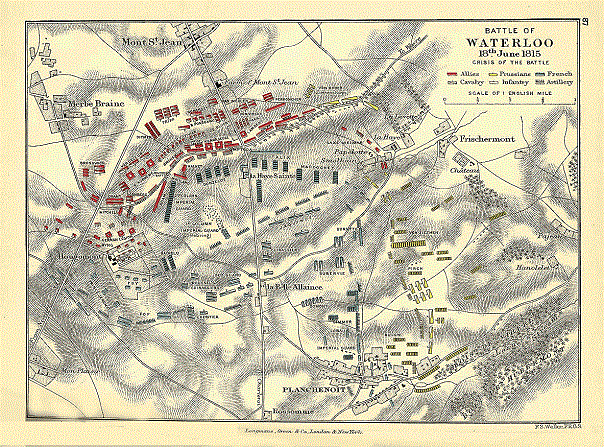
Stirred, I thought back to the map of the manly heart that my old school tried to instill in me — I was in Blucher House under Peter Willey at Wellington College, built as a memorial to the Iron Duke on the same patch of scrub land as Sandhurst and the Broadmoor Hospital for the Criminally Insane

waterloo-600.gif

How safe and reliable this terrain appears, I thought to myself, when contrasted with “the Open Country of Woman’s Heart” with its “internal communications, and the facilities and dangers to Travellers therein.”

Although upon reflection, my time at Wellington was not without its moments.

When Frank ‘Mad Axeman’ Mitchell escaped from Broadmoor, we were sent out in pairs on cadet patrol… myself and a similarly equipped companion, with our .303s and some blanks — ready at a moment’s notice to shout “Halt! Who goes there?” if the dastardly killer should pop out from behind one of our rhododendrons…

A Strategy for the Pacific – Will the US have the $$$ and the courage for a credible and survivable one?

Tuesday, October 4th, 2011

[by J. Scott Shipman]

To have an executable strategy, a nation needs the wherewithal to pay for it. This applies the United States, too. 

As the United States heads into an election year with rising unemployment, a double-dip recession threatening, and deep cuts to defense on the horizon (even as we continue to prosecute the war on terror) a controversy continues to brew in the South China Sea. China has increasingly heated up the rhetoric. On 30 September the Taipei Times reported on an opinion article in the Chinese Communist Party-run Global Times (the original article is here), calling on the Chinese to declare war on Vietnam and the Philippines over their intransigence with respect to China’s claim of the South China Sea as being part of China proper. While this tantrum might be a saber-rattling “fire for effect” exercise aimed at intimidation, the writer surmised the position of the United States:

“The US has not withdrawn from the war on terrorism and the Middle East … so it cannot afford to open a second front in the South China Sea,” he wrote…“[Military] action by a big country in the international arena may result in initial shock, but in the long run, regional stability can be achieved through great power strategic reconciliation.”

“It cannot afford” is writ large. What, indeed, would the US do if China followed the advice of this hot-headed pundit? The US Navy is operating at about 283 ships, and the op-tempo is wearing out both ships and crews—fast. A recent article in the Atlanta Constitution reported the USN is investigating extending the typical six month deployment for fast-attack submarines. As I wrote earlier, we are retiring our submarines faster than we’re replacing them. With the US defense budget under the axe for even further cuts, what is the proper course of action? And do we have a strategy supported by an adequate budget? Are we strengthening our relationships among allies, or are we neglecting relationships that will be vital if hostilities break out? I would submit the US refusal to Taiwan’s request to purchase modern F-16 C/D variants, offering instead upgrades for A/B sends a message of waning US resolve to honor the Taiwan Relations Act (TRA). (A rumor within the Beltway is the upgrades were a first step, with what the administration hopes will be a request by Taiwan for the troubled and increasingly costly F-35.) The TRA requires the United States “to provide Taiwan with arms of a defensive character”, and “to maintain the capacity of the United States to resist any resort to force or other forms of coercion that would jeopardize the security, or the social or economic system, of the people on Taiwan.” We may have that “capacity” today, but what are we doing to insure we sustain the capacity to maintain open sea lines of communications? Can we afford it?

Our friends in the South China Sea environs aren’t feeling the love. India, Indonesia, Japan, Malaysia, the Philippines, Singapore, South Korea, Taiwan, and Vietnam have all expressed concern about China’s increasingly belligerent actions with respect to the South China Sea areas. All of these nations rely ultimately on the USN to keep the sea lanes of communication open. Most have modest defense budgets, but they’re beginning to realize the new reality and are acting and good for them—we could learn something in the reality department. Vietnam has ordered six Russian Kilo Class diesel boats (very good subs, btw), and the Philippines are shopping. Singapore has a pretty impressive sub fleet (six reasonably modern hulls) and national defense given her size. Taiwan has two 20-plus year old subs and two WWII era US boats that are 60 years old!

If we look at numbers, our strategy seems pretty puny. As our fleet continues to atrophy in numbers, the Chinese continue to build. An inventory of submarines in the area shows that between China and North Korea there are about 128 hulls compared to a total of 42 among the aforementioned nations. Our friends in the area will continue to need US submarine support in the area for the foreseeable future as subs are long lead time platforms.

In this theater alone, cutting our defenses seems nuts. Rather than cut line units, perhaps DoD should begin to improve/streamline our antiquated procurement and acquisition processes. Our acquisition process is so complicated we have a Defense Acquisition University (DAU)! At an estimated $124M for FY012, perhaps we should cut DAU first. Last year at Boyd & Beyond 2010, Dr. Ray Leopold shared the contrasts in commercial contracting versus government contracting. Commercial contracts are built on the presumption of trust, government contracts are written on the presumption of distrust. Rather than use normal legal remedies to hold mischievous and unscrupulous contractors to account, DoD has erected mind-numbing processes that attempt to eliminate any risk a contractor could successfully rip-off the government. And when a contractor does rip-off the government, the contractor pays a fine and continues to do business with the Pentagon. If someone steals from you, do you continue to do business with them? Not me. This would be a good place for DoD to begin true accountability—you can bet one defense company out of the market would send a message to the others. The sad truth is the revolving door between the military and the contractor community has created a incestuous and inbred swamp of rules and processes only the participants understand that are so impenetrable DoD has no idea how much money it is spending (never mind tracking waste)—so fiscal irresponsibility continues in an increasingly dangerous world with budget cuts guaranteed. What’s the strategy again? This madness is fast becoming an issue of national security. On our current track we could well be incapable of defending ourselves, much less our allies.

Here are few other ideas for consideration before touching a single line unit:

  • DoD should lay-off every nonessential employee. Whenever there is a snowstorm in the DC area, nonessential personell are instructed to stay home or “liberal leave” is in effect. We need to disabuse ourselves of the luxury of the nonessential employee. Regular businesses don’t operate like this, neither should DoD. Every employee should be integral, essential, and necessary; if they’re not essential, we can’t afford them—not while we have troops in harm’s way.
  • Stop double-dipping on 1 January. If a member retires from the military, they shouldn’t be able work for the government (often in the same office where they separated from service) and draw two salaries. If the member wants to work for the government,  pick one, but not both. We can’t afford it and this contributes to the ongoing inbreeding in defense. And here’s a cruel truth: why should we pay a member who could not continue advancing in the military a military pension and a government civil service salary?
  • Flag officers and members of the Senior Executive Service should have a minimum five year ban on working in the defense or defense lobbying industry. Stop the revolving door. Our current mess was created by many of these folks (even if well-intentioned), they should take a five-year time out and give others a chance to fix the mess they’ve helped create.
  • Abandon the current acquisition process and close DAU. Hire commercial attorneys at a commercial rate to write contracts based on trust, but contracts with teeth. This would be cheaper than the bloated and incestuous bureaucracy we now carry.  If a contractor defrauds the government, ban that company for 10 years from doing business with the government, and put the offending members in jail. Word will get around, and folks will behave.
  • Allow contractors to earn 8-10% on their work and stop nickel-diming them on fee. Businesses are in business to make money.
  • The government should assume more technical oversight/intimacy in procurement programs. We have too many generalist contracting officers who can be misled by an unscrupulous contractor, or perhaps worse, have no idea “what” they’re buying. The government needs to get engaged and informed and know “what” they are buying and know real costs.
  • Develop a promotion system based on merit, not time in grade. Our promotion system breeds risk averse officers who focus on punching career tickets instead of doing. Following John Boyd’s “to be or to do” maxim, the promotion system should reward officers who think and take risks, not poster-boy/cookie cutter conformists. “We’re warriors, dammit!” was a phrase my old CO used—let warriors be warriors! Scrap time in grade and promote based on performance, and if folks don’t perform well enough to be promoted, separate them from service.

Robert Frost said good fences make good neighbors; well a good deterrent makes good neighbors, too—but fences and deterrence costs money. DoD can and must do better; business as usual is becoming a death of a thousand paper cuts for us, and our allies. We need a real strategy and the budget to make it happen—that won’t happen with our current acquisition rules. The axe should fall on the Pentagon procurement bureaucracy before it touches a single line unit.

America is better than this, we must raise the standard by bringing DoD into the real world of fiscal responsibility and contract law, so whatever our strategy it can have a sound fiscal and legal foundation.

Book Review: The Emily Updates by Thomas P.M. Barnett

Monday, October 3rd, 2011

euseriescover.png

The Emily Updates: One Year in The Life of a Girl Who Lived by Thomas P.M. Barnett

Grand strategist and author Dr. Thomas P.M. Barnett has published a starkly different book with The Emily Updates, an e-book series that turns away from abstractions of geopolitical strategy and to a deeply personal kind of conflict, his daughter Emily Barnett’s battle with advanced pediatric cancer. Culled from a blog originally written by Tom and his wife Vonne Meussling-Barnett to keep family and friends appraised of the details of Emily’s medical treatment, the series paints an intimate portrait of parental desperation and the amazing grace of a toddler facing a life-threatening disease.

There are two sizable groups of people who will react most strongly to The Emily Updates : parents of young children and those who have faced cancer themselves, or in a loved one. An excerpt:

…Javedan says that her right kidney is enormously enlarged. It is so big that it’s displaced the liver out of its usual spot. That’s what was so confusing in the examinations. There seems to be tumors in or on the kidney.

There’s no need to assume cancer just yet, he says, but he mentions the term Wilms’ Tumor. Javedan orders me to rush Emily to Georgetown within the hour. The head of pediatric surgery and the head of pediatric oncology are already alerted and waiting. The exploratory surgery will be tomorrow morning.

Javedan’s words just froze me: “It’s already been scheduled.”

The doctors will need to run many tests on Emily by the end of the day, so we must hurry. Javedan knows these people. “They are the best,” he assures me.

“Emily will survive,” he is certain.

“It’s wrong to assume she will die, no matter how bad things get in the next hours and days. Remember that,” he counsels.

Quite literally, every parent’s nightmare.

Barnett does not spare the details and The Emily Updates read very much like you are hearing what has just happened in a hospital waiting room or across the Barnett family kitchen table, grueling procedures no child so young should have to go through

Strongly recommended.


Switch to our mobile site