zenpundit.com » 2012

Archive for 2012

Book Review: Lords of the Sea by John R. Hale

Tuesday, November 6th, 2012

Lords of the Sea: The Epic Story of the Athenian Navy and the Birth of Democracy by John R. Hale 

“I cannot tune a harp or play a lyre, but I know how to make a small city great.” – Themistocles

Nautical archaeologist Dr. John R. Hale, an expert on bronze age shipbuilding and seafaring, has written a delightful and robust popular history of the navy of ancient Athens, but more importantly, a poignant political history of the Athenian navy’s  intrinsic relationship to radical Democracy and Empire.  A page turner with enough detail about triremes and warfare in the Aegean to leave you crying “The Sea! The Sea!”,  Lords of the Sea will be enjoyed by naval buffs and philo-Hellenes alike.

As you would expect, there is much in Lords of the Sea about the design, construction and care of triremes, Piraeus and the Long Walls, the shipsheds at Zea Harbor, the financing of the Athenian navy, trierarchy, naval tactics, rowers and rowing, superstitions of Athenian sailors on campaign, the deforestation of Athens for ship timber, comparisons with Spartan, Persian and Macedonian naval prowess and the great sea battles of the ancient world. Plenty, in fact, to keep naval aficionados happy while reading Lords of the Sea and all of which I am spectacularly unqualified to comment upon. I can say that in regard to ancient navies, I learned much that was new to me.

What was of greater relevance to me was Hale’s major theme of the political nature of the Athenian navy. That the imperial glory and thalassocracy was irrevocably bound up with democracy itself and bitterly opposed by the wealthy, would-be, oligarchs who consistently preferred a much diminished Athens they controlled as Sparta’s vassals to a democratic Athenian empire where they shared power with the people:

….The resumption of work on the Long Walls jolted Athens’ oligarchs into action. A small group of upper-class citizens still hoped to destroy the radical democracy. These men feared that once Athens was permanently and inseparably linked to its navy by the Long Walls, the common people would never be unseated from their rule. Before the walls had been completed, the oligarchs sent secret messages to a Spartan army that was at that moment encamped not far from the frontiers of Attica. The oligarchs invited the Spartans to attack Athens, promising to assist in the overthrow of the current regime. In their own minds, these men were patriots, pledged to restore the ancestral consitution.

Traitors are always heroic in their own minds.

Hale was a student of Donald Kagan, whom he credits with inspiring him toward an investigation of the naval prowess of Athens, however in covering the history of Athens, including the Persian and Peloponnesian wars, Hale is more evenhanded in his assessments than Kagan. The  faction of oligarchs come off quite badly, except for the rising to the occasion of the Areopagus, patriotism and sacrifice is to be found  by Hale primarily in the demos, especially the thetes and newly freed and enfranchised slaves who rose to the call to defend the city in the hours of Athens’ maximum  danger. However, the demos in the Assembly were not without fault; rule by the people also proved to be impetuous, arrogant, capricious toward Athenian generals and cruel toward allies and enemies alike. The Athenian empire was, in short,  afflicted with hubris and this caused their downfall.

Hale ties both democracy and Athens’ unparalleled cultural creativity to thalassocracy. When the political will to maintain Athenian naval dominance and independence as a power faded among the Athenian upper-classes, the spirit of oligarchy ignominiously surrendered Athens to a foreign king, despite a mighty navy and eagerly betrayed their own countrymen:

….The Assembly sent Phocion and Demades and Xenocrates, the head of the Academy, to ask Antipater [ Alexander the Great”s regent and successor ]  about terms: a war hero, an orator, and a philosopher to negotiate the fate of a once-great city. Antipater demanded a payment of indemnity equal to the full cost of the war, the handing over of Demosthenes and other enemies of Macedon, and the evacuation of Samos. The thetes of the demos, defined as all citizens with a net worth of less than two thousand drachmas, were to be expelled from Athens. The wealthier citizens who remained must surrender the fort on Munychia Hill in the Piraeus to a Macedonian garrison.

…..So the Athenian envoys returned to Athens with the terms of surrender that gave up Athenian independence and, for all practical purposes, Athenian identity. The incredible had happened. Almost three-fifths of the citizens – 12,000 out of 21,000 – failed to pass Antiper’s test of wealth. They were the rabble, the mob, the radical democrats who were everywhere blamed for all the crimes of restless, ambitious, and expansionist Athens. They were now to be banished for the good of all, not merely from Athens but for the most part from Greece itself

The Athenian Assembly would have been far better off keeping Demosthenes, executing the trierachs who had cravenly surrendered to Cleitus the White and his Macedonian fleet, ostracizing Phocion, Demades and Xenocrates and resuming the war. From this defeat, there was no recovery for Athens, nor did the new oligarchy, secure in their power now, seek any. Without the thetes there were no crews to man the ships or skilled laborers to build them at Zea. Athens was broken as a power and a polis forever.

Strongly recommended.
Details, nuances and blind-spots…

Sunday, November 4th, 2012

[ by Charles Cameron — Zen, Mahdism, and the importance of details ]
.

If you hear the phrase, “Details, details” from time to time, you may have noticed it is often accompanied by a sigh.


.

I’m never quite clear on which came first, the saying “God is in the details” or the saying “the Devil is in the details” — but whichever it is, the details are where you’ll find it.

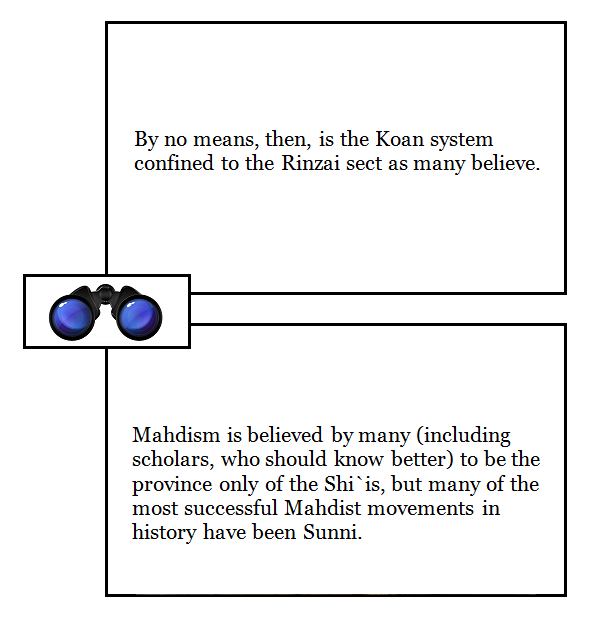
I ran across Philip Kapleau Roshi’s comment on koans (above) in his classic book, The Three Pillars of Zen, the other morning, and it sent me from Zen by rapid mental transit to Mahdism — one of the other termini in my mental system — and to the quote fro m Tim Furnish, one of many to the same effect, which I’ve juxtaposed to it.

If you still think Ahmadinejad (Shiite), and only Ahmadinejad, in terms of Mahdism, then you’ve missed the general point that Furnish is rightly making — and the specific point that Al-Qaeda (Sunni), and not only Al-Qaeda but many Sunnis are also liable to hold strong Mahdist expectations — Abu Musab al-Suri among them.

Because the Whichever-it-is is in the details, the details are the nuances and — when we make decisions without knowing the details, we’re liable to sail right into our blind-spots.

**

Now if you go to a zen master for instruction, you may or may not bee taught shikantaza (“just sitting”) or given a koan (“meditation paradox”) — both descriptions are simplistic; Kapleau Roshi’s book will take you deeper — but one way or another you’ll soon find out, and hopefully you and the master in question can figure things out.

If, on the other hand, you don’t know that Mahdism may be a Sunni as well as a Shiite phenomenon, watch out!

Amplified Mahdist expectation transforms the mental “set” of a jihadist from someone “fighting the good fight” in a generalized way into someone who believes the fight they are fighting is the Culminating War of Good against Evil.

Which, as Furnish’s article’s title, What’s Worse than Violent Jihadists? suggests, is a whole lot more intense.

**

I argued for taking “wide-angle view” at the end of my recent post, Sensitive dependence on initial conditions — here. I’m at the other end of a mental zoom, arguing for precise and nuanced focus on distinctions.

As with Hayakawa‘s Ladder of Abstraction, it pays to be able to work both ends of the spectrum — from the detailed specifics of “my cow Bessie” abstract statistical generalities of “livestock in Colorado” — and beyond.

Ladders will feature one of these days in a “form is insight” post of their own — Hayakawa’s Ladder, and William Blake‘s, and Herman Kahn‘s.

**

Details have their own details, and details are essentially differences — so there’s a lot of zooming in and out to do before you gain clarity. In Gregory Bateson‘s terms, you want to be clear on the differences that make a difference.

The Last Lion, Winston Spenser Churchill, Defender of the Realm, 1940-1965 — finally released!

Saturday, November 3rd, 2012

[by J. Scott Shipman]

The Last Lion, Winston Spenser Churchill, Defender of the Realm, 1940-1965, by William Manchester and Paul Reid

In the 1980’s, William Manchester wrote two of three planned volumes on the life of Winston Churchill. He had notes for the final volume but illness prevented him from completing. Instead, he brought in Paul Reid to finish his masterpiece. While it took 25 years, the wait was well worth it; Reid thus far (I’m halfway through) has channelled Manchester’s style and presenting a seamless connection to the first two volumes.

Strongest recommendation.

Cross posted at To Be or To Do.

Sensitive dependence on initial conditions — & more

Saturday, November 3rd, 2012

[ by Charles Cameron — on human impact, with a quick glance at Pundita’s wide-angle thinking ]
.

The “butterfly effect” identified by meteorologist Edward Lorenz suggests that when you are dealing with highly complex systems such as weather patterns, what eventually happens may be “sensitively dependent on initial conditions”. Very small differences at one moment in such systems may result in very large differences later on. As Lorenz explains in the upper quote above, however, we’re dealing with a myriad of influences simultaneously, and it’s entirely possible that our own meteorological impact exceeds and outweighs that of the butterfly species…

I’ve chosen to post this particular pair of quotes, in fact, because both examples point to severely deleterious effects of human impact on our home environment in the larger sense — “the world we live in” — at a level where human individuals may not feel they have much of an individual impact, but where the cumulative effect is much greater: global warming? devastating storms? loss of rain forest? — narcarchy?

Narcarchy: hereby defined as rule by cartel — see this fascinating news piece, and note in particular the presence of a significant religious thread in the midst of the drug / crime / warfare picture.

**

On the question of sensitive dependence on initial conditions, this graphic paints the picture nicely and with nuance, for those who “think in pictures”:

I found it attached to the Wikipedia entry on Lorenz’s Butterfly Effect which may also help if like me you’re a lay reader, mathematically speaking.

**

I also wanted to juxtapose the two quotes above because they give me a chance to talk about “wide angle views” and their virtues, and to point you to a recent Pundita post that set me thinking along those lines. The post is Then and Now: Instructive parallels between 9/11/01-Benghazi and Katrina-Sandy storms, and part of my comment read as follows:

…you have an amazing breadth of thought going on here – especially in your paragraph:

It’s as if a new era arrived, with its vast changes in weather patterns and attack patterns, and nobody is yet fully processing the nature of the threats. I guess such an observation is actually old news. But Sandy coming on the heels of Benghazi struck me as a kind of exclamation mark to the fact that civilizations start to fall at the point where they’re no longer able to process the cumulative effects of their past.

Seeing parallels between Benghazi and 9/11, or between Sandy and Katrina, would be one thing – but managing to see parallel changes in both “weather patterns and attack patterns” is quite another — and even though people may want to question and qualify some of the details, the overall scope and view is breathtaking.

We need this kind of wide-angle thinking, it seems to me, and I offer my two quotes here in much the same spirit.

So if “sensitive dependence on initial conditions” is one analytic thought pattern I’m promoting here, “wide-angle thinking” and the capacity to zoom from significant detail to global context is surely another.

When photoshop is as strange as fiction

Friday, November 2nd, 2012

[ by Charles Cameron — an intriguing resemblance, is all ]
.


.

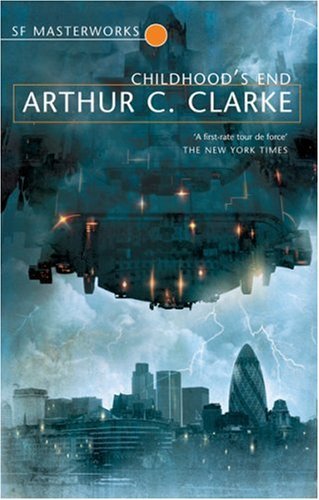
The upper image is a photoshopped (fake, fictive) image of Hurricane Sandy over New York — an image which apparently went a little viral on the web a day or two ago — while the lower one is from the cover illustration of an edition of Arthur C Clarke‘s science fiction novel, Childhood’s End, in which the aliens arrive to hover (and lord it, somewhat benignly) over us — in this case, over London.

Simply that: two images, quite different, yet curiously similar.


Switch to our mobile site