Two recently published essays, one by Belmont Club’s Richard Fernandez, one by Zenpundit’s Mark Safranski, when taken together reveal a portrait of human evil so horrific that young people and the severely depressed should not be allowed to see it. The rest of us need to contemplate what we have wrought by looking the other way as NATO military commands ordered soldiers in Afghanistan to act like saints in the face of ruthless armed militias and democratic governments promoted the lie that nonviolent resistance could topple dictators.
Pundita argues the notion of bloodless resistance has been oversold by the advocates of Mahatma Gandhi and Martin Luther King. It was a convenient alternative narrative to that perennial problem-solving algorithm, war. By skipping over the War of Independence and the Civil War and emphasizing the Salt March and Selma, Alabama they gave the mistaken impression that resistance was all about speeches and heroic poses. […] But nonviolence is a useful myth she argues, because it gives diplomats an excuse not to act. It makes a virtue of doing nothing by characterizing it as actively breaking the cycle of violence and counseling that eventually the tyrant will die of shame. But not before you die of a bullet. […] The truth is that every resistance movement — even largely nonviolent ones — carries with it the implicit threat of force. The police and army of the regime often switch sides when they see that the cost of dealing with impending storm of popular violence exceeds the cost of turning on the tyrant. They fear force and therefore decline to exercise it.
The idea of consequences was once deeply rooted in the public consciousness. Yahweh thundered. And even Christ came to save us from the fires of hell. But hell there was. The opportunity for nonviolent change was always understood to be the ‘last chance’ prelude to violent consequences. … This kind of reasoning is now out of fashion…..
There are a number of people whose views on the religious issues surrounding an Iranian nuclear weapons program interest me — I leave other aspects of the problem to others better informed than I — some because they have insight, some because they have megaphones, and so on.
I’m not the person you’d want to ask whether Reza Kahlili was a CIA source, whether he was trusted, and if so, on what issues – issues which might range from troop movements to popular opinion of the IRG rank and file to theology and apocalyptic, a range that no single source is likely to be omnicompetent in – but WND is a media source I’ve followed off and on for a dozen years, it’s strongly associated with one of the strands of recent Christian apocalyptic with its own messianic take on Islam and Mahdism, and it isn’t necessarily a source I’d trust without verification…
**
So I did some checking of my own on Reza Kahlili, and found that he, or more likely some ghost writer employed to write his book for him (along with his publisher’s copy editor), simply doesn’t know what a hadith is. A hadith is a statement attributed to the Prophet (or in the Shi’a case, one of the infallible Imams who succeeded him) and passed down through an authoritative train of transmission (isnad). For a practicing Muslim, the corpus of hadith is second only to the Qur’an, and knowing what a hadith is is like knowing what the Epistles are for a practicing Christian: basic. For a theologically nuanced scholar from Qom or Najaf, it’s kindergarten.
Kahlili gets the use of the word “hadith” right early on in his book, but when he starts talking about the return of the Twelfth Imam or Mahdi he writes (p. 334.):
Like others who think as he does, Ahmadinejad believes that many of the signs of Mahdi’s return have emerged. Known as hadiths, these signs include the invasion of Afghanistan, the bloodshed in Iraq, and the global economic meltdown. According to prophecy, the hadiths will grow increasingly furious as Mahdi’s return comes closer, including “persecution and injustice” engulfing the earth, “chaos and famine,” and “many wars.” The hadiths predict that “many will be killed and the rest will suffer hunger and lawlessness.” People like Ahmadinejad so completely believed that these conditions would hasten the return of the twelfth Imam that they were willing to foment universal war, chaos, and famine to bring it about.
That’s at best very sloppy writing — the signs are known as ayat (as are the verses of the Quran), and the Quran states (28.59):
Nor was thy Lord the one to destroy a population until He had sent to its centre a messenger, rehearsing to them Our Signs; nor are We going to destroy a population except when its members practise iniquity.
Giving this passage from Kahlili a charitable reading, it could be understood to mean that signs as described in reliable hadith “include the invasion of Afghanistan, the bloodshed in Iraq, and the global economic meltdown” – though there’s a lot of interpretive scope in there, as there is in locating Gog and Magog (are both place names, or is one a prince of the other?) in comparable Christian eschatological circles.
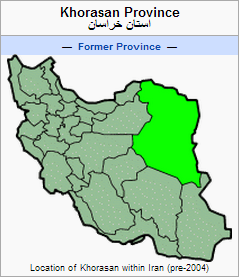
Taliban recruiters (Sunni) certainly take “Khorasan” as mentioned in some Mahdist hadith as referring to “Afghanistan” – see Ali Soufan‘s book, The Black Banners – but an Iranian would read “Khorasan” as referencing the region of that name in Iran, or perhaps a wider zone that includes it, but also encompasses portions of Afghanistan and other neighboring states – it was, after all, the name of Iran’s largest province until divided in three parts, North, South and Razavi Khorasan in 2004:
Interestingly too, the hadith traditions in question are considered likely to have been written by and for the Abbasids. David Cook, for instance, in his magisterial Contemporary Islamic Apocalyptic Literature writes of Khorasan (p. 173.):
The ‘Abbasids sought to present their movement as the fulfillment of messianic expectations, and so they produced a great quantity of materials given in the form of hadith traditions to indicate that the Mahdi would come from this region.
— not that scholarship of this kind is liable to influence popular apocalyptic sentiment…
**
Okay, so with a little creative forgiveness, we can read that first passage of Kahlili’s as saying that within the hadith can be found signs such mentions of Afghanistan / Khorasan, bloodshed in Iraq, and economic woes. But then we read this (p. 337.):
With the eyes of the world on them, the mullahs and the thugs who took orders from them fought mercilessly to hold on to the power that had never been their right, using extreme force to deny that their time was over. In their minds, Mahdi was coming and the blood they shed now was yet another hadith.
C’mon, now, has Kahlili even read his own book? Blood shed equals hadith?
The most charitable thing I can find to say is that Reza Kahlili may or may not have been some level of CIA source, but his credibility in matters involving any aspect of Iranian theology is utterly unconvincing.
**
Jeff Stern, in a WaPo piece from 2010, doesn’t sound any too convinced that Kahlili is worth our trust in other matters either, writing:
Reza Kahlili, a self-proclaimed former CIA “double agent” inside Iran’s Revolutionary Guards, appeared in disguise at a Washington think tank Friday claiming that Iran has developed weapons-grade uranium and missiles ready to carry nuclear warheads.
The pseudonymous Kahlili, whose previous accounts have been greeted with widespread skepticism, also said Iran was planning nuclear suicide bombings with “a thousand suitcase bombs spread around Europe and the U.S..
and:
Several current and former U.S. intelligence officials in the audience “rolled their eyes” at Kahlili’s claims, said one observer who was present.
Some in attendance compared Kahlili with Ahmed Chalabi, the former Iraqi exile who helped convince the George W. Bush administration that Iraqi leader Saddam Hussein had weapons of mass destruction. After the U.S.-led invasion of Iraq, the claims were proved false.
My personal knowledge-map features huge areas of ignorance where many others have strong opinions. On matters religious, Kahlili is not to be believed. On the siting of nuclear labs, or weapons development and deployment, we’re in areas that bear the legend “Here there be Smoke and Mirrors” on my map.
Thus endeth my blog-epistle to Pundita, whose knowledge of many of the other moving parts in the wider geopolitical situation far exceeds my own.
**
I’ll follow up with part II of this essay, in which I’ll talk a bit about Glenn Beck and Joel Rosenberg, and some other significant ways in which Shi’ite eschatology is being misrepresented via popular media in the west.
For those following the development of my book / media project, I am hoping the project will include a section of longer essays such as this one, in which I pull apart some of the myths currently surrounding western understanding of Islam, while pulling together major strands of a more nuanced view.
Michael Yon recently published a remarkable and courageous letter by US Army Colonel Harry Tunnell to the Secretary of the Army regarding deficiencies in our military operations in Afghanistan. Colonel Tunnell is now retired, but the letter was sent while he was on active duty in 2010. Yon calls it “stunning” and I wholeheartedly agree. It is a “must read“.
Colonel Tunnell is a controversial figure in the Army. A bluntly outspoken critic of COIN with strong views on military professionalism and tactical leadership, he served as a commander of combat troops in Afghanistan and in Iraq, where he was badly wounded. Overcoming his injury, Colonel Tunnel returned to command a Stryker brigade in Afghanistan and clash with his ISAF superiors over his use of older Army doctrine on counter-guerrilla operations instead of the pop-centric COIN of FM 3-24. Tunnell aggressively and repeatedly attacked the Taliban in his area of operations, pressing them, which resulted in frequent combat and casualties on both sides – something that was out-of-step with ISAF’s tactical guidance. Several enlisted soldiers in the Stryker brigade were convicted of the infamous “Kill Team” murders which led to Tunnell being investigated and cleared by the Army which found no causal responsibility from Tunnell’s advocacy of aggressive tactics but nonetheless reprimanded him for “poor command climate”.
In light of Tunnell’s letter to the Secretary of the Army, interpret that administrative action as you wish. Afterwards, Colonel Tunnell continued to be a harsh critic of COIN and the focus of periodic, extremely one-sided, negative stories in the media.
When Yon published his piece on Tunnell’s letter, I commented to him on a private listserv and he asked permission to use it, which I gave:
The following email came from Mark Safranski subsequent his reading this letter from Colonel (ret.) Harry Tunnell. The letter.
===Email from Mr. Safranski:===
Interesting, this part in particular:
“”A gross lack of concern for subordinates,” Tunnell wrote, “manifests itself in guidance that ‘zero’ civilian casualties are acceptable and coalition soldiers may have to be killed rather than defend themselves against a potential threat and risk being wrong and possibly resulting in injury or death of a civilian.” ….Tunnell’s memo exhibits particular disdain for British Maj. Gen. Nick Carter, commander of NATO forces in Regional Command South, which includes the Arghandab District where Sitton was killed.
It was Carter, Tunnell wrote, whose verbal order led commanders to risk their own troops rather than Afghan civilians – something Sitton complained about two years later in an email to his wife.”
Very helpful. I finally get it now.
I was always curious, reading threads [on private listserv] here on Afghanistan, how Colonel Tunnell was able to openly pursue counter-guerrilla operations in Afghanistan when pop-centric COIN was the heavy-handed, top-down and rigidly enforced tactical paradigm; Harry, IMHO, could do this because the *verbal* orders being issued went far beyond FM 3-24 theory into an unauthorized and unofficial but *politically desired* British policing model used in Northern Ireland. A kind of tactical guidance that could not be put in writing and enforced through the UCMJ because the American people would have found that guidance to be politically intolerable and morally outrageous – and rightly so.
Unlike Catholics in Ulster who are subjects of the Crown, Afghans are not American citizens and American soldiers and Marines are not cops in a bad neighborhood. Nor is the Taliban the IRA. Minimizing civilian casualties is a good and worthy goal; valuing political atmospherics over American lives is a sign of gross incompetence, at best.
Hence the anonymous leaks and smears about Harry to politically connected Beltway scribes instead. Tunnell’s superiors were afraid to air their real dispute…..
In my view, Tunnell’s letter raises critical questions that every officer has a duty to raise with his superiors in the chain of command if, in their view, operations are not properly being carried out, which endangers the campaign and the lives of the troops. Moreover, if the United States military is to adhere to some bizarre, complicated, unworkable “law enforcement model” ROE not required by the Laws of War, or even our own COIN doctrine, then this is a subject for Congressional hearings and testimony from the administration, not something to be instituted on the sly using allied foreign officers.
Wanting to police the world is hard enough without making our soldiers into policemen.
[ by Charles Cameron — thunder, lightning, wind, water, moon, thanks and praise ]
.
Pulse
.
Like a thunderbolt out of juicy nothingness
a chord
strikes, as if
from the face before time itself, lightning:
nor
is there any measuring the impact a breeze
might ripple out across waters, each drop
containing,
constraining
its reflected ocean.
Live, then, your
lively life, be struck, dumb, gifted, wildly
giving – what else? – thanks
and praise. Not as flattering tongues praise,
but as one moon
surrenders herself, gone, crescent, whole
and shattered, across each and all
turbulent and calm waters.
[ by Charles Cameron — here’s a musical experiment from the book / project i seem to be writing, which offers a grand slam intro to contemplative and artistic approaches to creative thinking, and hence a fresh angle on intelligence ]
.
It looks very much as though I’ve been beginning to write parts of let’s call it “a book” for a while here on Zenpundit. I laid out the overall topic and approach as I see it in my previous post, but here I would like to launch into it mid-stream, with a musical experiment to explore the mind’s capabilities. I’ll explain why, later.
**
.
**
Okay, here’s the experiment.
I invite you to listen to a short piece by JS Bach on YouTube. This will take roughly three and a half minutes of your time, the piece of music itself is one of the glories of the classical tradition, I’ve chosen the video because of the terrific graphics that accompany and illuminate the music, there will be some rock and ragtime to follow for those whose tastes go those ways — and I must ask you to pay very special attention while watching and listening to the video.
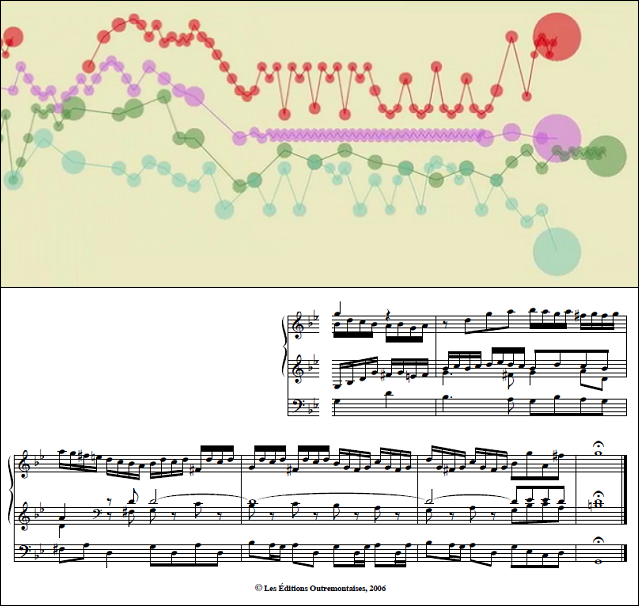
Before you do that, however, I’d like you to take a look at the image at the top of this post, which shows you the ending of the piece both as the video graphics present it, and in the musical notation or “score” an organist would read. The graphics are terrific because they allow the untrained eye to follow the threads of the different melodies or “voices” as Bach braids them together. The work is his “Little Fugue” in G minor, which you can find indexed in his collected works as “BWV 578”.
Here’s how I’d like you to pay attention during the piece:
As you listen to the performance on video, I’d like you to follow the colored lines of the melodies as they move along in the video graphic, and listen carefully to hear how many of the lines of sound you can actually follow distinctly in your mind. At the beginning there’s only one “voice” – only one line of melody – so your task is easy. If you are used to listening to music of one sort or another, you’ll almost certainly be able to track, more or less, some kind of thumping bass line and some kind of melody rising above it – two voices.
Can you manage three? four or more?
If you’re a musician you may still find the graphics — and the exercise – illuminating, but you might prefer to make the same experiment with a version of the piece played by Robert Köbler on a Silbemann organ, accompanied on video by the score..
Here’s the video — see how many voices you can hear and track:
**
How did you do? How many voices could you follow at one time?
And why am I bothering to as you to do this, and then talking so much about it? After all, you may already know everything I’m saying and more, or you may simply not care that much about such things.
Here’s why: the project is about creativity and intelligence.
It’s about how to apply forms of creativity that are generally found in the arts and humanities — and in the world’s contemplative traditions — to the questions that arise for every bright human as we face the exhilarating challenging and terrifyingly complex world around us.
It’s about understanding complexity, in the way the Intelligence Community needs to understand complexity, and business leadership, and our scientists and technicians, and the congregants at our synagogues, churches, mosques and temples, and, well, all the bright people everywhere — disillusioned, or fresh and rarin’ to go.
**
Complex problems often require some sort of recognition and resolution of several or many distinct and sometimes conflicting voices, points of view, concerns or vectors.. which may shift in intensity and direction as the situation evolves.
In musical terminology, any music that includes two or more distinct melodic lines or “voices” playing together simultaneously is polyphonic — from the Greek for “many voices”. Counterpoint — from the Latin for a point that counters another point — is the artful way in which composers can “work” two or more melodic lines together, so they clash at times, resolve, and harmonize.
The fugue — the particular contrapuntal form Bach uses in the piece you just heard — imposes even tighter constraints on the composer, and can elicit even greater creative inspiration as a result — as many of Bach’s, Mozart‘s, Beethoven‘s and others’ greatest works testify..
**
I imagine you can see that the many voices of polyphony — voices in counterpoint, that at times clash and are in need of resolution and harmony — have their equivalents in the complex multi-stakeholder problems, clashing points of view and need for constructive resolutions that creative artists, intelligence analysts, strategy, policy and decision makers, and anyone who wants to keep aware of the shifting currents of our strange and complicated times all need to take into account.
So polyphonic, and specifically contrapuntal, thinking, can be extended way beyond the realm of music — as Hermann Hesse suggested in his greatest novel, Glenn Gould tried to demonstrate in his “contrapuntal radio” pieces, and Edward Said understood when he characterized the Israeli-Palestinian issue in these words:
When you think about it, when you think about Jew and Palestinian not separately, but as part of a symphony, there is something magnificently imposing about it. A very rich, also very tragic, also in many ways desperate history of extremes — opposites in the Hegelian sense — that is yet to receive its due. So what you are faced with is a kind of sublime grandeur of a series of tragedies, of losses, of sacrifices, of pain that would take the brain of a Bach to figure out.
The “book” may turn out to be a DVD, or a workshop, at this point who knows? Whatever format it winds up it takes, it will teach contrapuntal thinking — using examples drawn from world culture and contemporary geopolitics — as a radical alternative methodology, complementary to but very different from our current analytic methods. It will be a text in the cross-disciplinary, associative, lateral or horizontal equivalent of the kind of disciplinary, siloed, linear or vertical thinking that our increasingly specialized culture has trained us in —
and which we need to supplement, if we are to have the mental flexibility to see and make the creative leaps our times require of us.
God only knows how many voices there are in Bob Dylan‘s song Sad Eyed Lady of the Lowlands, or Eric Clapton‘s Have you ever loved a woman from the 2004 Crossroads Guitar Festival – the principle’s the same, but we don’t (yet) have the graphics to allow your eye to follow what the musicians are doing — and there are solos, and sidemen.
Each musician has at least one voice, its melodies and its silences, to present – and sometimes several, as we saw with the Bach organ piece. And together the individual musicians add up to an ensemble, each with an awareness of the others’ voices and a concentration on their own.
And for an insight into the varieties of organ mastery, compare Billy Preston‘s amazing solo starting at 9’33” on the Clapton piece, Al Kooper‘s organ work on Dylan’s Sad Eyed Lady, and Ton Koopman‘s rendering of the same Little Fugue BWV 578 we started with – where at times you can watch Koopman’s fingers on the keys or feet on the pedals, for yet another way of visualizing the intricate interweavings of this glorious music.
**
Glenn Gould had an amazing mind: for your enjoyment, here’s a version of his own fugue, aptly entitled So You Want To Write a Fugue? — with a similar graphical display to help you follow along with the interweaving lines of melody…
It’s serious, and it’s hilarious too! Or maybe you’d prefer Scott Joplin? Either way, enjoy:
Glenn Gould:
Scott Joplin, Euphonic Sounds, a Syncopated Novelty:
Zenpundit is a blog dedicated to exploring the intersections of foreign policy, history, military theory, national security,strategic thinking, futurism, cognition and a number of other esoteric pursuits.