zenpundit.com » 2012

Archive for 2012

Pussy Riot IX, Of films, riots and hatred IV: Notre Dame 1950

Saturday, September 29th, 2012

[ by Charles Cameron — more food for thought on religious and irreligious outrage — and Paris again, too ]
.

Michel Mourre (in friar's habit) and Serge Berna reviewing "The Declaration of Mourre"

.

It will not have escaped the eagle-eyed readers of Zenpundit that three of the incidents we have been discussing recently — the Pussy Riot affair, the Innocence of Muslims video and the Charlie Hebdo cartoons — all revolve around issues of blasphemy and free speech.

I’m indebted to whoever it was pointed me to Colin Jager‘s Pussy Riot’s punk prayer, posted on the SSSR’s Imanent Frame blog ten days ago as a comment on the punk grrls incident:

Perhaps its most obvious precursor is the intervention staged by several young lettrist poets at Notre Dame Cathedral, on Easter Sunday, 1950. In the middle of the service Michel Mourre, dressed as a Dominican monk, climbed into a pulpit and began to read a sermon/poem that condemned the Catholic Church for “infecting the world with its funeral morality,” and announced that God was dead “so that Man may live at last.” As Greil Marcus details in Lipstick Traces, the response was dramatic: the Cathedral’s guards attacked the four with their swords, and the crowd chased them out of the Cathedral and down to the Seine, where they were apprehended by the police.

**

That’s the sort of hint I like to follow up on, so I found my way to Greil Marcus‘ book, and to this paragraph for starters:

At 11:10 A.M. on 9 April 1950, four young men — one got up from head to foot as a Dominican monk — entered Notre-Dame in Paris. Easter high mass was in progress; there were ten thousand people from all over the world in the cathedral. “The false dominican,” as the press called him — Michel Mourre, twenty-two — took advantage of a pause after the credo and mounted the altar. He began to read a sermon written by one of his co-conspirators, Serge Berna, twenty-five.

Let me say right away that there is at least one pointer here suggesting that Marcus may not be the best observer of religious detail. Marcus says Mourre “took advantage of a pause after the credo and mounted the altar” before reading his sermon — Mourre’s own account has him “mounting the pulpit”. Curiously enough, the writer of the Immanent Frame piece makes a similar error in describing Pussy Riot:

Singing “Mother of God, Chase Putin Out!,” and clad in brightly colored dresses, leggings, and balaclavas, the women danced, kneeled, and crossed themselves in front of the Cathedral’s high altar.

Only in a stretched sense can the Pussy Rioters be described as performing their act “in front of the Cathedral’s high altar.” They were in front of the great doors of the ikonostasis, which when opened, lead to the altar. But the ikonostasis itself is no more an altar than a pulpit is.

Sacred architecture, gentle readers: these are differences here that do make a difference.

**

Marcus then gives the text of the sermon, which can be found on Wikipedia and concludes with the line:

We proclaim the death of the Christ-god, so that Man may live at last.

Compare the Pussy Riot prayer, the Guardian’s translation of which can be found here, and which includes the lines:

Fight for rights, forget the rite – Join our protest, Holy Virgin.

**

Moving along, Greil next allows us to glimpse the response, which included the drawing of swords and the threat of lynching:

The cataclysm that followed went beyond anything expected by Mourre and his fellows, who first planned merely to let loose a few red balloons. The organist, warned that a disruption might take place, drowned out Mourre just after he pronounced the magic words “God is dead.” The rest of the speech was never delivered: swords drawn, the cathedral’s Swiss Guards rushed the conspirators and attempted to kill them. Mourre’s comrades took to the altar to shield him — one, Jean Rullier, twenty-five, had his face slashed open. The blasphemers escaped — his habit streaked with Rullier’s blood, Mourre gaily blessed the worshippers as he made for the exit — and were captured, rather rescued, by the police: having chased the four to the Seine, the crowd was on the verge of lynching them.

You may recall for comparison with this incident that the sum total of weaponry attributed to Christ’s disciples in the Gospels was two swords, worn on just the one evening —

And they said, Lord, behold, here are two swords. And he said unto them, It is enough.

— [Luke 22.38], and that the sum total of wounds inflicted by those swords was the loss of one ear, which was quickly and miraculously replaced by the savior himself —

And one of them smote the servant of the high priest, and cut off his right ear. And Jesus answered and said, Suffer ye thus far. And he touched his ear, and healed him.

— [Luke 22:50-51]

**

Next up, here is Michel Mourre’s own, retrospective account, from his book In Spite of Blasphemy:

It would be absurd to expect that the incident I was organizing with my friends was going to bring about a change in the state of the Church. In the fever of excitement we were in at the time, some of my friends, particularly one who was a former monk, a Spanish Jesuit, really believed it would. But I knew only too well that I had no message to deliver, no reforms to attempt, since I as in a far more wretched moral condition than so many others. I did not believe that God could be found anywhere outside His Church or that God could be an ally of ours against the Catholic Church. In this connection there was the example of all the pseudo-saintly sinners, the pseudo-mystics, the pseudo-illuminaries, both Buddhist and otherwise, who flourished in Saint-Germain-des Pres, and the “hidden knowledge,” the “esoteric intuitions,” the “visions” of the diabolical procession in honor of Satan, the Devil-Lucifer, of which at least one initiate could be found any evening in a Saint-Germain bar ready to describe his “trances.” All these voluntary outcasts from the Church, all these madmen drunk on occult fumes and in search of a substitute God, a substitute Church and Mysteries, discouraged, by the very excess of their nonsense, any attempt to look for God outside the discipline and rules of the Church.

No, I had really no idea of changing anything in the Church! I was trying rather to convince myself that God no longer counted for me, nor did His Church, nor above all did the atmosphere of sacredness that could be felt in the ceremonies of the Church. By this insult to God, by this small sacrifice I was going to make, but not without anxiety or fear, I was trying to make God equal in my eyes with human, transient things which are destined to die and which can be trodden underfoot relentlessly and without regret.

And yet, once I was embarked on the details of our scheme for creating a disturbance during the Easter service at Notre Dame, I began to take it all quite seriously. To my feverish mind the cry of revolt which we decided on at a table in the Mabillon was like a message to the Church, to the world, and I found it quite natural to put on my monk’s habit again before mounting the pulpit. For me the habit of Saint Dominic was an exasperating symbol, an object of reproach. By profaning it I hoped to be rid of it.

Next day, after the Credo of the Easter High Mass in Notre Dame, dressed as a Dominican and wearing a tonsure, I mounted the pulpit and shouted out the old blasphemy: “God is dead!” But the blasphemy is no longer what it was in Nietzsche’s day, the prelude to a hymn of joy; it is only a cry of madness and horribly sad.

**

While the Moscow Cathedral and Notre Dame incidents are similar in some ways, the Notre Dame venue — Paris, 1950 — prefigures both the students at the barricades in 1968 and the Last Temptation troubles that I reported in connection with the Innocence of Muslims video — and Charlie Hebdo, too. The motivations, however, are quite dissimilar, as the quotes from the grrls closing statements, which I’ve excerpted here and which are extensively quoted in the Jager piece, suggest:

Maria Alyokhina, for example, asserted that for the Orthodox Church “[t]he Gospels are no longer understood as revelation, which they have been from the very beginning, but rather as a monolithic chunk that can be disassembled into quotations to be shoved in wherever necessary.” Noting that Jesus himself had been accused of blasphemy, Alyokhina goes on: “I think that religious truth should not be static, that it is essential to understand the instances and paths of spiritual development, the trials of a human being, his duplicity, his splintering. That for one’s self to form it is essential to experience these things.” And she makes the link to contemporary art explicit: “all of these processes—they acquire meaning in art and in philosophy. Including contemporary art. An artistic situation can and, in my opinion, must contain its own internal conflict.”

and:

The radical power of that diagnosis becomes most clear in Yekaterina Samutsevich’s closing statement: “In our performance,” she writes, “we dared, without the Patriarch’s blessing, to unite the visual imagery of Orthodox culture with that of protest culture, thus suggesting that Orthodox culture belongs not only to the Russian Orthodox Church, the Patriarch, and Putin, but that it could also ally itself with civic rebellion and the spirit of protest in Russia.” Most striking here, perhaps, is the language of “uniting” orthodox and protest culture, rather than setting them against each other. This is done, Samutsevich suggests, in the name of a democratic ideal: both orthodox and protest culture are properties of the people rather than of one group or another. The performance, on this analysis, becomes a visual and aural demonstration of what Alyokhina had called “internal conflict,” something posed by all three women as the space in which religious revelation happens. Thus art, religion, and the state are not conceptually separated here but deliberately mixed up, in the name of religious truth.

**

It is worth noting that Michel Mourre, who had been a Dominican friar before the event in Notre Dame, came back into the Church and lived until 1977, writing a number of books including Religions et Philosophies d’Asie, Le Monde à la mort du Christ and L’Histoire vivante des moines, as well as his Dictionnaire d’histoire universelle.

As the world spins, so spins my head.

Of miraculous births and abominations

Friday, September 28th, 2012

[ by Charles Cameron — magical religion, the amnesia of the rationalists, a brief mention of poetry and a touch of Tillich ]
.

As you know, I’m interested in the clashing of worldviews. Yesterday, Teju Cole posted a tweet with a quick mention of apocalypse that caught my eye:

There’s a whole lot going on here, and it takes a neat combo of crabwise and linear thinking to get at it all.

But first, a brief and hopefully unnecessary note to our gentle readers:

Take a look at the tweet above, and if you don’t want to peer more deeply into the murky tabloid worlds of strange births, miracles and abominations that it touches on, don’t read the rest. This post may be gross enough in parts, or so absurd-sounding that you want to drop the whole thing and read something else.

As I see it, it’s also interesting and informative — fascinating even — besides being potentially quease-making. But seriously, if you’d rather skip that kind of thing, please don’t leave right away, just go to the very last section and read the two quotes from Paul Tillich. Thanks.

**

Still with me? Good…

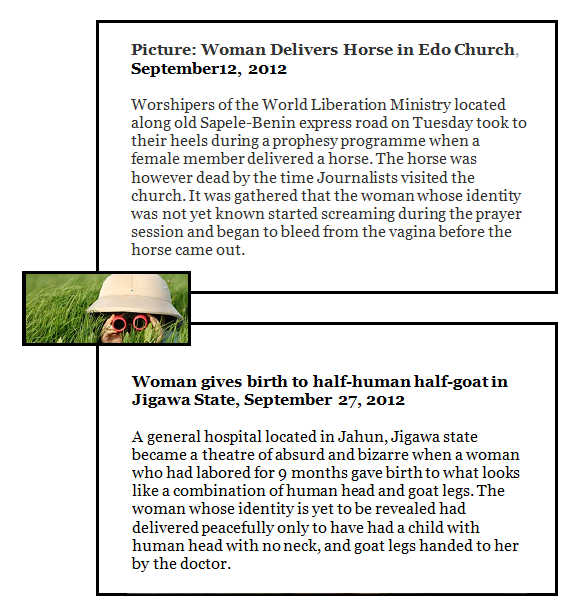
For starters, we can compare these two stories, located about two weeks apart, and described as happening in two Nigerian states: Edo and Jigawa:

It would be easy to dismiss them both as Weekly World News style fabrications, like WWN’s Werewolf Sues Airline Over Flight Delay — but that would miss the point: they’re believed.

**

Restricting ourselves from the moment to half-goat, half-human combos, we can then compare a human birth narrative with a narrative of a goat birth:

The same story? A completely different event? Or human memory, playing its strange tricks?

Note that the two tales are now three years apart, and while one is reportedly from Nigeria, the other is from Zimbabwe.

**

In that last telling, we saw one local explanation for strange — dare I call them paranormal — events of this kind: a curse.

Let’s explore that idea a bit further. The same report quoted above went on to say:

A belief in ghosts is still alive and well in the region and the creature was taken as a sign of evil – perhaps even witchcraft. But local Governor Jason Machaya (56) is sure, that it was a half-man, half-goat hybrid which was the result of bestiality: “A grown man was responsible for this.”

So there’s another possibility. The next paragraph offers yet another:

Doctors, however say that it would be a biological impossibility.

Score one for the scientific worldview.

**

It may be a gossip and conspiracy mag invention, or an old wives’ tale, or the result of a curse, or witchcraft — which could include the local medical tradition — or, as with the horse birth, a miracle — what else?

It could be archetypal…

It could be Pan, the erotic satyr-god of Greek myth and James Stephens‘ delightful tale, The Crock of Gold, or the hideous demon of the occultist Eliphas Levi — the god of the old cult becoming a demon in the new, as they so often do —

— in this case also giving us the portmanteau word pandemonium

**

But there’s one final possibility, and it’s the one that Teju Cole presented us with the first nine of his 140 characters:

end times

I want to give that one time to settle in, because almost all end times predictions involve “signs of the times” that show the world going to hell in a hand-basket, with (eg) family values upended, the sacred profaned, lies usurping truth, and so forth.

I don’t believe this is by any means limited to Islam, but I’ll give an Islamic example as it comes to hand. One of the major signs of the coming of the Qiyama (Last Day, Day of Judgment, Day of Resurrection) is as follows:

After the night of three nights, the following morning the sun will rise in the west. People’s repentance will not be accepted after this incident.

Compare this, from the Christian New Testament, Matthew 24.29:

Immediately after the tribulation of those days shall the sun be darkened, and the moon shall not give her light, and the stars shall fall from heaven, and the powers of the heavens shall be shaken.

**

Women in church giving birth to horses, goats or women giving birth to half-human, half-goats… The story crops up again in Turkey as reported on January 14th, 2010:

A sheep gave birth to a dead lamb with a human-like face. The lamb was born in a village not far from the city of Izmir, Turkey. Erhan Elibol, a vet, performed a caesarean on the animal to take the lamb out, but was horrified to see that the features of the lamb’s snout bore a striking resemblance to a human face. “I’ve seen mutations with cows and sheep before. I’ve seen a one-eyed calf, a two-headed calf, a five-legged calf. But when I saw this youngster I could not believe my eyes. His mother could not deliver him so I had to help the animal,” the 29-year-old veterinary said.

And again with the religious language — the picture accompanying the article carries the caption:

An Abomination of Nature or a Mutation Caused by Blind Industrialization?

Abomination, a word for the utterly unnatural, is another term found in connection with end times thinking. And industrialization? Perhaps that’s one version of the modernist end times…

**

A few things to note here in closing:

Indigenous religious beliefs and practices in many parts of the world include magical aspects that may seem shocking, absurd or distasteful to rational modern western sensibilities. Some of these beliefs and practices are deeply ingrained, and missionary churches have not infrequently carried some of them into their own structures, there being no clear dividing line between “culture” and “religion”. Churches which place an emphasis on miraculous healings as proofs of renewal in the Spirit are particularly prone to this kind of seepage.

The “rational modern western” sensibility I mentioned above, however, is so utterly out of touch with such matters that it treats them as jokes, lampoons them in the tabloids, and otherwise tends to ignore them.

Strongly held beliefs – what I referred to in Waco in Pakistan using Tillich’s term as “ultimate concerns” – are “facts on the ground” that we ignore at our peril.

Poetry — not flabby cherubic verses in greetings cards but the dedicated study of poetic tradition — contains an antidote.

**

Man, like every living being, is concerned about many things, above all about those which condition his very existence, such as food and shelter. But man, in contrast to other living beings, has spiritual concerns – cognitive, aesthetic, social, political. Some of them are urgent, often extremely urgent, and each of them as well as the vital concerns can claim ultimacy for a human life or the life of a group. If it claims ultimacy it demands the total surrender of him who accepts this claim, and it promises total fulfillment even if all other claims have to be subjected to it or rejected in its name.

and again:

It transcends both the drives of the nonrational unconsciousness and the structures of the rational conscious

Both quotes are from chapter 1, What Faith Is, of Paul Tillich‘s Dynamics of Faith.

Recommended Reading & Viewing

Friday, September 28th, 2012

Top Billing! Michael Yon – America’s Dumbest War, Ever 

If we had a real media, they might ask President Obama and Governor Romney about this. Or our Secretaries of Defense and State. However it seems that the goal of the MSM is to not let nasty foreign news interrupt the scripted rhythm of the presidential campaign, even if, you know, an embassy gets sacked and burned and our ambassador murdered by a terrorist-led mob.

Yesterday a concerned father forwarded to me a letter from his son in Afghanistan. I confirmed authenticity, and republish with permission:

Dad,

I am fed up. I cannot believe the lack of attention the recent changes in this war is receiving by the media or the country. I think I saw one thing on CNN about the following subject, but I had to dig extensively to find it. The purpose of this letter is to let you know of the garbage that our soldiers are going through right now. With this knowledge, I hope that you take action by writing your congressmen.

First, because of the recent green on blue incidents or “insider threats” as the new buzz phrase dictates, all coalition forces in Afghanistan have completely stopped partnering with the ANA, AUP, and ALP in order to prevent the death of anymore CF casualties by ANSF or Taliban disguised as them. This is also greatly spurred by President Karzi’s indifferent attitude and lack of action to take measures to prevent further insider attacks.

….To the second point: I don’t think that the American citizens would be happy if they knew that their soldiers were being prohibited from defending themselves in any way because of politically driven orders, but that is precisely what is happening in this war right now even as I write this letter. The soldiers of the U.S. never engage the enemy unless we know that we have will always have the tactical advantage in defending ourselves, that advantage is the use of close air support and air weapons team. To take those weapons away from us is to level the playing field for the enemy and thus exposing our soldiers to more danger. In the school house they teach us that the minimum ratio that we are to engage the enemy with, is a 3:1 ratio. In other words, we have the highest probability of winning because we don’t fight fair. The sound tactical principles behind this teaching have saved lives. The very presence of aircraft over our foot patrols has also saved lives and now our chain of command is being told by our political leadership that this is now not allowed.  If we are not partnering with the ANSF and we are not actively patrolling to prevent our enemies from massing their attacks on our COP and we can’t drop a bomb on the enemy that we have positively identified, than what the hell are we doing here? 

What indeed?

It seems the same physically safe DC political insiders who made the call for no security for our diplomats in Libya are now writing ROE that turns American soldiers and Marines into Taliban target practice.

Why? And more importantly…..Who?

Dr. Steve Metz– Strategic Horizons: The Future of Roboticized Warfare 

….Revolutionary military concepts like armored warfare and strategic bombing were created in the 1920s, a time of limited defense budgets, small militaries and a less frenetic operational pace that gave military theorists time to think and experiment. The United States appears to be entering a similar time, opening the door for revolutionary ideas. This may free military robots from their supporting role, as theoretical revolutionaries invent radically new ways to use them in innovative, robot-centric formations.

It’s not hard to imagine the advantages of robot-centric military formations, particularly for conflict on land. A roboticized Army or Marine unit could have as much or more capability than a current one, with significantly fewer humans. This would both lower the chances of U.S. casualties and save some of the massive costs represented by recruiting, training, educating, housing and feeding troops, as well as providing medical care and post-service benefits to members of the military. It also could ease a potential recruiting crisis as the annual cohorts of 18-year-olds get smaller.

Milpub (Seydlitz89) – Grand Strategy: Inherent Tensions 

Let’s start with a recap of Fuller’s concept of grand strategy. This is laid out in Fuller’s own detailed style in his The Reformation of Warfrom 1923. Fuller starts with a pyramid of military forces comprising land, sea and air forces which together constitute “a very complex and unstable organization”, in all force results from the integration of all three, so a political community could still extert force without air or naval forces, although this application of force would be of a more limited scope. The base of this pyramid rests on “the moral of the civil population and the commercial and industrial resources at their disposal”. Fuller likens this base to “fire” with the military forces being “earth”, the naval forces “water” and the air forces “air”. These four elements together produce a fifth which Fuller describes as the “national will to exist” and “the driving force of all military activities”. This “national will to exist” includes an ideological componentincluding the soldierly virtues present in society (“integrity, honour, justice and courage”). I would include with this something that Fuller assumes, that being best described as the German termOpferbereitschaft, or the willingness of the individual to sacrifice themselves in the interest of the political community. Fuller concludes, “This control and direction of the will to win and all the means whereby this will may be expressed I will call grand strategy.”Before getting to what Hew Strachan has to say, let me point out one more very important point – for Fuller, this grand strategy is contingent. The totality of moral and material elements exerts force which is then resisted by the enemy, who have in turn their own totality of elements that resist. It is the interaction of force and resistance which characterizes the war in question, making each war unique.

Steven Pressfield – Thinking in Blocks of Time 

….When we think in terms of blocks of time, it takes pressure off the need for immediate production. We don’t mind going slowly the first few days because we know we’ll hit our stride in a week or two.

Starting slow does something else that is not often appreciated. It sends a message. A low-pressure Day One tells the muscles, “Wake up, work is coming.” It doesn’t make the muscles panic. It just gets them in the mood. When we up the pace on Day Two, the muscles get the picture. They start to prepare.

Our imaginary colt does not dread running. He wants to gallop. The trick, for us the trainer, is not to give him his head too soon.

So we zoom out. We push the horizon back. We think in blocks of time.

Week One, we accomplish X.

Month One, we accomplish X+Y.

By New Year’s, we have nailed X, Y, and Z.

I recognize that what I do for a living—writing long-form pieces—is not analagous to what many people do. But the long-run mindset is a valuable one to master, even if you’re in the business of git-’er-done-now.

IVN – (John Sullivan) –Barbarization in Mexico Punctuated by Hyper Violence 

….As a result of the narco-violence refugees and internally displaced persons are also reported in contested areas with some estimates suggesting as many as 230,000 persons have fled the cartels’ ‘social cleansing.’ Journalists, police, and mayors are often targeted with assassination. In the case of journalists, the death toll ranges from 45-67 killed during the drug war; some estimates are higher. The goal of much of this violence is to remove opposition from rival gangsters and the state. Persons interfering with cartel operations are at risk. Again accurate numbers are hard to find.

….Barbarization and narcocultura go hand in handNarcocultura is a social phenomena that glorifies narcotrafficking. The narcos become heros worthy of emulation for the many “ninis” or youths without jobs or education. Think of it as Mexican gangsta rap on steroids. Two threads emerge: 1) the narco as hero; and 2) narco-folk saints like Jesus Malverde and Santa Muerte to bond narcos into a cohesive social structure that provides justification for their actions and spiritual protection for their deeds. Narcomantas (banners), corpse-messaging (leaving a message on a corpse), narcomensajes (messages or communiqués), and narcopintas (graffiti) accompany acts of violence and brutality to extend the cartels’ message in a form of narco-information operations. Such imagery can be a powerful social bond.

SWJ – An Enduring Argument Against Counterinsurgency and Primitivization of War and Prospects for Peace

Abu Muqawama – (Elkus) Targeted Killings and Pakistan: Focus on the Policy and (Trombly) The Logic and Risks of Capture Operations 

Ribbonfarm –Money as Pain Relief 

Fast Transients – The pivot point 

Adaptive Leader –Learning the Hard Way Gets Easier 

LESC Blog – Latest P1 Column: The anatomy of victory (part two): Victory at minimal cost  

USNI Blog – Guest Post by Robert Kozloski: Future Wars: US Homeland at Risk? , Guest Post by RDML James Foggo: Fostering Innovation in the United States Navy and Guest Post by LCDR Rachael Gosnell: Can We Really Afford to Pivot?

RECOMMENDED READING:


Graphic matches?

Thursday, September 27th, 2012

[ by Charles Cameron — Netanyahu’s UN speech, Jyllands-Posten cartoon, a nifty film technique, and is there an echo there? ]
.

**

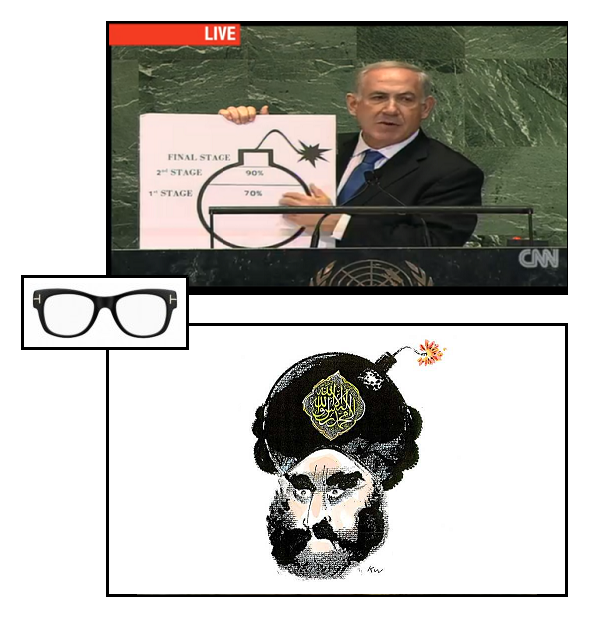
A fair number of people have commented on Israeli PM Netanyahu‘s displaying a cartoonish bomb graphic in the course of his UN address today, and some have complained, fairly IMO, at the choice of photo used to depict Netanyahu during his speech by eg Fox News:

I think it’s important to read graphic messages closely for the cues they contain.

**

Sometimes, as with images of the Virgin Mary seen in grilled cheese sandwiches or oil slicks, the correspondences don’t really mean much more than that the brain is designed for pattern recognition, and a little “imagination” without critical appraisal can get things wrong: the terms commonly used for this are apophenia, patternicity and pareidola.

My own favorite example of this phenomenon is of the wall-stain in a school in the East Bay that was recognized as the Virgin Mary by Catholics and the bodhisattva Kuan-Yin by Buddhists

Nonetheless, I’m reluctant to ridicule such modes of perception without also recognizing the utility of Rorschach blots in psychology and the even more creative uses to which Leonardo put them.

**

Perceived visual similarities, in short, can be the result of creative or merely overheated imagination, but in the visually sophisticated they become much more.

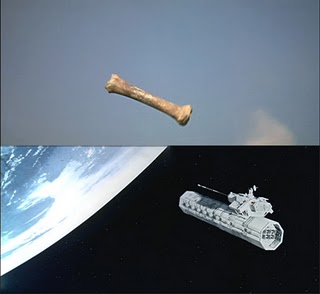
Film-makers, in particular, have several names for the kind of skillful editing by which one scene segues into another via a well-chosen visual similarity: match cut and graphic match.

My personal favorite example is that of Apocalypse Now, where the rotors of the fan in that claustrophobic hotel room in Saigon morph into the rotors of the helicopter coming to take Captain Willard out and away on his mission up river…

Perhaps even more celebrated, though, is Kubrick’s match between the bone tumbling through the air and the space station tumbling through space, in 2001: A Space Odyssey:

**

To get back to Netanyahu, then — is his hand held out a little above vertical, palm down, really a Hitler salute? I think not.

And does his image of a bomb carry any resonance from the Jyllands-Posten cartoon? I have to admit I’m almost undecided on that one.

And if there’s just a hint of a correspondence, would it be conscious or unconscious?

**

The thing is, politicians have to be extremely careful about tossing graphic matches onto dry kindling.

To my own way of thinking, both Netanyahu’s “cartoonish bomb” graphic and his “mid-heil” salute are potential fodder for incautious speculation — but neither one is even remotely as far-fetched as Jerome Corsi‘s claim in a recent WND that a recent Obama campaign use of the Stars and Stripes (above, upper panel) — in admittedly terrible taste — suggests that Obama in any way favored the decease of Ambassador Christopher Stevens in Benghazi (lower panel).

**

My point here, as so often, lies not in any political content or conclusion, so much as in a general purpose invitation to persons of intelligence (and a fortiori, intel) to watch out for possible graphic matches, to make close and cautious readings of visual as well as textual data — in short, to take a closer look

Yet More Books……

Tuesday, September 25th, 2012


For The Common Defense (Revised & Updated) by Allan R. MillettPeter Maslowski 

In the Shadow of the Sword by Tom Holland 

The Poison King by Adrienne Mayor

The Fate of Africa by Martin Meredith  

I seem to be on another bibliomaniacal binge where my reach exceeds my time 🙂

For the Common Defense: A Military History of the United States of America 1607-2012  is a courtesy review copy of the newly revised and updated 2012 edition.  I have referred students interested in a comprehensive look at American military history to older editions of For the Common Defense for years and I am curious about their handling of recent wars and how they applied new scholarship (Vietnam, Civil War) to explain old ones.

I am a big fan of Tom Holland already, having read his Persian Fire and Rubicon previously. Picking up In the Shadow of the Sword was a no-brainer.

The Poison King looks to be a fascinating read: Mithradates of Pontus was up there with Hannibal and the Parthians for dealing out devastating defeats to Roman power

I was sold on The Fate of Africa because it carried a robust endorsement on the book jacket from…. Ralph Peters!


Switch to our mobile site