zenpundit.com » 2012

Archive for 2012

Pakistan’s Strategic Mummery

Saturday, August 18th, 2012

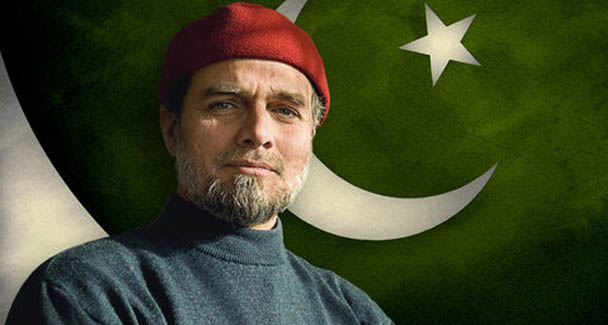
A while back, Charles Cameron had a post on the Ghazwa E Hind that served as my introduction to an oddball Pakistani agitator named  Zaid Hamid The colorful Mr. Hamid seems to be Pakistan’s fully militarized version of Glenn Beck fused with an Islamist George Friedman, with perhaps an astrologer and Rip Taylor thrown in for good measure. In discussing this figure, ZP commenter Omar offered:

….But this clown has serious backers. The deep state systematically uses these clowns to prepare the “information space” for their plans. ..and they are not kidding around. 

Zaid Hamid made a recent appearance in another post by Charles, so I felt inspired to look at him more closely and discovered that Hamid, who has a fondness for 4GW verbiage, has his own think tank, Brasstacks which publishes “geostrategic analysis”, largely about alleged “Hindu Zionist” (?) conspiracies to destroy Pakistan. These papers are fascinating, in a car-crash sort of way, much like a political intelligence letter from the LaRouchies. There is also a blog by Hamid, where his latest post remarkably declares Pakistan’s late dictator, the ruthless General Zia ul-Haq, a “shaheed”.

My question, since Hamid appears to stir controversy and criticism within Pakistan, is what is his real level of influence in Paskistani society? Comments welcome.

Glenn Greenwald misses target, hits good guys

Friday, August 17th, 2012

[ by Charles Cameron — I pretty much follow the people I follow because I learn from them, and that builds trust and friendship ]
.

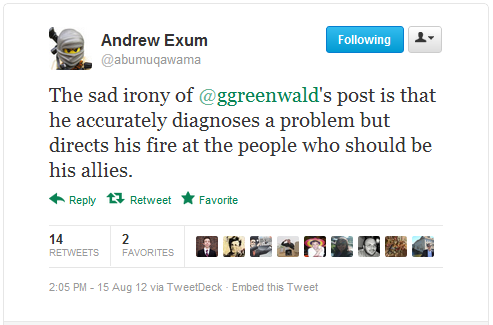
Exum nails it.

I mean, I can well imagine there are some phony “experts” on terrorism out there, but Glenn Greenwald hasn’t done his homework and misfires. Let me explain.

**

I don’t know about you, but I sometimes think the words that someone ends a book with are kinda significant. They’re the ones that give you the impression the author wants to leave you with. That’s partly why I go on and on at such length about the final hundred pages of Abu Musab al-Suri‘s Treatise being devoted to an exposition of apocalyptic hadith with strategic application.

So when Daveed Gartenstein-Ross writes an entire book arguing that al-Qaida’s strategy is to defeat the US by draining its economy – fair enough, given that bin Laden himself said he was continuing a policy of “bleeding America to the point of bankruptcy” – it should come as no surprise when Gartenstein-Ross closes his book with the following words:

When we are facing a crushing national debt, the interest payments for which are projected to eclipse our current defense budget by 2019, we cannot afford to overreact to every terrorist threat and to intervene in every conflict.

The course to maintaining American power in the twenty-first century begins with conserving our resources. And this must be as true of our counterterrorism and military efforts as it is of any other segment of the federal budget.

Likewise, when someone writes a 30-page analysis of the FBI’s infiltration of the Patriot movement, as JM Berger did in his report on PATCON for the New America Foundation, it’s hard to imagine that he’s solely concerned with Islamic terror. Indeed, Berger was researching the “Aryan Republican Army” at least as far back as 2006, when he posted Richard Guthrie’s Suicide: New Details Of ‘Aryan’ Bank Robber And OKBOMB Suspect’s Death In Prison; more recently, he published a piece about the Turner Diaries and today’s Patriot movement in the Daily Beast in June of this year.

**

It’s curious, then, and sad, that these are the two people that Glenn Greenwald specifically picks out by name and photograph to attack in his final, ill-informed piece for Salon, The sham “terrorism expert” industry, writing:

Gartenstein-Ross’ entire lucrative career as a “terrorism expert” desperately depends on the perpetuation of the Islamic Terror threat.

of the fellow who wrote:

we cannot afford to overreact to every terrorist threat

and similarly:

he spends his time doing things like shrieking about the Towering Menace of Anwar al-Awlaki and generally hopping on whatever Muslim-Terrorism-is-a-Grave-Danger train that comes along.

about the fellow who has been tracking many forms of US native terror – including all those mentioned in his piece, A Nation of Spies and Snitches in Foreign Policy in May of this year:

And it isn’t just about Muslims, or even terrorism. In recent months, informants and undercover agents have played a key role in criminal cases involving anarchists in Ohio associated with the Occupy movement and right-wing extremists in Georgia, Arizona, and Michigan

**

Greenwald has gotten this same sort of thing wrong at least once before, when he pilloried Will McCants. Greenwald had written:

I had a somewhat lengthy debate on Twitter last night about the Awlaki assassination with several people often identified as “Terrorism experts” — such as Will McCants and Aaron Zelin — and they and others (such as Andrew Exum and Robert Farley) objected rather vigorously when I said I found the entire concept of “Terrorism expert” to be invalid, as it is a honorific typically assigned due to ideology and interests served rather than actual expertise.

Ouch.

Exum neatly skewered him that time, too, albeit at greater length, writing:

Second, let me consider the case of my friend Will McCants, who Greenwald very much picked on in his Twitter feed along with Aaron Zelin (who I do not know well but who seems really smart in his own right). Greenwald is correct that the decade after the September 11th attacks created all kinds of incentives for self-proclaimed terrorism “experts” to rise to the fore, hawking their “expertise” and opinions on both the consulting market as well as in the mainstream media. Too often, this expertise has been ignorant or barely concealed Islamophobia. Ironically, though, one of the scholars who has done the most to condemn what he calls “CT hucksters” is Will McCants. Will is one of the more rigorously credentialed scholars studying violent Islamist extremist groups as well as being one of the most careful. Will fell into a study of terrorism after doing a Ph.D. in Near Eastern Studies at Princeton. He had no initial academic training in strategic studies or military affairs as far as I know, but his Arabic and understanding of the intellectual currents of political Islam made him ideal to work on al-Qaeda as a case study. And just like I started a dissertation on Hizballah with a background in Middle Eastern Studies and boned up on the theories related to small wars and insurgencies as I went along, so too did Will with respect to terrorism as a phenomenon. At the end of the day, Will is best described as an Arabist, perhaps, but if he is not a bona fide terrorism expert as well — again, no scare quotes necessary this time — I don’t know who is.

History may not repeat, but Greenwald seems to.

The equivalent skewering this time around can be found in Foreign Affairs — in Dan Trombly‘s What’s Glenn Greenwald’s Problem?

**

[ Saving grace note: I don’t think it quite admits me to the clique, but I’ve exchanged emails or tweets with all four of the people Greenwald mentioned with less than due diligence, and consider each of them “virtual acquaintances” and in some cases “friends” ]

So many browser tabs, so little time

Thursday, August 16th, 2012

[ by Charles Cameron — Hindutva vs Ghazwa-e-Hind, India vs Pakistan, battle of the girl orators, flags flying in the other guy’s capital, Zaid Hamid, erased from the map, what have I missed? ]
.

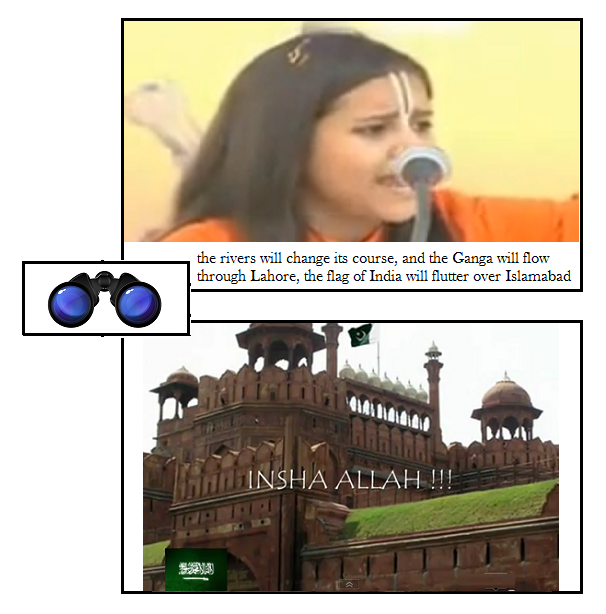
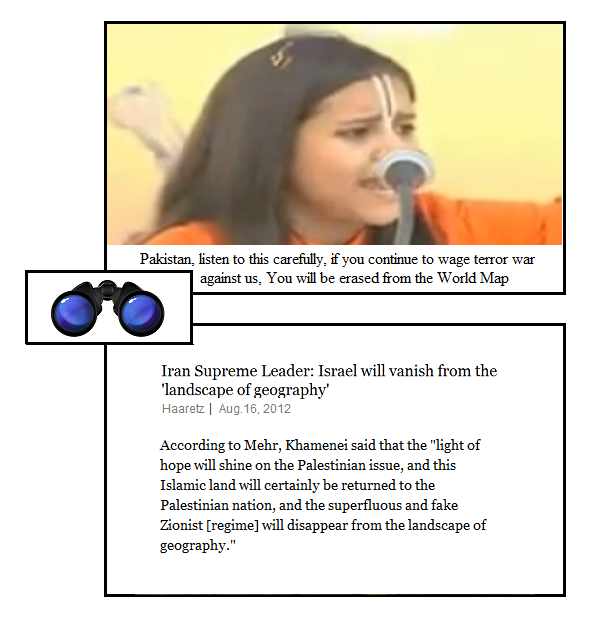
For starters, when I saw the blurry headlines under 13-year-old Sadhwi Balika Saraswati‘s speech to a Vishwa Hindu Parishad gathering, I wasn’t sure whether to pair her speech with Zaid Hamid‘s image of the Pakistani flag flying over Delhi’s Red Fort:

or with the Ayatollah Khamenei‘s recent statement about the “fake” Zionist regime disappearing from the “landscape of geography”:

I mean, there are parallels there, and differences, in each case.

**

And then, when I did a little more digging, all hell broke metaphorically loose, and I couldn’t get enough tabs on my browser to hold all the videos I seemed to want to check out.

I’ve combed through my history and sorted things out now, so I can point you, for starters, to:

13 yr old Hindu girl speaks out against Anti-India forces at a VHP rally — a Youtube video of the relevant part of her speech with English subtitles. You can read a transcript of the speech — missing all the excitement — here. And to give you an idea of its (relative) popularity, one YouTube version of this speech without subtitles, has had 410,535 views, with 1,503 likes and 1,589 dislikes, while another has had 200,964 views, with 801 likes and 491 dislikes… Bear in mind, though, that the Indian population exceeds one billion.

A Pakistani girl replies to 13 yr old Hindu girl who spoke against pakistan — sadly, no subtitles here, but at least it’s a response from someone of roughly equivalent age..

Reply to bajrangdal’s girl by Zaid Hamid which is also interesting, as he’s the spokes-guy for the Ghazwa-e-Hind idea…

**

Which in turn brought me back to thinking once again about the Ghazwa, and:

Ghazwa-e-Hind is our destiny — Zaid Hamid himself addressing the topic (posted this month) — “and we invite the Muslims from Afghanistan, Iran, Turkey and the rest of the Muslim world to come and join us in the fulfilment of this most fascinating destiny which awaits us now: recapturing of India.”

Ghazwa-e-Hind Hadith Explaination — the picture is very blurry , is that our old friend Sheikh Imran Hosein, perhaps? — and

Ghazwa-e-Hind By Dr Israr Ahmed

**

I’m afraid Zaid Hamid wouldn’t be satisfied with India alone, though:

That’s him, top left, overseeing everything.

Oh, and for good measure, here’s a humorous response to Hamid, zaid hamid latest about india — featuring a barking dog.

**

Look, I don’t think Pakistan is about to capture India, or vice versa, any time soon.

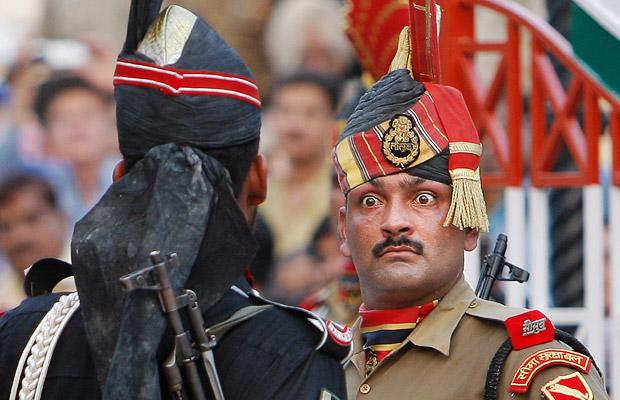
If the two countries feel the need to face off, I hope they will limit themselves to a little ritual drama and some fierce stares, and they do every day in the border ceremonial at Wagah:

Beyond that, I’m an advocate for conflict-resolution and peace-making.

What I do think is that undercurrents of the kind found in the incendiary rhetoric of both sides are worth the attention of analysts.

The zen of Cage II: from the A Train to Liverpool Street Station

Wednesday, August 15th, 2012

[ by Charles Cameron — two performances of Cage’s 4’33” in the New York and London Times: an interlude in my review of Where the Heart Beats, with a brief meditation on contrapuntal listening ]
.

I began to review Kay Larson‘s Where the Heart Beats in a post here last week, and am not done yet.

**

London:

photo credit: Chris Harris for the London Times

In John Cage’s sound of silence… at Liverpool Street station [London Times, subscription required], Igor Toronyi-Lalic describes performing John Cage‘s silent work 4’33” in what Cage himself — but few others — would have recognized as a concert venue, London’s Liverpool Street Station:

My rendition isn’t going down well. “This is doing my head in!” groans a drunken West Ham supporter as he watches me at the piano outside Liverpool Street station. I hear shuffling. “I can’t dance to this,” someone shouts. The restlessness is in danger of turning to anger. And I probably should have guessed it would. Presenting a performance of one of the most controversial works of music yet written in a rowdy Central London station forecourt on a Friday night on a public piano (one of several that made up the City of London Festival’s Play Me, I’m Yours artwork) was always going to be ambitious.

The work itself is hardly over before it begins — again, a paradox Cage would have enjoyed:

At my Liverpool Street Station performance, there was a symphony of rush-hour noise: commuter patter, train announcements, drunken heckling and the screeching of taxis stopping to pick up fares. Not everyone appreciated the music in this.

“When’s he going to start?” asked one lady as I finished the final movement. Others felt like they’d been had. “I thought you were going to play,” they shouted.

There’s more, and if you can get past the pay-wall you should read it all. I’ll just quote one more snippet here, though, because it leads directly into one strand of the book that I’ll be discussing in Part III of my review of Larson’s book:

“Classical musicians don’t know about Cage. They don’t perform it. We aren’t taught it in schools,” Volkov says.

But, for visual artists, Cage is a revered figure, a key part of the 1950s and 60s New York arts scene and godfather to conceptual and sound art, a connection cemented by Cage’s 40-year creative relationship with his lifelong partner, the late choreographer Merce Cunningham. “Cage worked with Rauschenberg and Cunningham and, at Black Mountain College, he mainly taught music to artists,” observes Volkov, “So, today, in art schools, they teach Cage properly. They teach his ideas.”

**

New York:

photo credit: Christian Hansen for the New York Times

From London’s Liverpool Street Station we pass to New York City’s subway system. I don’t know what it is about trains, but there you are and there you go. Or perhaps the transit is from Times to Times?

Allan Kozinn‘s John Cage Recital? Take the A Train [New York Times] starts by defining “Cage moments”:

You know about Cage moments, don’t you? We all have them, whether we think of them that way or not. They occur when happenstance kicks in, and surprising musical experiences take form, seemingly out of nowhere. They can happen anywhere at any time.

Listening. Listening as though all life is music.

Kozinn is a listener, a listener to music — but he doesn’t always listen for the music in his daily life. This time, as it happens, he did:

On the A train I wasn’t thinking about Cage at all. I had just heard an exquisitely turned, energetic performance of Schubert’s String Quintet in C at a church in Greenwich Village, and Cage could not have been further from my thoughts. Nor did the crowded subway car bring him to mind at first. But I noticed that it was unusually noisy.

**

Then something shifted:

Typically, most of the noise you hear comes from the subway itself: its din drowns out conversations, and people tend to stare at their feet, or at whatever they are reading, and listen to their portable music players. But this Tuesday evening just about all the people were talking, and working hard to drown out both the subway and the chats taking place around them.

I would normally have tuned all this out, but instead I sat back, closed my eyes and did what Cage so often recommended: I listened. I made no effort to separate the strands of conversation or to focus on what people were saying. I was simply grabbed by the sheer mass of sound, human and mechanical. It sounded intensely musical to me, noisy as it was, and once I began hearing it that way, I couldn’t stop.

Okay, this is where it get’s interesting. You remember that I pointed to the pianist Glenn Gould in my Said Symphony posts, and quoted this passage from David Rothenberg‘s Sudden Music:

Gould set himself up to hear the world in a new way. In diners he ate his lunch alone, eaves dropping closely on the voices around him. He learned to hear conversation as music, the lilting lines, the rhythms everywhere up, down, and around, what Bach does to our sense of talk. There are two part inventions in words, themes and variations in the quarrels of couples and the tales told by friends. Gould met the world on his own terms, and he was fascinated by this way of listening to human voices as if they were a musical interplay, not participating in a conversation but taking it all in, as an audience.

What Gould sets out to do — and records for Canadian Broadcasting — Kozinn finds himself doing:

Strand upon strand of the chatter was animated and midrange: there were neither basso profundos nor soaring sopranos in this choir, but after a moment the pitch levels began to sort themselves out as a kind of orchestration. Argumentative voices created driving, punchy rhythms that sailed over more smoothly floating narrative tones.

At least three languages were being spoken, each with its own melodic lilt and rhythmic character. To my left, a woman’s laughter momentarily changed the coloration of this vast choral tapestry and offset the argument to my right.

Within it all, squeaking metal yielded a high-pitched ostinato, and the ever-so-slightly-clattery rumble of the train was the high-tech equivalent of a Baroque basso continuo. As the train pulled into each station, the muted squeal of the brakes, the opening and closing of the doors and the slight shift in the balance of voices as some people left and others entered, already talking, suggested shifts between connected movements.

Again, I recommend reading the entire piece, but will close with just one more short clip:

I have heard “4’33” ” performed by pianists, percussion ensembles, oboists, cellists and orchestras, but none of those versions were as exciting as what I now think of as “4’33”: The Extended Subway Remix” by the A Train Yakkers, an ensemble so conceptual that its members had no idea they were in it.

Cage would have understood.

**

And wherever:

Listening — and listening to the world around us as music — can happen anywhere and everywhere. But as usual, I’d like to take this a step further.

As I never tire of repeating, Edward Said — pianist and music critic as much as writer on Israeli-Palestinian issues — carries the idea of listening to multiple voices a step further, when he suggests:

When you think about it, when you think about Jew and Palestinian not separately, but as part of a symphony, there is something magnificently imposing about it. A very rich, also very tragic, also in many ways desperate history of extremes — opposites in the Hegelian sense — that is yet to receive its due. So what you are faced with is a kind of sublime grandeur of a series of tragedies, of losses, of sacrifices, of pain that would take the brain of a Bach to figure out.

Said’s proposed manner of listening to the many voices of life in counterpoint involves listening to the words, their meanings, their stories, their histories, and thus to a simultaneous listening across time itself — not just to a harmonious blur, “Strand upon strand of the chatter .. a kind of orchestration .. driving, punchy rhythms that sailed over more smoothly floating narrative tones.”

It goes way deeper: my life and concerns, and yours, and yours, heard together — separate and interwoven — in polyphony, in a many-voiced music — in counterpoint.

In conflict, and in hope of resolution.
For Klan read Islam?

Tuesday, August 14th, 2012

[ by Charles Cameron — headlines, McVeigh, mea culpa, Breivik, media, guessing games and blame, puns, great tweet ]
.


.

That’s yesterday’s Charlotte Observer‘s headline and opening paras for an article they reposted from Slate, which had more cautiously titled it What’s on a Ku Klux Klan Membership Application?

We’ll come back to that headline later.

**

Okay, seriously.

Educated guesses can prove wrong in retrospect. Educated guesses can lay considerable blame. Educated guesses can have pernicious side effects.

When a bomb ripped through the Federal building in Oklahoma City, many people’s first reaction — including my own — was that it was probably the work of Al-Qaida “Muslim terrorists”.

The media initially broadcast the “Islamist” theory of the bombing quite extensively, and one of the results, according to Penny Bender Fuchs in an American Journalism Review piece titled Jumping to Conclusions in Oklahoma City? was:

A Muslim woman who suffered a miscarriage in her Oklahoma City home said she was afraid to seek medical attention because a crowd of people was throwing stones at her house.

Two more clips from that article:

Within hours of the bombing, most network news reports featured comments from experts on Middle Eastern terrorism who said the blast was similar to the World Trade Center explosion two years earlier. Newspapers relied on many of those same experts and stressed the possibility of a Middle East connection.

The Wall Street Journal, for example, called it a “Beirut-style car bombing” in the first sentence of its story. The New York Post quoted Israeli terrorism experts in its opening paragraph, saying the explosion “mimicked three recent attacks on targets abroad.”

“We were, as usual, following the lead of public officials, assuming that public officials are telling us the truth,” says John R. MacArthur, publisher of Harper’s magazine and author of a book on coverage of the Persian Gulf War. He believes the media overemphasized the possible Middle Eastern link and ignored domestic suspects because initially the police were not giving that angle much thought.

“Reporters can’t think without a cop telling them what to think,” MacArthur says. “If you are going to speculate wildly, why not say this is the anniversary of the Waco siege? Why isn’t that as plausible as bearded Arabs fleeing the scene?”

Most news organizations did mention other possible culprits. They noted the bombing took place on the second anniversary of the government raid on the Branch Davidians in Waco, Texas, suggesting that homegrown terrorists might be responsible. But that angle was buried in most stories.

And:

Jim Lobe, bureau chief for Inter Press Service, says tying the bombing solely to the Middle East “was in a sense a comforting story for Americans.”

Inter Press, a small wire service for papers in the Third World and development agencies in Europe and Canada, was perhaps the first news outlet to raise the possibility that domestic paramilitary fanatics carried out the bombing.

“Of course the Middle East has to be considered,” Lobe says. “But when you considered the weight of all the evidence, it takes you a different direction.”

Lobe, who is familar with militia groups, says many news organizations failed to notice a big clue: traffic on the Internet detailing bomb recipes and talking about the need to avenge the government’s attack on the Branch Davidians. He says the bombing coverage offers “a major lesson for the profession.”

Will that lesson be heeded? MacArthur doesn’t think so. The media are doing a poor job covering Timothy McVeigh and the militia groups around the country, he says. “They are going to turn them into oddball crazies, caricaturing McVeigh as a trailer park terrorist, which is no better than the caricature of the Arabs.”

**

Something similar happened in the immediate aftermath of the Oslo bombing, as this account from the media watch-dog group FAIR details:

On news of the first round of attacks–the bombs in Oslo–CNN’s Tom Lister (7/22/11) didn’t know who did it, but knew they were Muslims: “It could be a whole range of groups. But the point is that Al-Qaeda is not so much an organization now. It’s more a spirit for these people. It’s a mobilizing factor.” And he speculated confidently about their motives:

You’ve only got to look at the target–prime minister’s office, the headquarters of the major newspaper group next door. Why would that be relevant? Because the Norwegian newspapers republished the cartoons of Prophet Mohammad that caused such offense in the Muslim world…. That is an issue that still rankles amongst Islamist militants the world over.

CNN terrorism analyst Paul Cruickshank (7/22/11) took to the airwaves to declare that “Norway has been in Al-Qaeda’s crosshairs for quite some time.” He added that the bombing “bears all the hallmarks of the Al-Qaeda terrorist organization at the moment,” before adding, almost as an afterthought, that “we don’t know at this point who was responsible.”

On Fox News Channel’s O’Reilly Factor (7/22/11), guest host Laura Ingraham declared, “Deadly terror attacks in Norway, in what appears to be the work, once again, of Muslim extremists.” Even after Norwegian authorities arrested Breivik, former Bush administration U.N. ambassador John Bolton was in disbelief. “There is a kind of political correctness that comes up when these tragic events occur,” he explained on Fox’s On the Record (7/22/11). “This kind of behavior is very un-Norwegian. The speculation that it is part of right-wing extremism, I think that has less of a foundation at this point than the concern that there’s a broader political threat here.”

**

Peter Bergen, who wrote the book more than once on Bin Laden and his demise, recently discusses the topic, Right-wing extremist terrorism as deadly a threat as al Qaeda? for CNN — some key findings for perspective:

The word “terrorism” in the United States usually brings to mind plots linked in some way to al Qaeda, while the danger posed to the public by white supremacists, anti-abortion extremists and other right-wing militants is often overlooked.

Militants linked to al Qaeda or inspired by jihadist ideology have carried out four terrorist attacks in the United States since September 11, which have resulted in 17 deaths. Thirteen of them were in a shooting incident at Fort Hood, Texas, in November 2009.

By contrast, right-wing extremists have committed at least eight lethal terrorist attacks in the United States that have resulted in the deaths of nine people since 9/11, according to data compiled by the New America Foundation.

And if, after investigation, Sunday’s attack on the Sikh temple in Wisconsin is included in this count, the death toll from right-wing terrorism in the U.S. over the past decade rises to 15.

The shooting suspect, Wade Michael Page, posed with a Nazi flag on his Facebook page and has played a prominent role in “white power” music groups. The FBI is investigating the case as a “domestic terrorist-type incident.”

Here’s a link to the SPLC’s updated roster: Terror From the Right: Plots, Conspiracies and Racist Rampages Since Oklahoma City.

And there are no doubt other threats, some from potential left wing sources — and some from other half-crazed wingless entities who roam among us on two legs.

**

I said we’d come back to that Charlotte Observer headline later. Here we are:

.

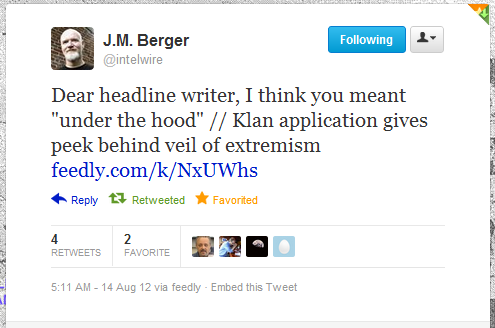
That tweet from friend JM Berger — think about it, “veil” suggests “Muslim”, doesn’t it? — and “hood” means “KKK”? — that’s really quite a double-barreled pun — and, given the context, it makes so much more sense!

JM gets my Tweet of the Month award.


Switch to our mobile site