zenpundit.com » 2012

Archive for 2012

A digital Mahdi? No way…

Tuesday, July 17th, 2012

[ by Charles Cameron — a computer virus with mild Mahdist implications ]
.

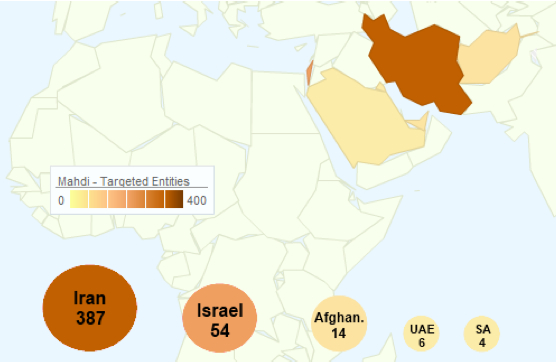
Mahdi: targeted entities, credit: Seculert via Wired
.

Ah. From a religious studies standpoint, the targeting here is curious.

Iran is the country of the Mahdaviat, the nation whose President, wreathed in light, prays at the United Nationsfor the soon coming of the Promised One, that perfect and pure human being, the one that will fill this world with justice and peace, the Mahdi.

**

My own concern is not with the virus, but with the religious connotations of the name that has been given to it.

For those whose concern is with the virus itself, I’d suggest the Wired article, although if blog-friends involved in computer security would like to offer further pointers, I’m sure our readers would welcome them.

**

In case you were wondering, here are the key paras regarding the implications as I see them, from the Jerusalem Post:

Seculert and Kaspersky dubbed the campaign Mahdi, a term referring to the prophesied redeemer of Islam, because evidence suggests the attackers used a folder with that name as they developed the software to run the project.

They also included a text file named mahdi.txt in the malicious software that infected target computers.

and from the Wired coverage:

The infections in Iran and Israel, along with the Farsi strings, suggest the malware may be the product of Iran, used to spy primarily on domestic targets but also on targets in Israel and a handful of surrounding countries. But the malware could also be a product of Israel or another country that’s simply been salted with Farsi strings in order to point the finger at Tehran.

**

So we really can’t tell if it’s the Mahdi (Islam’s awaited one) or the Dajjal (Islam’s antichrist figure)?

**

Here, for your edification, is the potrait of the Dajjal from the cover of Okasha Abdelmannan al-Tibi’s The Whole Truth about the Antichrist (courtesy of JP Filiu):

image credit: J-P Filiu, Apocalypse in Islam
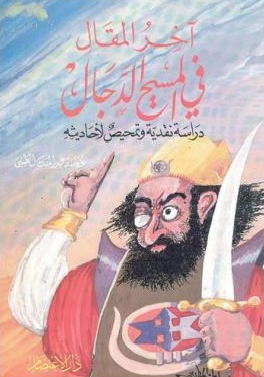
According to the tradition as narrated by ‘Abdullah bin ‘Umar, the Prophet said:

I turned my face to see another man with a huge body, red complexion and curly hair and blind in one eye. His eye looked like a protruding out grape. They said (to me), He is Ad-Dajjal.

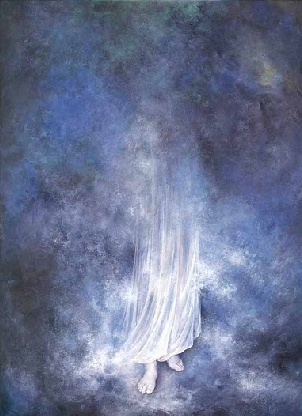
And here is a portrait of the Mahdi, the “Birth of Hope” — insofar as the artist Mahmoud Farshchian feels able to depict him:

image credit: Mahmoud Farshchian
**

While it’s pretty clear that neither Mahdi or Dajjal could be a computer virus, it also seems likely that the virus is associated, either mockingly or sympathetically, with the Mahdi — an indicator, if nothing else, that this end-times figure once little known outside Shi’ite Islam has by now become part of a wider “universe of discourse” and general conversation.

Mahdi has arrived among the geeks.

When does music become noise?

Tuesday, July 17th, 2012

[ by Charles Cameron — a little rock criticism with military, political and theological overtones ]
.


.

When does music become noise?

  • When it annoys you.
  • Even when it’s Nancy Sinatra.
  • And FWIW, much the same can be said of prayer.

I say this, because there’s currently a battle of the noises in Jerusalem. Or should I call that a battle of rock music vs the call to prayer?

Noise, in any case. That’s what the people who don’t like it call it.

**

It may be that you’ve sought out events with “strobe lights and screamingly loud rock and rap music” — they’re called concerts when you volunteer for them, but torture when you have no choice…

**

The New York Times piece quoted above brings us a legal opinion that the practice at Gitmo constituted torture, and a hint of the playlist:

David Sheffer, a senior State Department human rights official in the Clinton administration who teaches law at George Washington University, said the procedure of shackling prisoners to the floor in a state of undress while playing loud music – the Guantánamo sources said it included the bands Limp Bizkit and Rage Against the Machine, and the rapper Eminem – and lights clearly constituted torture. “I don’t think there’s any question that treatment of that character satisfies the severe pain and suffering requirement, be it physical or mental, that is provided for in the Convention Against Torture,” Mr. Sheffer said.

It also tells us what impact of the “strobe lights and screamingly loud rock and rap music” had on the Gitmo prisoners, who had to put up with it for fourteen hour stretches:

Another person familiar with the procedure who was contacted by The Times said: “They were very wobbly. They came back to their cells and were just completely out of it.”

How does being shackled to the floor compare with being in a compound inside an FBI cordon — how does “Nancy Sinatra songs, shrieks of dying rabbits, Christmas carols and Tibetan monk chants” compare with “strobe lights and screamingly loud rock and rap music”?

I’d say there are significant similarities and significant differences.

**

For one thing, David Koresh, the “sinful messiah” of Waco, was a guitarist-songwriter himself:

How shall I put this? That’s not what I expected…

**

But hey, Manuel Noriega.

You remember him? It is perhaps worth recalling that when Gen. Noriega was holed up at the Panama City residence of the Papal Nuncio — a place where one can imagine the Angelus bell modestly calling the faithful to prayer thrice daily, but I digress — “American troops directed loudspeakers his way in an attempt to blast him out“.

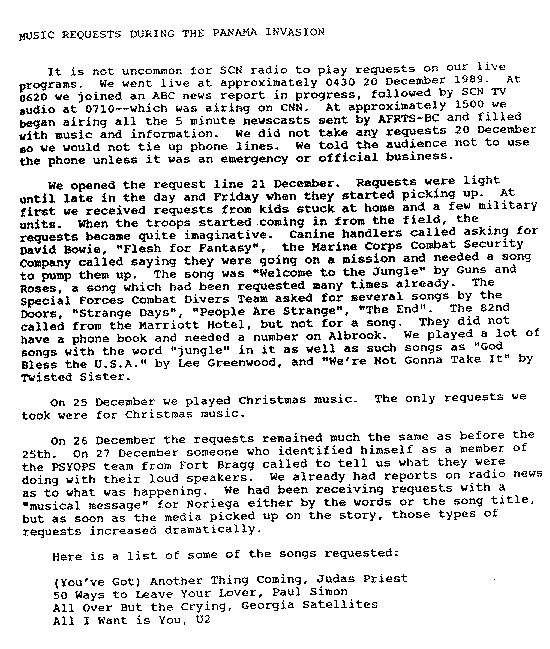
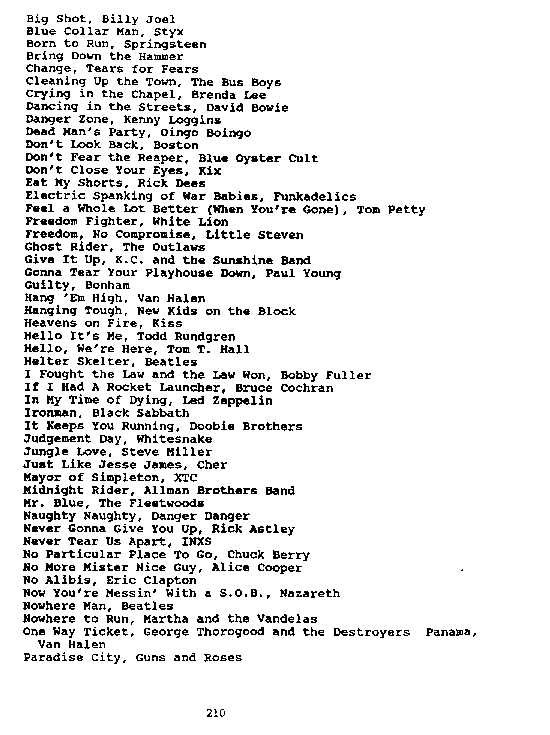
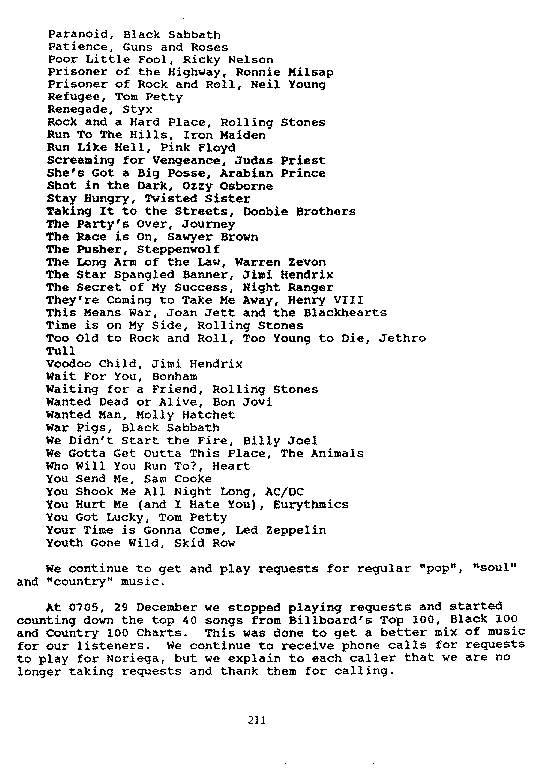
Happily for those of us interested in the musics of siege and torture, the National Security Archive associated with George Washington University has posted a copy of the playlist of songs requested by US troops to regale the General.

One can only imagine how much a man of his discerning taste must have enjoyed listening to Jimi Hendrix’ high-tweakin’ guitar on one of Rolling Stone‘s top 500 songs evah — Voodoo Child:

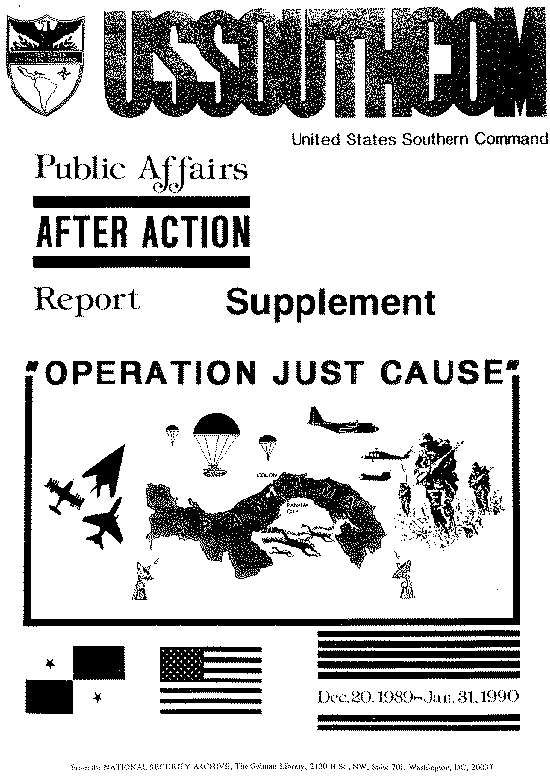
Oh, and so much more besides. For the full playlist, see here and here and here. Those selections are drawn from USSOUTHCOM’s After Action report on Operation Just Cause.

The Papal Nuncio’s residence would in essence be a diplomatic extension of the Vatican, wouldn’t it? Can you imagine the berobed monsignori tapping their feet to Electric Spanking of War Babies by the Funkadelics — or, with subtle religious overtones, War Pigs by Black Sabbath?

**

So, onwards to Jerusalem.

Today’s adhan or call to prayer in Jerusalem / al-Quds would have been sung out by the muezzin at 4:11am (Fajr) and again at 12:47pm, 4:27pm, 7:47pm and 9:17pm.

**

Under the title Mosque’s Loud Prayer Generates Mega-Decibel ‘Battle of the Bands’, the Jewish Press reports:

After the French Hill neighborhood of Jerusalem has decided to play very loud music, in defiance of the volume and disturbance of the sound of the muezzin at the mosque in nearby Al-Issawiya, two additional Jewish neighborhoods, Pisgat Ze’ev and Har Choma, have announced that they, too, will take up a similar approach. French Hill also decided to go with hard rock, and not Mediterranean tunes, as had originally been planned, because, as they put it, hard rock is more likely to deliver the message.

According to Yediot Jerusalem, the French Hill neighborhood has recently approached an amplification company with an order for four huge speakers to be directed at Al-Isawiya. As soon as the village muezzin will start his exceedingly loud prayer, it will be responded to with ear shattering Rock n’ Roll, letting local Arabs understand how disturbing the loud prayers have been to their Jewish neighbors.

French Hill, according to Wikipedia:

French Hill (Hebrew: HaGiv’a HaTzarfatit, Arabic: at-tel al-faransiya), also Giv’at Shapira is a neighborhood in northeastern Jerusalem. It is located on territory occupied during the Six-Day War in 1967, later annexed to Israel under the Jerusalem Law in 1980. The United Nations Security Council declared this law a violation of international law, and states that the Council will not recognize this law, and calls on member states to accept the decision of the council. The International Court of Justice stated in its 2004 Advisory Opinion that the Israeli settlements in the Occupied Palestinian Territory (including East Jerusalem and therefore also in French Hill) have been established in breach of international law. The European Union considers French Hill to be an illegal settlement in East Jerusalem.

**

Noise is in the hearts and minds of the hearers and beholders.

Or beauty, as the case may be.

Liminality II: the serious part

Monday, July 16th, 2012

[ by Charles Cameron — follow-up to Liminality I: the kitsch part, dealing with the strange business of liminality, submarines, monks and more ]
.

Limen is the Latin for threshold, and the liminal is therefore what happens at thresholds.

**

Something pretty remarkable happened as 1999 turned into 2000 — something liminal. And it happened aboard the USS Topeka, SSN-754 (below):

USS Topeka, credit: United States Navy, released ID 090623-N-1126G-005

The Associated Press reported:

Its bow in one year, its stern in another, the USS Topeka marked the new millennium 400 feet beneath the International Dateline in the Pacific ocean. The Pearl Harbor-based navy submarine straddled the line, meaning that at midnight, one end was in 2000 while the other was still in 1999… The 360-foot-long sub, which was 2,100 miles from Honolulu, Hawaii, straddled the Equator at the same time, meaning it was in both the northern and southern hemispheres. Some of the 130 crewmembers were in Winter in the North, while others were in Summer in the South…

Sitting pretty on the threshold between two millennia, two centuries, two decades, years, seasons, months, days and hemispheres was an extraordinarily liminal idea — as the two-faced January is a liminal month — and I think illustrates effectively the terrific power of the liminal to sway human thinking

Navy commanders in charge of billion dollar ships seldom get up to such “fanciful” behaviors!

**

And if we might turn from the contemporary US Navy and its submarine to ancient Indian mythology and Hindu religion for a moment:

Narsingh avatar depicted in Nepali dance, credit: Navesh Chitrakar, Reuters / Landov

The story of Narsingh (above), the fourth avatar of Vishnu in Vaisnavism, also captures the idea of what’s meant by thresholds very nicely:

A tyrannous and oppressive king obtained a boon from the gods that he should die “neither by day nor night, neither within the palace nor outside it, neither at the hand of man nor beast” and thought his boon conveyed immortality — but when he persecuted his son, a devotee of God, a half-man half-lion figure — the Narsingh avatar of Vishnu — met him on his own doorstep at dusk and slew him, so that he died neither by day nor by night, neither within the palace nor outside it, and neither at the hand of beast nor of man.

Dusk, doorsteps and metamorphs are all liminal, — with respect to day and night, home and abroad, man and beast respectively.

**

Anthropologist Mary Douglas has pointed out how things that are “not this, not that” (ie that don’t fit our categories) are precisely the ones that taboos form around – hence her remark in Purity and Danger:

Uncleanness or dirt is that which must not be included if a pattern is to be maintained

Consider for instance the dietary condemnation of amphibians in Leviticus, as being neither walking nor swimming creatures — fitting neither the normative category of “animal” nor that of “fish”. But Douglas is thinking in static categories, while Victor Turner thinks in process.

**

Turner takes the condition that’s between “this” and “that” and views it as part of a process in time, where “this” is how things have been, and “that” is how they can be in future – effectively, the turning point between one way of life and another.

Turner is interested in this primarily because the tribes he studies as an anthropologist create rituals which act as magnifiers of this sort of transition (his scholarly reason), and because such turning points, so ritualized, turn out to be important junctions in human lived experience (his human reason).

Turner tells us that those who are passing through a limen in social life are usually thrown in the stockade — the vice-chief who is about to become chief along with the village drunk, the pickpocket and the crazed idiot — and can then be taunted and tomatoed by all and sundry, while feeling that intense kinship with their stockade mates no matter the symptoms (success, failure) which brought them there. Which keeps them humble, builds character, and builds their capacity for empathy.

Only then can the vice-chief be brought back into society and proclaimed as the new chief.

**

Basing his own work on van Gennep‘s account of rites of passage, Turner sees such rites as involving three phases: before, liminal, and after.

  • Before, you’re a civilian, after, you’re a Marine — but during, there’s an extraordinary moment when you’ve lost your civilian privileges, not yet earned your Marine status, and are less than nothing — as the drill sergeant constantly reminds you — and yet feel an intense solidarity with your fellows.
  • .

    .

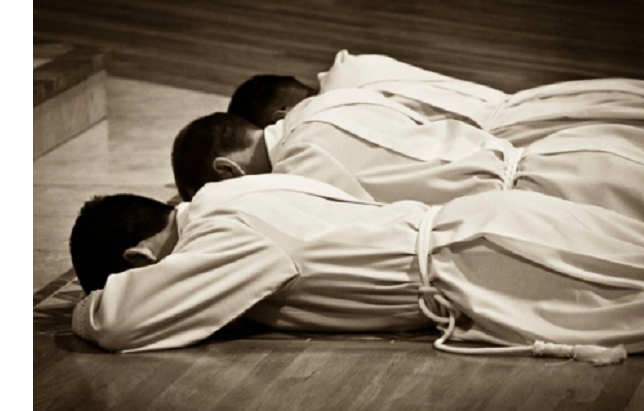
    • Before, you’re a novice, not yet “professed”, after, you’re a monk — but during, you lie prostrate on the paving stones of the abbey nave in as you transition into lifelong vows poverty, chastity and obedience.
    • .

      .
      There are two things to note here. One is that liminality is a *humility* device, the other is that is creates a strong sense of bonding which turner calls *communitas*: in one case, the Marine’s esprit de corps, in the other quite literally a monastic community. Part of what is so fascinating here is the (otherwise not necessarily obvious) insight that humility and community are closely related.

      **

      There are also liminal festivals, like India’s Holi Festival or the mediaeval Catholic Feast of Fools (about which Harvey Cox wrote a book), in which the usual hierarchy is turned upside down for a day — so that a choirboy celebrates Mass and the bishop becomes the busboy, or the brahmins are pelted with old shoes and paint balloons by the village prostitutes and drunks…

      This may all sound pretty silly, but consider again the specific quality of humility which it brings out:

      Something of the sacredness of that transient humility and modelessness goes over, and tempers the pride of the incumbent of a higher position or office. Liminality implies that the high could not be high unless the low existed, and he who is high must experience what it is like to be low.

      Turner comments that these are socially sanctioned devices for *making the certain degree of hierarchy that’s inevitable in human affairs tolerable once again* — that we need such devices, that the “modernizing” west tends to forget them, and that liminality as process is deeply embedded in human social wiring, and should be appreciated rather than overlooked.

      **

      Turner himself was a Catholic, and it’s not surprising that he turns to Saint Francis for another example of liminality, pointing out that Francis was basically trying to convene a group of friends to live a *permanently liminal life* with him – that was what his idea of the Franciscan Order was all about — and that all such attempts fail (he compares flower power in the sixties) because the liminal cannot sustain itself but must naturally pass across into hierarchy, where it refreshes and revivifies structures which would otherwise become dry and lifeless:

      It is as though there are here two major “models” for human interrelatedness, juxtaposed and alternating. The first is of society as a structured, differentiated, and often hierarchical system of politico-legal-economic positions with many types of evaluation, separating men in terms of ” more ” or ” less.” The second, which emerges recognizably in the liminal period, is of society as an unstructured or rudimentarily structured and relatively undifferentiated comitatus, community, or even communion of equal individuals who submit together to the general authority of the ritual elders.

      In Turner’s view, this liminal refreshment is constantly arising in the margins of structures, and should be welcomed and incorporated — the strange, edgy and uncomfortable fellow in beggars rags being invited to the high feast – the limen offering spontaneity and inspiration to match and complement the discipline and reliability of the structure.

      **

      And where does all this leave us?

      Hopefully, with the understanding that our categories of the sacred and the profane are too simplistic for the complex workings of human culture and religion.

      Liminality is a mode of intensification.

      And I’m wondering to myself: regiments and battalions and brigades are clear cut categories, there’s nothing (apart from their initiation rites) liminal about them. But insurgents, able to blend in and out of a population, civilian yet militant, militant yet civilian?

      Is insurgency warfare inherently liminal? And if so, what does that have to teach us?

Liminality I: the kitsch part [note: NSFW]

Monday, July 16th, 2012

[ by Charles Cameron — a light-hearted post about serious matters — not for the squeamish — discusses politicians, fecal matter, children’s glee and Christmas spirit ]
.

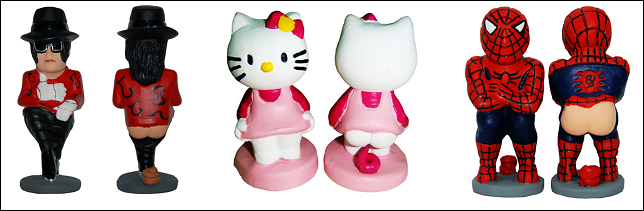
top shelf: Mary, Joseph, the Christ Child, kings, shepherd; lower shelves: popes, princesses, and politicians, pooping

.

As children, we are taught that we extend from the crowns of our heads to the tips of our toes, that our skin is our outer boundary, that we’re us, here, this living, perceiving, thinking being — and we know that there’s an appropriate distance for others to keep, that under certain circumstances they can touch us, perhaps while demonstrating they don’t have a knife up their sleeve, and that with a certain amount of social approval, depending, they can enter partially inside us or vice versa — the result on occasion being the arrival of a third one that pretty much belongs to the two of us, growing inside one of us for months only to somewhat belatedly separate out…

That last example — child-bearing and childbirth — shows that the simple notion that we are our skin and whatever is inside it is a bit simple. And there are various bits of us that seem to cross the boundary that separates us from the rest without too much problem: nail clippings, hair, saliva, which I’ve covered in two recent posts, ear-wax…

Even the air we breathe in and hold in our lungs is “us” — our breath — though once we breathe it out again, it’s air, part of the room we’re in, or if we’re outdoors, part of the atmosphere, the sky…

Mathematician John Allen Paulos suggests in his book Innumeracy: Mathematical Illiteracy and Its Consequences, calculates that there’s a better than 99% chance that the last deep breath you breathed in and out contained one molecule from the dying breath of Julius Caesar

**

But it is poo, perhaps, that best exemplifies how something that was us a minute or two ago can be not us, and frankly faintly disgusting, a minute or two later. And because it breaches the me / not me distinction so forcefully, it’s a matter of keen delight and humor to all children, as far as I can tell, everywhere.

Which is where the caganer comes in.

**

A caganer — I kid you not — is “a figurine depicted in the act of defecation appearing in nativity scenes in Catalonia and neighbouring areas with Catalan culture such as Andorra, Valencia, Northern Catalonia (in southern France) and the Balearic Islands. It is most popular and widespread in these areas, but can also be found in other areas of Spain (Murcia), Portugal and southern Italy (Naples)”. That’s Wikipedia‘s current take on the topic, which has also been written up extensively elsewhere, and indeed, caganers in their profusion have become collectibles in their own right

All of which brings me to Bob Dylan‘s “emperor’s new clothes” line:

Even the president of the United States: Sometimes must have to stand naked.

Or squat, vulnerable and with his pants down. Even Fidel Castro must do the same. Even Death

Even Elizabeth the Second, by the Grace of God, of Great Britain, Ireland and the British Dominions beyond the Seas Queen, Defender of the Faith.

**

All of which is either a complete mockery or a source of considerable hilarity — especially to the kids, who must find these caganer hidden in among the shepherds, kings, animals and straw that surround the Christ Child in his manger.

Right in the heart of the sacred, if you will.

Which brings up the twin questions:

Is no-one sacred?

Is everyone sacred?

**

Which is actually a pretty profound pair of questions — and one which, again, may help us understand a little more about religion than piety alone can tell us.

The fact is, religion can exalt us, but does so at the risk of our becoming pompous and inflated — and when we do, it can also deflate us.

Which lands us right on the topic of liminality, communitas and the work of Victor Turner, which I shall address in a follow-up post — invoking a US submarine, a Hindu avatar and St Francis along the way.

New Article at IVN: Putin’s Geopolitical Realism on Syria

Monday, July 16th, 2012

In case you missed it earlier, IVN is running my take on Syria:

Putin’s Geopolitical Realism on Syria 

….It would be harder for Putin to have been more clear about what his priorities were, or that for Russia, R2P as a doctrine has no standing whatsoever in international law [ incidentally, he’s correct on that point] and Syria is not going to be allowed to go the way of Libya, if the Kremlin can prevent it.

Generally, the media reported this speech, highly misleadingly, as Putin’s prediction of “Western decline” when the message was Russia’s opposition to Western military intervention in Syria to remove Assad from power. Putin neither overestimates the means at Russia’s disposal to accomplish his limited objective (blocking intervention) nor inflates his objective to an unrealizable, vaguely defined, abstraction.

Contrast, with the speech on Syria made recently by Secretary of State Hillary Clinton. Here is a snippet that gives the tenor of her remarks…. 

read the rest here.


Switch to our mobile site