zenpundit.com » 2012

Archive for 2012

A chilling reminder

Wednesday, July 11th, 2012

[ by Charles Cameron — Marisa Urgo on Zawahiri ]
.

I have long been familiar with the second quote in this pair, the one by Anais Nin, and regard it as one of the touchstones of my understanding of the creative process. Anais Nin is exactly right in thinking that in terms of the arts, it is the deeply felt personal detail that profoundly touches the artist’s audience, and thus becomes universal.

It was therefore with quite a shock of recognition that I read Marisa Urgo‘s latest post in her series on Zawahiri‘s Knights Under the Banner of the Prophet. If Zawahiri’s spiritual autobiography draws this sort of response from an analyst giving it a close reading, it’s likely something we should be paying attention to.

.

.

Marisa’s series thus far can be read in reverse order here.

It Seems the Oligarchs Distrust their own Creepy-state

Tuesday, July 10th, 2012

I previously made note of the emergence of an authoritarian Creepy-state element in American government, enjoying bipartisan popularity with this era’s predominantly Boomer elite politicians, CEOs and academic activists. Largely because this growing surveillance state is directed at controlling the rest of us and eroding the democratic and legal accountability of a self-imagined superclass.

Here’s a new (but unsurprising) wrinkle. The political-bureaucratic folks quietly building this incipient machinery of coercion already distrust and fear the men and women who are employed to run it. Evidently, the Rise of the Praetorian Class theory has been widely read.

US spy agency accused of illegally collecting personal data

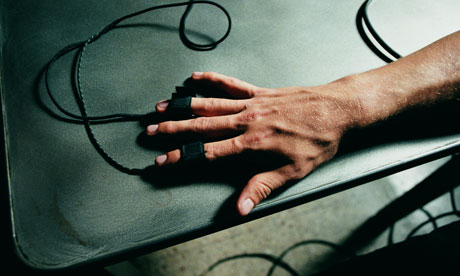
WASHINGTON — One of the nation’s most secretive intelligence agencies is pressuring its polygraphers to obtain intimate details of the private lives of thousands of job applicants and employees, pushing the ethical and legal boundaries of a program that’s designed instead to catch spies and terrorists.

The National Reconnaissance Office is so intent on extracting confessions of personal or illicit behavior that officials have admonished polygraphers who refused to go after them and rewarded those who did, sometimes with cash bonuses, a McClatchy Newspapers investigation found.

The disclosures include a wide range of behavior and private thoughts such as drug use, child abuse, suicide attempts, depression and sexual deviancy. The agency, which oversees the nation’s spy satellites, records the sessions that were required for security clearances and stores them in a database.

Even though it’s aggressively collecting the private disclosures, when people confess to serious crimes such as child molestation they’re not always arrested or prosecuted.

“You’ve got to wonder what the point of all of this is if we’re not even going after child molesters,” said Mark Phillips, a veteran polygrapher who resigned from the agency in late May after, he says, he was retaliated against for resisting abusive techniques. “This is bureaucracy run amok. These practices violate the rights of Americans, and it’s not even for a good reason.”

The agency refused to answer McClatchy’s questions about its practices. However, it’s acknowledged in internal documents that it’s not supposed to directly ask more personal questions but says it legally collects the information when people spontaneously confess, often at the beginning of the polygraph test.

Even though it is against the law as well as internal regulations, the NRO management have given themselves the green light in a self-investigation to keep doing it to their own employees and anybody going through a security clearance background investigation – a vast number of people, many of whom have or will someday have incredibly sensitive positions in the defense, intelligence and national security communities.

After a legal review of Phillips’ assertions, the agency’s assistant general counsel, Mark Land, concluded in April that it did nothing wrong. “My opinion, based on all of the facts, is that management’s action is legally supportable and corrective action is not required,” he wrote.

But McClatchy’s review of hundreds of documents – including internal policy documents, memos and agency emails – indicates that the National Reconnaissance Office is pushing ethical and possibly legal limits by:

-Establishing a system that tracks the number of personal confessions, which then are used in polygraphers’ annual performance reviews.

-Summoning employees and job applicants for multiple polygraph tests to ask about a wide array of personal behavior.

-Altering results of the tests in what some polygraphers say is an effort to justify more probing of employees’ and applicants’ private lives.

Read the rest here.
.
The charitable explanation is that all this is bureaucratic overreach motivated by tiny empire building and budget-padding in the age of  austerity, where cybersecurity is one of the few “growth” areas of discretionary spending for senior bureaucrats to pursue.
.
The cynical explanation is that these are blackmail files being compiled systematically and deliberately; to be used later to compel IC/DoD/DHS/DoJ employees to stick with an agency party line, intimidate and punish whistleblowers or use their official positions to engage in illegal misconduct to benefit politically influential VIPs. Like harassing American citizens or journalists critical of an agency or administration policy or special interests.
.
There’s few good reasons for the government to do this – and those few are all narrowly related to genuine and specific security concerns we have had to live with since WWII – but many bad ones.

SWJ: Casebooks on Insurgency

Tuesday, July 10th, 2012

This looks to be an invaluable resource. From SWJ:

Casebooks on Insurgency and Revolutionary Warfare 

US Army Special Operations Command and Johns Hopkins University/Applied Physics Laboratory National Security Analysis Department have put together a useful reference for small wars students and practitioners entitled “Casebook on Insurgency and Revolutionary Warfare Volume II:  1962-2009.”  The resource is available for download in PDF format here.  If you are wondering where Volume I is, that government document covers post-World War I insurgencies and revolutions up to 1962 and can be downloaded in PDF here.  The original was published by the Special Operations Research Office at The American University in 1962.

Volume II is broken down by conceptual categories as can be seen by the table of contents….

Read the rest here.


Truth in advertising?

Monday, July 9th, 2012

[ by Charles Cameron — British politics and religion: reading billboards as signs of the times ]
.

On the Fourth, in my post On the inforced uniformity of religion, I registered my lack of total enthusiasm for a highly-publicized campaign to “declare the plans of heaven” over the British parliament. One of the problems inherent in any such arrangement is the wide diversity of political opinions attributed to the Godhead.

Happily, these days we can quickly ascertain God’s views on matters of religion and politics by watching the signs of the times — billboards:

By way of pointing up the contrast, the BNP is opposed in particular to:

the Crescent Horde — the endless wave of Islamics who are flocking to our shores to bring our island nations into the embrace of their barbaric desert religion.

**

I’m indebted to Archbishop Cranmer, the British blogger on matters of religion and politics, for drawing my attention to each of these billboards (i and ii).

As Abraham Lincoln in a far different context once said: “The prayers of both could not be answered.”

Recommended Reading

Monday, July 9th, 2012

Top Billing! Kitchen Dispatch –A Travesty Forged by Politics: Support SFC Walter Taylor 

This story makes my stomach turn.

We now have retroactive ROE for enlisted operators so that lawyers can parse chaotic firefights second by second against ex post facto political requirements of our corrupt and useless lotus-eating client, Hamid Karzai. Read Kanani Fong’s post and ask yourself how a vehicle that was deemed a threat in eyes of prosecutors can only have non-threatening occupants who approach American GIs in the midst of combat? WTF?

The initial investigation which blamed “failures of leadership” in the tragic death of Dr. Aqilah Hikmat has been swept under the rug by Army prosecutors.

The senior generals  of the US Army are failing in their moral obligation to stand behind our soldiers when they are right and to demonstrate that when they are wrong, that the standards that apply to the least of privates apply equally to the most august of commanding officers:

A few weeks ago, over on Facebook, I shared the tragic story of the accidental death of a female Afghan gynecologist. She had stepped into a battle, where a convoy had not only been bombed, but were engaged in a firefight. I remember scratching my head, thinking about the scores of women who needed her skills, and now they wouldn’t have them. Everyone on Facebook agreed. We were all saddened and troubled.
But I also recall thinking that in her snap decision, she underestimated the situation, the danger, and her own mortality. Had she not rushed into the middle of things, she would be alive today. Sometimes you cannot save the world, only yourself and the ones you love.
War in itself is messed up. War and politics even more so. The president of that creaky nation called for an investigation. 
Now, Army prosecutors are bringing charges of negligent homicide against SFC Taylor.
His Facebook support page is here: In  Support of SFC Walter Taylor
Since he’s hired a civilian military defense attorney, a fund has been set up because it’s already wiped out his life savings. Please go here: On Indiegogo: Defense Fund for SFC Walter Taylor
Then keep reading. From the L.A. Times:

“Four Seconds in Afghanistan: Was it combat or a crime?  

Four seconds….Good fucking Lord.

Imagine your head has just been rocked by the concussive force of high explosive, bullets are snapping around you and the air is thick with the cries of wounded friends. You don’t know where are the enemy is. No officer is giving you orders. You can’t hear properly. Your heart is pounding in your chest. All of you may die in the next few minutes. A black car pulls up and everyone sprays it with bullets. Someone gets out and walks at you….what do you do?

You had far more time reading that passage than SFC Taylor had to make the decision for which he is on trial for his freedom.

Peter J. Munson –Rajiv Chandrasekaran on Afghanistan, COIN, and the Future of the MAGTF 

RC:  I believe that we could have fought this war in a far smarter way.  Fighting smarter does not have to involve an existential threat.  If the President of the United States and his war cabinet determine that committing US troops and US civilians and American taxpayer money was a critical thing to do for our national security, then I believe the organs of our government had an obligation to employ those resources in the most judicious way possible.  You outline a number of problems that I illustrate in the book.  Each of the problems you cite has a different cause.  Let me take a few of them. 
The Marine decision to push for contiguous battlespace – let me say at the outset that this book is not in any way a criticism of the Marines who went to Afghanistan and fought so bravely.  They did phenomenal work and I try to capture that in the opening chapters of this book.  I recently found out that the 2nd Marine Expeditionary Brigade is going to be awarded the Presidential Unit Citation, an incredibly prestigious award. I think that a reader would determine from their work that I detail in the book that they were deserving of an honor like this.  My criticism is with senior officers in the Corps in Washington, as well as our senior Pentagon leadership for sending the Marines where they were sent.  There is no argument that Helmand is a bad place; lots of insurgents there.  Helmand is the epicenter of poppy production.  It was a nasty place, but was it the nastiest place in all of Afghanistan?  Was it the most critical place? 
Dave is right. The problem of an advanced economy with rentier policies is that economic stagnation is the natural byproduct of managing markets for the benefit of a politically connected oligarchy:

….I see that others are beginning to recognize the point that I made several years ago, that if you want more scientists you need to produce more jobs for scientists:

Obama has made science education a priority, launching a White House science fair to get young people interested in the field.

But it’s questionable whether those youths will be able to find work when they get a PhD. Although jobs in some high-tech areas, especially computer and petroleum engineering, seem to be booming, the market is much tighter for lab-bound scientists — those seeking new discoveries in biology, chemistry and medicine.

The smartest math PhD I know is working at, essentially, the same job as he held before he got his doctorate, working as a computer programmer. Outside of a handful of fields, e.g. petroleum engineer—a field that produces fewer than 300 new graduates with bachelors annually from just a handful of programs nationally, or biomed, enormously subsidized, there just aren’t a lot of jobs out there. Even biomed is shrinking:

CTOVision.com (Alex Olesker)-Tech at the Tip of the Spear 
I think they used to call some of this “network-centric” in the old days:  🙂
….though most don’t associate computer networks with special operations forces, SOCOM is seeking technology for cyberspace operations. It is looking information assurance throughout worldwide enterprise systems that also connect to joint, coalition, and partner networks. SOCOM is also interested in offensive and counter-threat capabilities, wanting to globally identify, attribute, geo-locate, monitor, interdict, and defend against threats while simultaneously being able to access, control, and disrupt enemy networks.

Intelligence, surveillance, and reconnaissance requirements also hinge on information technology, analytics, and Big Data. SOCOM seeks to identify and track targets using biometrics, unique mechanical defects, and augmentation of natural signatures. They want advanced processing techniques for the intelligence they gathered with secure data warehousing and data mining. Special Operations Command also seeks to improve communication and navigation technology on unmanned vehicles and data transmission on sensors.

Chet Richards -Be agile and win
Agility can negate strength
Kickstarter is good.
Germany shaped the twentieth century to a greater degree than we give it credit, largely because it was almost always for the worse.
Venkat Rao – Not Important, Not Urgent  
That’s it.

Switch to our mobile site