zenpundit.com » 2012

Archive for 2012

Fabius Maximus on Sumida on Clausewitz

Saturday, June 16th, 2012

Fabius Maximus has a nice round-up on an important book – Decoding Clausewitz by Jon Sumida  

Is Clausewitz Still Relevant? 

1)  Review from the Marine Corps Gazette

Decoding Clausewitz: A New Approach to On War
by Jon Tetsuro Sumida (2008)

Reviewed by J. Alex Vohr. Originally published in the Marine Corps Gazette, March 2009. Republished here with their generous permission.

Abstract

While primarily a naval historian, Dr. Sumidas decade-long foray into Clausewitz has resulted in a book uncovering issues significant to those whose professional interests involve either the formulation of our national military strategy or the professional education and development of military officers. Current prevailing wisdom holds that Clausewitz was concerned only with nation-state warfare, and modern military theorists like General Sir Rupert Smith, in his book, The Utility of Force (Vintage, 2008, reviewed in the August 2007 Gazette), have asserted that the Western world has seen the end of these types of conflicts. 

Professor Sumida is on my “to be read” list but I have not gotten to it yet. Readers who have are cordially invited to sound off in the comments.


Recommended Reading: Five Notable Posts

Thursday, June 14th, 2012

[by J. Scott Shipman]

Recently, several notable posts have continued, or amplified the ideas introduced by Lt. Benjamin Kohlman’s post at Small Wars Journal calling on “disruptive thinkers.” I’ll be sharing five posts: three are serialized and offer a historical example of disruptive thinking in the U.S. Navy and the resultant lessons. The fourth is written by LTG Walter F. Ulmer, Jr. (USA, Ret) and defines a major obstacle to the disruptive thinker, namely, “toxic leaders.” The fifth is an current example of a young active duty officer, Richard Allain (USMC) thinking deeply about his profession and offering ideas on adaptability and innovation.

VADM William Sims

Navy Lieutenant Commander Benjamin “BJ” Armstrong wrote a three installment post at the US Naval Institute blog, and his topic was an example of not only disruptive thinking, but of courage, persistence, and what LCDR Armstrong calls (correctly) “grit.” Here is an excerpt from the first installment describing then-Lt. William Sims:

In 1900 he was a Lieutenant, fresh off staff duty in Europe as an intelligence officer.  He had orders to China Station to join the U.S. Navy’s newest and most powerful battleship, the USS KENTUCKY.  He arrived aboard the battleship having studied the early Dreadnaught battleships of Europe and the gunnery practices of both potential allies and potential adversaries alike.

Sims checked onboard and discovered that the Navy’s “newest and most powerful” may have been new, but it certainly wasn’t powerful.  There were a number of problems with the ship.  The hull was armored under the waterline, but the sides and gun turrets were open and un-protected.  The gundecks were so low to the waterline that when the ship was fully loaded and took heavy seas water would pour into the turrets.  And there was no separation of the magazines and the weatherdecks and gundecks, so a hit from an enemy shell could directly access the magazines.

Sims was incensed.  He set about recording the deficiencies.  In a letter to a friend he wrote: “The Kentucky is not a battleship at all.  She is the worst crime in naval construction ever perpetrated by the white race.” 

In the second installment, Lt. Armstrong describes then-Lt. Sims “grit:”

Sims had submitted 13 reports in all, over the span of two years, each one continually improving his method and technique.  When he heard that the Bureau of Ordnance had completed a test and proved that what he claimed was impossible, he finally had enough.  He knew that if the United States Navy went up against a force that was using continuous aim fire it would be decimated.  Destruction of the fleet would open up the U.S. coast to invasion, as the Brits had done in the War of 1812 (a war that was roughly as distant to him as World War I is to us).  He believed that the nation’s security depended on his success.

Lieutenant William Sims did something that he later characterized as “the rankest kind of insubordination.”  He wrote a letter to the President.

Writing the President is is pretty disruptive, and the President read the letter and acted.

LCDR Armstrong, in his final installment called, Voice, Grit, and Listening…A Look at the Possible:

Finally, we all need to learn to listen.  This is especially true as we become more senior.  Today we may be the junior leaders, but that means tomorrow some of us will be the mid-grade leaders, and in the future some of us will be the senior leaders of the Navy.  Sims is proof that when you remember it’s not about you but instead it’s about the idea and about the Service, you can continue to innovate as you are promoted.

These three posts are exceptionally relevant, and highly recommended.

LTG Ulmer’s essay in Army magazine, June 2012 issue, is titled: Toxic Leadership, What Are We Talking About? General Ulmer defines toxic leadership:

Defining toxic leader is the first priority before addressing numbers, impact, cause and solution. Webster’s defines toxic as poisonous, not far from destructive or harmful.

Toxic leaders are a major obstacle, and according to General Ulmer’s essay, make up almost 10% of the Army’s officer corps. General Ulmer goes on to define precisely toxic leaders in the military context, explain how they continue to survive, and offer solutions. His analysis is lucid and spot-on. The other services could learn from the Army’s lesson, and take positive action to separate toxic leaders using indigenous resources—essentially using the personnel system to weed these folks out:

A very good soldier and scientist, LTC Larry Ingraham, now deceased, commented on the dramatic differences among subordinate reputations of senior officers, saying that the personnel system that cannot distinguish between the revered and the despised must have a fundamental flaw.

The final essay comes from today’s Small Wars Journal. The title is Innovation in a Small War, and is truly an exercise in deep thinking on how the Marine Corps plans, adapts, innovates, and fights. On creativity, Allain says:

Current theories of creativity support a process consisting of four key themes.  Creativity results from the invention and bounding of a problem, deconstruction of existing mental concepts, synthesis of these concepts in a new way, and test and development of the novelty to become valuable.

Allain recognizes the institutional obstacles to innovation:

It is clear that we need both innovators and adaptors within the Marine Corps to execute our doctrine.  Without a balance we can stagnate or fluctuate wildly, rapidly finding ourselves unable to cope with structured or unstructured situations.  While Marines are elite, they still have a spread in distribution of natural talents and attributes and exercise a spectrum of adaptive and innovative thought processes.

He concludes:

The field of military innovation studies must expand its orientation and re-examine the interconnectedness of adaptability and innovation, appreciation and leadership, and military effectiveness.  Specific focus should be given to the aforementioned instances of resistance to innovation.  It created stagnation and inhibited learning, a sign of ineffectiveness under this theory, and deserving of analysis.

Allain’s essay, along with the other posts, should be required reading for all are instructive, and all offer examples and solutions—and I would offer, an inspiration to those members on the fence about wading into the debate.

Well done to all!

ADDENDUM to original: Mark Tempest over at EaglesSpeak links to some insightful posts (duplicating a few above), and makes a good point about age (us old guys), illustrating you can teach an old dog new tricks—if the dog is paying attention…

Cross posted at tobeortodo.com

A host of lessons on the web, with room for admiration

Thursday, June 14th, 2012

[ by Charles Cameron — Farrall and McCants, debate and discourse]
.


.

There’s a whole lot to be learned about jihad, counter-terrorism, scholarship, civil discourse, online discourse, and social media, and I mean each and every one of those, in a debate that took place recently, primarily between Leah Farrall and Will McCants.

Indeed, Leah still has a final comment to make — and when she makes it, that may be just the end of round one, if I may borrow a metaphor from a tweet I’ll quote later.
.

1.

Briefly, the biographies of the two main agonists (they can’t both be protagonists, now, can they? I believe agonist is the right word):

Dr. Leah Farrall (left, above) is a Research Associate at the University of Sydney’s United States Studies Centre (USSC). She was formerly a senior Counter Terrorism Intelligence Analyst with the Australian Federal Police (AFP), and the AFP’s al Qaeda subject matter specialist. She was also senior Intelligence Analyst in the AFP’s Jakarta Regional Cooperation Team (JRCT) in Indonesia and at the AFP’s Forward Operating Post in response to the second Bali bombings. Leah has provided national & international counter terrorism training & curriculum development. She recently changed the name of her respected blog. Her work has been published in Foreign Affairs, Foreign Policy, The Atlantic, and elsewhere.

Dr. William McCants, (right) is a research analyst at the Center for Strategic Studies at CNA, and adjunct faculty at Johns Hopkins University. He has served as Senior Adviser for Countering Violent Extremism at the U.S. Department of State, program manager of the Minerva Initiative at the Department of Defense, and fellow at West Point’s Combating Terrorism Center. He edited the Militant Ideology Atlas, co-authored Stealing Al Qa’ida’s Playbook, and translated Abu Bakr Naji‘s Management of Savagery. Will has designed curricula on jihadi-inspired terrorism for the FBI. He is the founder and co-editor of the noted blog, Jihadica. He too has been published in Foreign Affairs, Foreign Policy, The Atlantic and elsewhere.
.

2.

Gregory Johnsen, the Yemen expert whose tweets I follow, noted:

Watching @will_mccants and @allthingsct go at it, is like watching heavyweights spar for the title about 17 hours

Daveed Gartenstein-Ross commented on the civility of the exchanges:

it was an excellent model of argument within this sphere. Competitive analysis is important, and it is generally best when conducted in the open, as this has been. Further, the exchange has been respectful and collegial, something that is atypical for today’s debates.

Between those two comments, you have the gist of why this debate is significant — both in terms of topic and of online conduct.
.

3.

The debate started with a blog post by Leah, went to Twitter where the back and forth continued for several days, was collated on Storify, received further exploration on several blogs, turned sour at the edges when an article on Long War Journal discussing Leah’s original blog post draw some less than civil and less than informed drive-by remarks in its comments section, and continues…

And to repeat myself: all in all, the debate is informative not only about its topics — issues to do with terrorism and targeting — but also in terms of what is and isn’t possible in online dialog and civil discourse on the web.
.

4.

Leah Farrall’s Some quick thoughts on reports Abu Yahya al-Libi has been killed was the counter-intuitive (but perhaps highly intuitive) blog post which began the debate, and perhaps her key paras were these:

And if he has in fact been killed, I wonder if those who think this is a victory (and those supporting the strategy of extrajudicial killings more generally) have given ample thought to the fact that he along with others who have been assassinated were actually a moderating force within a far more virulent current that has taken hold in the milieu. And yes, given his teachings I do note a certain irony in this, but sadly, it’s true.

What is coming next is a generation whose ideological positions are more virulent and who owing to the removal of older figures with clout, are less likely to be amenable to restraining their actions. And contrary to popular belief, actions have been restrained. Attacks have thus far been used strategically rather than indiscriminately. Just take a look at AQ’s history and its documents and this is blatantly clear.

I say, “counter-intuitive” because, as Leah herself notes, this is not the received opinion — “Right now you’re probably scoffing at this” she writes. And I say intuitive because Leah may be the one here who whose insight comes from herself not the crowd, who sees things from a fresh angle because she has a more wide angle of vision, who is in fact intuiting a fresh and revealing narrative…

Not that she’s necessarily right in this, and not that it would be the whole picture if she was — but that she’s challenging our orthodoxies, giving us food for thought — and then, having read her, we need to see how clearly thought out the response is, how strongly her challenge withstands its own challenges… how the debate unfolds.
.

5.

I am not going to summarize the debate here, I am going to give you the pointers that will allow you to follow it for yourselves.

It is very helpful indeed for those who are interested in this unfolding debate, that Khanserai has twice Storified the initial bout of tweets between Farrall and McCants.

Khanserai’s second Storify is the one to read first, as it offers the whole sweep of several days of tweeting. That’s the full braid. Khanserai’s earlier Storify is worth reading next. It concerned itself solely with Leah’s significant definitional distinctions regarding discriminate vs indiscriminate targeting and targets vs victims.

There’s a lot to read and even more to mull right there, but the persevering dissertation writer for whom this is the ideal topic will then want to read a number of significant posts triggered by the debate:

Jarret Brachman was among the first to comment on al-Libi’s reported demise, in a post titled In a Nutshell: Abu Yahya’s Death. I don’t know if his post appeared before or after Leah’s, but his comment is congruent with hers:

The cats that Abu Yahya and Atiyah had been herding for so long will begin to wander. They will make mistakes. They will see what they can get away with. Al-Qaida’s global movement cannot endure without an iron-fisted traffic cop.

I look forward to Brachman’s comments on al-Libi’s “other important role: that of Theological-Defender-in-Chief for al-Qaida”. Another day…

McCants’ On Elephants and Al-Qaeda’s Moderation posted on Jihadica first paraphrases Farall:

Leah argues that the US policy of killing senior al-Qaeda Central leaders is wrongheaded because those leaders are “a moderating force within a far more virulent current that has taken hold in the milieu.” Leah compares these strikes to the practice of killing older elephants to thin a herd, which leaves younger elephants without any respectable elder to turn to for guidance as to how to behave. By analogy, killing senior al-Qaeda Central leaders means there will be no one with enough clout to rein in the younger generation of jihadis when they go astray.

He then argues that while there “might be good reasons not to kill al-Qaeda Central’s senior leaders with drones but their potential moderating influence is not one of them” — and proceeds to enumerate and detail them. His conclusion:

It is hard to imagine a more virulent current in the jihadi movement than that of al-Qaeda Central’s senior leaders. Anyone with a desire or capability of moderating that organization was pushed out long ago. AQ Central may have moderated in how it conducts itself in Muslim-majority countries, but it certainly hasn’t moderated toward the United States, which is what has to be uppermost in the minds of US government counter-terrorism policymakers.

Other responses worth your attention — and I know we’re all busy, but maybe this is an opportunity to dig deeper something that shouldn’t only concern those in search of a dissertation topic — would include:

Daveed Gartenstein-Ross’s The Strategy of Targeting al Qaeda’s Senior Leadership posted at Gunpowder and Lead contains the most thoughtful counterpoint to Leah’s point that I have found:

contrary to Farrall’s argument, a strategic opponent actually seems far more dangerous than an indiscriminate opponent

Clint Watts should be read and pondered, too. His post, It’s OK to Kill Senior al Qaeda Members in Pakistan, tackles Leah’s position from several angles, one of which focuses on her “law enforcement” perspective on terror:

I am with Leah that in an ideal world, it would be great to capture, convict and imprison terrorists. This approach only works when there are effective criminal justice methods for implementing it.

I wonder how he views military vs law enforcement attempts to corner Joseph Kony, but that’s off topic. To return..

Bernard Finel, too, posted a thoughtful piece on The Unsatisfying Nature of Terrorism Analysis, and wrapped up his post with the words:

In short, I’ll keep reading Farrall, McCants, and GR because they are smart, talented folks. They know a lot more than I do. But I can’t help by feel that there just isn’t enough there to make their arguments convincing on a lot of scores.

Those are the heavyweights weighing in, as far as I can see — feel free to add others in the comments section. But then…
.

6.

But then there’s Andrew Sullivan in The Daily Beast, asking Are Drones Defensible? in what I found to be a lightweight contribution. As I read it, Sullivan’s key question is:

if you’d asked me – or anyone – in 2001 whether it would be better to invade and occupy Afghanistan and Iraq to defeat al Qaeda, or to use the most advanced technology to take out the worst Jihadists with zero US casualties, would anyone have dissented?

as if such a hypothetical — asking about popular opinion rather than ground realities, which are a whole lot more complicated either way — was the right question to be asking. And his conclusion, interesting but unsubtle: “drones kill fewer innocents”.
.

7.

Oh, lightweight is more or less okay in my book, as is the strong affirmation of a strong position.

The editors at Long War Journal clearly feel strongly about Leah’s suggestion, and make no bones about it in a post titled US killing moderate al Qaeda leaders, like Abu Yahya, says CT analyst — which I don’t think is quite what Leah was saying — and opens with the sentence “This is one of the more bizarre theories we’ve heard in a while.”

That, you’ll notice, is a pretty bluntly phrased attack on Leah’s ideas, not her person. But what follows is interesting.

In the comments section at LWJ we see comments like “I assume this young lady is paid for her thoughts. If so by whom? Is she the ACLU lawyer? If so when was her last interview with Abu Yahya al Libi” and “Leah Farrall is one of these many Peter Panners who form a loosely knit confederation of self identified intellectuals with little or no understanding of violence & of those presently arrayed against ‘us'”…

You don’t see comments like those on the other sites I’ve mentioned, and to my mind they show surface ignorance of the deep knowledge that informs the main participants on both sides — and perhaps as a corrollary, the absence of the civility that characterizes the debate as a whole.
.

8.

My own interest in terrorism / counterterrorism is explicitly limited to the ways in which theological drivers manifest, and while I read a fair amount about the broader issues into which theology enters, I’m no expert, humble and (inside joke) for the moment at least, more or less clean-shaven.

I am waiting for Leah Farrall’s response to the debate thus far, but have no expectation of being the best proponent of any of the positions or nuances involved: I leave that to the experts, and am glad they are on the case, every one of them.

Two broad context pieces that have caught my attention:

Francine Prose, Getting Them Dead in the NY Review of Books
Patrick B. Johnston, Does Decapitation Work?

For myself, then, the main point here is to acknowledge the knowledge and insights of those who know what I can only guess, or perhaps catch out of the corner of my eye. The second lesson: that there’s much to be found in Joseba Zulaika‘s book, Terror and Taboo: The Follies, Fables, and Faces of Terrorism.

Even a brief glimpse of the book when Leah mentioned it has convinced me once again that Zulaika’s is a voice worth attending to.
.

9.

But wait, I am a Howard Rheingold friend, I’m concerned with dialog and deliberation and decency in discourse, not just terrorism and CT — and here I have no need for disclaimers.

What I learn here is that attentive listening to all (the folks in the comments section included) brings knowledge, that incivility frequently accompanies ignorance, and — I hope you will forgive me going all aphoristic here — that nuance is an excellent measure of insight..

This is a debate to admire and follow.

Mini – Recommended Reading

Tuesday, June 12th, 2012

Brain Pickings –Cargo Cult Science: Richard Feynman’s 1974 Caltech Graduation Address on Integrity

Colin Gray – Concept Failure: Counterinsurgency and Strategic Theory  

“A R2P Festival”Leon Wieseltier –They Died for Westphalia,  Henry Kissinger vs. Anne-Marie Slaughter, Jason Fritz of Inkspots vs. Slaughter & Shadi Hamid,  Daveed Garstein-Ross vs.Dan Trombly vs. Danielle Pletka  and finally, Adam Elkus vs. Westphalia

Hat tip to my amigo Bruce Kesler!

Thomas PM Barnett -An accurate if overwrought description of the Chinese economy

Global Guerrillas –This Version of the Four Horsemen the Apocalypse actually Makes Sense

That’s it


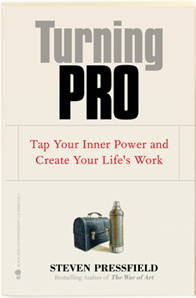
Book Review: Turning Pro by Steven Pressfield

Monday, June 11th, 2012

Turning Pro by Steven Pressfield 

Steven Pressfield has a new nonfiction book and a new publishing company and both are vehicles for the same message.

[Full disclosure: I consider Steve a friend and this early review was made possible by his sending me a review copy and the “lunch pail manifestoBlack Irish lunchbox pictured above. OTOH, I get many review copies from publishers and PR folks and if the book they send is terrible, or just not well suited for ZP readers, I won’t review it]

First, Turning Pro is the latest sequence of a series of books that explore the mindset of the authentic creator or artist, following The War of Art and Do the Work and their struggle with what Steve terms “Resistance”, the internal psychological force that insidiously undermines our will to complete creative works (or…start them) and fulfill our life’s dreams. In the War of Art, one turned “pro” when one acquired for the first time, the mindset required to successfully battle resistance instead of supinely giving in. Turning Pro naturally expands on that aspect of Pressfield’s creative philosophy.

I say “philosophy” because that is what it is. Many of Steve’s novels are set in the ancient world of classical civilization and I know that  he has done a great deal of reading in ancient history, philosophy and literature. Before the moderns and post-moderns, philosophy asked fundamental questions and students of most schools of philosophy were seeking how to live a good life, with “good” usually meaning “virtuous” in the sense of a life that is authentic, noble or honorable. We see this in particular with Socrates, the Stoics and those influenced by them such as Xenophon, Epictetus,  Cicero and Marcus Aurelius, all of whom were concerned with philosophy as a practical way of life and not as an abstract exercise. My impression is that this has left a mark on Pressfield’s view of life.  This is not to say that Steve is writing advice from the perspective of book-learning – far from it; he makes clear his long education in the school of hard knocks, but I think the books and the knocks have been mutually reinforcing.

For example, here is Epictetus from the  The Enchiridion:

….Aiming therefore at such great things, remember that you must not allow yourself to be carried, even with a slight tendency, towards the attainment of lesser things. Instead, you must entirely quit some things and for the present postpone the rest. But if you would both have these great things, along with power and riches, then you will not gain even the latter, because you aim at the former too: but you will absolutely fail of the former, by which alone happiness and freedom are achieved. 

And here is Steve from Turning Pro:

My shadow career (I’ve had more than one) was driving tractor-trailers.

In my late twenties and early thirties, I drove trucks for a living….What I was really doing was running away from writing. Driving trucks was for me a shadow version of writing, because being a truck driver was, in my imagination, powerful and manly (just as I imagined being a writer would be). It was interesting: it was never boring. It was a career I could take pride in, an occupation that felt right to me….

….Of course this was all self-delusion.

The road was taking me nowhere.

I wasn’t writing books. I wasn’t facing my demons. I was spectating at life through the movie screen of a cab-over windshield, while every mile I traveled only carried me farther away from where I needed to go and from who I needed to become.

This is one of the major themes of Steve’s nonfiction work – the need to conquer resistance, ignore distractions, eschew indirect approaches and confront head-on what you need to do and fear to try. To take the risk and dive into the deep end of the pool without rationalizing procrastination. Easy to say, but difficult for all of us to do and Steve breaks his advice in Turning Pro into digestible vignettes that separate the world of the aspiring amateur from the polished professional, the apprentice from the master. Turning Pro can be read in one sitting or read again and again until you gain the habit of “the Professional Mindset”.

A second theme, maybe a meta-theme in Turning Pro is also present in Black Irish Books, which Steve has launched in partnership with Shawn Coyne, Steve’s co-blogger and the publisher of The War of Art, has to do with what might be called “craftsmanship as an identity”. This is probably not quite the right description, but there is an essence of nostalgia for America’s boom years of WWI to the early sixties when a man’s job was substantially his identity and his hard work  provided not only a rising standard of living for his family, but a psychological anchor and sense of pride. Something generally considered worthy of admiration.  An era I recall dimly from my earliest years of childhood in a bungalow neighborhood in Chicago where this way of life was still the norm.

Black Irish Books has a “lunch pail manifesto” authored by Coyne:

The retro lunch pail and towering thermos on the cover of Steven Pressfield’s Turning Pro are in honor of some legendary Pros.

Back in the analog days when the economy relied on blue collar muscle to build the modern world, Steelworkers gave everything they had to get that work done. In three shifts, twenty four hours a day, three hundred and sixty five days a year, hard-hatted men with lunch pails swinging from their gnarled hands passed through mill gates in Aliquippa, Baltimore, Bethlehem, Braddock, Buffalo, Chicago, Clairton, Cleveland, Gary, Homestead, Lehigh, McKeesport, Pittsburgh, Pueblo, Tuscaloosa, Steubenville, Weirton, and Youngstown among many other cities.

Without those fully stocked lunch pails, these men would never have made it through a single shift.  Let alone a double.

They couldn’t duck out and drive to a fast food joint for lunch. Their Chevy Impalas were in the rank and file parking lot, five football fields away from the shop floor. Sweat-soaked and exhausted after four hours in 100+ degree heat, they had to shed twenty pounds of flame retardant asbestos clothing just to take their twenty-minute break.

What kept them going for the second half of their shifts were the two or three chipped ham sandwiches, the couple chunks of cheese, the extra donuts from breakfast and the quarter piece slab of peach pie jammed inside their pails. And, of course, a huge thermos of coffee.

Wives spent the tail end of their evenings packing their guys’ pails. The best cold cuts and treats always went to dad.  It was a sacred thing for a kid to see a scarred hard hat and a full lunch pail on the kitchen counter. That helmet and pail represented the indispensable tools of her father’s work—the armor to enter his chosen profession and the fuel to get him back home….

This is a theme that strikes a jarring contrast with America’s melancholy zeitgeist – an economy that is stagnant and in danger of cratering, elites who look out for a quick buck and an upcoming generation of cheerful smartphone experts with helicopter parents who expect huge rewards for just showing up.  The stark, black, industrial lunch box is an artifact of the world of Nelson Algren or Studs Terkel but it is also a symbol of skilled labor, hard work, excellence and productivity, of a simpler but more muscularly dynamic time while the boxing glove denotes a pugnacious stance toward adversity or resistance.

Are you ready for Turning Pro?


Switch to our mobile site