zenpundit.com » 2012 » August

Archive for August, 2012

The zen of Cage II: from the A Train to Liverpool Street Station

Wednesday, August 15th, 2012

[ by Charles Cameron — two performances of Cage’s 4’33” in the New York and London Times: an interlude in my review of Where the Heart Beats, with a brief meditation on contrapuntal listening ]
.

I began to review Kay Larson‘s Where the Heart Beats in a post here last week, and am not done yet.

**

London:

photo credit: Chris Harris for the London Times

In John Cage’s sound of silence… at Liverpool Street station [London Times, subscription required], Igor Toronyi-Lalic describes performing John Cage‘s silent work 4’33” in what Cage himself — but few others — would have recognized as a concert venue, London’s Liverpool Street Station:

My rendition isn’t going down well. “This is doing my head in!” groans a drunken West Ham supporter as he watches me at the piano outside Liverpool Street station. I hear shuffling. “I can’t dance to this,” someone shouts. The restlessness is in danger of turning to anger. And I probably should have guessed it would. Presenting a performance of one of the most controversial works of music yet written in a rowdy Central London station forecourt on a Friday night on a public piano (one of several that made up the City of London Festival’s Play Me, I’m Yours artwork) was always going to be ambitious.

The work itself is hardly over before it begins — again, a paradox Cage would have enjoyed:

At my Liverpool Street Station performance, there was a symphony of rush-hour noise: commuter patter, train announcements, drunken heckling and the screeching of taxis stopping to pick up fares. Not everyone appreciated the music in this.

“When’s he going to start?” asked one lady as I finished the final movement. Others felt like they’d been had. “I thought you were going to play,” they shouted.

There’s more, and if you can get past the pay-wall you should read it all. I’ll just quote one more snippet here, though, because it leads directly into one strand of the book that I’ll be discussing in Part III of my review of Larson’s book:

“Classical musicians don’t know about Cage. They don’t perform it. We aren’t taught it in schools,” Volkov says.

But, for visual artists, Cage is a revered figure, a key part of the 1950s and 60s New York arts scene and godfather to conceptual and sound art, a connection cemented by Cage’s 40-year creative relationship with his lifelong partner, the late choreographer Merce Cunningham. “Cage worked with Rauschenberg and Cunningham and, at Black Mountain College, he mainly taught music to artists,” observes Volkov, “So, today, in art schools, they teach Cage properly. They teach his ideas.”

**

New York:

photo credit: Christian Hansen for the New York Times

From London’s Liverpool Street Station we pass to New York City’s subway system. I don’t know what it is about trains, but there you are and there you go. Or perhaps the transit is from Times to Times?

Allan Kozinn‘s John Cage Recital? Take the A Train [New York Times] starts by defining “Cage moments”:

You know about Cage moments, don’t you? We all have them, whether we think of them that way or not. They occur when happenstance kicks in, and surprising musical experiences take form, seemingly out of nowhere. They can happen anywhere at any time.

Listening. Listening as though all life is music.

Kozinn is a listener, a listener to music — but he doesn’t always listen for the music in his daily life. This time, as it happens, he did:

On the A train I wasn’t thinking about Cage at all. I had just heard an exquisitely turned, energetic performance of Schubert’s String Quintet in C at a church in Greenwich Village, and Cage could not have been further from my thoughts. Nor did the crowded subway car bring him to mind at first. But I noticed that it was unusually noisy.

**

Then something shifted:

Typically, most of the noise you hear comes from the subway itself: its din drowns out conversations, and people tend to stare at their feet, or at whatever they are reading, and listen to their portable music players. But this Tuesday evening just about all the people were talking, and working hard to drown out both the subway and the chats taking place around them.

I would normally have tuned all this out, but instead I sat back, closed my eyes and did what Cage so often recommended: I listened. I made no effort to separate the strands of conversation or to focus on what people were saying. I was simply grabbed by the sheer mass of sound, human and mechanical. It sounded intensely musical to me, noisy as it was, and once I began hearing it that way, I couldn’t stop.

Okay, this is where it get’s interesting. You remember that I pointed to the pianist Glenn Gould in my Said Symphony posts, and quoted this passage from David Rothenberg‘s Sudden Music:

Gould set himself up to hear the world in a new way. In diners he ate his lunch alone, eaves dropping closely on the voices around him. He learned to hear conversation as music, the lilting lines, the rhythms everywhere up, down, and around, what Bach does to our sense of talk. There are two part inventions in words, themes and variations in the quarrels of couples and the tales told by friends. Gould met the world on his own terms, and he was fascinated by this way of listening to human voices as if they were a musical interplay, not participating in a conversation but taking it all in, as an audience.

What Gould sets out to do — and records for Canadian Broadcasting — Kozinn finds himself doing:

Strand upon strand of the chatter was animated and midrange: there were neither basso profundos nor soaring sopranos in this choir, but after a moment the pitch levels began to sort themselves out as a kind of orchestration. Argumentative voices created driving, punchy rhythms that sailed over more smoothly floating narrative tones.

At least three languages were being spoken, each with its own melodic lilt and rhythmic character. To my left, a woman’s laughter momentarily changed the coloration of this vast choral tapestry and offset the argument to my right.

Within it all, squeaking metal yielded a high-pitched ostinato, and the ever-so-slightly-clattery rumble of the train was the high-tech equivalent of a Baroque basso continuo. As the train pulled into each station, the muted squeal of the brakes, the opening and closing of the doors and the slight shift in the balance of voices as some people left and others entered, already talking, suggested shifts between connected movements.

Again, I recommend reading the entire piece, but will close with just one more short clip:

I have heard “4’33” ” performed by pianists, percussion ensembles, oboists, cellists and orchestras, but none of those versions were as exciting as what I now think of as “4’33”: The Extended Subway Remix” by the A Train Yakkers, an ensemble so conceptual that its members had no idea they were in it.

Cage would have understood.

**

And wherever:

Listening — and listening to the world around us as music — can happen anywhere and everywhere. But as usual, I’d like to take this a step further.

As I never tire of repeating, Edward Said — pianist and music critic as much as writer on Israeli-Palestinian issues — carries the idea of listening to multiple voices a step further, when he suggests:

When you think about it, when you think about Jew and Palestinian not separately, but as part of a symphony, there is something magnificently imposing about it. A very rich, also very tragic, also in many ways desperate history of extremes — opposites in the Hegelian sense — that is yet to receive its due. So what you are faced with is a kind of sublime grandeur of a series of tragedies, of losses, of sacrifices, of pain that would take the brain of a Bach to figure out.

Said’s proposed manner of listening to the many voices of life in counterpoint involves listening to the words, their meanings, their stories, their histories, and thus to a simultaneous listening across time itself — not just to a harmonious blur, “Strand upon strand of the chatter .. a kind of orchestration .. driving, punchy rhythms that sailed over more smoothly floating narrative tones.”

It goes way deeper: my life and concerns, and yours, and yours, heard together — separate and interwoven — in polyphony, in a many-voiced music — in counterpoint.

In conflict, and in hope of resolution.

For Klan read Islam?

Tuesday, August 14th, 2012

[ by Charles Cameron — headlines, McVeigh, mea culpa, Breivik, media, guessing games and blame, puns, great tweet ]
.


.

That’s yesterday’s Charlotte Observer‘s headline and opening paras for an article they reposted from Slate, which had more cautiously titled it What’s on a Ku Klux Klan Membership Application?

We’ll come back to that headline later.

**

Okay, seriously.

Educated guesses can prove wrong in retrospect. Educated guesses can lay considerable blame. Educated guesses can have pernicious side effects.

When a bomb ripped through the Federal building in Oklahoma City, many people’s first reaction — including my own — was that it was probably the work of Al-Qaida “Muslim terrorists”.

The media initially broadcast the “Islamist” theory of the bombing quite extensively, and one of the results, according to Penny Bender Fuchs in an American Journalism Review piece titled Jumping to Conclusions in Oklahoma City? was:

A Muslim woman who suffered a miscarriage in her Oklahoma City home said she was afraid to seek medical attention because a crowd of people was throwing stones at her house.

Two more clips from that article:

Within hours of the bombing, most network news reports featured comments from experts on Middle Eastern terrorism who said the blast was similar to the World Trade Center explosion two years earlier. Newspapers relied on many of those same experts and stressed the possibility of a Middle East connection.

The Wall Street Journal, for example, called it a “Beirut-style car bombing” in the first sentence of its story. The New York Post quoted Israeli terrorism experts in its opening paragraph, saying the explosion “mimicked three recent attacks on targets abroad.”

“We were, as usual, following the lead of public officials, assuming that public officials are telling us the truth,” says John R. MacArthur, publisher of Harper’s magazine and author of a book on coverage of the Persian Gulf War. He believes the media overemphasized the possible Middle Eastern link and ignored domestic suspects because initially the police were not giving that angle much thought.

“Reporters can’t think without a cop telling them what to think,” MacArthur says. “If you are going to speculate wildly, why not say this is the anniversary of the Waco siege? Why isn’t that as plausible as bearded Arabs fleeing the scene?”

Most news organizations did mention other possible culprits. They noted the bombing took place on the second anniversary of the government raid on the Branch Davidians in Waco, Texas, suggesting that homegrown terrorists might be responsible. But that angle was buried in most stories.

And:

Jim Lobe, bureau chief for Inter Press Service, says tying the bombing solely to the Middle East “was in a sense a comforting story for Americans.”

Inter Press, a small wire service for papers in the Third World and development agencies in Europe and Canada, was perhaps the first news outlet to raise the possibility that domestic paramilitary fanatics carried out the bombing.

“Of course the Middle East has to be considered,” Lobe says. “But when you considered the weight of all the evidence, it takes you a different direction.”

Lobe, who is familar with militia groups, says many news organizations failed to notice a big clue: traffic on the Internet detailing bomb recipes and talking about the need to avenge the government’s attack on the Branch Davidians. He says the bombing coverage offers “a major lesson for the profession.”

Will that lesson be heeded? MacArthur doesn’t think so. The media are doing a poor job covering Timothy McVeigh and the militia groups around the country, he says. “They are going to turn them into oddball crazies, caricaturing McVeigh as a trailer park terrorist, which is no better than the caricature of the Arabs.”

**

Something similar happened in the immediate aftermath of the Oslo bombing, as this account from the media watch-dog group FAIR details:

On news of the first round of attacks–the bombs in Oslo–CNN’s Tom Lister (7/22/11) didn’t know who did it, but knew they were Muslims: “It could be a whole range of groups. But the point is that Al-Qaeda is not so much an organization now. It’s more a spirit for these people. It’s a mobilizing factor.” And he speculated confidently about their motives:

You’ve only got to look at the target–prime minister’s office, the headquarters of the major newspaper group next door. Why would that be relevant? Because the Norwegian newspapers republished the cartoons of Prophet Mohammad that caused such offense in the Muslim world…. That is an issue that still rankles amongst Islamist militants the world over.

CNN terrorism analyst Paul Cruickshank (7/22/11) took to the airwaves to declare that “Norway has been in Al-Qaeda’s crosshairs for quite some time.” He added that the bombing “bears all the hallmarks of the Al-Qaeda terrorist organization at the moment,” before adding, almost as an afterthought, that “we don’t know at this point who was responsible.”

On Fox News Channel’s O’Reilly Factor (7/22/11), guest host Laura Ingraham declared, “Deadly terror attacks in Norway, in what appears to be the work, once again, of Muslim extremists.” Even after Norwegian authorities arrested Breivik, former Bush administration U.N. ambassador John Bolton was in disbelief. “There is a kind of political correctness that comes up when these tragic events occur,” he explained on Fox’s On the Record (7/22/11). “This kind of behavior is very un-Norwegian. The speculation that it is part of right-wing extremism, I think that has less of a foundation at this point than the concern that there’s a broader political threat here.”

**

Peter Bergen, who wrote the book more than once on Bin Laden and his demise, recently discusses the topic, Right-wing extremist terrorism as deadly a threat as al Qaeda? for CNN — some key findings for perspective:

The word “terrorism” in the United States usually brings to mind plots linked in some way to al Qaeda, while the danger posed to the public by white supremacists, anti-abortion extremists and other right-wing militants is often overlooked.

Militants linked to al Qaeda or inspired by jihadist ideology have carried out four terrorist attacks in the United States since September 11, which have resulted in 17 deaths. Thirteen of them were in a shooting incident at Fort Hood, Texas, in November 2009.

By contrast, right-wing extremists have committed at least eight lethal terrorist attacks in the United States that have resulted in the deaths of nine people since 9/11, according to data compiled by the New America Foundation.

And if, after investigation, Sunday’s attack on the Sikh temple in Wisconsin is included in this count, the death toll from right-wing terrorism in the U.S. over the past decade rises to 15.

The shooting suspect, Wade Michael Page, posed with a Nazi flag on his Facebook page and has played a prominent role in “white power” music groups. The FBI is investigating the case as a “domestic terrorist-type incident.”

Here’s a link to the SPLC’s updated roster: Terror From the Right: Plots, Conspiracies and Racist Rampages Since Oklahoma City.

And there are no doubt other threats, some from potential left wing sources — and some from other half-crazed wingless entities who roam among us on two legs.

**

I said we’d come back to that Charlotte Observer headline later. Here we are:

.

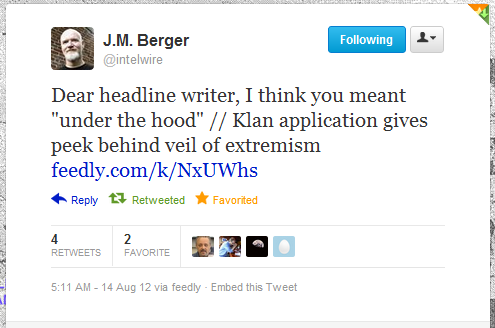
That tweet from friend JM Berger — think about it, “veil” suggests “Muslim”, doesn’t it? — and “hood” means “KKK”? — that’s really quite a double-barreled pun — and, given the context, it makes so much more sense!

JM gets my Tweet of the Month award.

Recommended Reading

Tuesday, August 14th, 2012

Top Billing! Bruce Kesler –Campus Hate Speech and Speech Codes 

We have educated an elite in the past two generations, now reaching the peak of leadership positions in government, corporations, finance and academia, containing an influential plurality who hold our core Constitutional principles and freedoms enshrined in the Bill of Rights in disdain. Who are, in essence, authoritarian and anti-democratic, pushing policies to remake American society in their own image, enlisting the state to bully those with differing opinions for daring to “think wrongly” or belong to groups they despise.

Universities have more than their share of these folks, as Bruce Kesler explains:

Many of the finest and most honest minds – conservative and liberal — in and out of academia have argued, and sometimes succeeded, that campus speech codes often cross the line to suppression of First Amendment freedom of speech. The excesses in the wording of such codes, their arbitrary and often biased application, and the fear of usurping a constitutional right, together send chills up the spine.

Nonetheless, in court cases, private colleges have more leeway to enact speech codes than do public colleges, as they are not as subject to the First Amendment prohibition on government interfering with free speech. In the face of opposition to speech codes per se colleges, both public and private, have turned to anti-harassment policies. These seemingly turn the offense from the speech to the impact on those sensitive, and in effect make judging the offense even more subjective.  Alongside, many campuses have instituted judgment procedures that deny those charged from confronting their accuser or, in some cases, even appearing to defend themselves. In many cases, those supporting such near star-chamber exercises in speech or behavioral prejudice are those judging for the kangaroo procedures. And, alongside these, liberal and leftist faculty have denied tenure or opposed research by those who have empirically challenged cherished thoughts or prejudices.

So, understandably so, any further enlargement of speech codes or definition of hate speech raises hackles among almost all those who have battled the present excesses. Further, most opponents have cause for little faith that in the prevailing leftist or hypocritical atmosphere on campuses that an enlargement to anti-Israel speech and actions that are anti-semitic would be enforced or fairly…..

Pundita – Meet the new U.S. defense policy. Same as the old policy 

….The rest of the writing is mostly taken up with Mr Bhadrakumar’s ruminations on how India’s government feels about being folded into America’s Asia Pivot. So he doesn’t rake up embarrassing history; namely, that about 95 percent of the global terrorist threat could have been neutralized after 9/11 if the United States had bombed Pakistan and Saudi Arabia back into the stone age, and that if a few stray bombs had fallen on London this would have further reduced the threat by a couple percentage points. 

Nor does he dwell on the unpleasant present, which finds the U.S. government still covering for Pakistan’s military, which has been supporting groups that kill American troops in Afghanistan. 

And he doesn’t mention that if the USA is so intent on taking down global Islamic terrorism it has a strange way of going about it, given that one can’t find a more anti-Islamic terrorism government than China’s, unless it’s Russia’s — the other country in the cross-hairs of America’s Asia Pivot. 

But Mr Bhadrakumar’s carefully limited discussion is still enough to convey that when one looks past the new-fangled widgets and geegaws of the Light Footprint era and its reliance on proxy armies and special forces, one hand is fighting the other hand, which is another way of describing NATO’s protracted cold war against the Soviet Union.

In the post-WW 2 era, the United States and its NATO allies were intent on quickly rebuilding Western Europe’s industrial base, which meant Western Europe relied heavily on Soviet energy supplies, which provided Russia with the wherewithal to build a nuclear arsenal and stave off collapse of the Soviet Union for decades.

So if you switch out yesterday’s bad guys for today’s, you’re looking at the same old U.S. Cold War defense policy, gussied up with the weapons and communications technologies of this era. The basis of the policy isn’t victory over Islamic terrorism, any more than victory over the Soviets was the objective of the U.S.-led Cold War. 

What, then, is the government of United States really aiming at?  I think the answer was alluded to by ISAF/U.S. Forces in Afghanistan Commander General John R. Allen when he gave a pep talk earlier this year to a gathering of grim-faced American soldiers in Afghanistan…..

Seydlitz89 –Defining “Literacy”

Seydlitz has a very interesting riff on an earlier post by Venkat:

….Venkat mades some interesting claims here. I think he has a point as to our Western dismissal of oral cultures being simply about memorization, there is more to it than that, but is there not more to the Western concept of literacy as well? Here’s where his analysis falls short imo. Also his example of Indian oral culture is not meant to appeal to most students, but to “a few” who don’t see it as “mindless tedium”. The recitation he uses as an example are religious texts, hardly ones to promote critical thinking which is another drawback.I think the main problem is that he is conflating “orality” with “literacy” which are in fact two different things. This distinction is important because the cultural implications are profound. Following Walter Ong’s distinctions, we have this….

Gunpowder & Lead (Daveed Garstein-Ross) –Reflections on Byman’s “Breaking the Bonds”, (Dan Trombly) Weapons Still Don’t Make War

Information Dissemination (Galrahn)-Time To Talk Lasers

Cool.

Chicago Boyz (LC Rees)- Crap Cleaner

Helpful Freeware recommendation. Used it.

Dave Schuler – The War on Algebra 

S. Anthony Iannarino-How to Upgrade the Operating System That Runs Your Brain

Michigan War Studies Review –The Deaths of Others: The Fate of Civilians in America’s Wars and 1066: A New History of the Norman Invasion and 1812: The Navy’s War

The last review is by occasional ZP commenter Ralph Hitchens 

Gene Expression –  Human on human Sex and The Jewish Diaspora:not an empire of the mind 

Before you get too excited, Razib’s first post is about Neanderthal genetic legacy in modern non-Africans.

That’s it.

Pew II: Prevalence of belief in the Jinn

Monday, August 13th, 2012

[ by Charles Cameron — Corbin on Queen Bilqis, Qur’an and hadith regarding jinn, Pew statistics on belief in jinn — with some earlier Natsec implications & a non-serious suggestion from contemporary physics ]
.

La Jinn the Mystical Genie of the Lamp
from the Yu-Gi-Oh card game

.

I’ve been “fond” of the jinn (djenoun) since first encountering them in the brilliant short stories of Paul Bowles, and notably his A Hundred Camels in the Courtyard.

But that’s a literary fondness, neither science nor belief-based on my part. In my view, that’s only right and proper, since djenoun belong in the realm of imagination — or better said, the Imaginal, as Henry Corbin terms it — see note 16, p, 326. of his Creative Imagination in the Sufism of Ibn ‘Arabi, where he speaks of the Sheikh’s Bilqis Queen of Saba in his poetry as a being “born from a jinn and a woman” — it’s a fascinating passage, connecting Bilqis with Jesus in terms of the (unorthodox) angelology that Corbin envisioned uniting the Abrahamic faiths at a visionary level.

**

Here are two of the mentions of jinn in the Qur’an:

And the Jinn race We had created before from the fire of a scorching wind. [Sura 15, 27]

Say: It has been revealed to me that a company of Jinns listened (to the Qur’an). They say ‘We have really heard a wonderful Recital! It gives guidance to the Right and we have believed therein: We shall not join (in worship) any (gods) with our Lord. And exalted is the Majesty of our Lord: He has taken neither a wife nor a son.’ [Sura 72, 1-3]

And here is a tale of the Prophet and a jinn, as narrated by the Companion Malik ibn Anas:

The Prophet said to the jinni: “This is the stride of a jinni, as well as the tone of his voice!” The jinni replied: “My name is Hamah ibn Laqqis ibn Iblis.” The Prophet said: “Only two generations seperate you from him [Iblis].” He replied: “True.” The Prophet asked: “How long have you lived?” The jinni replied: “Almost all of time. I was a small boy when Abel was killed. I believed in Noah and repented at his hands after I stubbornly refused to submit to his call, until he wept and wept. I am indeed a repentant — God keep me from being among the ignorant! I met the prophet Hud and believed in his call. I met Abraham, and I was with him when he was thrown in the fire. I was with Joseph, too, when his brothers hurled him into the well—I preceded him to its bottom. I met the prophet Shu’ayb, and Moses and Jesus the son of Mary, who told me: ‘If you meet Muhammad, tell him Jesus salutes thee!’ Now I’ve delivered his message to you, and I believe in you.” The Prophet said: “What is your desire, 0 Hamah?” He said: “Moses taught me the Torah, Jesus the Gospels, can you teach me the Qur’an?” So the Prophet taught him the Qur’an.

The Tasneem Project

**

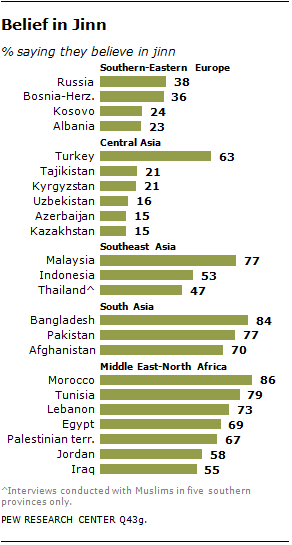
Literal vs metaphorical, let alone imaginal belief is not something the interviewers who conducted the Pew poll had the leisure to distinguish — but for the record, here are their findings as to the Muslim belief in jinns:

According to the Quran, God created jinn as well as angels and humans. Belief in jinn is relatively widespread – in 13 of 23 countries where the question was asked, more than half of Muslims believe in these supernatural beings.

In the South Asian countries surveyed, at least seven-in-ten Muslims affirm that jinn exist, including 84% in Bangladesh. In Southeast Asia, a similar proportion of Malaysian Muslims (77%) believe in jinn, while fewer in Indonesia (53%) and Thailand (47%) share this belief.

Across the Middle Eastern and North African nations surveyed, belief in jinn ranges from 86% in Morocco to 55% in Iraq.

Overall, Muslims in Central Asia and across Southern and Eastern Europe (Russia and the Balkans) are least likely to say that jinn are real. In Central Asia, Turkey is the only country where a majority (63%) of Muslims believe in jinn. Elsewhere in Central Asia, about a fifth or fewer Muslims accept the existence of jinn. In Southern and Eastern Europe, fewer than four-in-ten in any country surveyed believe in these supernatural beings.

In general, Muslims who pray several times a day are more likely to believe in jinn. For example, in Russia, 62% of those who pray more than once a day say that jinn exist, compared with 24% of those who pray less often. A similar gap also appears in Lebanon (+25 percentage points), Malaysia (+24) and Afghanistan (+21).

The survey also asked if respondents had ever seen jinn. In 21 of the 23 countries where the question was asked, fewer than one-in-ten report having seen jinn, while the proportion is 12% in Bangladesh and 10% in Lebanon.

**

Two markers concerning National Security concerns regarding Pakistan, nuclear weapons and those who believe (literally, energetically) in jinns — from the early 2000s, but dating back by implication to the era of Zia ul-Haq:

Just after the September 2001 terrorist attacks in the U.S., Pakistan’s intelligence service detained two retired nuclear scientists who had met with senior members of al Qaeda, including Mr. bin Laden, during charity work in Afghanistan. One, Sultan Bashiruddin Mahmood, was a former director at the Pakistan Atomic Energy Commission and a controversial Islamic scholar who had postulated that energy could be harnessed from fiery spirits called djinns.

WSJ, Inside Pakistan’s Drive To Guard Its A-Bombs

But as a subscriber to a brand of what is known to practitioners as “Islamic science,” which holds that the Koran is a fount of scientific knowledge, Mr. Bashiruddin Mahmood has published papers concerning djinni, which are described in the Koran as beings made of fire. He has proposed that these entities could be tapped to solve the energy crisis, and he has written on how to understand the mechanics of life after death.

NY Times, Pakistani Atomic Expert, Arrested Last Week, Had Strong Pro-Taliban Views

— together with a Pakistani critique:

If a scientist is European or Hindu he will be restricted in his vision by reason. A Muslim scientist has unlimited scope; he will relate his science to miracles, mostly performed by himself. Sultan Bashiruddin, our top enrichment expert, believed he could draw electricity from a captured jinn. (For Pakistan’s needs just one jinn would suffice.)

Khaled Ahmed, Scientists, our kind

There are times when beliefs have, or might just have, consequences.

**

Jinn are significant not only for their own sakes, so to speak, but also for their etymological implications. To quote again from the Tasneem Project:

One saying of the Prophet (aws) mentions that, “God divided the jinn and the humans into ten parts. One part makes up the human race, and the other nine parts is made up of the jinn.” The invisible is everywhere. The Arabic language itself bears witness to how the invisible realm insinuates itself on everyday life. In Arabic, each time the two letters jeem and nun occur together, as in jinn, they convey the meaning of invisible or hidden. Thus, paradise is jannah because paradise is hidden from the human sight; janin is the foetus in the womb; the expression ajannahu al-layl means the night covered him.

The jinn, like paradise itself, are among the hidden secrets…

**

And how large is the universe, that it might encompass the angels and jinn? Hugh Everett III quite brilliantly argued for what has come to be known as the “many worlds” hypothesis in quantum measurement while still a grad student:

Hugh Everett III was a student in his mid-twenties in 1957 when he presented his revolutionary formulation of quantum mechanics in his PhD thesis. Everett himself called his theory variously; pure wave mechanics, the relative-state formulation of quantum mechanics, and the theory of the universal wave function. His theory, however, came to be popularly known as the many-worlds interpretation, because it predicts that everything that might happen, does in fact happen. As the physicist Bryce DeWitt later described it, Everett’s theory predicts that our universe is composed of countless parallel universes that are each constantly splitting into yet further copies, and in the process, creating copies of each observer, each of which subsequently observes a different quantum universe and splits into further copies.

While a science fiction fan might embrace such a theory simply by dint of how cool it would be if something like that were true, one might naturally wonder what good scientific reason one might have for believing that our universe is in fact composed of countless parallel splitting universes.

**

The whole article from which that quote was taken, The Quantum Measurement Problem and the Everett Interpretation, is indeed worth reading. But whereas physicists and (most) science fiction writers might confine their “many worlds” to physical, “materialist” universes, students of the imaginal are under no such restriction, as the same Tasneem Project article suggests:

The Muslim universe has always been made up of multiple worlds – the Qur’an itself refers to “universes” in the plural, in its open chapter al-fatihah. According to prophetic tradition, the cosmos consists of 18000 universes. …

So the jinn when summoned might come — somewhat unexpectedly — from one of Everett’s more hidden “many worlds”, perhaps?

Wonderland Battlespace Revisited

Monday, August 13th, 2012

[ by Charles Cameron — Syria, snipers, urban tactics, architecture ]
.

You remember the Wonderland Battlespace?

I wrote about it almost a year ago, and quoted:

the strategy of walking through walls, as Israeli architect Sharon Rotbard reminds us, is reinvented for every urban battle in response to local conditions

Okay, here it is again:

Clambering up the fallen concrete using a makeshift wooden ladder, the group enters a bombed-out building. Abu Thabet’s men have broken holes in the walls to create safe passages for them to move around in Salaheddine, out of the snipers’ sights.

“Now we are on a street parallel to Al-Albesa Street,” Abu Thabet explained. “On our right are snipers and on our left snipers. So we will go through these buildings to get to the Salaheddine roundabout.”

This building takes them into a maze of holes through deserted homes and apartment hallways back to back until they reach the roundabout that for now marks the frontline. The holes in the walls are tight and their edges jagged with broken brick. Rebels squeeze through, legs first, then arms, scratching their skin and turning their hair white with dust.

There is evidence of abandoned lives all around. A prayer mat lies on the floor of an empty bedroom. Another room has a cabinet filled with china tea cups and crystal glasses. A bird cage stands empty. In a kitchen, a jar of pickles sits half-eaten and rotting on the counter, flies circle around a pile of dishes in the sink. In one apartment, rebels use the master bedroom as a weapons depot, placing ammunition and rocket-propelled grenades (RPGs) on top of the red blanket covering a bed.

The hallways are dim and the zig-zag route, up stairs, through bedrooms, from apartment to apartment, makes it hard to keep track of how many buildings have been traversed. The last hole is through a large wooden closet, its back smashed through and behind it a gap two meters (six feet) wide, opening into an apartment filled with water bottles and bread. About five rebels are crammed in a hallway waiting for orders. In a small living room a candle lights up a sofa set and family pictures sitting on a small television.

“We are now at the Salaheddine roundabout. The new frontline of the battle of Aleppo,” announced Abu Thabet, walking out into the bright street. “The army is just behind this building.”

Hadeel Al Shalchi, Syrian rebels carve paths through buildings to avoid snipers, Aleppo, Aug 11 2012 — h/t Caitlin Fitz Gerald

This time the buildings were abandoned: they aren’t always.


Switch to our mobile site