zenpundit.com » 2012 » September

Archive for September, 2012

Boyd & Beyond 2012 Final Agenda

Monday, September 10th, 2012
[by J. Scott Shipman]
Photo credit: Zenpundit


A modified note from Stan Coerr:

To All-

We are looking forward to seeing everyone a month from now, on the morning of 12 October 2012 in Quantico.

IF YOU ARE A SPEAKER:  I need a positive response from you that your time allotted, subject and day are correct.  If you need us to move you, let me know.

Coordinating instructions:

1.  Dress code Casual.

Officers:  you do not need to wear a uniform.  There will be people there in blue jeans.

2.  Location

We are going to be in two different places on the two days we are there.

On Friday, the first day, we will meet at 7:30 am in the Command and Staff College building, right next to the Gray Research Center. You should have no trouble at the gate.

To stay overnight:  Crossroads Inn is a hotel on the base, less than a mile from the venues.  It is at 3018 Russell Rd, Quantico, VA 22134 Phone  (703)630-4444

On Saturday, we will meet at 8:00 am at the Expeditionary Warfare School, also on the base in Quantico.  We will give those directions on Friday.

3.  Food

We are looking for volunteers for food and drink.  Coffee, water and snacks are most welcome. Please contact me and Scott Shipman if you are able to help. [Note: Scott Shipman is bringing coffee. Someone volunteered for water and bagels, but I misplaced the note—drop me a comment/email to close the loop.]

4.  Tempo

We are cramming in a lot of information and a lot of presentations…and a lot of people. I know that the math does not add up on our schedule; people can contract or expand as needed. It is my intent that we will eat right there in the room, both days, and take breaks right there as well.

5.  Next

It is my intent that we will start doing this twice a year. I am planning to start a Boyd and Beyond 2013 conference in Silicon Valley / Monterey / Palo Alto area next spring, IN ADDITION TO our usual October event in Quantico.  I am convinced that people there will be intrigued by our group and will want to participate. I have started talking to people about how, and where, to do this.  If you have ideas, bring them and we will discuss.

Scott and I look forward to seeing everyone in a month!

Yours,

Stan Coerr

Boyd and Beyond 2012 Friday 12 October

0730-0815 Stan Coerr intro

Dr. Terry  Barnhart :  Ten-minute teaching modules  throughout conference

0815-0945 Present at the Creation

Chet Richards: Closing the OODA Loop: Boyd, the Conceptual Spiral, and the Meaning of Life (60 min)

Greg Wilcox: Boyd’s: People, Ideas, and Things, In That Order (30 min)

Dr. Terry Barnhart : Ten-Minute Teaching Modules throughout conference

Break

1000-1200 The Rise of the Marines

Brigadier General Stacy Clardy USMC: John Boyd, Quantico and Marine Corps Enlightenment (60 min)

Break

Captain Paul Tremblay USMC: Boyd and Bravo Company: Tempo in Ground Combat (60 min)

Terry for Ten

1215 Lunch brought in

Terry for Ten

1245-1345 Boyd and the Real World

Katya Drozdova: Afghanistan, Force and Tempo (30 min)
Marshall Wallace: NGO Team Decision Cycles in Crisis: Boyd in Action (30 min)

Terry for Ten

1345-ENDEX Holding the Grail

Mike Miller: The Boyd Archives: Lecture and Tour Round-Robin

To archives: small groups, 30 minutes each

Concurrent in classroom: Case Method Instructors (Bruce Gudmundsson/Damien O’Connell).

GI Wilson: How it Happened

Boyd and Beyond 2012 Saturday 13 October

Terry for Ten

0800-1030 Boyd and the Brain

Venkatesh Rao: What does “inside the Tempo” Mean? (60 min)
Critt Jarvis: Ecolate OODA (30 min)
Michael Moore: WinBowl II (60 min)

1030-1300 Boyd in Battle : Insurgency

Pete Turner: Human Terrain Systems and COIN (30 min)
Tom Hayden: Boyd and COIN (60 min)
Mike Grice: The Second O: The Effect of COIN on Orientation (30 min)

Adam Elkus: OODA and Robotic Weapons (30 min)

Terry for Ten

1300-1500 Boyd and Business

Jake Wood and William McNulty: Boyd and Bureaucracy: Starting Rubicon (30 min)
David Diehl: Boyd in the Cyber Conflict Domain (30 min)
Mike Grice & Jonathan Brown: Boyd Cycle in High-Pressure Business (30 min)
Chris Cox: Boyd and Politics (30 min)

Ten for Terry

1515-1545 Boyd and Beyond IV Silicon Valley Spring 2013

Stan Coerr: Next Steps

Cross-posted at To Be or To Do.

Bassford’s Dynamic Trinitarianism Part I.

Monday, September 10th, 2012


“Clausewitz wants us to accept the practical reality that these dynamic forces are ever-present and constantly interacting in the everyday world….”

I just finished reading a working paper by Professor Christopher Bassford he has posted at Clausewitz.com that I am strongly recommending to the readership (with a hat tip to Peter at SWJ Blog).

Tiptoe Through the Trinity, or, The Strange Persistence of Trinitarian Warfare

At 31 pages of analytic prose, diagrams and footnotes regarding the nature of  Carl von Clausewitz’s “fascinating” trinity; how Bassford thinks Michael Howard and Peter Paret got some important points in their translation of On War wrong ; the real meaning of Politik and on the perfidy of non-trinitarians – Bassford’s paper is not a quick read but a worthwhile one. I learned some important things about On War from reading this paper and had some uncertain speculations strengthened by Bassford’s expertise on Clausewitz and Clausewitzians.  I am not going to attempt a summary of so long and abstruse an argument, but I would instead like to highlight some of Bassford’s more valuable insights. There were also a couple of points where, in stretching to make analogies with other fields, I think Bassford may be going astray, as well as some commentary I might make regarding “non-state war”.

This paper will be more digestible if we blog the topics one at a time, in succession.

The most important part in the paper and I think most helpful to people who have not read On War many times was Bassford’s emphasis on the extremely dynamic nature of Clausewitz’s “fascinating” (his translation) trinity:

….in fact, the Trinity is the central concept in On War. I don’t mean “central” in the sense that, say, Jon Sumida applied in his conference paper*7 to Clausewitz’s concept of the inherent superiority of the defensive form of war. That is, I do not argue that the Trinity is Clausewitz’s “most important” concept, that the desire to convey it was his primary motivation in writing, or that all of his other insights flowed from this one. Rather, I mean simply that the Trinity is the concept that ties all of Clausewitz’s many ideas together and binds them into a meaningful whole.

….In any case, the role of the Trinity within the narrow confines of Book One, Chapter One ofOn War, which reflects Clausewitz’s most mature thinking, is crucial. That chapter must be read in terms of Clausewitz’s dialectical examination of the nature of war. That discussion is very carefully structured but (purposefully, I suspect) largely unmarked by clear dialectical road markers labeling thesis, antithesis, and synthesis,*8 or even by sections clearly devoted to one stage of the dialectic or another. The Trinity itself represents the synthesis of this dialectical process.

….The H/P translation then gives the impression that the Trinity is being offered simply as an alternative metaphor. In truth, Clausewitz has already ceased riffing on the chameleon imagery. He is actually switching to a whole new metaphor, with a new structure, new entailments, and new purposes. The chameleon metaphor pointed to changes in war’s appearance from case to case; the Trinity addresses the underlying forces that drive those changes.

….The second problem here is the choice of modifying adjective. It seems that no modern translator is prepared to render wunderliche in the military context as “wonderful,” “wondrous,” or “marvelous” (much less “queer,” “quaint,” or “eccentric,” all good dictionary definitions). H/P 1976 gives “remarkable,” a throw-away word of no particular significance. This was changed to “paradoxical” in the 1984 edition, but this word seems to have no relationship to wunderliche and carries inappropriately negative connotations. Clausewitz wants us to accept the practical reality that these dynamic forces are ever-present and constantly interacting in the everyday world. But he clearly found this shifting interaction really, really interesting—to the point of being mesmerized by it.

…..Clausewitz, in contrast, was skeptical (to put it mildly) of any positive doctrine that was not highly context-specific. The pursuit of such a doctrine was entirely alien to his approach to theory. His Trinity was descriptive, not prescriptive, and foretold the very opposite of balance. (Schwebe carries the connotation of dynamism, not equilibrium.) The message of this Trinity was that the relationships among his three elements were inherently unstable and shifting. What he actually said was that “the task … is to keep our theory [of war] floating among these three tendencies,” and not to try to set, or to count on, any fixed relationship among them.

….it is the infinite variability among the trinity’s factors and in their interaction that underlies Clausewitz’s insistence on the inherent unpredictability of war. It is a classic model of Chaos, in the modern scientific sense.

….In short, this last element of the Trinity represents concrete reality, i.e., everything outside of our own skull and its emotions and calculations.

…. Clausewitz’s Trinity is all-inclusive and universal, comprising the subjective and the objective; the unilateral and multilateral; the intellectual, the emotional, and the physical components that comprise the phenomenon of war in any human construct. Indeed, through the subtraction of a few adjectives that narrow its scope to war, it is easily expanded to encompass all of human experience. It is thus a profoundly realistic concept.  

What came across to me from Bassford’s essay is that the Clausewitzian trinity makes the most sense understood as a true trinity – three separate coexistent forces in unity – and not a mere triad, which would be a simple grouping of three forces. So while Bassford is probably right that Clausewitz had no mystical intentions whatsoever here, his contemporary readership, aristocratic, educated, army officers versed in Christian doctrine of the Holy Trinity, would have grasped the difference and that primordial violence and hatred, probability and chance and the pure reason of policy were in fusion and tension and not three entirely separated forces.

I particularly like Bassford’s analysis that the trinity was unstable and shifting which wars frequently do, sliding from disciplined and limited use of military force to unconstrained barbarism or “total war” and back again.

When the rivers run red

Sunday, September 9th, 2012

[ by Charles Cameron — science and / or apocalypse, quirky, not analytic ]
.

The upper image of this par shows the Yangtze River recently, as reported by the Daily Telegraph under the delightful header, Red China:

I got it from Scence, Space & Robots, which commented:

NDTV reports that Chongqing’s Environmental Protect Bureau is blaming sand for the color change in the river. They claim flooding upstream washed sand downstream which turned the river red.

Okay, so as anyone who has stirred watercolors with their fingers knows, water can be all kinds of colors…

But what it it’s the apocalypse?

That was one possible conclusion Live Science found whehn they asked people about the red color of a lake in Texas (lower image):

The color has some apocalypse believers suggesting that OC Fisher is an early sign of the end of the world, but Texas Parks and Wildlife Inland Fisheries officials say the bloody look is the result of Chromatiaceae bacteria, which thrive in oxygen-deprived water.

So — when you see red water, do you think “aha! daub time” or “ooh, chromatiaceae” — or “OMG, it’s the end, it must be”?

**

Do you prefer to get your explanations for curious events from science, or from religion?

As Caitlin Fitz Gerald — who has an impressive acquaintance with watercolors as the artist behind the Clausewitz for Kids project — kindly tweeted:

John the Revelator puts it this way, in Revelation 16.4:

And the third angel poured out his vial upon the rivers and fountains of waters; and they became blood.

Even the Onion mentions the streets running red, though out of concern for good taste, I won’t quote…

Iwo Jihad?

Thursday, September 6th, 2012

[ by Charles Cameron — our stuff turned against us once again, this time it’s our symbolism ]
.

.

**

Richard Clarke, at that time Chair of the President’s Critical Infrastructure Protection Board and Special Advisor to the President for CyberSpace Security, said in December 2001:

Just as Al-Qaeda used 767s, transforming them into effective missiles, our future enemies will turn our technology against us.

It’s a recurring theme: as Seth Baum noted in April of this year in an article titled When Our Technology Is Used Against Us:

The 2008 Mumbai terrorist attacks, which killed 164 people, were made possible by the sophisticated use of information technology.

Baum links to an AP piece by Kathy Gannon, in which she writes:

In an Internet age, al-Qaeda prizes geek jihadis as much as would-be suicide bombers and gunmen. The terror network is recruiting computer-savvy technicians to produce sophisticated Web documentaries and multimedia products aimed at Muslim audiences in the United States, Britain and other Western countries.

**

So far, this is all techno-heavy stuff.

But they’re using our symbolism too, and turning it against us, as Ibn Siqilli notes in his blog post today, IN PICTURES: “Jihad Is Not Terrorism”:

Sad but true: Iwo Jihad.

**

To be honest, I don’t think this works for them. Using clips from the Lord of the Rings works far better, IMO, because it’s a symbol-system that can appeal to youth, and because it draws on a fantasy realm whose “good” and “evil” characters can be mapped directly onto their own identifications.

Propaganda is a subtle business. Still, kudos once more to Chris at Ibn Siqilli for spotting this and posting it.

Biblical prophecy and foreign policy: a caution

Thursday, September 6th, 2012

[ by Charles Cameron — on prophetic stances towards Israel: both blessings and rebukes ]
.

It seems to be fairly common in some Christian circles to view the Israeli Prime Minister’s position on war with Iran as somehow sacrosanct.

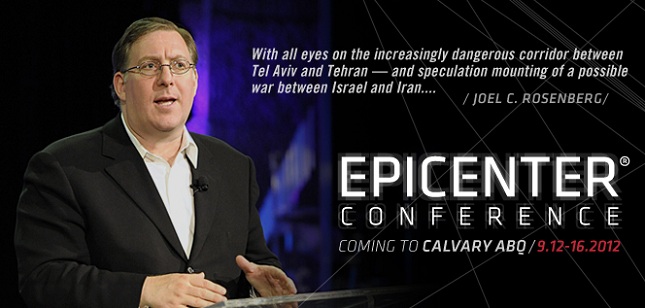
Thus the end times fiction and non-fiction author Joel Rosenberg, for instance, recently blogged a “sermon” in two posts [Rediscovering the power and purpose of Bible Prophecy: 1 and 2] about the importance of prophecy to an understanding of Middle Eastern affairs, noting:

Israel is the epicenter of God’s plan and purpose in the last days. Other countries mentioned in Bible prophecy are Russia, Iran, Syria, Lebanon, Turkey, Libya, Sudan, the revived Roman empire, and several others. The United States, however, is never mentioned directly or specifically in the Bible. In my recent book, Implosion, I go into this in greater detail. But the bottom line is that even though America is the wealthiest and most powerful nation on the face of the earth in the history of mankind, the Bible does not describe a specific role for us in the last days. Something, therefore, apparently happens to neutralize us or paralyze from played a key role in the events that lead to the return of Christ.

Despite this lack of emphasis on the Unites States, he followed these two posts up with a post titled Troubling development: rift between White House & Israel growing as threat of war rises:

In recent days, anyone watching U.S.-Israel relations has seen a very troubling development: the already serious rift between the current White House and Israel is growing. The relationship between President Obama and Prime Minister Netanyahu has been strained for nearly four years. But as the threat of war between Israel and Iran this fall continues to rise, the Obama administration seems to be intentionally signaling a growing distance from the Netanyahu government.

He doesn’t draw a direct link to prophecy in this particular post, but he does close with this prayer:

Please pray for the Lord to change the heart of President Obama and his advisors, and that they would change course and truly and publicly stand firmly with Israel, our most faithful ally in all of the epicenter. As we read in Genesis 12:1-3, God promises to bless those who bless Israel, and curse those who curse Israel. With America facing a growing risk of economic and moral implosion, now is certainly not the time to turn our backs on Israel.

**

As usual, my interest is in nuance — so I’d just like to say that from a purely Biblical point of view, it is by no means out of the question for believers to disagree with the kings and rulers of Israel. Indeed, Rav Moshe Taragin, writing in the Virtual Beit Midrash of Yeshivat Har Etzion, hardly a bastion of anti-Israeli sentiment, goes so far as to say:

In general, the function of the prophet is to rebuke the nation, to expose its negative traits and to help the people improve their behavior. As the Rambam teaches (Hilkhot Teshuva 4:2): “Thus, all the prophets rebuked Israel so that they would repent.”

Just because someone rebukes Israel doesn’t mean they don’t bless her…

**

I addressed a question to my Christian friends on Twitter the other day, using the Iraq war as my example — but it applies to the current face-off between Israel and Iran, too:

If you and I disagree on, say, the Iraq war now, will one of us have to change his or her mind in heaven?

I added that my question was not about the Iraq war as such, but about our certainties when so many of our certainties differ.

My friend Mike Sellers responded with this admirable quote — which as he pointed out is often attributed to St Augustine (for more on its origins, try Wikipedia):

In things necessary, unity, in things doubtful, liberty, in all things, charity.


Switch to our mobile site