It is going to be a very large post with a multitude of pictures and links to presenters, Boydian papers and sites of interest.
Unfortunately, it is taking far more time than I would like given my awesomely craptacular personal and professional schedule. But I think it will be a better read if it is done right; the peeps who made the conference possible largely did so gratis – the least they deserve is some blogospheric recognition and link traffic.
I will link to other posts as they emerge.
By the way, California may be the location of the next Boyd and Beyond. Just FYI.
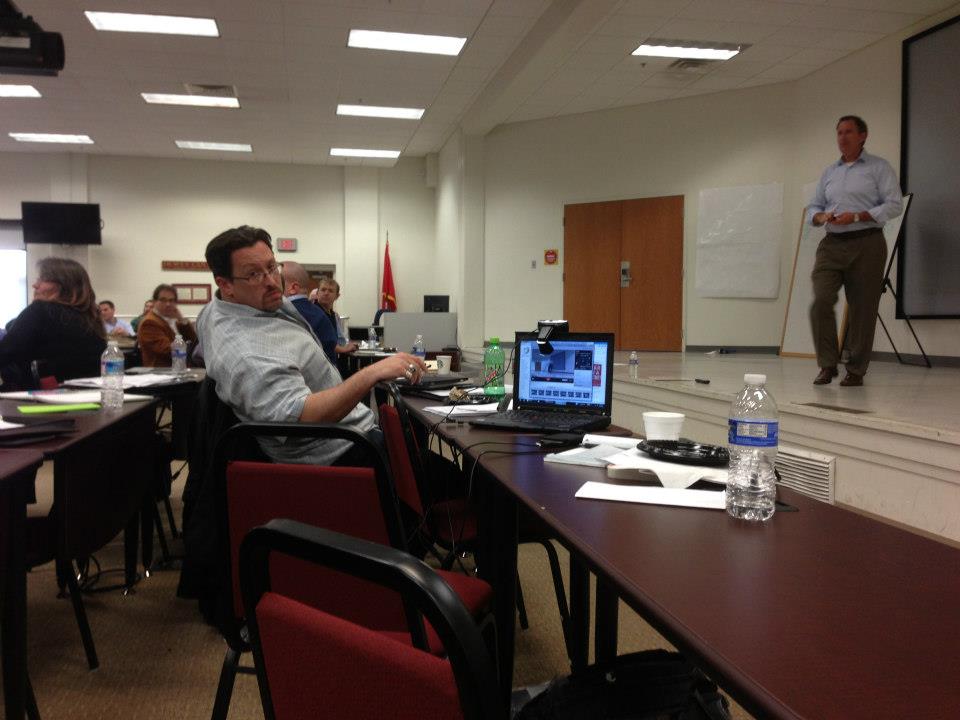
For the third consecutive year, Boyd and Beyond was held at Quantico, Virginia. This year we had a record turn-out, approaching 100 on Saturday. In fact, had we had 138 total RSVPs, and many had to cancel at the last minute. This year we were missing our traditional “law enforcement” contingent, but added speakers from areas not traditionally associated with Boydian thoughts and methods, most notably NGOs and humanitarian relief organizations and web design/marketing. Mary Ellen Boyd, one of John Boyd’s daughters, joined us for both days, and her active participation, for me, was a true highlight of the event.
Zenpundit is writing a more exhaustive post, so what I plan to share are a few highlights and will not cover all presenters:
Chet Richards, author of Certain to Win, a close associate of Boyd and the only person authorized to give Boyd’s presentations, gave a one hour talk on Boyd’s Conceptual Spiral and The Meaning of Life. Chet was kind enough to include the paper he delivered on his website Fast Transients. The paper is a fascinating exposition into “how” Boyd’s ideas developed, and the circumstances surrounding the evolution of his presentations.
Terry Barnhart, who has a new book out, Creating a Lean R&D System, walked the audience through the development of an A3, a tool used in Lean problem identification and solution, and sourced from John Shook’s Managing to Learn. Terry’s passion and depth of knowledge have been a benefit at each Boyd and Beyond event since 2010, and this year was no exception.
The remaining speakers were first-timers in both attendance and speaking…..
[ by Charles Cameron — silos, motorcycles, zen and the DNI ]
.
.
Pam Benson writing at the CNN Security blog may or may not have had anything to do with the title of her post, Spy chief gets Zen, but she’s presumably responsible for her first paragraph:
You usually don’t associate spying with being Zen, but that’s exactly what the nation’s chief intelligence officer did this week at an intelligence gathering in Orlando, Florida.
Here at Zenpundit we’re naturally prone to both Zen and Punditry, so we like that — but to be honest it’s a little over the top. I’m dropping his entire keynote in at the bottom of this post, but for now let’s just say instead that DNI James R Clapper gets bikers.
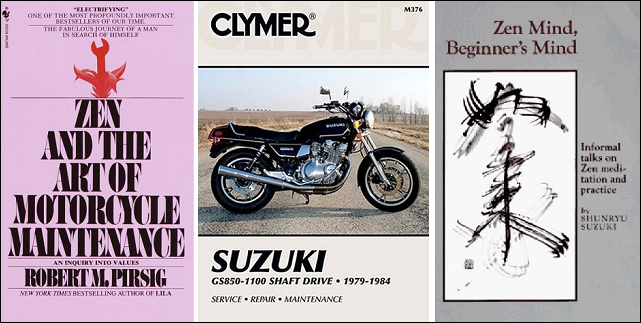
Okay, maybe we can go a little further, and say he gets Zen and the Art of Motorcycle Maintenance. That’s not quite Zen, but it’s getting closer. Kristin Quinn‘s piece at Trajectory magazine is titled GEOINT 2012: Zen and the Art of Intelligence, which at least pays hommage to Pirsig’s book, and focuses on Pirsig-zen as it applies to Intelligence…
And that’s a direction we can applaud.
Two questions, then: what is zen, and what is intelligence?
**
Zen is, strictly speaking:
A direct transmission outside the Scriptures,
Not dependent on words and letters,
Directly pointing to one’s own mind
Seeing into one’s own nature.
Those words, however, are something of a scripture, so the transmission isn’t in them — it’s one of those things like ceaseless change, always there, never the same, flexible beyond the capacity of words to capture it — as Laozi remarked at the start of the Dao De Jing, in scribbled response to a border guard who demanded that his scriptures be verbal — “dao ke dao, fei chang dao” — two Chinese phrases English can barely translate.
Where do we go from here, then, if we’re accustomed to think in words?
The zen master Shunryu Suzuki Roshi has one answer in the title of his book Zen Mind, Beginner’s Mind.
Zen takes you back to where your mind is fresh and playful, before it got narrow-minded, siloed and rutted. Zen means wide-angle alertness, from a point prior to preference, assumption and prejudice.
Zen takes your thoughts and emotions to the laundry, while you take a shower. They come back lighter and cleaner, and you’re freshened up and ready to go.
**
Let me put that another way, using the analogy of Google glasses. Zen takes you behind words: you can still see them, you can see through them. Very quickly, then, since 5 images are worth 5,000 words and take a lot less time to ingest:
Wearing some futuristic Google Glasses, you would be able to…
Let your glasses know you want to go to the Strand Bookstore (great idea, btw!):
Get yourself a quick map from there to here, visible but superposed on your natural ability to see the street:
Know when you’ve arrived at the bookstore (a) because you can see the books and (b) because your glasses tell you so.
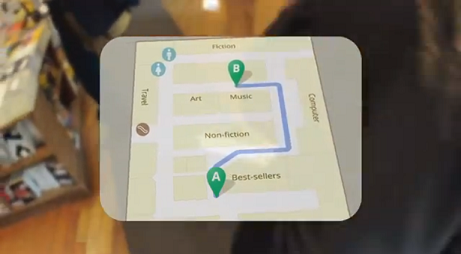
Use a map to navigate to the Music section:
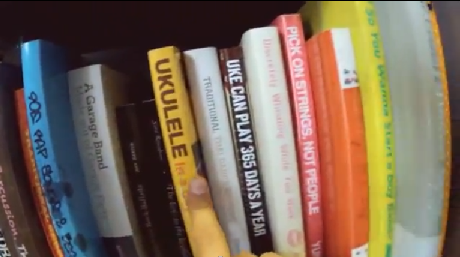
And locate the Ukulele shelf:
When IMO you’d be better off reading about Johann Sebastian Bach — though that’s a matter of personal taste.
With zen, your thoughts and emotions are like head- and heart-mounted displays — you can see them, they can inform your understanding, but you can also see through them, they’re transparent. You can see the world.
**
I’m going to suggest my own definition of intelligence: it’s the ability, given some data point or points, to recognize a variety of salient patterns into which it or they fit, and to create a synthetic understanding of how to move, given that all those salient pattern-fields are in play.
It is seeing in depth, past the surface, where the surface is your assumptions and expectations, and depth is the currents and undercurrents of nuance that your expectations hide.
Let me say that another way: assumptions and preferences — taking sides, being on a team — deprive you of depth. And another: the opposite of surface / superficial thinking is depthful thinking / pattern-recognition.
That, in a nutshell, is why I feel intelligence and zen “go together” even more seamlessly than zen and bikers.
**
Here’s Clapper’s speech:
**
In a future post, I hope to tackle the question of koans — those strange zen riddles, of which the best known may be…
[ by Charles Cameron — comparative images, Russian and British, with videos of Sunday’s Occupy-related protest during Evensong at St Paul’s in London ]
.
By way of contrast with the bright balaclavas of the Pussy Riot grrls, the British protesters wore white, and chained themselves to the pulpit steps during the Sunday service of Evensong.
**
Here’s a short video featuring the way St Paul’s integrates their protest into a ceremonial procession, so that it’s just a little odd in about the same way that Elton John playing piano during a service in the same cathedral is just a little odd.
Or let’s just say, eccentric… British.
Here’s the 30-minute official St Paul’s version, including the sermon, some muffled protester voices, and some blasts from the great cathedral organ…
.
**
Essentially, the protesters get co-opted by the clerics — with an offer of a little chat, probably over a cuppa tea, to follow…
At theBoyd & Beyond 2012 Conference, one of the people I had the pleasure of meeting was British political consultant Chris Cox, who blogs at Campaign Reboot. Chris not only a presenter at the conference, he was first out with a review of the proceedings too.
In terms of the event itself, I need to put it in the context that I found it. I know about 3 people who I can mention John Boyd to and have them know who I mean, so coming to the conference was special in and of itself. It was also gratifying to meet some other Brits there, JB and Michael Moore, who both spoke on their specific areas of expertise. Having so many people there who have immersed themselves in the concepts was hugely exciting.
The calibre of all the speakers was extremely high and the range of topics as diverse as could be expected. It was particularly good to have so many Marine speakers in attendance, since for a civilian it’s sometimes hard to conceive of how Boyd’s ideas get used in the military context. I don’t want to call out particular speakers as being better than others. Some were more resonant to me but all had a perspective which was interesting and valuable.
Getting to visit the Boyd archives was also a very special experience, and Mary Ellen Boyd was kind enough to take the time to talk to some of us about her father on a more personal level. I now have a copy of a hand drawn version of the OODA loop which we found in a draft of one of Boyd’s presentations. I also received audio copies of various of Boyd’s briefings which I can’t wait to listen to when I’m back in the UK.
Overall I felt the strength of the event wasn’t in the questions that it answered, but in the questions that it raised. It’s easy to become navel gazing when you’re coming up with ideas in isolation, and I don’t think anyone who spoke got away without someone asking a sharp question or two which challenged what they were saying. I know from my own experience that I need to go back to the drawing board.
Although the focus of the conference is on Boyd there was healthy discussion of ideas which are only loosely connected to Boyd, or are implementations of his ideas which could not be predicted. It’s a chaotic field, which I imagine is how Boyd would have wanted it to be, with people spinning off his ideas to unexpected places.
Zenpundit is a blog dedicated to exploring the intersections of foreign policy, history, military theory, national security,strategic thinking, futurism, cognition and a number of other esoteric pursuits.