zenpundit.com » 2013

Archive for 2013

Myanmar between Woolwich and Al-Aqsa 1: interfaith hatred

Wednesday, October 23rd, 2013

[ by Charles Cameron — in which jihadis take on Jews, Christians, Muslims and Buddhists, quite an interfaith haul for hatred ]
.

Aaron Zelin at Jihadology posted an hour-long video entitled Woolwich Attack a week or so ago, and I found it particularly interesting on two accounts: first, that it makes a multi-faith attack that includes Buddhism in its catalogue of enemies of Islam, and second, that it uses an innovative feature of modern digital typography. Here, I’ll concentrate on the first. Here’s the video’s title:

**

Christianity as a target is well represented in the form of Dr Justin Welby, the recently-appointed Archbishop of Canterbury:

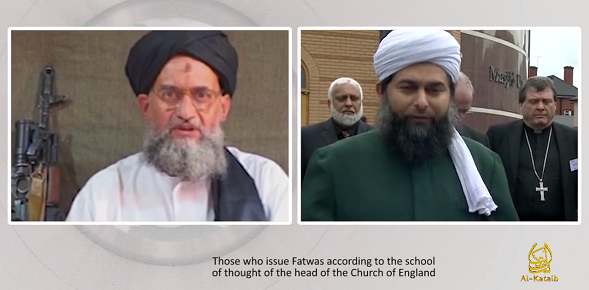
Notice also the lower of these two screengrabs, this one showing Ayman al-Zawahiri (left) berating a leading Muslim spokesman in the UK, Ibrahim Mogra of the Muslim Council of Britain (right), for speaking at the same event as the Archbishop. The damning subtitle suggests he’s one of those “who issue Fatwas according to the school of thought of the head of the Church of England”.

**

It wasn’t the attack on Christians or fellow Muslims that caught my eye, though, but the unexpected presence of the monk Wirathu, the rhetorical leader of Myanmar’s recent Buddhist rioting against Burmese Muslims. I’d seen his face on Time magazine and elsewhere, but it came as a bit of a shock here in a jihadist video — I’d filed him and his 969 movement under “Buddhism” rather than “Islam” in my mental listing of violent movements with religious underpinnings.

Ugly, ugly.

**

Finally, no invitation to jihad these days is complete without its mention of the al-Aqsa mosque and Jerusalem — and it is here that Judaism comes in for attack. Consider these two screengrabs:


**

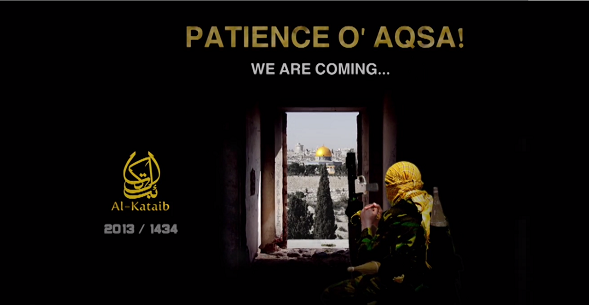
The video closes, significantly, with a long shot of the Dome of the Rock through a window…
Yesterday my friend William Benzon made a post titled On Describing a Painting which began:

Harvard art historian Jennifer Roberts bills her article thus: The Power of Patience: Teaching students the value of deceleration and immersive attention. OK. But I take a different lesson from it, one about one of my current hobby horses: description. Roberts focuses on an 18th Century painting by John Singleton Copley, A Boy with a Flying Squirrel. Her point is that the more you look at the painting, the more you notice and hence the more you can note in a written description. She asks her students to spend a full three hours with a single painting.

Of her own experience with that painting she observes:

It took me nine minutes to notice that the shape of the boy’s ear precisely echoes that of the ruff along the squirrel’s belly—and that Copley was making some kind of connection between the animal and the human body and the sensory capacities of each. It was 21 minutes before I registered the fact that the fingers holding the chain exactly span the diameter of the water glass beneath them. It took a good 45 minutes before I realized that the seemingly random folds and wrinkles in the background curtain are actually perfect copies of the shapes of the boy’s ear and eye, as if Copley had imagined those sensory organs distributing or imprinting themselves on the surface behind him. And so on.

She begins her next paragraph: “What this exercise shows students is that just because you have looked at something doesn’t mean that you have seen it.”

Looking at that final screengrab with this in mind, I see a close correlation between the golden Dome that focuses our attention on the Noble Sanctuary / Temple Mount, and the round, yellow-gold keffiyeh of the jihadist observing it through his window — “making some kind of connection between” them, to echo the words of Harvard’s Elizabeth Cary Agassiz Professor of the Humanities…

It’s a skilled and meaning-filled use of the medium.

**

In my second post in this series, I’ll point to a significant development in graphics and technology introduced in this video.

Ruminating…..

Tuesday, October 22nd, 2013

[by Mark Safranski, a.k.a. “zen“]

Busy writing a book review for Pragati Magazine that should be published on Friday. In lieu of a post, I wanted to make a few completely disconnected observations.

First, Charles Cameron in his recent post on Pattern Recognition had a link to an interesting paper, “Outline of a Psychology of War”, that I did not want readers to miss.

Secondly, there is a bitterly apoplectic piece on The Tea Party and National Security by conservative defense intellectual Dov Zakheim that should stir some debate.

In a move that meshes the paranoid control-freakishness of some senior military leaders, penny-wise and pound-foolish military budget cutting, a political desire to outsource futurism to crony capitalists like Goldman Sachs, and the zealous intolerance of the administration’s “Chicago wing” for dissenting opinions or even informed advice – creeping apparatchiks in the Obama administration have their knives out for Andrew Marshall and the Office of Net Assessment.

This is the Joint Chiefs  intellectual equivalent of the longstanding USAF desire to kill the A-10. Seldom am I in complete agreement with The Lexington Institute but on this issue they are correct.

Readers can sound off on these or any issues they wish in the comments…….


DoubleBurn: mosque and synagogue

Sunday, October 20th, 2013

[ by Charles Cameron — tipping my hat to a moving interfaith gesture ]
.

This past Wednesday, a person or persons unknown torched a mosque in Gdansk, Poland, known to me as the place where Lech Walesa founded the Solidarnosc movement.

Thankfully, the physical damage doesn’t appear to have been complete [upper panel, below]:

What brings this particular event to our attention is the response from the city’s Jewish community [lower panel, above: an image of a current Gdansk synagogue].

The Jewish Telegraphic Agency [JTA] gives us the story:

Polish Jews say mosque torching reminiscent of Kristallnacht

Representatives of the Jewish community of Gdansk, Poland, said the torching of a mosque had “frightening connotations” of the Nazi-inspired Kristallnacht pogroms against Jews.

The association was inescapable, three of the city’s Jewish leaders wrote in a statement Thursday.

“On the eve of the 75th anniversary of Kristallnacht, during which synagogues were burned in the Free City of Gdansk, the burning of the mosque must bear frightening connotations,” the statement said.

Unidentified individuals started the fire early Wednesday morning. It consumed the mosque’s door and some of the equipment, resulting in damages to the tune of $16,000.

“In the face of this cowardly act of barbarism, Jews of Gdansk cannot stand idly by,” wrote the authors of the statement, Michal Samet, Michal Rucki and Mieczyslaw Abramowicz. “We express our deep indignation against the attack on the temple and the sadness of the fact that it took place in Gdansk.”

**

An echo in time.

A powerful analogy, deeply felt.

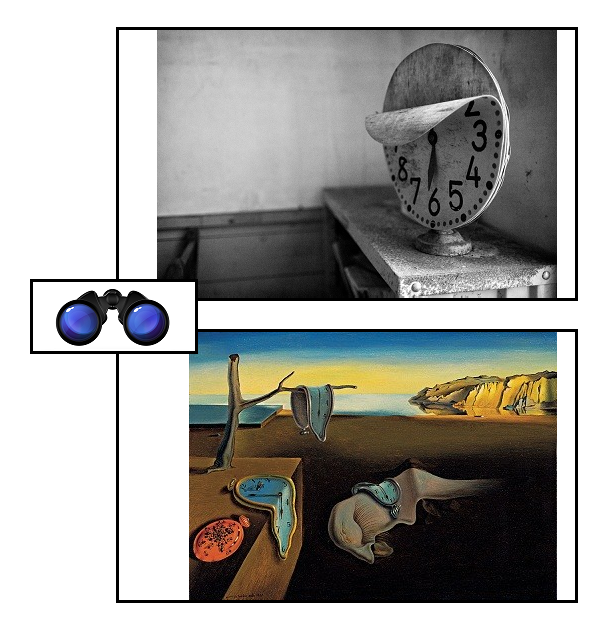
Sunday surprise 9: surreal art imitates real life?

Sunday, October 20th, 2013

[ by Charles Cameron — my semi-official idiocy to cap the week ]
.

Here, surreal art imitates real life — ahead of time, and or much later.

**

Sources:

  • Tokyo Times, An abandoned and atmospheric Japanese school in the mountains
  • Salvador Dali, The Persistence of Memory

  • A tip of the hat to Bryan Alexander of Infcult
  • **

    Footnote:

    Time itself is a curious business, and the question of its “reality” comes up from time to time. Physicist Sean Carroll talked about it a while back on the pompously named Closer to Truth series, and makes some interesting points. I have to say, though, that I wasn’t overwhelmed — Carroll may be the equivalent of Hawking when it comes to physics, but the equivalent of Wittgenstein when it comes to philosophy he has yet to prove himself.

    But then of course we have never seen Wittgenstein talking off the cuff on YouTube: my sense is that this was a wise decision on his part — although many of the slips of paper on which he typed the aphorisms that go to make up his Zettel might well have been Tweeted, give or take a century.

    Twitter’s immense fan-base does include thousands — and likely hundreds of thousands — of folks who would follow a Witty Wittgenstein twitter-feed among it’s half-billion (2012 estimate) users if wittgenstein were alive and tweeting… Indeed, the entirely posthumous Wittgenstein Tweets feed has more than 4,000 followers, and you might care to join them — although the quotes in the tweets are more than 60 years old at time of tweeting. My own preference for a philosophical feed, btw, runs to Kim Kierkegaardashian.

    But it’s Sunday, we were talking surrealism, and I digress.

    Pattern recognition: backlash

    Sunday, October 20th, 2013

    [ by Charles Cameron — on human obstinacy, a change of heart, and what seems to me a major piece from Res Militaris ]
    .

    There’s a pattern of backlash that occurs when you present people with facts that don’t fit their preconceptions — they don’t switch, they double up. Here’s the opening of io9‘s report, The Backfire Effect shows why you can’t use facts to win an argument:

    “Never let the facts get in the way of a good story” isn’t just a maxim for shady politicians and journalists. It’s also the way people often live their lives. One study indicates that there may even be a “backfire effect,” which happens when you show people facts that contradict their opinions.

    Then there’s a study — Brendan and Jason Reifler, When Corrections Fail: The persistence of political misperceptions. I won’t go into the details, it’s the pattern it finds that’s of interest to me, but I will note that the title is a tip of the hat to Leon Festinger‘s When Prophecy Fails, a classic study in the same pattern of denial as it applied to a group whose belief in an end time prophecy was not shattered when the day arrived and the world went on as usual…

    Here’s how the pattern works:

    Participants in the experiments were more likely to experience the Backfire Effect when they sensed that the contradictory information had come from a source that was hostile to their political views. But under a lot of conditions, the mere existence of contradictory facts made people more sure of themselves — or made them claim to be more sure.

    Everyone has experienced the frustration of bringing up pertinent facts, in the middle of an argument, and having those facts disregarded. Perhaps the big mistake was not arguing, but bringing up facts in the first place.

    Okay? That’s a veeery interesting pattern to think about any time you’re considering ways to persuade people to change their minds during, for instance, a CVE campaign.

    I’d like to dig into it a great deal more, of course.

    **

    Maajid Nawaz, a former recruiter for Hizb ut-Tahrir who renounced his membership and is now Chairman of the counter-extremist Quilliam Foundation, seems to have persuaded Tommy Robinson, until recently a leader of the English Defence League, to renounce the EDL and join Qulliam — a move whose results and second-order effects have yet to be seen. Both men, however, offer us examples of people who have in fact changed their minds on matters of profound belief, religious and political, and the odd uncomfortable fact may have played some role in those changes.

    The role of anomalies (cf. “outliers”) in Kuhn‘s The Structure of Scientific Revolutions comes to mind.

    And if showing people the error of their ways (a very loose equivalent of telling them unwelcome facts, I’ll admit) doesn’t work, here’s another anomaly that I ran across only yesterday, that “proves the rule” by, well, partially disproving it.

    Dutch ex-politician Arnoud van Doorn, previously a senior member of Geert Wilders‘ fiercely anti-Islamic party, has changed his mind — or his heart was changed for him, within him, depending on your perspective. He has made the Shahada and is henceforth Muslim himself. In this photo, van Doorn is performing the Hajj, the pilgrimage to circumambulate the Kaaba in Mecca:

    Do I detect a hint of enantiodromia here?

    **

    In closing, I would like to offer this link to an article in Res Militaris by Jean Baechler, titled Outlines of a psychology of war. It’s a weighty piece, as befits its grand sweep, and I believe it throws some light on the obstinacies of the mind to which this post is addressed.

    I tried excerpting it, but it appeared to me that each sentence in every paragraph in turn begged to be highlighted, approved, tweaked, questioned, or disagreed with, and I wound up feeling you should read it for yourselves. I’ll be very interested to see if it captures the attention of the ZP readership, and leads to a more extended discussion…


    Switch to our mobile site