zenpundit.com » 2013 » July

Archive for July, 2013

Those black banners / AQ flags, revisited

Tuesday, July 9th, 2013

[ by Charles Cameron — don’t let’s go overboard, eh? ]
.

I’d like to note up front that Liz Sly was talking about a pro-Morsi rally, and Leah very possibly about an anti-Morsi event…

In any case, these two tweets between them remind me that my own interpretation of “black banners” in terms of the army from Khorasan may well be due for retirement except when specifically indicated.

**

I’ve been writing here for a while about the black banners of Khorasan and their apocalyptic resonance, especially for those in Afghanistan and recruiting for AQ: today I’d like to suggest two qualifications.

The first is that there are a variety of black flags flown in various parts of the world for various purposes, and have been since the Prophet first flew his black flag, the Raya. It seems plausible that the Khorasan ahadith originated with the ‘Abbasids, in support of their own miltary activities, and certainly black banners taken together with those ahadith have been a powerful recruiting tool for AQ, as illuuminated in their respective books by Ali Soufan and Syed Saleem Shahzad.

But there are black flags and black flags, some plain black, some bearing the shahada, some with what looks to be a replica of the Prophet’s seal — and the one that is most commonly called “the Al-Qaida flag” is the one that originated with the Islamic State of Iraq — see Aaron Zelin‘s post on the matterr at al-Wasat. That post, btw, is likely the one that seeded my thoughts here.

My second point, then? A problem arises when we begin to think that any black flag seen, photographed, or reported in any Islamist context is “the AQ flag” — or indeed that any of the varieties of black flag reported hither and yon would qualify for that appellation.

In Iraq, the flag with seal, okay. A black flag with shahada in a Khorasan / Mahdist context — yes, and with Mahdist overtones. Otherwise — maybe, or maybe not so much.

So could we be a little more cautious, and more specific?

As for Cairo — I wasn’t there, and haven’t see a Liz Sly photo, so I don’t know which black flag or flags she saw. And yes, she was at a pro-Morsi rally. But as Leah notes, in recent days black flags have been less prominent, and Egyptian flags more in evidence — as indeed, this photo from an anti-Morsi rally on July 3 this year suggests:

If my guess is any good, then, black flags showing up in Egypt now presumably indicate MB or Islamist but not necessarily by any means AQ sympathies, while Egyptian flags would appear to indicate dissatisfaction with Morsi and his Islamist cohorts, combined with strong nationalist sentiment and pride.

**

Corrections, amplifications etc are welcome… This is a test post, really: a big question mark. I’ve an inquisitive mind to be sure — but as you’ll have seen in my previous post, I also admit to ignorance.

Oh —

And now I’m totally confused, too — El Cid just pointed me to Arch Enemy‘s Under Black Flags We March video. Eh?

Redux: I’d like to game an idea entering a mind

Tuesday, July 9th, 2013

[ by Charles Cameron — another angle on the whole idea of qualitative node-&-edge graphs for concept mapping ]
.

Image of a virus letting its DNA loose in a cell, from the Bjork app-game-song

The other day I found myself re-reading a comment I’d made on Zen’s post The Games People Play back in January 2008, which I’d been searching for in the back of my mind for months — too attic-like and cobwebbed, probably not the best place to look for it. In any case, now I’ve found it I’ve dusted it off and offer it here for your consideration:

**

Ideas can be infectious.  We know this, and thus we can explore the spread of ideas using models drawn from epidemiology, an approach which Malcolm Gladwell takes in his book Tipping Point. Ideas can also be viewed as existing in an ecosystem, and thus what we know of genetics can be applied to them, as Dawkins suggested in coining the term "meme". Having said that, I’d still like to game an idea entering a mind.

Specifically, I would like to game the way in which the idea that constitutes "martyrdom" (shahada) in an al-Qaida mind enters a mind that’s primed with the ideas of Tablighi Jamaat, for instance, and once it’s "in," conforms the idea of "obligation" (fard) that’s already present in TJ’s non-violent and apolitical version into the al-Q sense of the word — that "to kill the Americans and their allies — civilians and military — is an individual duty (fard ‘ayn) for every Muslim who can do it in any country in which it is possible to do it"… I’m thinking of something along the lines of the kind of research that allows someone to write, describing the John Cunningham virus (JCV):

the JC virus enters the central nervous system by fastening itself to the 5HT2AR receptor for serotonin, which is found on the surface of glial cells.  When this receptor for serotonin is triggered, it opens the pathway that allows the virus to enter the cell.

The thing is, we can manage a very brief verbal sketch of how an idea enters a mind and becomes part of a person’s "thinking" — and we can model in some detail the way that an idea spreads through a population — but we’re not very good at modeling, or gaming, thought processes.  And from my POV, that’s the most fascinating challenge of all.

My question is: what kind of game should this be, how do we set up the board, what markers shall we have for ideas or parts of ideas and for views or congregations of ideas, what rules do we need to use in combining them, etc — how do we get as close to a mental conversation as humanly possible?

I happen to think that meditators will have quite a bit to teach us here, that the Tibetans may have a better vantage point than we as a culture do… because they’ve been watching the mind, and in particular watching its various coiled springs uncoil, and putting the process into words, for longer than we have. But it will take a whole new series of aha!s to really figure this out.

**

The result wouldn’t look like the image at the top of this post — it might look more like a PERT chart, but with sequences of ideas rather than actions. And it would be based on narratives, not theories. Above all, it would be multi-voiced, polyphonic, fluid — like that diagram from Edward Tufte about the Ocean of Stories:

That’s it — what say you all?

The Bjork Virus video can be found here, the Virus app-game-song can apparently be downloaded here.

Egypt and the spider’s web

Tuesday, July 9th, 2013

[ by Charles Cameron — a short course in my own ignorance, plain, simple — and having to do with Egypt ]
.

.

Nathan Brown writes with humility (“I do not know what Egyptians should do”), and a lucidity that Lewis Carroll himself might admire in What’s Next in Egypt? A roadmap for backseat drivers:

Egyptian legal disputes could only have been diagrammed by M.C. Escher

And that, I’d say, is just the beginning of a very tangled web.

**

Spiders and dewdrops

Spiders and dewdrops do a pretty convincing job of portraying a certain level of complexity in this node-and-edge diagram of the global situation.

spider_web.jpg

When, say, Castro hands over power to his brother, or Musharraf has to give up control of the Pakistani army, it’s like snipping a couple of threads in that spiders web — and the droplets fall this way and that, carom into one another, the fine threads they’re on swing down and around until a new equilibrium is reached…

That’s something I wrote a while back, as you can see — but drop in a few different names and places, and it’s still good to go today.

**

I mean — can you imagine? Let’s use me for a guinea pig — or you can try it for yourself.

Mentally assign as many factors in the present situation as you can find to the various dewdrops on the spiders web — in such a way that cutting a given thread would nudge and budge, tear relationships apart and form new partnerships, until the whole thing settles into that new equilibrium — or even skip the Egyptian part, just imagine one of those threads snapping in the spider’s web itself, or a gust of wind shaking it, and the systemic shifts that would result…

Here, in full, are my own lab notes from that experiment:

**

Well, how about those better informed than I?

Morsi was living in Egypt, I’m not. Morsi speaks Arabic, I don’t. In addition to what anyone on the Cairene street might know, Morsi had access to whatever secrets could be derived from the Brotherhood apparatus, and from the Mukhabarat and sister services. He had a powerful position as President, and presumably preferred to keep it rather than going back to his old professorship at Cal State Northridge or languishing in Mubarak-like confinement.

He made his decisions with a view to aligning events in his favor. And voilà, he got what he not wanted.

I, of course, was not blinded by his particular lust for power, nor endowed with the perspective that researching and writing a dissertation on High-Temperature Electrical Conductivity and Defect Structure of Donor-Doped Al2O3 would give one… I just got dizzy at some point, wandered off and listened to Grimaud play Bach instead — but surely Morsi should have been able to figure out the future of Egypt, eh? Or Mubarak, perhaps? You’d have thought Mubarak at least must have had his finger on the pulse..

And Hilary Clinton? What with NSA hoovering, or better, dysoning up all the world’s communications, secret and otherwise, she must have seen both Mubarak’s fall and Morsi’s a mile off, eh? — and switched out Anne Patterson months ago, right? So we’d be well-placed for the turmoil that now ensues?

**

My sources for the DoubleQuote:

  • Steven Metz
  • Leah Farrall
  • And here, finally, for your consideration, is another tweet I liked:

    G’day, all.

    Of short stories and a dark sacrament

    Monday, July 8th, 2013

    [ by Charles Cameron — a powerful tale of “de-radicalization” as metanoia ]
    .

    Munir

    .

    Munir, by his own account, was drifting under the influence of various radical Muslim clerics, Abu Hamza al-Masri among them. One’s never too sure about the exactness of journo quotes, but here’s one media report to be going on with:

    “Look who I ended up with,” he said.
    “We had a fantastic relationship. It was a match made in heaven – his anger, my lack of self-esteem.
    “He wanted me to die on the battlefield.”

    It was, mashallah, not to be — Munir had a change of mind and heart, and now works to offer potentially susceptible British youth alternatives to the “al-Qaeda narrative”.

    Here is his story in two brief tweets:

    Sources:

  • Tweet 1: I once held a spoon
  • Tweet 2: That same spoon gouged
  • **

    That little double event — the holding of a spoon, the revelation of its invisible history — I am calling a dark sacrament. I draw the word “sacrament” my own theological background, but also from Joseba Zulaika‘s analysis of Basque terrorism in his fine book Basque Violence: Metaphor and Sacrament, wherein he quotes GB Ladner:

    The sacrament is altogether a very different kind of symbol: it not only signifies, but also effects what it symbolizes.

    I call this passing of the spoon a dark sacrament in two interwoven but opposite senses. The one who gave Munir the spoon intended it as a gesture making and marking a symbolic connection between Munir himself and its history, a gift of intensification in the dark religion of terror which calls on Islam for its justification.

    And yet it was also sacramental in another sense entirely from the one intended: it reached deep enough into that darkness to turn Munir himself towards the light — Islam rediscovered as the struggle of the soul to reorient from ignorance towards the Niche for Lights mentioned in the Verse of Light in the Qur’an, 24.35:

    God is the Light of the heavens and the earth; the likeness of His Light is as a niche wherein is a lamp (the lamp in a glass, the glass as it were a glittering star) kindled from a Blessed Tree, an olive that is neither of the East nor of the West whose oil wellnigh would shine, even if no fire touched it; Light upon Light; (God guides to His Light whom He will.) (And God strikes similitudes for men, and God has knowledge of everything.)

    Note those two last sentences: God strikes similitudes for men, so that each moment may be a signpost if we do but see it. And God guides to His Light whom He will.

    **

    Professional writers naturally have an affinity for all kinds of form, from the epic epic via the novel, novella, short story, sestina and sonnet to the haiku, and Twitter has unsurprisngly engaged their imaginations. Thus the New Yorker Fiction account, @NYerFiction, has been running a short story in tweets by Jennifer Eagan, while Teju Cole, more to my taste, has posted Seven short stories about drones in a tweet apiece.

    But those are prize-winning professional writers, which as far as I know Munir makes no claim to be: he is simply offering us his personal story, unvarnished — yet his effort effortlessly matches theirs. Here is a signal to myself and to the rest of us who try to understand radicalization, CVE and de-radicalization: that true epiphanies — sacramental signs, sacred moments — unleash a power into the system that no amount of calculation could predict.

    Mostly it’s religion, now and then it’s sports

    Sunday, July 7th, 2013

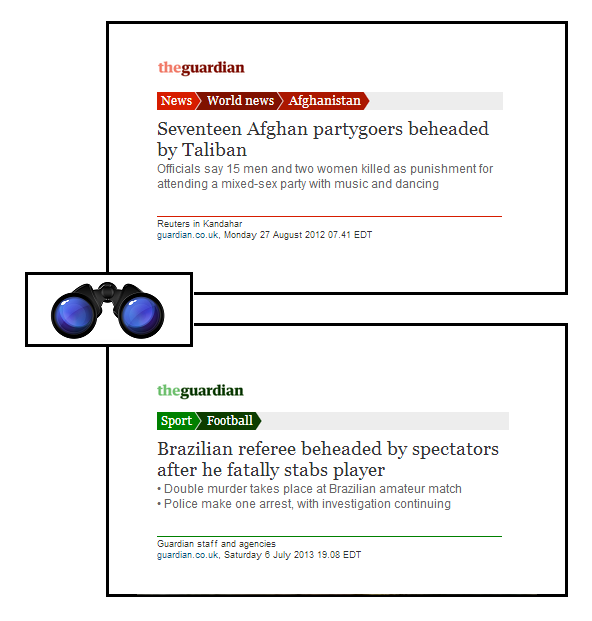
    [ by Charles Cameron — beheadings and the questions they raise ]
    .

    **

    Tim Furnish, friend of this blog, had a piece titled Beheading in the Name of Islam in the Middle East Quarterly back in 2005, in which he wrote:

    The February 2002 decapitation of Wall Street Journal reporter Daniel Pearl, true to its intention, horrified the Western audience. Chechen rebels, egged on by Islamist benefactors, had adopted the practice four years earlier, but the absence of widely broadcast videos limited the psychological impact of hostage decapitation. The Pearl murder and video catalyzed the resurgence of this historical Islamic practice. In Iraq, terrorists filmed the beheadings of Americans Nicholas Berg, Jack Hensley, and Eugene Armstrong. Other victims include Turks, an Egyptian, a Korean, Bulgarians, a British businessman, and a Nepalese. Scores of Iraqis, both Kurds and Arabs, have also fallen victim to Islamist terrorists’ knives. The new fad in terrorist brutality has extended to Saudi Arabia where Islamist terrorists murdered American businessman Paul Johnson, whose head was later discovered in a freezer in an Al-Qaeda hideout.

    For myself, convinced as I am that perceived, preached or proclaimed divine endorsement for such killings plays a major role in facilitating them, the existence of what are overtly at least non-religious examples of the same brutal behavior are valuable, albeit humanly distressing, for the questions they raise:

  • is the brutal behavior in question a bestial aspect of human nature in general, and religion merely a thin veneer with which it sometimes conveniently clothes itself?
  • or are sports in some way alternative modalities of group transcendence — and thus effectively religious in their essence?
  • **

    Bryan Alexander, another friend, comments today on a related story at his gothic-themed blog, Infocult, under the heading When sports fans attack, Russian remix.

    DoubleQuote Sources:

  • Seventeen Afghan partygoers beheaded
  • Brazilian referee beheaded

  • Switch to our mobile site