zenpundit.com » 2013 » August

Archive for August, 2013

Blessed are the conflict resolvers II: in dance and song

Monday, August 5th, 2013

[ by Charles Cameron — what can these two stunning performances tell us about conflict and / or peace? ]
.

I’m not sure if I’ve said it here before, but conflict resolution is pretty much the same as peace making, hence my title for both parts of this post, Blessed are the conflict resolvers (Matthew 5.9). In the second part of this post, I’d like to shared with you two stunning and highly stylized situations in which peace and conflict are brought together by sheer art.

Battle as dance, from Carlos Saura‘s Carmen — in the aftermath of a gambling disagreement, the jealous rivalry of two men over the young female lead bursts into violent dance:

And …

The battle of songs, from Breuer and Telson‘s Gospel at Colonus. Oedipus, played here by Clarence Fountain and the Blind Boys of Alabama, at the end of his days, wishes to enter the city of Colonus and find rest and the peace prophesied for him at last — the people of Colonus, knowing him accursed, try to resist him:

**

What can we learn from these two examples of conflict circumscribed within the parameters of art?

For comparison, here are two reports of the stylized Beating Retreat ceremony at the Wagah Border crossing, jointly performed each evening by the Indian Border Security Force and Pakistan Rangers and aptly described as a “synchronized display of stomps and shouts” — with some suggestive comments about the rivalry between the two nations in each.

From Michael Palin:

and from Voice of America:

Blessed are the conflict resolvers I: in three religions

Monday, August 5th, 2013

[ by Charles Cameronpeace making tells us that the goal of the activity is peace, conflict resolution tells us that this goal is not achieved in peace but on the field of conflict ]
.

Michael Lempert‘s book, Discipline and Debate: The Language of Violence in a Tibetan Buddhist Monastery, has a somewhat harsh take on the practice of debate in the education of Buddhist monks. The Introduction begins:

Buddhist ‘debate’ (rtsod pa), a twice-daily form of argumentation through which Tibetan monks learn philosophical doctrine, is loud and brash and agonistic. Monks who inhabit the challenger role punctuate their points with foot-stomps and piercing open-palmed hand-claps that explode in the direction of the seated defendant’s face. I was curious about the fate of this martial idiom in which monks wrangle, curious especially about its apparent disregard for ideals like nonviolence, compassion, and rights that Tibetans like the Dalai Lama have promoted…

For a more “nonviolent” view, see Daniel E. Perdue, Debate In Tibetan Buddhism — and by way of comparison, John Daido Loori‘s account of the Zen equivalent, Cave of Tigers: The Living Zen Practice of Dharma Combat

**

For a comparable Christian form of debate, we can turn to the writings of Peter Abelard, the medieval scholastic (educator and lover of Heloise) who introduced his book Sic et Non — “Yes and No” — in which he selected what are essentially DoubleQuotes from the Early Church Fathers, setting them one against another to display their seeming contradictions, with the following words:

In view of these considerations, I have ventured to bring together various dicta of the holy fathers, as they came to mind, and to formulate certain questions which were suggested by the seeming contradictions in the statements. These questions ought to serve to excite tender readers to a zealous inquiry into truth and so sharpen their wits. The master key of knowledge is, indeed, a persistent and frequent questioning. Aristotle, the most clear-sighted of all the philosophers, was desirous above all things else to arouse this questioning spirit, for in his Categories he exhorts a student as follows: “It may well be difficult to reach a positive conclusion in these matters unless they be frequently discussed. It is by no means fruitless to be doubtful on particular points.” By doubting we come to examine, and by examining we reach the truth.

**

The essence of both the above examples is conflict circumscribed, with the goal of enlightenment.

It’s my impression that Sura 49 verse 13 of the Qur’an implies a similar process, though here it is difference rather than conflict that is the starting point, and mutual understanding that is the goal:

O mankind, We have created you male and female, and appointed you races and tribes, that you may know one another. Surely the noblest among you in the sight of God is the most godfearing of you. God is All-knowing, All-aware.

That’s AJ Arberry‘s translation. Yusuf Ali‘s draws out more of the implications:

O mankind! We created you from a single (pair) of a male and a female, and made you into nations and tribes, that ye may know each other (not that ye may despise (each other). Verily the most honoured of you in the sight of Allah is (he who is) the most righteous of you. And Allah has full knowledge and is well acquainted (with all things).

**

In the second part of this post, I’ll present two extraordinary examples of conflict presented as art…

First impressions

Monday, August 5th, 2013

[ by Charles Cameron — how “first impressions count” applies to print media, an egregious case ]
.

Both panels (above) are screenshots from the same WaPo post, at the same magnitude. FYI.

Recommended Reading

Monday, August 5th, 2013

Top Billing! Adam Elkus –Banquo in Bandit Country 

One long, deadly night in an isolated outpost in a place few Americans could place on a map. A tragic turn of events and Americans dead. The headline could stand in for a dizzying number of places from the Horn of Africa to Afghanistan. So why Benghazi? Why has it stuck in the spotlight while the others have not?

Partisanship is a big reason. Like many post-Bush security debates, it’s easier to point fingers when the other guy is sitting in the Oval Office. But this doesn’t really begin to get to the bottom of the puzzle. The public has evinced little interest in Benghazi. The political press has mostly forgotten about it. So why do DC insiders fight so heavily over it? And why is CNN claiming in its latest scoop that the “CIA is involved in what one source calls an unprecedented attempt to keep the spy agency’s Benghazi secrets from ever leaking out?”

Benghazi is the Banquo’s Ghost of the post-Bush counterterrorism wars, a lingering symbol of a dangerous flaw within a consensus national security policy that many in Washington have convinced themselves is the way to fight the wars of future while avoiding a heavy ground presence. To be sure, the Macbeth analogy here is not a one-to-one mapping. The “ghost” here is a metaphor for the lingering specter of the disaster, its dead, and what the torching of the consulate represents for the indirect strategy. Like Banquo, the specter lingers during what should be a feast and time of celebration. But a review of the strategic landscape in the so-called “arc of conflict” reveals little to celebrate.

To understand why, it’s important to briefly review some parts of the Benghazi affair that have mostly escaped attention in the political obsession with tactical marginalia….

SWJ Blog  (Gian Gentile) Counterinsurgency: The Graduate Level of War or Pure Hokum?,   (Robert Bunker)-How Caribbean Organized Crime is Replacing the State and (William Olson) The Continuing Irrelevance of Clausewitz 

….This notion of counterinsurgency warfare requiring a special martial skill set because of its so-called difficulty that conventional armies by nature do not have is nothing new in modern history.  Starting in the 19th century, the French and British armies began to treat small wars (an earlier moniker for counterinsurgency) as a special form of war requiring officers with unconventional skills who can transform the hidebound conventional armies that were resistant to change.

Counterinsurgency experts, especially since the Vietnam War, have written histories of various cases of counterinsurgency warfare with the idea that a special form of war requires special skills as a foundational premise.  For example, in The Army and Vietnam, Andrew Krepinevich argues that the American Army lost the war because it could not break out of its conventional war mindset that focused on the abundant use of firepower instead of the correct and special methods of COIN designed to win hearts and minds.[3]

Unfortunately, counterinsurgency is not the graduate level of war, it is simply war.  Moreover, the notion that counterinsurgency wars require the soldiers who fight them to possess special skills is not supported by historical evidence.  And contrary to what writers like Krepinevich and Cassidy say, counterinsurgency wars have not been won or lost by the tactical methods of the armies that have fought them.  Instead, as historian Douglas Porch argues, they were won or lost “because the strategic context in which the wars were fought defied a tactical remedy.”[4] 

Pundita –You didn’t actually think Obama would let Greenwald testify to Congress about NSA, did you? and Let’s roll: Some legislators mount desperate campaign to save the U.S. republic 

Raúl goes on to speculate about other possible reasons for the President’s ploy. My take is that Obama had already lost face with Liberals over drone war and related issues. And I don’t think there is one genuine Leftist or civil libertarian in the world who has any illusions left about what Obama is.  

Yet it was the American Leftist, law professor and political scientist Stephen F. Diamond who alone pegged Obama during the Democratic presidential primary campaign in early 2008.  After studying Obama’s political career up to that point he said that Obama was no Leftist; that he was an authoritarian — although what specific type, he wouldn’t speculate at that early stage.  

“Isn’t that just like a Leftist,” I observed sarcastically at the time. “When one of their own turns out to be a monster they say, ‘Oh that’s not a real Leftist.'”  But I listened to Steve despite my grumbling, and made sure Pundita readers heard what he had to say.  I am very glad I did.

The American democracy may be strong enough to survive the Obama presidency, but there are many younger democracies that can count themselves lucky he wasn’t born there.

The secret origin of Doctrine Man!

Not the Singularity (Steve Hynd) – NSA Surveillance Didn’t Help Identify New Alleged Al Qaeda Threat and ( Matthew Elliot) – Weekend NSA Reader

BLACKFIVE – Brian Stann – The Dark Side of a Warrior 

Slightly East of New – Incestuous delusion

Dr. Tdaxp –Pimps, Hos, and When to Get Out of the Ghetto

Nick Carr – PRISM and the New Society

Bruce Schneier – XKeyscore and Scientists Banned from Revealing Details of Car-Security Hack 

Presentation Zen –Good science makes for good story 

Eric Drexler – Transforming the Material Basis of Civilization:

The Long Now Foundation blog – Language may be much older than previously thought

Aeon MagazineOut of the Deep 

Studies in IntelligenceIntelligence Officer’s Bookshelf

NRO Jeb’s Education Racket  

Democracy Journal – An Elite Deserving of the Name 

Reason – Thanks to NSA Surveillance, Americans Are More Worried About Civil Liberties Than Terrorism

Recommended Viewing:

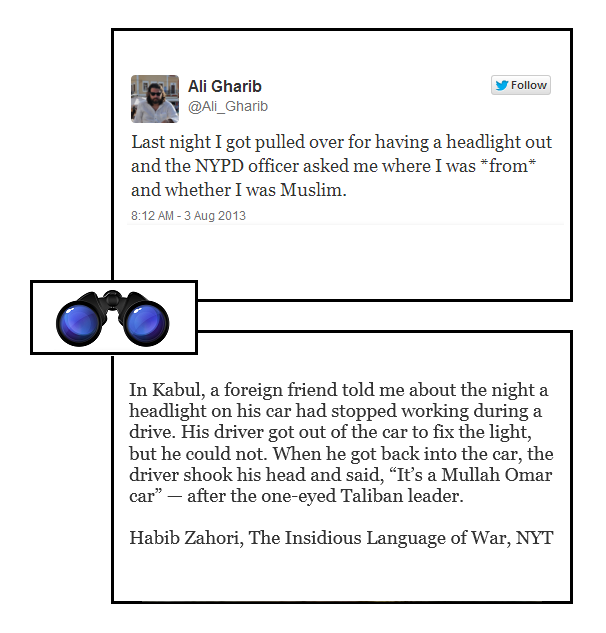
One-eyed: or suspecting Ali Gharib might just be the Dajjal…

Saturday, August 3rd, 2013

[ Charles Cameron — always on the lookout for signs of the dajjal — even in the New York Times ]
.

Seriously, WTF?

Are you Presbyterian?

**

I probably wouldn’t have take much notice of Ali Gharib’s tweet (upper panel, above) if I hadn’t just wandered off after reading a tweet from Habib Zahori:

to find out who he was, and run across his NYT piece, The Insidious Language of War, which looked interesting enough that I read it — leading me to the headlights quote (lower panel, above).

Okay, two one-eyed remarks in five minutes got me thinking…

**

But as you may know, by now my mind is fully stocked with what Coleridge in his Biographia Literaria calls the “hooks and eyes of memory” — so a broken headlight in Kabul and mention of the Mullah’s missing eye brought me naturally to the celebrated image of Mullah Omar (below, upper panel)

and thence (lower panel) to the Dajjal — Islam’s version of the Antichrist.

**

Thus, a sort of Six degrees of Kevin Bacon game brought me from a Daily Beast blogger via broken headlights to the Dajjal in three quick hops — and the result is what one might term a false positive

It was fun while it lasted — I just wonder how many times NYPD officers ask drivers “Are you Amish?” Maybe a horse and buggy on Fifth Avenue would somewhat justify so inquisitive an inquiry.

**

Sources:

  • Ali Gharib
  • Habib Zahori
  • Mullah Omar
  • Dajjal

  • Switch to our mobile site