Joas Wagemakers on al-Maqdisi & the Jordanian pilot negotiations
Friday, February 13th, 2015[ by Charles Cameron — it’s so awkward when the top jihadist scholar in your own lineage doesn’t like your caliphate or your behavior! ]
.
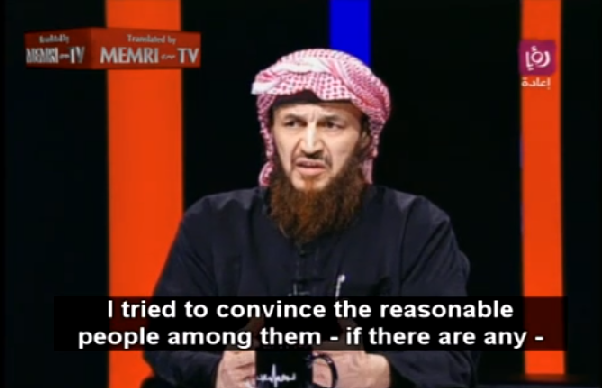
Maqdisi on Roya TV Jordan via MEMRI
**
In the Foreword to issue 7 of the IS magazine Dabiq, we find mention of Abu Muhammad al-Maqdisi, mentor of IS’ inspirational predecessor Abu Musab al-Zarqawi, along with a curious related footnote:
The Islamic State immediately requested for the release and transfer of Sajidah ar-Rishaw? – a mujahidah who was imprisoned by the Jordanian taghut for almost 10 years – to the lands of the Khilafah in exchange for Kenji Goto Jogo. The Jordanian regime recklessly complicated the process for the Japanese by attempting to include their pilot in the exchange deal, but the Khilafah explicitly refused such during the negotiations with the representative of the Jordanian taghut – ‘?sim T?hir al-Barqawi (AKA Abu Muhammad al-Maqdisi [1]) – as there were other plans for the murtadd pilot. In the end, both al-Barqawi’s murtadd client and the Japanese prisoner were executed due to the negligence of both regimes in heeding the warnings of the Islamic State.
Footnote 1: Perhaps Allah will facilitate a detailed exposure of how al-Barqawi (whose campaign of lies carries on) represented the Jordanian taghut in these negotiations.
**
Their prayers are answered. I’m not sure of the exact timings, but their prayers may have been answered before they were even asked — or at least, published.
Joas Wagemakers, author of the highly reputed study A Quietist Jihadi: The Ideology and Influence of Abu Muhammad al-Maqdisi, takes us behind the scenes. On Jihadica, he posted Maqdisi in the middle: An inside account of the secret negotiations to free a Jordanian pilot:
It’s that time of the year again: the well-known Jordanian radical Islamic ideologue Abu Muhammad al-Maqdisi is released from prison and speculation about why this happened and whether he cooperated with the Jordanian regime to get freed starts all over. I’ve commented on this before on Jihadica when he was released on a previous occasion and I’ve also briefly analysed his latest release in a Facebook post, so I won’t go into this here.
Wagemakers continues:
Much more interesting, however, are the recent statements al-Maqdisi has made on the execution of the Jordanian pilot Mu’adh al-Kasasiba, who had been captured by the Islamic State (IS) and was subsequently burned alive by them. These comments were made during a recent interview with al-Ru’ya, a Jordanian television channel, and a letter al-Maqdisi reportedly sent to IS’s leader, Abu Bakr al-Baghdadi. These give an inside account of the secret negotiations that have taken place to free al-Kasasiba and, as such, throw an altogether new light on them, showing that al-Maqdisi has likely been in the middle of this affair from the beginning.
Here, then, is a brief quote from that FB post on the point that Dabiq is interested in — the negotiations:
The well-known Jordanian Jihadi-Salafi scholar Abu Muhammad al-Maqdisi was released from prison last week and just gave an interview to the Al-Ru’ya channel in which he was asked to comment on the execution of the Jordanian pilot Mu’adh al-Kasasiba. He says that he tried to negotiate on the pilot’s behalf by writing letters to “influential” people within the Islamic State (IS), like its leader Abu Bakr al-Baghdadi, its official spokesman Abu Muhammad al-‘Adnani and one of its main scholars, Turki al-Bin’ali. He says he tried to get IS to accept the trade-off between al-Kasasiba and the imprisoned Sajida al-Rishawi. All of these efforts failed, however, despite – al-Maqdisi emphasises this – his numerous attempts and even though – he later adds – the major Jihadi-Salafi scholars all supported the mediation efforts with IS.
Returning to Jihadica, here are some key passages from Wagemarker’ post, which is worth reading in full:
It was first reported on 5 February that al-Maqdisi had been released from prison a week before. A day later, he gave an interview on Jordanian television in which he stated that as soon as he heard about the capture of the pilot Mu’adh al-Kasasiba, which was reported on 24 December 2014, he wrote letters to IS to try to get them to engage in a prisoner exchange, trading the pilot for Sajida al-Rishawi, an Iraqi woman who had been sentenced to death for her involvement in the 2005 Amman hotel bombings that were ordered by former Al-Qa’ida in Iraq leader Abu Mus’ab al-Zarqawi. The latter, of course, was a former student of al-Maqdisi’s when the two were still in Jordan together in the 1990s and is seen by IS today as the godfather of their organisation.
Al-Maqdisi claims to have contacted IS’s leader al-Baghdadi, the organisation’s official spokesman Abu Muhammad al-’Adnani and its “scholar-in-arms” Turki al-Bin’ali, who used to be very close to al-Maqdisi before their disagreements over the Islamic State and its policies arose. His efforts to have IS exchange al-Kasasiba for al-Rishawi didn’t work out, however, since it turned out that the pilot had already been executed a month before, in early January. In retaliation, Jordan executed al-Rishawi (and another, Ziyad al-Karbuli, an Iraqi radical Islamist on death row). This turn of affairs caused al-Maqdisi to feel he had been betrayed by IS, with whom he had apparently negotiated in good faith. In the interview, al-Maqdisi calls IS “liars” and scolds them for equating jihad with slaughter and killing, the latest example of which is burning the Jordanian pilot alive, which is not allowed according to sayings of the Prophet Muhammad, he says.
Then there’s the letter:
Given al-Maqdisi’s previous criticism of IS and his long-held belief that jihad should be kept free from “excesses”, such comments are to be expected and sound familiar. What we did not know before, however, was that al-Maqdisi – if his statements are to be believed – was involved in negotiating al-Kasasiba’s release from the beginning. In fact, if he did indeed start writing letters to IS right after he heard about the pilot’s capture, he must have been involved in this as early as late December 2014, about a month before he was released from prison. If true, this not only means that there is less of a direct connection between his efforts on al-Kasasiba’s behalf and his own release from prison, but also that al-Maqdisi may have had a central role in this entire saga.
This is confirmed by the letter al-Maqdisi allegedly wrote to al-Baghdadi and which was recently published on the internet (including by the Jordanian newspaper al-Ghad). The letter is dated “Rabi’ al-Awwal 1436?, which coincides with the period 23 December 2014-21 January 2015, meaning that – if truthful – al-Maqdisi did indeed start negotiating with IS before he was released, which is said to have happened on 29 January 2015. It was also around that time – and not in early January, let alone late December – that the media started reporting about IS’s demands to have Sajida al-Rishawi released in return for the Jordanian pilot. Since hardly anybody had heard of al-Rishawi, many people wondered why on earth IS was suddenly so interested in this person and why they wanted her released. Al-Maqdisi’s alleged letter shows, however, that we may have consistently looked at this from the wrong angle.
Wagemakers comments:
In the letter al-Maqdisi is supposed to have written to al-Baghdadi, he never seems concerned with the fate of the Jordanian pilot at all. Citing the Prophet Muhammad and the 14th-century Muslim scholar Ibn Kathir, he states that it is a Muslim’s duty to free those who are suffering (either from imprisonment or otherwise), but does not refer to the pilot when saying this. On the contrary, he states that it is imperative that al-Baghdadi works towards releasing al-Rishawi. He emphasises that she is their Muslim sister, a close associate of al-Zarqawi’s and a mujahida, a female jihad fighter, for whom al-Baghdadi is responsible. Al-Maqdisi claims that al-Zarqawi himself had wanted to free her but was killed before he was able to. It now fell on al-Baghdadi, as al-Zarqawi’s successor, to finish what the latter couldn’t and free al-Rishawi. The key to this – as al-Maqdisi states repeatedly in his letter – is in al-Baghdadi’s hands: the Jordanian pilot Mu’adh al-Kasasiba.
If this letter is to be believed, al-Maqdisi thus wrote to al-Baghdadi to have al-Rishawi released and saw the capture (and possible exchange) of the Jordanian pilot as a golden opportunity to achieve this. IS’s interest in al-Rishawi thus appears to have come not so much from any specific desire on their part to have her back, but much more from al-Maqdisi’s wish to see her released. In fact, if al-Maqdisi had not brought up al-Rishawi’s name in his supposed letter to al-Baghdadi, we might never have heard of her at all. This means that while many of us were looking for ways to explain IS’s interest in this obscure woman, we should perhaps have looked at al-Maqdisi instead.
After some further discussion, Wagemakers offers confirmation of the letter’s provenance and authenticity:
The above is confirmed by a document written by Abu l-’Izz al-Najdi, a presumably Saudi member of the Shari’a Council of al-Maqdisi’s website, who provides details of the negotiations taking place between al-Maqdisi and IS. He confirms the authenticity of al-Maqdisi’s letter and, given that al-Najdi’s document is posted on al-Maqdisi’s website, we may assume that the latter does so too. He also confirms that the Jordanian pilot was an apostate in al-Maqdisi’s eyes, but that an Islamically legitimate purpose could be served by setting him free because it would cause the Jordanian regime to release al-Rishawi. That it didn’t happen this way is, al-Najdi writes, ultimately IS’s fault and he therefore holds that organisation responsible for al-Rishawi’s death, as does al-Maqdisi.
Al-Najdi writes that while al-Maqdisi was engaged in negotiating al-Rishawi’s release with IS, the latter’s spokesman, Abu Muhammad al-’Adnani, didn’t even mention her in his audio messages to show that he cared about her. Al-Maqdisi, however, encouraged other jihadis to “send [letters] and put pressure on all those in IS in whom a remnant of good remains in order to rescue their sister Sajida [al-Rishawi]“, al-Najdi writes. A man named Abu Mahmud al-Mawsili eventually came to the fore, claiming to be a prominent member of IS who could mediate between al-Maqdisi and al-Baghdadi to get al-Rishawi released. This, al-Najdi writes, was “the first clear lie” since “it was confirmed to [al-Maqdisi] from week one that the pilot had already been killed, based on information that reached him from inside Iraq and Syria”. The mediator al-Mawsili said that this was a lie, however, and swore he was serious about this prisoner exchange. He also swore that the pilot was still alive, al-Najdi writes. Al-Maqdisi, unwilling to accept that a mujahid would lie about this, believed him.
**
There’s more, including al-Maqdisi’s critique of IS in its behavior and in its claim to the title of caliphate — both of which al-Maqdisi disputes in no undertain terms.
From the transcribed TV interview:
These people invented many bad practices. The first practice they invented – which they attributed to the Prophet Muhammad – was the public slaughtering of people. They slaughter their rivals, including several leaders and mujahideen in Syria.
People started to believe that slaughtering people was the Prophet’s norm. They cite the hadith: “Oh people of Quraysh, I have brought slaughter upon you.” The Prophet said this when these people mocked him. What they forget to mention is how the Prophet treated the people of Quraysh when he eventually captured them. Didn’t he say to hundreds of them that they were free to go? This way, he turned them from enemies into followers.
They ignore that and cite one thing that the Prophet said when he was mocked, and turn the slaughtering into a habitual practice of the Prophet. They have painted Islam, the Jihadi movement, and the mujahideen in red. They have made people think that Jihad can be waged only by killing and slaughter. [ .. ]
Then they came up with the practice of immolation. People will now follow them in this
practice. Immolation?! The Prophet Muhammad said: “Only the Lord of Fire torments with
fire.” They cite one quote by Ibn Taymiyyah, severing it from what precedes it and what
follows it. They give Ibn Taymiyyah precedence over the Prophet Muhammad.
and:
If someone purports to have a caliphate but cannot provide the fruits of a caliphate, he leads the Muslims to dispersal. They have presented Islam in the image of slaughter and immolation. [ .. ]
Until yesterday, you were Baathists, torturing and killing Muslims, and today, you are leaders in the Caliphate?! What kind of a caliphate is this? [ .. ]
These people have distorted the image of the Jihadi movement. They have caused great
harm. They invent something new every day. First it was slaughter and now immolation. Let me tell you, this has nothing to do with Islam. Jihadi salafism has nothing whatsoever to do with this.
**
For further news on Dabiq issue 7, see New issue of ‘Dabiq’ features interview with widow of Paris gunmen today on LWJ.




