zenpundit.com » 2016

Archive for 2016

It is the Nine Eleven Century

Sunday, September 11th, 2016

[by Mark Safranski / “zen“]

Thomas Wade, long time ZP reader reminded me this morning of the post I wrote on the 10th anniversary of September 11. If anything the world has changed for the worse. Will we change course?

I don’t know.

The Nine Eleven Century?
nineleven2.jpg

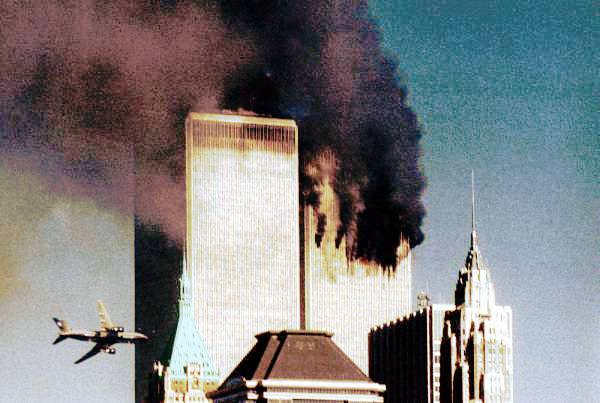
Ten years ago to this day, almost to the hour of which I am writing, commercial jetliners were highjacked by al Qaida teams armed with boxcutters, under the direction of Mohammed Atta, were flown into the towers of the World Trade Center and the Pentagon. A fourth plane, United Airlines Flight 93, believed to be headed to the US Capitol building, crashed in Pennsylvania when passengers led by Todd Beamer heroically attempted to stop the highjackers. The whole world watched – most with horror but some with public glee – on live television as people jumped out of smoke-engulfed windows, holding hands, to their deaths. Then, the towers fell.

From this day flowed terrible consequences that are still unfolding like the rippling shockwave of a bomb.

We look back, sometimes on the History Channel or some other educational program, at the grainy, too fast moving, sepia motion pictures of the start of World War I. The crowds wildly cheered troops with strangely antiquarian uniforms that looked reminiscent of Napoleon’s day, march proudly off to the war that gave Europe the Somme, Gallipoli, Passchendaele and Verdun. And the Russian Revolution.

After the armistice, the victors had a brief chance to reset the geopolitical, strategic and economic patterns the war had wrought and in which they were enmeshed. The statesmen could not rise to that occasion, failing so badly that it was understood even at the time, by John Maynard Keynes and many others, that things were being made worse. World War I. became the historical template for the short but infinitely bloody 20th century of 1914-1991, which historians in future centuries may simply describe as “the long war” or a “civil war of western civilization”.

There is a serious danger, in my view, of September 11 becoming such a template for the 21st century and for the United States.

On the tenth anniversary of 9/11, as we remember the fallen and the many members of the armed services of the United States who have served for ten years of war, heroically, at great sacrifice and seldom with complaint, we also need to recall that we should not move through history as sleepwalkers. We owe it to our veterans and to ourselves not to continue to blindly walk the path of the trajectory of 9/11, but to pause and reflect on what changes in the last ten years have been for the good and which require reassessment. Or repeal. To reassert ourselves, as Americans, as masters of our own destiny rather than reacting blindly to events while carelessly ceding more and more control over our lives and our livelihoods to the whims of others and a theatric quest for perfect security. America needs to regain the initiative, remember our strengths and do a much better job of minding the store at home.

The next ninety years being molded by the last ten is not a future I care to leave to my children. I can think of no better way to honor the dead and refute the current sense of decline than for America to collectively step back from immersion in moment by moment events and start to chart a course for the long term.

Just this

Sunday, September 11th, 2016

A Tale of Two Places – Dabiq and Rumiyah

Sunday, September 11th, 2016

[ by Charles Cameron — Rumiyah is a city for sure, Dabiq not so much ]
.

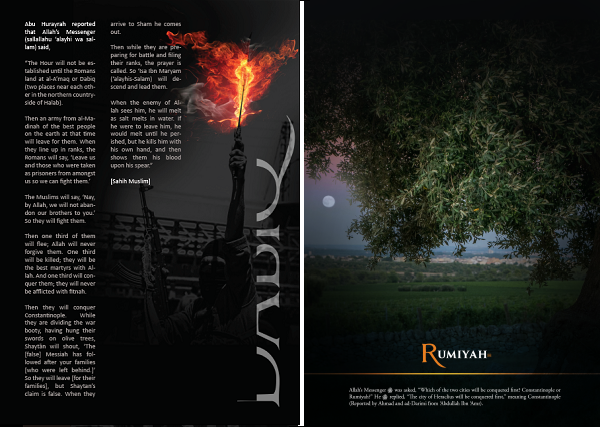
The Islamic State has a new magazine out, and it’s titled Rumiyah, not Dabiq. Here’s the first inside page of the first issue of Dabiq, together with the cover of the first issue of Rumiyah:

dabiq-rumiyah-front

And here’s the back cover of each magazine:

dabiq-rumiyah-back

What’s significant here is that the names of both magazines, like bookends, refer to a significant location in IS eschatology — but not the same place, two different places. And thereby hangs my Tale.

**

The front cover of Rumiyah, the new magazine, opens with a quote from Abu Hamzah al-Muhajir, who was Abu Mus’ab al-Zarqawi‘s immediate successor as emir of Al-Qaida in Iraq (AQI), the precursor to the Islamic State:

O muwahhidin, rejoice, for by Allah, we will not rest from our jihad expect beneath the olive trees of Rumiyah (Rome)

Moreover, the back page of Rumiyah, the new magazine, features a hadith about Rome:

Allah’s Messenger (saw) was asked, “Which of the two cities will be conquered first? Constantinople or Rumiyah? He (saw) replied, “The city of Heraclius will be conquered first,” meaning Constantinople (Reported by Ahmad and d-Darimi from ‘Abdullah Ibn ‘Amr).

**

By way of contrast, the first issue of Dabiq opens with a quote from Abu Mus’ab al-Zarqawi, the founder of AQI and thus “grandfather” to the Islamic State:

The spark has been lit here in Iraq, and its heat will continue to intensify – by Allah’s permission – until it burns the crusader armies in Dabiq.

The back page then offers this hadith concerning Dabiq:

Abu Hurayrah reported that Allah’s Messenger (sallallahu ‘alayhi wa sallam) said,

“The Hour will not be established until the Romans land at al-A’maq or Dabiq (two places near each other in the northern countryside of Halab).

Then an army from al-Madinah of the best people on the earth at that time will leave for them. When they line up in ranks, the Romans will say, ‘Leave us and those who were taken as prisoners from amongst us so we can fight them.’

The Muslims will say, ‘Nay, by Allah, we will not abandon our brothers to you.’ So they will fight them.

Then one third of them will flee; Allah will never forgive them. One third will be killed; they will be the best martyrs with Allah. And one third will conquer them; they will never be afflicted with fitnah.

Then they will conquer Constantinople. While they are dividing the war booty, having hung their swords on olive trees, Shaytan will shout, ‘The [false] Messiah has followed after your families [who were left behind.]’ So they will leave [for their families], but Shaytan’s claim is false. When they arrive to Sham he comes out.

Then while they are preparing for battle and filing their ranks, the prayer is called. So ‘Isa Ibn Maryam (‘alayhis-Salam) will descend and lead them.

When the enemy of Allah sees him, he will melt as salt melts in water. If he were to leave him, he would melt until he perished, but he kills him with his own hand, and then shows them his blood upon his spear.”

[Sahih Muslim]

**

It looks to me that Rodger Shanahan has the difference nailed in his Lowy Interpreter piece, Australia stars in first edition of new ISIS magazine:

First is the name change; no longer is ‘Dabiq’ the title (unless this masthead continues to put out editions separately); ‘Rumiya’ [sic] (formal Arabic for Rome) has replaced ‘Dabiq’. As most marketers will tell you, when a company’s brand is on the skids then it’s time for a refresh.; the same applies to jihadists. Jabhat al-Nusra has (to date) unsuccessfully tried to re-brand itself as a non-Al Qaeda jihadist group by changing its name to Jabhat Fatah al-Sham, as its old name long ago became a dead weight on its leadership aspirations.

With its hold on territory becoming more precarious by the day, ISIS has possibly decided that naming your social media magazine after a town that will likely soon fall out of your control would not be a good look ‘going forward’. Re-naming your publication after the centre of Christendom is a way to show what you aspire to, rather than what you have lost. It’s also in line with the late Muhammad al-Adnani’s recent claims that IS did not fight for territory as a way of extolling the virtues of continuous jihadi resistance.

**

Recent posts featuring the idea that we may be near the end of ISIS, at least as a proto-state:

  • Kyle Orton, The End of the Islamic State by Christmas?
  • Kyle Orton, Is This the Beginning of the End for the Islamic State?
  • Anthony Cordesman, Syria and Iraq: What Comes After Mosul and Raqqa?
  • Washington Post, Flow of foreign fighters plummets as Islamic State loses its edge
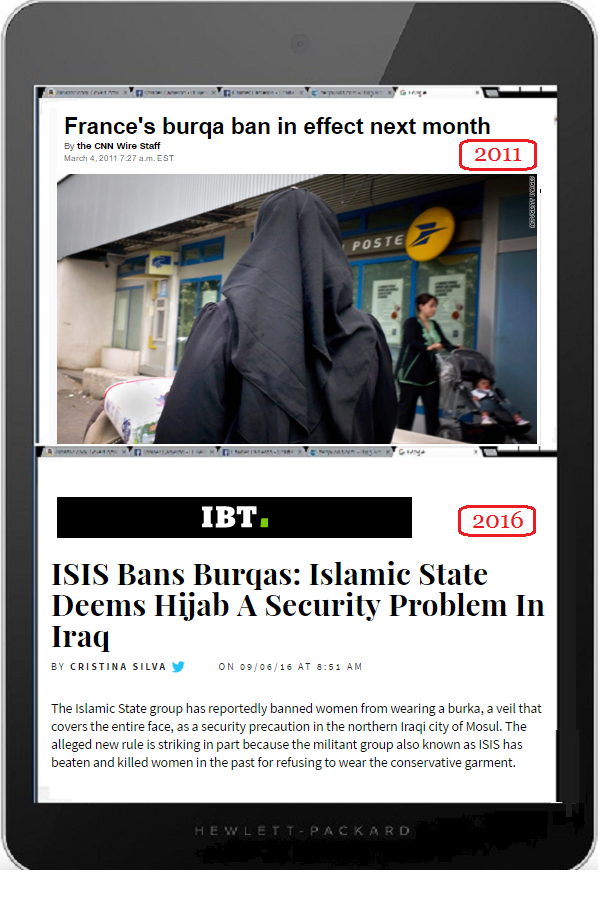
  • Burqa Burqa Jihad

    Sunday, September 11th, 2016

    [ by Charles Cameron — how ISIS imitates the French state ]
    .

    Laïcité! Jahiliyyah!

    tablet-dq-600-burqa

    Once again, the jihadists are borrowing our western ideas, only to turn them against us — this time, after a lapse of fours years.

    **

    My title? How could you forget..

    Syria and drawing the web of tensions

    Friday, September 9th, 2016

    [ by Charles Cameron — with a Magnus Ranstorp squib in its tail ]
    .

    The issue is complexity, and how you represent it. The case in point is Syria.

    Here’s a diagram that suggests complexity as a sort of crazy weaving, all straight lines and colors:

    Daveed’s diagram has a network feel to it, with actord as nodes and the tensions between them as edges:

    Karl Sharro’s tackling the wider context, but his illustration at least gives the sense of a ball of twine after a cat has carefully re-arranged it:

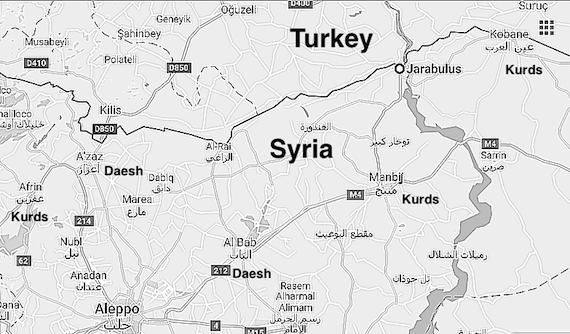
    Juan Cole simply provides a screenshot from Google Maps —

    jarabulus

    — the headline America’s Syria SNAFU: Pentagon’s Militias fight Turkey & CIA’s Militias — which is effectively friendly fire framed as paradox — and some paras beneath it using words to describe the tangle:

    The Turkish incursion into Syria at Jarabulus was advertised as an attack on a Daesh (ISIS, ISIL) stronghold and smuggling station in conjunction with (fundamentalist) remnants of the Free Syrian Army.

    But the southern outskirts of Jarabulus had already fallen to the Pentagon-backed Syrian Democratic Forces, which are majority Kurdish but have a significant Arab component. The Arab, non-Kurdish SDF brigades such as the Seljuk brigade, the Army of Revolutionaries, and Northern Sun Brigade had fought to liberate the northern Syrian city of Manbij, due south of Jarabulus from Daesh. They have an outpost in the village of Amarna just a few miles south of Jarabulus, where they call themselves the Jarabulus Military Council.

    The Turkish army, having secured Jarabulus itself with the help of fundamentalist militias, moved down to Amarna, where they met fierce resistance from the Syrian Democratic Forces, who are allied with the Kurds. The Turkish air force bombarded the SDF positions in Amarna and the militias responded by destroying two tanks and killing one Turkish soldier. Fighting continues there.

    To be honest, I’m not sure which of those means of modeling a complex system leaves us best able to understand the situation on the ground.

    **

    Maybe this one’s the best:


    Switch to our mobile site