zenpundit.com » 2017

Archive for 2017

Blowback blues redux, and redux redux, recurring

Thursday, February 9th, 2017

[ by Charles Cameron — category title would be along the lines of “the unobvious which ought to be blindingly obvious” — maybe that explains why these things are so hard to see ]
.

It’s a pattern.

**

You can stumble on an unintended blowback example any day of the week — and thrice on some days:

let me quickly add the next two in Callimachi’s series:

**

Sources:

  • TBIJ, Nine young children killed: The full details of botched US raid in Yemen
  • Politico, CIA Memo: Designating Muslim Brotherhood Could ‘Fuel Extremism’
  • Twitter, Rukmini Callimachi
  • Strategy and Prometheus Unbound

    Wednesday, February 8th, 2017

    [Mark Safranski / “zen“]

    Senior Counselor to the President and Chief Strategist, Steve Bannon

    Steve Bannon has been very much in the news lately, as one might expect of a former Breitbart editor turned closest adviser to the President of the United States. Much of this has been political fare by friends and foes (ok, mostly foes). We have read debates about his ideological worldview, the exact nature of Bannon’s (and Breitbart’s)  ties to the sinister Alt-Right, his rank in the White House pecking order, Bannon’s vision of realignment of American politics, populism, ethnonationalism, executive orders, the books he reads and so on. Charles has already weighed in here but I am not delving into these things today.

    Less attention, though usually also accompanied by outrage, have been stories on foreign policy and national security. Nevertheless, the media gave wide play to Bannon’s comments about potential war with China, possible civilizational partnership with Putin’s Russia and most notably, Bannon being given a permanent invitation to meetings of the Principal’s Committee of the National Security Council. Most Democrats and many national security professionals believed Bannon, as a political adviser,  had no business being seated on the NSC by historical standards. While this is true, it is not a very credible argument in light of the previous administration’s decision to make a mere campaign speechwriter with no prior experience an unusually powerful Deputy National Security Adviser.

    I think the criticisms based on customary protocol arguments miss the mark by a country mile.

    We are all familiar with the ancient Greek myth of the Titan Prometheus. It was Prometheus, whose name meant “forethought”, who defied the gods to give Man the gift of fire – a gift that unleashed the immense creative powers of mankind. For this affront to the gods’ authority, Prometheus was severely punished. Zeus binds Prometheus to Mount Caucasus where an eagle tears out his liver each day. A torment Prometheus endures for ages until the coming of Hercules.

    Strategy in American national security is much like Prometheus. Potentially useful as a creative force, sometimes employed like the gift of fire as a useful tool in a small way, most often inert, bound immobile to the rock of policy as politics savagely tears out the liver of anyone posing a strategy that might prevent a foreign policy crisis from becoming a debacle. The truth is that the gods, or in this case the established political class, much prefer a predictable and orderly debacle under their stewardship than a messy win for America with unpredictable second and third order effects.

    In fairness, most of the time, stability while accruing small losses is preferable for a global hegemonic power like the United States to disruptively embarking upon large risks to its position in order to win small gains. So long as the international system is strategically designed to sustain hegemony, occasional losses can be a cost of doing business until the system or parts of it no longer appear to be working. Or until political support wanes at home.

    The objection to Bannon (aside from his politics) is that a domestic political strategist should not be involved in the NSC. David Axelrod and Valerie Jarrett were not. Karl Rove wasn’t.  James Carville, Lee Atwater and innumerable other key political White House staffers never sat on the NSC. However, I don’t think Steve Bannon was invited to attend NSC Principal Committee meetings in that role. Nor was he “replacing” the DNI or CIA Director or the Chairman of the Joint Chiefs of Staff. They were not “replaced” but as customary bureaucratic constraints on policy formulation they were intentionally removed.

    I think Steve Bannon – whose prior professional efforts at a high level were all about creating and articulating a vision – is really the Trump administration’s grand strategist.

    And he’s unbound.


    Sunday surprise: Sir Ian McKellen plays Sir Thomas More

    Sunday, February 5th, 2017

    [ by Charles Cameron — For I was an hungred, and ye gave me meat: I was thirsty, and ye gave me drink: I was a stranger, and ye took me in ]
    .

    It is, as you’ll discover, the only Shakespearean speech we possess in Shakespeare‘s own hand, and a mighty on at that. I’ll present the video first, and then the text so you can follow along should you so choose.

    **

    **

    Sir Thomas More: Act 2, Scene 4

    MORE:

    Grant them removed, and grant that this your noise
    Hath chid down all the majesty of England;
    Imagine that you see the wretched strangers,
    Their babies at their backs and their poor luggage,
    Plodding tooth ports and costs for transportation,
    And that you sit as kings in your desires,
    Authority quite silent by your brawl,
    And you in ruff of your opinions clothed;
    What had you got? I’ll tell you. You had taught
    How insolence and strong hand should prevail,
    How order should be quelled; and by this pattern
    Not one of you should live an aged man,
    For other ruffians, as their fancies wrought,
    With self same hand, self reasons, and self right,
    Would shark on you, and men like ravenous fishes
    Would feed on one another.
    [ .. ] O, desperate as you are,
    Wash your foul minds with tears, and those same hands,
    That you like rebels lift against the peace,
    Lift up for peace, and your unreverent knees,
    Make them your feet to kneel to be forgiven!
    [ .. ] You’ll put down strangers,
    Kill them, cut their throats, possess their houses,
    And lead the majesty of law in line,
    To slip him like a hound. Say now the king
    (As he is clement, if th’ offender mourn)
    Should so much come to short of your great trespass
    As but to banish you, whether would you go?
    What country, by the nature of your error,
    Should give you harbor? Go you to France or Flanders,
    To any German province, to Spain or Portugal,
    Nay, any where that not adheres to England,—
    Why, you must needs be strangers. Would you be pleased
    To find a nation of such barbarous temper,
    That, breaking out in hideous violence,
    Would not afford you an abode on earth,
    Whet their detested knives against your throats,
    Spurn you like dogs, and like as if that God
    Owed not nor made not you, nor that the elements
    Were not all appropriate to your comforts,
    But chartered unto them, what would you think
    To be thus used? This is the strangers’ case;
    And this your mountanish inhumanity.

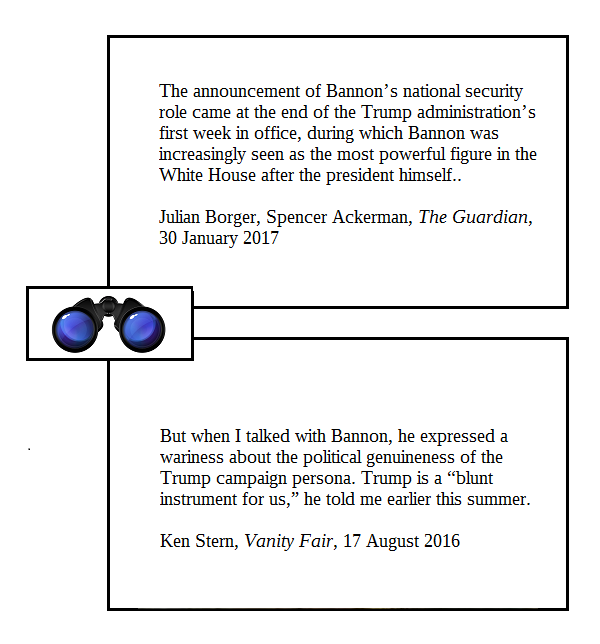
    Does Trump trump Bannon, or does Bannon bannon Trump?

    Thursday, February 2nd, 2017

    [ by Charles Cameron — there’s so often an eminence grise, neh? ]
    .

    The New York Times editorial board raises the question quite bluntly:

    Mxx Boot answers it. Unless that title, too, was an editorial decision.

    **

    Digging in for a little more detail..

    **

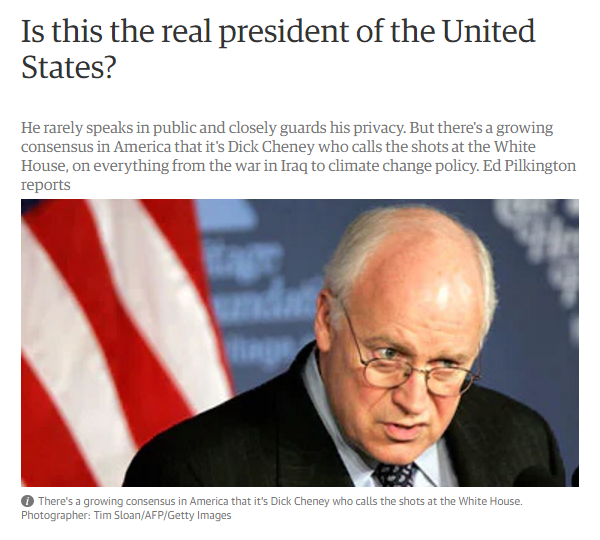
    Oh, ah — but we have heard the like before:

    **

    Sources:

  • New York Times, President Bannon?
  • Foreign Policy, President Bannon’s Hugely Destructive First Week in Office

  • Guardian, Steve Bannon’s role in inner circle of Trump team raises fears of security crisis
  • Vanity Fair, Steve Bannon, Trump’s New CEO, Hints at His Master Plan

  • Guardian, Is this the real president of the United States?
  • **

    I strongly doubt that simple org charts can capture the niceties of influence in situations like these.

    Dawson & Amarasingam, Furnish & McCants

    Thursday, February 2nd, 2017

    [ by Charles Cameron — multi-causal and single focus motivations not incompatible ]
    .

    Tim Furnish offered a terse “File this under ‘duh.'” in response to a CNSNews report titled Study: Religion is ‘Primary Motivator’ of Foreign Jihadists Who Go to Iraq & Syria on Facebook today. In response to a comment, he elaborated: “I’ve done the same study about 37 times over the last 15 years.”

    Tim’s right. But I also believe we need a more nuanced approach to the issue of motivation.

    **

    Here’s the passage from the study in question, Lorne Dawson and Amarnath Amarasingam‘s Talking to Foreign Fighters: Insights into the Motivations for Hijrah to Syria and Iraq:

    The findings reported here converge with those of these other studies in terms of how people radicalize and become foreign fighters. However, they tend to diverge with regard to why they go. In the twenty interviews analyzed no one indicated, directly or indirectly, that forms of socioeconomic marginalization played a significant role in their motivation to become a foreign fighter. Moreover, the interactions with these individuals were so heavily mediated by religious discourse it seems implausible to suggest that religiosity (i.e., a sincere religious commitment, no matter how ill-informed or unorthodox) is not a primary motivator for their actions. Religion provides the dominant frame these foreign fighters use to interpret almost every aspect of their lives, and this reality should be given due interpretive weight.

    There we are:

    Religion provides the dominant frame these foreign fighters use to interpret almost every aspect of their lives

    I couldn’t agree more. But then again, as Will McCants reminds us in Trump’s misdiagnosis of the jihadist threat (late 2016, but now twitter-pinned “because the causality question comes up constantly”):

    The disappoint stems from the desire to attribute the jihadist phenomenon to a single cause rather than to several causes that work in tandem to produce it. To my mind, the most salient are these: a religious heritage that lauds fighting abroad to establish states and to protect one’s fellow Muslims; ultraconservative religious ideas and networks exploited by militant recruiters; peer pressure (if you know someone involved, you’re more likely to get involved); fear of religious persecution; poor governance (not type of government); youth unemployment or underemployment in large cities; and civil war. All of these factors are more at play in the Arab world now than at any other time in recent memory, which is fueling a jihadist resurgence around the world.

    **

    I’ve never been clear-headed enough to follow Aristotle‘s distinctions between material, formal, efficient, and final causes, let alone discussion of hypothetical causes that follow their effects, but it seems to me that the two statements above are easily reconciled if we understand that there are many causes for disgruntlement, to which a religious solution is in all cases present as disgruntlement turns to ISIS-sympathetic recruitment.

    Religion (as Dawson & Amarasingam have it, “i.e., a sincere religious commitment, no matter how ill-informed or unorthodox”) is the sine qua non of jihadism.

    **

    So yeah, doh! — with multi-factorial causality earlier in the process..


    Switch to our mobile site