[ by Charles Cameron — prone to be wrong himself, for that matter ]
.
The media seems having a hard time of it. Journalists are neither all scholars of religion, nor necessarily religiously inclined, so it’s only too easy for the New York Times to get Easter wrong:
or for AP to manage the same sort of trick with Islam.
**
The New York Times has had time to repent of its sins, and has published a retraction that comes close enough to accuracy for my taste:
An earlier version of this article mischaracterized the Christian holiday of Easter. It is the celebration of Jesus’s resurrection from the dead, not his resurrection into heaven.
The AP needs to make a similar confession. The Hajj is not a pilgrimage directed to Muhammad’s place of birth, but to the Ka’aba — which is indeed in the city where the Prophet was born, but is believed to have been a site of pilgrimage since the time of Abraham, and to have been cleansed of idols by Muhammad and restored to its original purpose as a shrine to the one God.
And BTW, the honorific would be “Hajji” not “Hajii” — FWIW.
**
This is Islam 101, just as the Resurrection is Christianity 101. I’ve forgotten what the numbering system is for remedial classes, but we need them.
[ by Charles Cameron — more of some familiar ZP themes, now in a new container ]
.
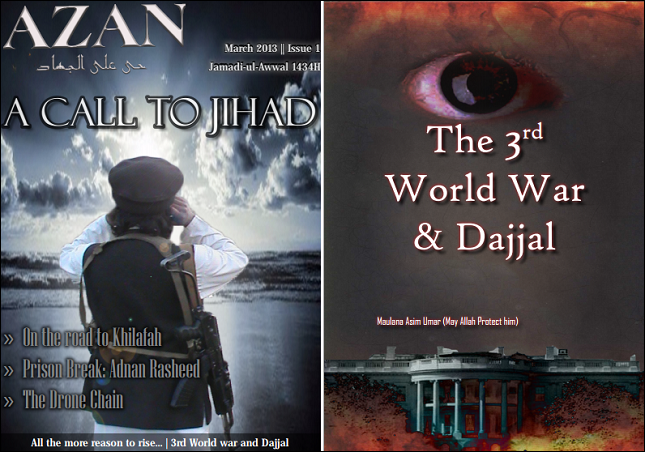
There are several matters of special interest to me that I’d like to draw your attention to in the new magazine, Azan, just issued from the Afghanistan / Pakistan region:
.
**
First, Azan has a major article devoted to the Dajjal [pp. 38 ff.], the end times figure in Islam equivalent to the Christian antichrist. Here’s the introduction:
The world today stands nearer to the Day of Judgment than ever. 1434 years after the migration of the last Prophet (May Allah’s Blessings be upon him), the conflict between the satan and the human being is nearing its final stage. It is therefore crucial that the world events that are unfolding themselves in quick succession be viewed by the and analyzed by the Muslims in the light of the Divine Shariah. Of the Islamic scholars who have dedicated themselves to this pristine cause is Maulana ‘Asim Umer (May Allah Protect him) whose books regarding Islamic eschatology have proved invaluable in guiding the Ummah through these troubled times. In addition, the Maulana (HA) is, by his self, part of the global Jihad caravan that is seeking to implement the Khilafah on Allah’s Earth. This article is about the state of the world before the advent of Dajjal, the false Messiah (Antichrist in the Biblical Tradition). It carries an eerie resemblance to the world we live in today.
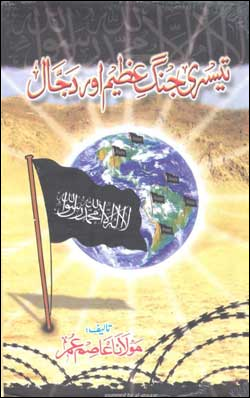
It looks as though this excerpt comes from “Third World War and Dajjal: Maulana ‘Asim ‘Umar Page 111-114 8th Edition” [p. 41].
Sadly, I lack Urdu — along with Bangla, Arabic and most everything else.
**
Second, the “sign of the times” that’s emphasized in the article — the “fitna of the Dajjal” — is one that would appeal to those who already mistrust world leaders and the press…
The truth would be indistinguishable from falsehood and the callers to misguidance would be plentiful. The propaganda during his time would be so ghastly that the truth would be presented as falsehood and the falsehood would be presented as the truth. And this twisted reality would be broadcast to the entire world. The enemies of humanity would be shown as saviors while the real saviors of humanity would be shown as “terrorists.”
That is why the Prophet Muhammad explained the Fitnah of Dajjal in great detail.
**
Third, there’s a sidebar to that article from al-Awlaki [p.41], titled Shaykh Anwar Al-Awlaki (RA) on the Final Battle. He suggests we are nearing the end times:
So the upcoming battle will be either lose it all or win it all and that is part of al-Malhama. It will be the final battle between Kufr and Iman; it will be a battle that will give victory to this Muslim Ummah. It’s not the end of it all as you still have Dajjal, Ya’juj and Ma’juj; but that battle will be the battle that will establish the Islamic Khilafah on a global scale.
So this is an indication that we are getting close to those times. Now, if we are getting close to those times, you really don’t want to be sitting on the sidelines and lose out on all of this reward in this Golden Era; because it is a Golden Era. Upon reading these ahadith, people would wish they were there; and here we are living in those times sitting on the sidelines just as Shaykh ‘Abdullah Yusuf ‘Azzam (rahimahullah) said, “The Jihad was a market that opened, people made a lot of money, and then the market closed.” It’s not going to last forever; if you sit behind, if you hesitate, if you are reluctant, then you will miss out because the chance only comes once.
**
Fourth, in a round-up of jihadist fronts from around the world, there are a few paragraphs devoted to the Ghazwah e-Hind, termed here “the Jihad of Hind” [pp. 15-16]:
As for the Jihad of Hind (present-day India, Pakistan and Bangladesh), it comes in a Hadith:
Abu Huraira (RA) narrates that, “The Prophet Muhammad promised us the Jihad of Hind. If I get a chance to be part of that then I would spend my whole wealth and life in that. Then if I’m martyred, I’ll become the best of martyrs and if I return alive, then I will be a free-from-hell Abu Huraira.” [Sunnan Al-Nisai]
“Thauban (RA) narrates in a Marfoo’ Hadith that the Messenger of Allah said that there are two Jama’ahs (groups) in my Ummah for whom Allah Has Decreed salvation from Hell. One of these Jama’ahs is the one that will wage Jihad in Hind and the second Jama’ah is the one that will wage Jihad with Isa (AS) after he descends during the last days.” [Tibrani Shareef]
With such glad tidings from the Messenger of Allah [saw], the Mujahideen of Pakistan have their firm sights on freeing both India and Pakistan from the rule of the disbelieving rulers and to establish Shariah in all these lands once more. May Allah Grant victory to them! Ameen!
**
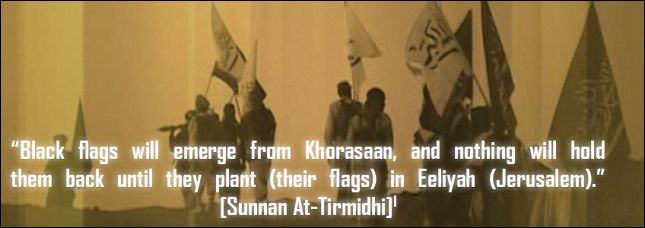
And finally, there’s mention of the obligatory black banners of Khorasan [pp. 13-15]:
Black flags were unfurled from Khorasaan just as the Prophet Muhammad [saw] had foretold:
“Black flags will emerge from Khorasaan, and nothing will hold them back until they plant (their flags) in Eeliyah (Jerusalem).” [Sunnan At- Tirmidhi]
So, if indeed these Taliban are the flag bearers mentioned in the Hadith, then they shall inshAllah march forth to and conquer Jerusalem. And this is a note to the “powers” of today. In fact, the Shariah of the Taliban gained such acceptance with Allah The Exalted, that He Made the land of Afghanistan the base for the start of the global Jihad movement.
…
The black flags of Khorasaan became being unfurled all around and the sacred call to Tawheed (monotheism) was renewed.
**
There is plenty more, of course, and I’ve cherry-picked the bits that bear on specific themes I have been exploring here at ZP that have end times relevance.
Aaron Zelin has made a .pdf of the magazine available via Jihadology. Bahukutumbi Raman discusses it from an Indian intelligence perspective on his blog. Reuters looks at what the magazine has to say about drones. And no doubt others will be providing analysis from various other perspectives in the coming days.
[ by Charles Cameron — taking a break from my pressing writerly duties ]
.
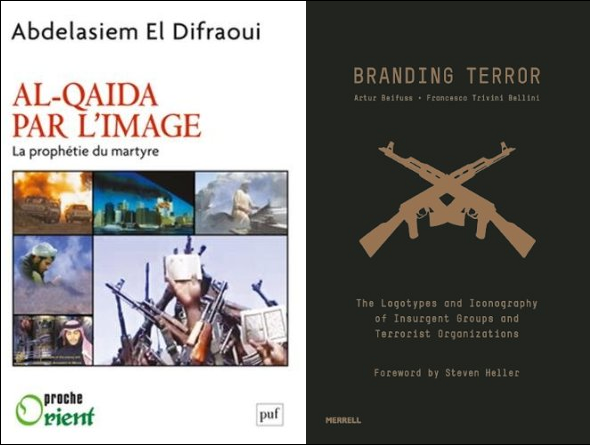
I wouldn’t have noticed these two offerings quite so clearly if I hadn’t been pointed to each of them in the last couple of days. Both look to be of considerable interest:
Hat-tip Nico Prucha at Jihadica, and who or whatever pointed me to HuffPo — idenitfy yourselves and be saluted!
**
The first image in the HuffPo slideshow for Branding Terror (lower image, below, AQIM) really hit me square between the eyes, because when I was in Mashhad, Iran, in the early seventies, I snarfed up a postcard with a very similar design — Shi’ite rather than Sunni, and not so distinctly violent (upper image):
[ by Charles Cameron — you can safely ignore this if you have zero interest in any or all of Bach, Eliot, Christianity and Sufism ]
.
It’s Sunday evening here, let’s start with Yehudi Menuhin playing Bach — the great Chaconne:
**
This post began to coalesce for me when Dr Alan Godlas, whose web-pages at the University of Georgia offer, among other things, a profound “gateway to Sufism“, gave me his permission to quote a comment he’d made in a private communication:
Sufis and Muslims need to learn how to recite and listen to the Qur’an (and how to do dhikr and practice Islam and Sufism) at the depth at which Bach wrote this Chaconne and at which it was played by Menuhin.
**
That really gets to the heart of the issue of spirituality and beauty — and it brought to mind a comment made by then Cardinal Joseph Ratzinger, now Pope Benedict Emeritus, in his speech at Rimini on The Feeling of Things, the Contemplation of Beauty:
The encounter with the beautiful can become the wound of the arrow that strikes the heart and in this way opens our eyes, so that later, from this experience, we take the criteria for judgement and can correctly evaluate the arguments. For me an unforgettable experience was the Bach concert that Leonard Bernstein conducted in Munich after the sudden death of Karl Richter. I was sitting next to the Lutheran Bishop Hanselmann. When the last note of one of the great Thomas-Kantor-Cantatas triumphantly faded away, we looked at each other spontaneously and right then we said: “Anyone who has heard this, knows that the faith is true”. The music had such an extraordinary force of reality that we realized, no longer by deduction, but by the impact on our hearts, that it could not have originated from nothingness, but could only have come to be through the power of the Truth that became real in the composer’s inspiration. Isn’t the same thing evident when we allow ourselves to be moved by the icon of the Trinity of Rublëv? In the art of the icons, as in the great Western paintings of the Romanesque and Gothic period, the experience described by Cabasilas, starting with interiority, is visibly portrayed and can be shared.
**
John Eliot Gardiner, the great conductor of Bach with whom I apparently spent some of my earlier school-years, offers us an intriguing insight in In Rehearsal with John Eliot Gardiner (Bach Cantata No. 63), immediately after Sara Mingardo‘s deeply devotional rendering of the recitative O selger Tag —
Nota bene: Bei einer andächtigen Musik ist allezeit Gott mit seiner Gnaden Gegenwart. Now I find that very, very significant. That he’s saying wherever there is devotional music, God with his grace is present. Which, from a strict theological point of view is probably heresy, heretical, because it’s saying that music has an equivalent potency to the word of God. And I think that in essence is why Bach is so attractive to us today because he is saying that the very act of music-making and of coming together is, in a sense, an act which invokes the latency, the potency, the potentiality of God’s grace, however you like to define God’s grace; but of a benediction that comes even in a dreadful, overheated studio like Abbey Road where far too many microphones and there’s much too much stuff here in the studio itself, that if one, as a musician, puts oneself in the right frame of mind, then God’s grace can actually come and direct and influence the way we perform his music.
**
But I’ve quoted both Benedict and Gardiner on this very topic before, I know, so I’ll move on to the poet TS Eliot, who in Four Quartets tells us:
For most of us, there is only the unattended
Moment, the moment in and out of time,
The distraction fit, lost in a shaft of sunlight,
The wild thyme unseen, or the winter lightning
Or the waterfall, or music heard so deeply
That it is not heard at all, but you are the music
While the music lasts. These are only hints and guesses,
Hints followed by guesses; and the rest
Is prayer, observance, discipline, thought and action.
**
I would like to offer three more interpretations of the Bach Chaconne, and one anecdote. The first interpretation is of the entire Solo Violin Partita #2, including the Chaconne, by the young and already great Hilary Hahn. Her rendition of the Chaconne alone is available as a separate YouTube video here:
There’s also a Busoni piano arrangement, played here by Helene Grimaud — it was, I think, our own J Scott Shipman who introduced me to this stunning performance:
Finally –since I obviously love the Chaconne — I would like to leave you with the story of a double performance of this same piece by violinist Joshua Bell at L’Enfant Plaza metro in Washington, DC — as told by Washington Post reporter Gene Weingarten — who won a Pulitzer for this article:
HE EMERGED FROM THE METRO AT THE L’ENFANT PLAZA STATION AND POSITIONED HIMSELF AGAINST A WALL BESIDE A TRASH BASKET. By most measures, he was nondescript: a youngish white man in jeans, a long-sleeved T-shirt and a Washington Nationals baseball cap. From a small case, he removed a violin. Placing the open case at his feet, he shrewdly threw in a few dollars and pocket change as seed money, swiveled it to face pedestrian traffic, and began to play …
Go ahead, read it if you haven’t already — it’s quite a story!
….I would like to focus on one sentence hidden in the body of the report. Shortly after the implementation of the Merida Initiative in 2008, the Mexican intelligence agency CISEN discovered that various cartels were employing American trained, ex-special forces. Understandably alarmed, American intelligence agencies floated a proposal to cut the power of the cartels:
“Anxious to counterattack, the CIA proposed electronically emptying the bank accounts of drug kingpins, but was turned down by the Treasury Department and the White House, which feared unleashing chaos in the banking system.”This one sentence betrays Washington’s distorted foreign policy priorities. The CIA proposal had several clear benefits: drug lords forced to pull their investments would have less incentive to stay in the game, cartels would be robbed of operating funds, and most importantly of all, the proposal could be implemented with minimal American involvement. [2] There would be no need for more boots on the ground. The drawbacks were also clear: folks on Wall Street would lose money. The White House took Wall Street’s side in the debate, and favored a policy designed to kill or capture the “high value targets” whose bank accounts were not to be touched. (Readers curious about the cost of these operations — in terms of man-power as well as money — will find plenty of details in the last few pages of the Washington Post report.)
….If the investigation determines that Quintanilla was killed because of his narcocorridos it would be the first known assassination of a narcocantante (narco-singer) in the United States. This would be a significant shift in targeting and the U.S. would be firmly in the operational zone of targeted killings to shape the ‘narcosphere’ or ‘drug war zone.’
Quintanilla was identified with the CDG: Cartel del Golfo (Gulf Cartel) and had dedicated songs to Tony Tormenta (Antonio Ezequiel Cárdenas Guillén)[6] the CDG capo who died in a battle with Los Zetas in November 2010.[7] One of his songs, “Estamos En Guerra (Los Zetas Vs. CDG),”chronicled the battles following the Gulf-Zeta split.[8],[9]
It is possible that Quintanilla became a target of one or both of those cartels as a result of his characterization of their activities in the current conflict in Tamaulipas. Certainly both cartels have a presence in Texas and could operate there as seen in recent reports of narcobloqueos (narco-blockades) in Texas.[10] It is also possible that he crossed other criminal enterprises (such as U.S. gangs) or was targeted for more mundane criminal reasons. Nevertheless, the modus operandi or tactics, techniques, and procedures (TTPs) involved in his death are consistent with those of narco-assassinations.
….Prosecutions of government corruption initiated under the Calderon administration are falling apart in the early months of the Peña Nieto administration, leading to accusations among Mexico’s political elite. On one side, PRI officials say the Calderon government abused its authority, relied on untrustworthy witnesses, and targeted politically convenient officials. On the other side of the debate are concerns that the PRI is allowing impunity for corruption and harming relations with US agencies that provided evidence and want corrupt officials out of government. Regardless of whether the officials named were or were not working with transnational criminal organizations, the Mexican government’s failure to successfully investigate and prosecute high-level corruption should be a source of concern. Rumors of high level corruption have only increased since ex-President Felipe Calderon declared a war on violent drug trafficking organizations in Mexico upon taking office in December 2006.
Zenpundit is a blog dedicated to exploring the intersections of foreign policy, history, military theory, national security,strategic thinking, futurism, cognition and a number of other esoteric pursuits.