zenpundit.com » IS

Archive for the ‘IS’ Category

A DoubleQuote from Peter C Vangjel

Wednesday, April 8th, 2015

[ by Charles Cameron — Col Kurtz meets Frederick Nietzsche ]
.

Peter Vangjel tweeted a DoubleQuote yesterday, and I’ve now formatted it and am reposting it here:

SPEC Nietzsche Kurtz

**

I’m always happy to see that others find the DoubleQuote concept serviceable.

What are your views on Col. Kurtz? What did Capt. Willard think of him? And Francis Ford Coppola?

And where would you locate the heart of darkness?

A powerful, credible narrative?

Wednesday, April 1st, 2015

[ by Charles Cameron — how about a powerful, credible foreign policy? — maybe that’s asking too much ]
.
double

**

James P. Farwell‘s piece in the National Interest, Information Warfare: The Key to Destroying ISIS, claims:

A coalition of Shia militias, Iraqi government forces and anti-ISIS Suncni tribesman are making progress towards ejecting ISIS from Tikrit. What’s needed now is to capitalize on those defeats and complement kinetic action with a cohesive information war campaign driven by a powerful, credible narrative that demoralizes, divides, confuses, and frustrates ISIS members in order to blunt their effectiveness as fighters, and undermine their expectations, destroy their momentum, and quash any hope of victory in creating a sustainable Islamic State or caliphate.

A powerful, credible narrative?

**

Let’s look at two recent efforts. The first was just “published from above” by the US Government:
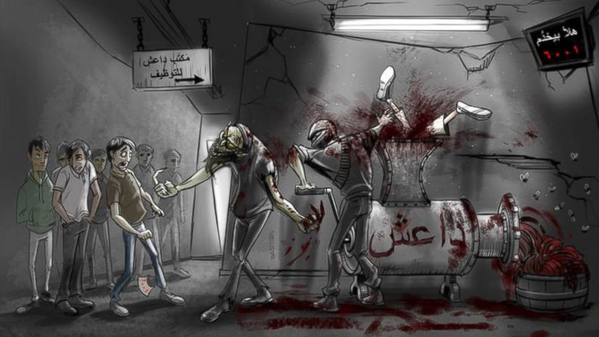
PsyOps lealet

Here’s some context and commentary, from Al Jazeera’s DC office:

On March 16 an F-15E fighter jet dropped 60,000 copies of the above leaflet on Raqqa, the base of operations for the Islamic State of Iraq and the Levant, or ISIL.

The image shows a “Daesh Employment Office” (Daesh is a pejorative nickname for ISIL in the Arab world).

Two ISIL recruiters, one of whom appears more monster than man, feed young men into a meat grinder with “Daesh” written in blood on its side. A sign in the upper-right corner reads “Now Serving Number 6,001”.

When asked about the intended message of the leaflet, Pentagon spokesman Colonel Steve Warren, said “If you allow yourself to be recruited by Daesh, you will find yourself in a meat grinder.”

Warren said the leaflet was created by the Army’s Military Information Support Operations, or MISO. Until 2010 that outfit was known as “PSY-OPS” (short for “Psychological Operations”).
Experts have questioned the efficacy and tenor of the leaflet.

Faysal Itani, a Fellow at the Atlantic Center in Washington who studies the various groups fighting in Syria’s civil war, said anyone in Raqqa thinking of joining ISIL is either ideologically committed or coerced.

“Members of the first category are likely immune to leaflet propaganda, especially if distributed by an air force that has been bombing Raqqa,” Itani told DC Dispatches.

Frankly, I think that’s the wrong way to appeal to the people of Raqqa, who see worse everyday, and either don’t want or don’t need to be reminded.

**

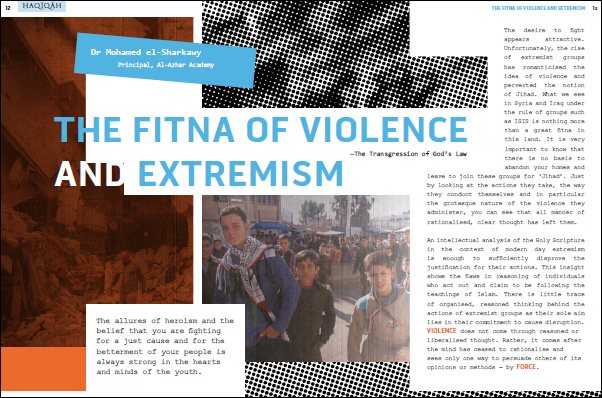
Next up is the effort of a consortium of British Imams — a magazine called Haqiqah, whose editor pitches it thus:

We’re turning the tide – though we still have a way to go, we know that by taking efforts to support and mobilise the huge online Muslim population we will eventually drown out the violent voices

Here’s a sample double-page spread:
Haqiqah

I would like to applaud the effort, but I’m afraid a 17-page magazine featuring text blocks in a typewriter face and the occasional poor color photograph is just no match for IS’ own magazine, Dabiq, whose first issue ran 50 pages, and which looked like this:

Dabiq double page

Ouch. Richard Barrett of the Soufan Group is gentle in the way he phrases his comment, but I’m afraid he’s also right on the mark:

**

Okay, let’s look at some of the possible theological “alt-narratives” I’ve seen proposed.

First, there’s the idea that losing battles might “prove” that ISIS was not divinely approved and supported — but Qur’an 2:154-56 concerns those who fight fi sabil Allah, an suggests they will encounter “tests” up to and including “loss of lives” in the course of events:

And do not say about those who are killed in the way of Allah, “They are dead.” Rather, they are alive, but you perceive [it] not. And We will surely test you with something of fear and hunger and a loss of wealth and lives and fruits, but give good tidings to the patient, Who, when disaster strikes them, say, “Indeed we belong to Allah , and indeed to Him we will return.”

Furthermore, IS’ favorite eschatological hadith (I’ve quoted it before) specifies that many will be lost, both to glorious death and inglorious desertion:

The Last Hour would not come until the Romans would land at al-A’maq or in Dabiq. An army consisting of the best (soldiers) of the people of the earth at that time will come from Medina (to counteract them). When they will arrange themselves in ranks, the Romans would say: Do not stand between us and those (Muslims) who took prisoners from amongst us. Let us fight with them; and the Muslims would say: Nay, by Allah, we would never get aside from you and from our brethren that you may fight them. They will then fight and a third (part) of the army would run away, whom Allah will never forgive. A third (part of the army). which would be constituted of excellent martyrs in Allah’s eye, would be killed ani the third who would never be put to trial would win and they would be conquerors of Constantinople

Losing ground? I think the third “alt-narrative” — the narrative brought into effect by IS losing significant ground they had previously captured, is the most powerful of those currently proffered — but it depends on perspective rather than capture or loss. Blows to IS such as the loss of Tikrit, or a fortiori the possible loss of Mosul, might seem persuasive to most western eyes, but in the eyes of potential recruits they may well be counterbalanced by new oaths of allegiance such as thos of Boko Haram and Al-Shabaab to the IS caliph.

At least, though, we glimpse here that changes in military reality may impact thelogically-based beliefs.

**

Taking that a step further, I’d suggest that credible behavior on our own part, rather than the fatwas of ulema — even Abu Muhammad al-Maqdisi, let alone those who may seem obviously compromised by complicity in power — will comprise the most effective of counter-narratives.

America supported Muslims in Afghanistan against the Russians, America supported Bosniac Muslims against the Orthodox Serbs and Catholic Croats — these are the kinds of action that most clearly refute the idea that the US is at war with Muslims — as it may appear to be in the cases Bacevich listed a few months back in a WaPo op-ed:

As America’s efforts to “degrade and ultimately destroy” Islamic State militants extent into Syria, Iraq War III has seamlessly morphed into Greater Middle East Battlefield XIV. That is, Syria has become at least the 14th country in the Islamic world that U.S. forces have invaded or occupied or bombed, and in which American soldiers have killed or been killed. And that’s just since 1980.

Let’s tick them off: Iran (1980, 1987-1988), Libya (1981, 1986, 1989, 2011), Lebanon (1983), Kuwait (1991), Iraq (1991-2011, 2014-), Somalia (1992-1993, 2007-), Bosnia (1995), Saudi Arabia (1991, 1996), Afghanistan (1998, 2001-), Sudan (1998), Kosovo (1999), Yemen (2000, 2002-), Pakistan (2004-) and now Syria. Whew.

That could be viewed as a pretty devastating list.

**

Actions — as a poet, I dread to utter these words, but they seem appropriate in this context — actions (in the form of foreign policy) just may speak louder that words .
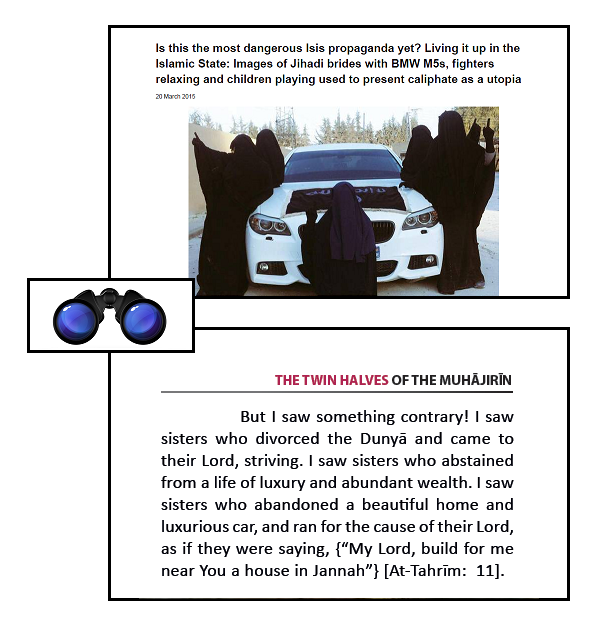
The paradoxical roles of luxury cars in the lives of the women of IS

Tuesday, March 31st, 2015

[ by Charles Cameron — not particularly anxious to own a BMW — but did I once win a Rolls for a night of Bach at the Hollywood Bowl ]
.

SPEC DQ IS BMW

Sources:

  • Belfast Telegraph, Jihadi brides with BMW M5s
  • Dabiq, issue #8 p.34, The Twin Halves of the Muhajirin
  • So we’re somewhat fond of the Dunya after all, ladies?

    Jessica Stern and dancing lessons

    Wednesday, March 25th, 2015

    [ by Charles Cameron — a trifle, in which life follows art as one of my favorite Vonnegut / Bokonon quotes comes to life ]
    .

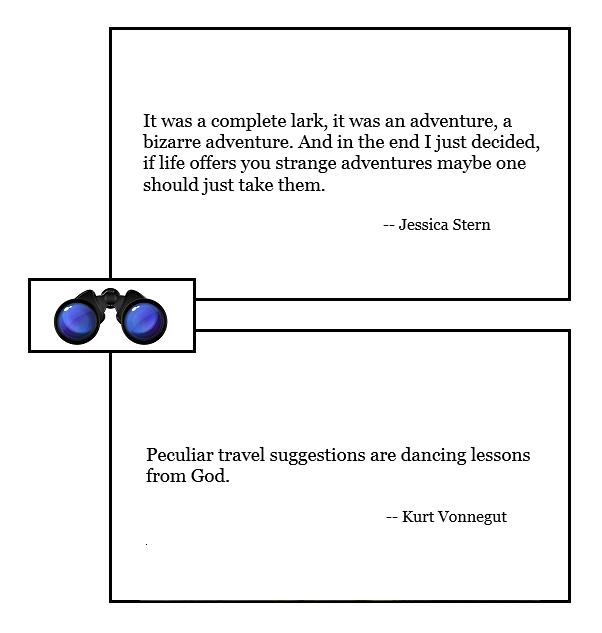
    SPEC DQ Stern Vonnegut

    **

    Sources:

  • UN Dispatch, Mark Leon Goldberg interviews Jessica Stern:

    Jessica Stern was a mid level National Security Council staffer when Hollywood literally came calling. Nicole Kidman portrayed a fictionalized version of her work as a nuclear security analyst in the Clinton White House in the film “The Peacemaker” (also starring George Clooney). Stern’s academic and professional life have taken some interesting turns. In the 2000s she published groundbreaking research on what motivates individuals to commit violent acts of terror, and she did so by speaking to actual terrorists. Stern recently published a new book called ISIS: State of Terror, co-authored by J.M. Berger that takes a deep dive into the historic origins of the so-called Islamic State.

    This is a great episode with fun and fascinating stories from a longtime national security wonk. Enjoy.

  • The prophet Bokonon, in Kurt Vonnegut, Cat’s Cradle
  • Jessica Stern, in the quote above, is describing the twists and turns which brought her via the NSC to the set of The Peacemaker. Quite a story, I recommend the interview — and the dance goes on.

    So: how does it feel at World’s End?

    Saturday, March 21st, 2015

    [ by Charles Cameron — on conveying the experience of the eschatological — on the way to better understanding the allure of IS ]
    .

    Beatus de Facunda. And the fifth Angel sounded the trumpet: and I saw a star fall from heaven upon the earth, and to him was given the key of the bottomless pit" -- Revelation 9.1-11

    And the fifth Angel sounded the trumpet: and I saw a star fall from heaven upon the earth, and to him was given the key of the bottomless pit

    **

    WE ARE ENTERING PHASE TWO:

    I think we’re entering Phase Two of our conversations about Islamist eschatology.

    In Phase One, the task was to point out that apocalyptic scriptures and scriptural interpretations were a feature of Al-Qaida discourse, and specifically used in recruitment, and this phase was necessary because apocalyptic movements, in general, are all too easily dismissed by the secular mind until “too late” — think Aum Shinrikyo in Tokyo, the Branch Davidians in Waco, Heaven’s Gate in Rancho Santa Fe.

    With GEN Dempsey declaring that IS holds an “apocalyptic, end-of-days strategic vision”, with Graeme Wood describing that vision in a breakthrough article in The Atlantic, with Jessica Stern and JM Berger making the same point forcefully in their ISIS: The State of Terror, and with Will McCants promising us a book specifically about the eschatological dimension of IS, that need may now have passed.

    In my view, the salient points to be made in Phase Two are:

  • that the apocalyptic ideology of IS has strategic implications
  • that there’s a largely and unwisely ignored area of religious studies dealing specifically with eschatological violence, and
  • that the sense of living in eschatological time is viscerally different — I’ve termed it a “force multiplier”
  • In particular, IS strategy is likely to draw in part on the specifically eschatological last hundred pages in Abu Musab al-Suri‘s 1600-page Call to Global Islamic Resistance. As I noted in my review of Jean-Pierre Filiu’s Apocalypse in Islam, Filiu himself states there is “nothing in the least rhetorical about this exercise in apocalyptic exegesis. It is meant instead as a guide for action”. While Filiu devotes several pages to it, Jim Lacey ignores it completely in his A Terrorist’s Call to Global Jihad: Deciphering Abu Musab al-Suri’s Islamic Jihad Manifesto, commenting only, “Where appropriate, we have also removed most of the repetitive theological justifications undergirding these beliefs” — see my review of Lacey for the Air force Research Institute.

    I’ll deal with the religious studies literature on violent apocalyptic movements in a future post.

    This post is my first attempt at addressing the feeling engendered by being swept up in an “end times’ movement. I foresee this as my major upcoming area of interest and future contributions.

    **

    SUGGESTED CONTEXTS:

    There’s an extraordinary paragraph in Seduction of the Spirit by Harvey Cox, the prominent Harvard theologian, in which he tells us what the world’s next great encyclopedic work on religion might be like — using the analogy of Thomas AquinasSumma Theologica in a decidedly post-psychedelic age:

    Thus the next Summa might consist not of a thousand chapters but of a thousand alternative states of being, held together not by a glued binding but by the fact that all thousand are equally real.

    Imagine what kind of world it would be if instead of merely tolerating or studying them, one could actually be, temporarily at least, a Sioux brave seeing an ordeal vision, a neolithic hunter prostrate before the sacred fire, a Krishna lovingly ravishing a woodsful of goat girls, a sixteenth-century Carmelite nun caught up in ecstatic prayer, a prophet touched by flame to go release a captive people…

    Religious experience is as wide, and in fact as wild as that, and the lives and world views of a Black Elk, a Teresa of Avila, an incarnation of Vishnu and an Isaiah are as different as cultures can be, united only in the degree of their focus. Cox can list them, he can invite us to consider their experiences in turn, but he cannot entirely bring us into each of their lives. Between them and his readers is a distance not only of cultural imagination, but of conviction, of tremendous passion.

    **

    In Fiction as the Essence of War, George Vlachonikolis wrote on War on the Rocks recently:

    Coker reveals the struggle of many a veteran by asking: “how can someone who was there tell others what it was like? Especially if they can’t find a moral?” This is a thought that will resonate with anybody with a wartime experience. As for me, my 6 years in the Army has now all but been reduced to a handful of dinnerpartyfriendly anecdotes as a consequence of this plight.

    Stern & Berger, on page 2 of their book, ISIS: The State of Terrorism, write:

    It is difficult to properly convey the magnitude of the sadistic violence shown in these videos. Some featured multiple beheadings, men and women toether, with the later victims force to watch the irst die. In one video, the insurgents drove out into the streets of Iraq cities, pile out of the vehicle, and beheaded a prisoner in full view of pedestrians, capturing the whole thing on video and then driving ogg scot-free.

    Some things are just hard to explain in a way that viscerally grips the reader, engendering rich and deep understanding.

    The power of religion is one of them, and that’s true a fortiori of the power of its extreme form, that of those who are “semiotically aroused” — in Richard Landes‘ very useful term — by the power of an “end times” vision.

    **

    I have quoted the first paragraph of Tim Furnish‘s book, Holiest Wars, often enough already, and I’ll quote it again for shock value — I don’t think it’s the sort of analogy that can be “proven” or “refuted”, but it gives a visceral sense of the importance of identifying an Islamist jihadist apocalyptic movement as such, and understanding what that implies:

    Muslim messianic movements are to fundamentalist uprisings what nuclear weapons are to conventional ones: triggered by the same detonating agents, but far more powerful in scope and effect.

    And Richard Landes in Fatal Attraction: The Shared Antichrist of the Global Progressive Left and Jihad gives us a sense of how an apocalyptic undercurrent works:

    It is a great mistake to suppose that the only writers who matter are those whom the educated in their saner moments can take seriously. There exists a subterranean world where pathological fantasies disguised as ideas are churned out by crooks and halfeducated fanatics for the benefit of the ignorant and superstitious. There are times when this underworld emerges from the depths and suddenly fascinates, captures, and dominates multitudes of usually sane and responsible people, who thereupon take leave of sanity and responsibility. And it occasionally happens that this underworld becomes a political power and changes the course of history.

    **

    A FIRST APPROXIMATION:

    Let me take a first stab at indicating — by analogy — the level of passion involved:

    Cox writes of prophecy, Sylvia Plath of electroshock treatment. In her poem, The Hanging Man:

    By the roots of my hair some god got hold of me.
    I sizzled in his blue volts like a desert prophet.

    And her description of the same experience in her novel The Bell Jar is no less, perhaps even more powerful — note also the “end times” reference:

    I shut my eyes.

    There was a brief silence, like an indrawn breath.

    Then something bent down and took hold of me and shook me like the end of the world. Whee-ee-ee-ee-ee, it shrilled, through an air crackling with blue light, and with each flash a great jolt drubbed me till I thought my bones would break and the sap fly out of me like a split plant.

    Let me suggest to you:

    Many IS members feel they have been shaken “like the end of the world” and live and breathe in “an air crackling with blue light”.

    __________________________________________________________________________________________________________

    The illustration at the head of this post is one of many from The Beatus of Facundus, itself one of many brilliantly illustrated versions of Beatus of Liebana‘s commentary on Revelation. I was first exposed to Beatus by an article Umberto Eco wrote for FMR magazine. Eco also mentions the Beatus in Name of the Rose, and indeed wrote a most desirable book on the topic.


    Switch to our mobile site