I accepted an offer from Dave Dilegge to join the new SWJ Monthly E-News to do a Recommended Reading column with Crispin Burke of Wings Over Iraq – sometimes we’ll both do a column….depends how much reading is worth recommending 😉
Once a month, beginning on 1 May, we will be sending out an e-mail overview of the latest news, issues, events and more from SWJ and the broader Small Wars / Irregular Warfare community of interest and practice.
Keep abreast of what’s happening in the far flung reaches of the SWJ Empire – sign up below for our newsletter today.
The contents of SWJ E-News No. 1 will include:
* SWJ News – Journal articles and blog entries, Council debates and discussions, This Week at War and a sneak preview of our SWJ challenge coin,
* Doctrine Man @ SWJ – DM’s exclusive for Small Wars Journal cartoon commentary,
* Professional Reading – Snapshots and links to articles of interest from a wide array of professional journals,
* SWJ Interviews – A recap with links covering our SWJ interview series,
* Starbuck and Zenpundit – Recommended reading,
* Book Review – Bing West’s The Wrong War,
* Upcoming Events – Small Wars-related workshops, conferences, seminars and webcasts,
* More…
The Warlord is Colonel John Collins, who has over a half century of national service as a military officer and analyst and now is the proprietor of the national security listserv, The Warlord Loop. His tips fit in well with my review of Do the Work.
Research Techniques
*Peruse a broad spectrum of opinion with an open mind. Never reach conclusions first, then prepare a paper to support them. You will often find that initial impressions were poorly founded.
*Take nothing for granted. Challenge conventional wisdom to see if it is sound, regardless of the source.
*Document important ideas with footnotes, so readers can pursue selected topics in greater depth, if they so desire
For the contrast between Mr. Ryan last week and Mr. Obama on Wednesday wasn’t just about visions of society. There was also a difference in visions of how the world works.
Indeed there were and I found them visions that varied from mistaken to delusional to demagogic. But it likely explains why the 2011 budget was so late: there are conflicting and irreconcilable visions of how the world works and all parties finally came together on the single point they could agree on (getting re-elected).
Dave, with trademark evenhandedness, gives each plan a fisking and finds them all wanting.
….Understand that Washington had wanted Germany to pick up a big share of the tab for funding the Nabucco nightmare, which, when Wikipedia last checked, still hasn’t found funding.2. U.S. and British machinations in Ukraine, which egged on Ukraine’s President Viktor Yushchenko to escalate his cold war with Putin. This included holding Europeans who were dependent on Russia natual gas hostage to the prospect of freezing in the winter, and which threatened to crash a good chunk of the EU economy. And which by 2008 also had something to do with a cold war between the Kremlin and the British foreign office over a joint oil deal involving British Petroleum — er, “BP.”3. The very same war in Georgia that Herr Schockenhoff delicately alluded to. You remember that war, right? The one where presidents Bush and Putin had to learn while sitting next to each other at China’s Olympics that Georgia’s president — the necktie-chewing Mikheil Sakaashvili, installed as Georgia’s President in a U.S.-orchestrated putsch (“The Rose Revolution”) — was trying to start World War Three?Yeah. That war.There are surely additional reasons not specifically related to the United States — the economic crisis for one, which brought home to Germans that they couldn’t continue bankrolling the expansion of the European Union at the rate they’d done in the past.
And there was simply the fact that a shaking out in alliances was inevitable when it became clear to West Europeans that continuing with the policy of using former Soviet republics to create an ever-expanding front against Russia was threatening to create the very instability on the Continent that had driven European fear of Russian hegemony. The Georgia war was the starkest demonstration that there had to be a realignment of priorities for Europe, even if this caused a major rift with the United States
Every nation has historic policies that are cherished and repeatedly get dusted off. The Russo-German partnership goes back to Bismarck….unless we want to count the brief period of Tsar Peter II’s Germanomaniac worship of Frederick the Great
BLOGFRIENDS UNITE! The eponymous Adam Elkusand Great Satan’s Girlfriend, Courtney Messerschmidt, the gamine of COIN, have joined forces to seize control of Wings Over Iraq! Or….maybe….Starbuck just went on vacation or something.
Where earlier attempts have fired ungainly missiles that tumbled end-over-end through the air like “hypersonic bricks,” this one uses a sabot round, which flies straight and smoothly for a distance of seven kilometers, AFTER punching through a solid steel plate
I read the GeorgeR.R. Martin series which is heavy on swords, political intrigue, war, sex and a 4GW-like collapse of a great and venerable feudal realm and lighter on sorcery. More like Machiavelli than Tolkien, at least in the earlier books ( the series is not finished). Looks quite good and true to the story, from the trailer and the preview. The first episode aired last night.
….Traditionally, the military has valued an engineering approach to problem-solving. Formulaic methods, such as the Military Decision-Making Process, focus on well-structured, tactical problems. While an MDMP-formulated plan might be complicated, it’s by no means complex. For most tactical problems, there is generally one established solution. The mission, purpose, key tasks, and end state spelled out in an order from a higher headquarters.
Most importantly, the environment is relatively free from outside influence.
Using similar methods, the German General Staff, under the direction of Alfred von Schlieffen and Helmuth von Moltke the Younger, meticulously planned the opening stages of the First World War. The vaunted Schlieffen Plan, much like its French counterpart, Plan XVII, was meticulous.
Yet, the Schlieffen Plan failed when subjected to the messy complexity inherent at the strategic level. The plan’s underlying assumptions — a mere six-week offensive in France, followed by a sudden re-direction towards the Eastern Front — would prove to be untenable. France was able to halt the Germans at the Marne, and the Russians were able to swiftly mobilize their army, trapping Germany in a two-front war.
….The Fourth Republic, the democratic French state, inherited from its pre-war predecessors a dicey situation in Algeria. The millet system, inherited from the Ottoman Empire upon France’s conquest of Algeria in 1830, let the initial Muslim community live under Sharia Law while the European community lived under French law, voted in French elections, and so on. The increasing power of the French state, however, made this situation decidedly unequalal. The Fourth Republic’s mission was to essentially reestablish the status quo before the rise of the French state, to allow the Pied Noir to be full citizens of the Republic while also allowing the Algerians to effectively government themselves.
Each of these three factions had specific challenges. The FLN, paranoid, fratricidalal, uneducated, and given to a degree of sexualized hyperviolence that would make al Qaeda in Iraq blush. The Pied Noir, demographically the weakest faction, were (barely) an over-class in Algeria while suffering the lowest living standards of any group of French citizens. The Fourth Republic, established after Petain’s collaborationist military dictatorship, attempted to avoid a return to tyranny by creating a weak executive.
….When you are on a sales call, in sales meeting, or at any point engaged with another human being for whom you are supposed to respect and care for, close the laptop.
I recently started doing this myself, and it is remarkable the difference it makes.
The first thing you will notice is how uncomfortable it makes the other person; it’s like they are not sure that they haven’t done something wrong. You will most likely have to explain that nothing is wrong and that you are just trying to give them your full and undivided attention. You will also notice that they get straight to the point, and they behave as if your time is valuable.
…. The will to fight, the passion to be great, is an indispensable element of the Warrior Ethos. It is also a primary quality of leadership, because it inspires men and fires their hearts with ambition and the passion to go beyond their own limits. Epaminondas, the great Theban general, was the first to beat the Spartans-at the battle of Leuctra in 371 B.C. …
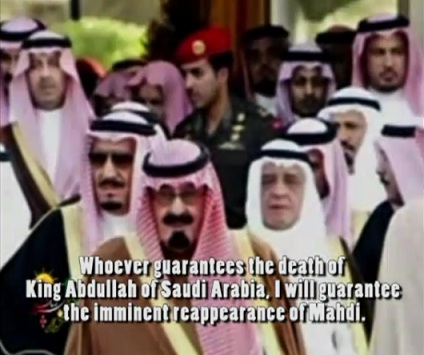
Okay, I’d say things are heating up. Here’s a screen grab from what we are led to believe is a recent video from Iran, made with government backing as described below the fold.
According to Kahlili, who has also posted the full video to YouTube, it is a half-hour long program sponsored by the Basij militia and the Office of the President of Iran, affirming the soon-return of the Mahdi.
And containing “inflammatory language” about King Abdullah of Saudi Arabia (see subtitle above)? Can I say that?
For what it’s worth, the supposed “hadith” about the death of King Abdullah is discussed in some detail at The Wake-Up Project, so it’s definitely “in the air” — but I don’t recall seeing any references to it in Abbas Amanat, Abdulazziz Sachedina, or any of the lists of Signs of the Coming I’ve read, so my suspicion is that this is an opportunistic addition to the corpus rather than a reliable hadith.
Which brings me to my last point:
I am not posting these materials to encourage panic — that’s what terrorism strives for, and it is the very opposite of what I would wish to see. If anything, these stirrings of Mahdist sentiment should make us more careful and attentive to the serious scholarly work that has been done in this area. Jean-Pierre Filiu‘s book Apocalypse in Islam, which I reviewed for Jihadology, would be an excellent place to start.
*
There are plenty of other things going on that I would love to track, blog about or comment on these days, but for the next while I shall try to restrain myself and focus in on this particular issue and its ramifications:
Contemporary Shi’ite Mahdist expectation
The Iranian nuclear program in the light of Mahdist expectation
Iranian attempts to use Mahdism to unite Sunni and Shi’a
Mahdism and jihad
The role of Khorasan in Mahdist rhetoric
Christian apocalyptic responses to Mahdist stirrings
Joel Rosenberg‘s book, The Twelfth Imam
Joel Richardson‘s book, The Islamic Antichrist
Glenn Beck‘s increasing focus on Iranian Mahdism
The increasing influence of Islamic and Christian apocalyptic on geopolitics
This is a pretty complex and potent mix of topics, and while I’ll post some individual pieces of the puzzle as I see it, I shall also try to put together a “bigger picture” piece with the whole mosaic laid out.
*
Apart from that, I remain deeply committed to questions of chivalry and peace-making, and will continue to monitor developments and write what I can on those topics as time allows…
I’m certain there are SFODAs (SF Operational Detachment Alpha) that have planned and trained for employment in Libya to support guerilla operations. But given our decade long preoccupation with Iraq and Afghanistan, those teams may not be immediately available or not immediately ready to move into Libya. On the other hand, I’m sure there are teams with Arabic and desert training ready to go in the 3rd, 5th or 10th Groups. The headquarters for the operation would probably be in Stuttgart, Germany where EUCOM, AFRICOM and, conveniently enough, 1st Battalion, 10th SFGA are located. An assessment/ command team should be immediately inserted into Benghazi to make contact with the Libyan resistance. In a previous post I alluded to the difficulty and criticality of this initial contact. How this team will be received is unknown. However, I am getting the impression that the resistance forces initial euphoria is being tempered by the realization that they have a difficult struggle ahead of them. This assessment team will serve as liaison to the resistance leadership and a command element to the SFODAs to follow. The assessment team will determine the size, abilities and needs of the resistance fighting forces and relay this information to Stuttgart so the SFODAs can properly prepare for their insertion. The ODAs will be in isolation intensively preparing for their insertion and mission execution. ….
…The Long War against extremism has spawned an explosion in books on global terrorism and America’s interventions in Iraq and Afghanistan. While Operation Enduring Freedom was the first counter-blow, following quickly on the heels of 9/11, it has not garnered as much attention as the larger Iraqi conflict. In contrast, the protracted contest in Mesopotamia generated George Packer’s Assassin’s Gate, Tom Ricks’ superlative Fiasco and The Gamble, and Linda Robinson’s Tell Me How This Ends among others.
Afghanistan has produced some notable exceptions. Sean Naylor’s Not a Good Day to Die topped the field until Sebastian Junger’s War was issued last year. The former was an operational history of the ferocious fight against Al Qaeda in the Shahikot Valley during Operation Anaconda in March 2002. Junger’s micro-epic focused more narrowly on a small unit over a longer period of time in 2008 in the Korengal Valley.
The imbalance in our bookshelves is starting to become rectified, and Bing West’s latest book tops the list. Mr. West, a former Marine, Pentagon policy official and noted author, brings much insight and no small amount of prior experience to this particular subject. During the Vietnam War, he had the opportunity to closely examine creative approaches and political complications of modern conflict. His first book, the renowned The Village, captured the complexity of American efforts to provide local security assistance to a foreign population beleaguered by a fierce conflict.
Zenpundit is a blog dedicated to exploring the intersections of foreign policy, history, military theory, national security,strategic thinking, futurism, cognition and a number of other esoteric pursuits.