zenpundit.com » islamist

Archive for the ‘islamist’ Category

Tamerlan Tsarnaev end times videos I: the Mahdist video, pt 2

Sunday, April 21st, 2013

[ by Charles Cameron — the Jewish Afghans — part 2 of a series on two end times videos that Tamerlan Tsarnaev “liked” ]
.

At this point, we are about a quarter of the way into the Mahdist video I was describing in the first part of this post, and you’d be well-advised to catch up to speed there if you want to follow along here… with the fascinating story of the Afghan children of Isaac.

At [03.16, 03.28 and 03.37] the story begins to unfold [transcripts below]:
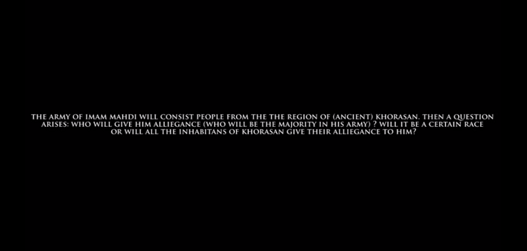
The first of these reads:

The army of Imam Mahdi will consist people fro the region of (ancient) Khorasan. Then a question arises: who will give hin alliegance (who will be the majority in his army)? Will it be a certain race or will all the inhabitans of Khorasan give their alliegance to him?

The second:

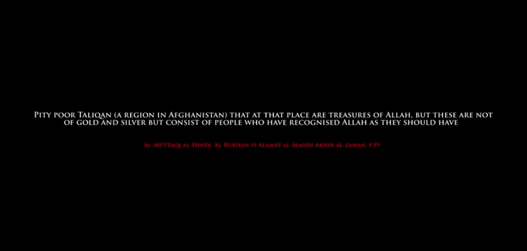
Pity poor Taliqan (a region in Afghanistan) that at that place are treasures of Allah, but these are not of gold and silver but consist of people who have recognized Allah as they should have

Al-Muttaqi al-Hindi, Al-Burhan fi Alamat al-Mahdi Akhir al-zaman, p.59

It is interesting to note that Harun Yahya quotes this same hadith under the heading “The Occupation of Afghanistan (1979)” and comments:

There is an indication that Afghanistan will be occupied during the Last Days. The Russian invasion of Afghanistan took place in 1979 (1400, according to the Islamic calendar).

The third is headed “Note” in red, and reads:

The word Taliqan not just mentions the Taliqan region of today only but it describes the whole of the area since in older times sometimes a name of small region describes the whole of the region for example the King of whole Afghanistan and many parts of Central Asia i.e. MAHMUD OF GHAZNI was known as the KING OF ZABUL (Persian Poet Firdausi always called him as SHAH-E_ZABUL in his famous poem “Shahnama Ferdausi”). Zabul was a small province but the whole area was known as ZABUL at that time. SO the word TALIQAN means the whole of the area of Khorasan and not just TALIQAN itself.

I have tried to copy the spelling and syntax of the original, which to my ear might betray a touch of the subcontinent — but may of course have introduced errors of my own, or those of some damnable auto-correct function.

To continue. There’s something decidedly educational going on here in this video – the first, I do believe, that I’ve seen footnoted in quite this way.

The next four text slides read [04.00, 04.10, 04.15 and 04.30]:

We now know that the army of Mahdi will come out of Khorasan with their black banners and as to the question earlier (will it be a certain race or will all the inhabitants of Khorasan give their alliegance to him?

*

This answer is given to us when we read (the hadith in)
Saheeh Muslim Kitaab al-Fitan Hadith 2920

*

Abu Huraira (RA) reported that the Prophet (SAW) said, you have heard about the city of which is in the land and the other is in the sea (Constantinople). They said, Allah’s Messenger, yes. Thereupon he said, The last hour would not come unless seventy thousand persons from BANI ISHAQ would attack it.

Ishaq/Isaac: son of brahim/Abraham, father of Yaqub/Jacob

*

When they would land there, they will neither fight with weapons nor would shower arrows but would only say: “There is no god but Allah and Allah is the Greatest,” that one side of it would fall. Thaur (narrator) said: I think that he said: The part by the side of the ocean. Then they would say for the second time: “There is no god but Allah and Allah is the Greatest” that the second side would also fall, and they would say: “There is no god but Allah and Allah is the Greatest,” that the gates would be opened for them and they would enter therein and, they would be collecting spoils of war and distributing them amongst themselves that a noise would be heard and It would be said: Verily, Dajjal has come. And thus they would leave everything there and would turn to him.

And at this point, with pedagogical precision, there’s a numbered summary of what we’ve learned thus far [05.01]:
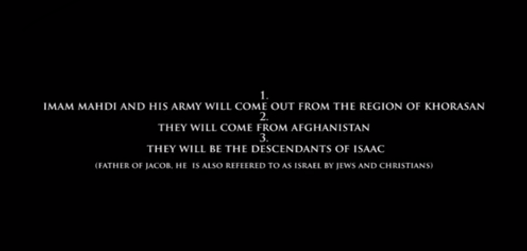
Then an Afghan appears in video [05.06 forward] —
— while what sounds to me liker a cultured British voice translates:

When I was young, and had no beard, my grandfather’s uncle died at the age of a hundred and fifteen. He used to say that we are the children of Israel. I am of the Musahem, the People of Moses.

Got that?
**

And then things take another interesting turn. Our next screen-grab offers an introduction:
What follows is the “Jewish (Bible) scholar” — on camera —
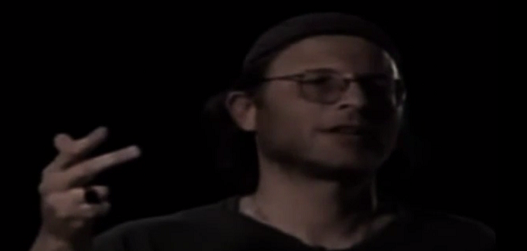
saying [05.32]:

We are in a country that is supposedly dominated by Muslims, but not Muslims just any Muslims, Muslim fundamentalism, And yet, we come face to face with people that say, “We are Musahem – We are from the people of Moses”. Reuben, Gad, Ephraim, Shimon – four more tribes. So we’ve actually located nine of the tribes. Or, let me put it differently: we think we located nine of the tribes. If we haven’t located nine of the tribes, then it’s a very strange coincidence going on, that you have all these people, with Biblical names, with Biblical practices, with an Israelite memory, exactly where they should be according to the Biblical map.

I’m glad the next slide says, again, “And Allah knows best”. But then it segues into the Mahdi’s physical appearance, and again there’s a Jewish strand…

And Allah knows best
Now, let’s look at a hadith which explains Imam Mahdi’s appareance

Here [06.44] follows a long paragrapoh, which I’ve transcribed for easier reading:

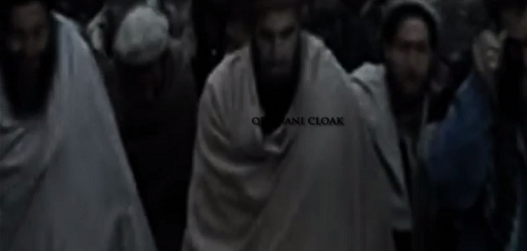
The appearance of Imam Mahdi (according to AHadith) is that he has deep wheatish complexion, light stature, medium height,beautiful broad comlexion, long straight nose, eyebrows round like bow, big natural black eyes, very white front two teeth and with a spacing between the teeth, a black mole mark on the right cheek, face glowing like a shining star, a mark on shoulder like that of Prophet Muhammad (SAW),complexion like the Arabs and body like the Childern of Israel, slight stutter in the tongue due to which he hits his right hand on left thigh sometimes because of annoyance, will appear at the agae of 40 ,while praying to Allah he will expand his hands for prayers like birds expanding their wings, will be wearing Qutwani cloaks (the clothes of the Children of Israel), will resemble in character to Prophet Muhammad (SAW) but in appearance he will be different from Prophet Muhammad (SAW)

And this section closes with an illustration — again, presumably from Afghanistan — of what is meant by a Qutwani cloak [07.26]:
**

I am going to take a break here, at the end of the section in which the people of Afghanistan, and indeed the Mahdi himself, are seen as having characteristics of the Children of Isaac.

In the third and, I hope final, section of this post, Jesus will make a stunning appearance, and attention will then turn back to Khorasan and the march of the black banners on Jerusalem… That final section of this post will, God willing, appear tomorrow.

In the meantime, I’ll also post Tamerlan Tsarnaev end times videos II: a Vinnie Paz video, which deals briefly with a second “end times” song that Tsarnaev “liked” — this one a whirl of contemporary conspiracy theories with Shaytan at the helm…
Tamerlan Tsarnaev end times videos I: the Mahdist video, pt 1

Saturday, April 20th, 2013

[ by Charles Cameron — possibility of Mahdist belief or sympathies on the part of one of the Boston bombers surfaces, with some details of the relevant video ]
.

Source: https://twitter.com/gregorydjohnsen/status/325264215025782788

**

Having said that, here’s the explicitly Mahdist video that Tamerlan Tsarnaev liked on FaceBook — one of two “end times” videos as it happens, and worth viewing in context with the other.

The theme here of the black banners of Khorasan is one I have been writing about for years now, as the editors at NRO kindly noted yesterday.

**

I’m not alone in noticing this video [1, 2, 3], but I may have more interest in it than many others, because I believe Mahdism — and “end times” excitement in general — is a volatile conceptual additive and should be handled with considerable caution.

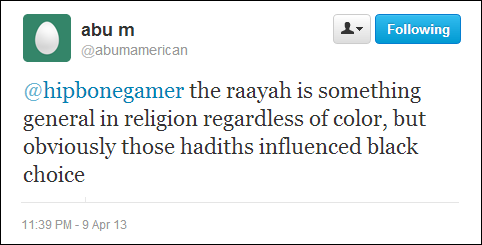
In particular, I would note that the “black banners of Khorasan” ahadith, cited in the video, have been widely used in AQ recruitment as reported by ex-FBI agent Ali Soufan and Syed Saleem Shahzad in their respective books [1, 2], although the ahadith are of probable Abbasid origin as suggested by David Cook [Contemporary Muslim Apocalyptic Literature, Chapter 8, Apocalyptic Predictions concerning Afghanistan and the Taliban, pp. 172 ff.] — and indeed, I’d recently asked the tweeting American mujahid Abu Mansoor Al-Amriki (Omar Hammami):

to which he’d responded:

[ I started to tweet occasional theological questions to Abu M after he instructed his followers to read Zenpundit, here and more emphatically here — I believe the post he was specifically referring to was this one ]

**

Okay.

This account of the Mahdist video would make a long post, and if you can watch the video and make out most of what it is saying in the title cards (intertitles) that form, along with the occasional voice over, the through-line of the movie, you won’t need most of the rest — I’m mostly going to offer transcriptions of those portions that aren’t too fuzzy for me to read.

Three things you might find worth noting, however, are:

  • the quotes from Imran Nazar Hosein, whom I’ve discussed before eg: 1, 2, 3, 4], starting in this section
  • the section on the supposedly Jewish origins of the Afghan people [which I discussed in some detail here], in part 2 of this post, and
  • the short clip from Mel Gibson‘s The Passion of the Christ which has been slipped into the video with dramatic effect, in part 3.
  • **

    For those of you who feel like following along — and there’s plenty of detail of interest — I’ve broken the thing into parts, and my account of the video begins here…

    After the Bismillah:

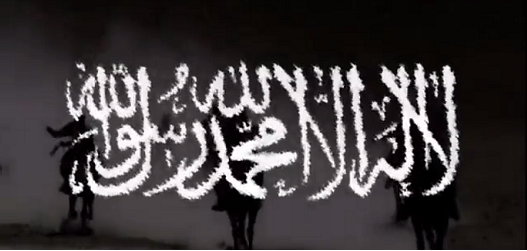
    … followed by a card proclaiming it to be the work of T.R.U.E.E. Productions [00.07], the video begins with the “black banner” itself [00.21], in this form:

    This serves as the opening title of the video, which is presented on YouTube and a minute into the video with the title “The Emergence of Prophecy: The Black Flags From Khorasan“. The banner fades slightly to show present-day horsemen, presumably from Afghanistan:

    There are others — I’m thinking of Chris Anzalone and Aaron Zelin — who could tell you the origins of the various video clips and anasheed that are used throughout the video, but I’ll confine myself to the text cards and voice overs.

    Over the last of the horsemen, the voice of Imran Nazar Hosein speaks [00.46]:

    The prophet said, “When you see the black flags coming from the direction of Khorasan, go and join that army.” That army has already started its [march). They know it. And that’s why they demonize as a terrorist anyone, anyone who supports that army. They know it. And that’s why they demonize as a terrorist anyone, anyone who supports that army.

    That’s the end of the Intro, after which the title in English appears [01.16]:

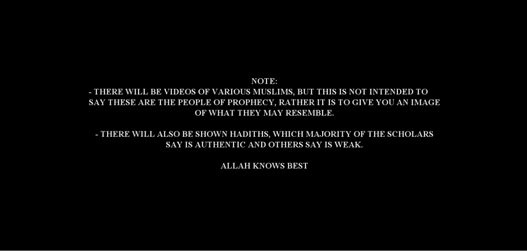
    For a bit of flash and excitement, there’s a count-down [01.23 – 01.32] — we’re approaching zero hour, I’m guessing — and the first major text card shows up [01.38]. It is the first of several “notes”:

    The caution exhibited here is interesting — someone doesn’t want to be caught out in an error by theologically more sophisticated viewers, hence the admission that some scholars view the black banners of Khorasan ahadith as weak… and the always welcome admission:

    Allah knows best.

    At [01.56] a hadith is introduced over black and white visuals of war by night:

    I’ve magnified this one a little for easier reading [02.09]:

    The citation in red is hard to make out, but I believe it references “Sunan Ibn Majah Hadith 971 Volume 3”.

    The statement, “their weapon will be the weapon of Emaan (Faith)” is of interest, compare in the New Testament Ephesians 6.13-17 —

    Wherefore take unto you the whole armour of God, that ye may be able to withstand in the evil day, and having done all, to stand. Stand therefore, having your loins girt about with truth, and having on the breastplate of righteousness; And your feet shod with the preparation of the gospel of peace; Above all, taking the shield of faith, wherewith ye shall be able to quench all the fiery darts of the wicked. And take the helmet of salvation, and the sword of the Spirit, which is the word of God.

    as is the reference to the conquest of Constantinople “without materialistic weapons”. But all that’s fodder for another post on another day.

    At [02.36] we get:

    The text in red here — compare with the use of white and red print against a black background in the screen-grab by JM Berger from an As-Sahab Media video at the top of this post — reads fairly clearly:

    Saheeh Muslim Book Hadith 2896, page 1904, volume 3

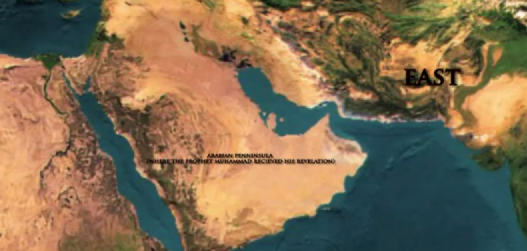
    There’s a brief flash of the world map, then this map with its central text in small print and the word EAST quite large by comparison [02.54]:

    That central text reads:

    Arabian Penninsula
    (Where the Prophet Muhammad received his Revelation)

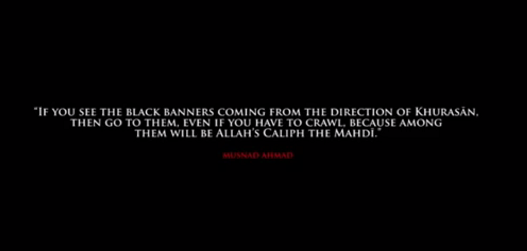
    Next coes another hadith [02.59]:

    Here the only reference is “Musnad Ahmad”.

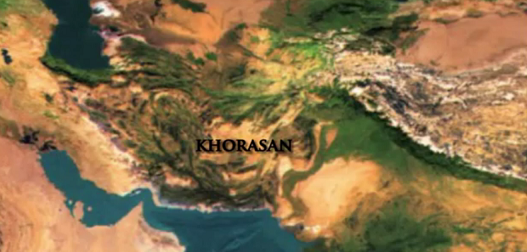
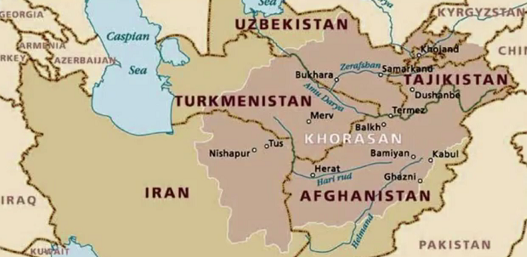
    Then two maps identifying Khorasan [03.04 and 03.07]:

    So that’s the set-up.

    Things get pretty intriguing around here, as a question is posed as to the race or races of those who will follow the black banners, and the comments on Afghanistan and the Lost Tribes of Israel begin…

    **

    I’ll take a break here, and continue in Part II.

    A Boston DoubleQuote, via Jim Friedrich

    Saturday, April 20th, 2013

    [ by Charles Cameron — the subject of interest is in the details ]
    .

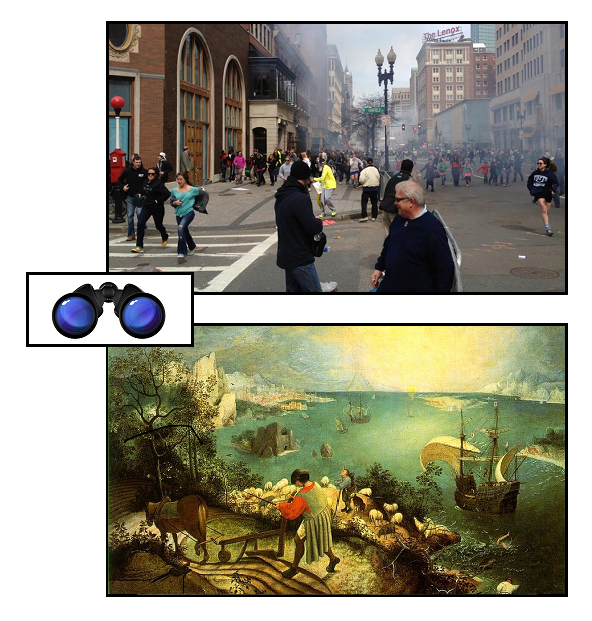
    My friend Jim Friedrich, an Episcopalian priest and artist, posted a thought-provoking juxtaposition of images on FaceBook yesterday, which I have resized and cropped to fit my own DoubleQuotes format:

    Fr Friedrich’s comment:

    This photo snapped Monday in Boston is like Brueghel’s “Fall of Icarus.” The critical subject in each is, from the viewer’s position, just a small detail practically lost in the totality of the scene. Very strange to look at, and to think about – ethically, existentially, theologically…

    **

    Also worth recalling in this context is WH Auden’s poem, Musee des Beaux Arts:

    About suffering they were never wrong,
    The old Masters: how well they understood
    Its human position: how it takes place
    While someone else is eating or opening a window or just walking dully along;
    How, when the aged are reverently, passionately waiting
    For the miraculous birth, there always must be
    Children who did not specially want it to happen, skating
    On a pond at the edge of the wood:
    They never forgot
    That even the dreadful martyrdom must run its course
    Anyhow in a corner, some untidy spot
    Where the dogs go on with their doggy life and the torturer’s horse
    Scratches its innocent behind on a tree.

    In Breughel’s Icarus, for instance: how everything turns away
    Quite leisurely from the disaster; the ploughman may
    Have heard the splash, the forsaken cry,
    But for him it was not an important failure; the sun shone
    As it had to on the white legs disappearing into the green
    Water, and the expensive delicate ship that must have seen
    Something amazing, a boy falling out of the sky,
    Had somewhere to get to and sailed calmly on.

    **

    I hope to post something tomorrow on the Mahdist video that Tamerlan Tsarnaev “liked” on FaceBook and added to his “Islam” folder. In its own way, that’s a minor — yet significant — detail, too.

    Khorasan to al-Quds and the Ghazwa-e-Hind

    Tuesday, April 2nd, 2013

    [ by Charles Cameron — expecting the unexpected — transcribing Bill Roggio on “something that everyone is overlooking” and Ambassador Haqqani on “one of the unwritten books it has been my desire to write” ]
    .

    I’ve talked about the “Black Banners” hadith and the Mahdi‘s victorious army marching from (roughly) Afghanistan to Jerusalem more than once, and perhaps less frequently, the other prong of the jihad, the Ghazwa-e-Hind, which flows from Pakistan into India. In the video that follows, Bill Roggio of the Long War Journal talks with Husain Haqqani, one-time Pakistani Ambassador to the US — and both have some striking things to say.

    We pick up the conversation close to the end of the first half of a two-tape session at the Foundation for the Defense of Democracies — and I’ve provided a transcript after the video, for easier quotation and annotation.

    **

    BILL ROGGIO:

    One of Al-Qaida’s propaganda since it took a beating in Iraq was, that they made the Khorasan, which is an old Islamic empire basically in central Asia and South Asia, they said that this is where we are going to beat them, and once we win in the Khorasan, we’re going to move towards the Levant. So this has become a key part of AQ’s propaganda. What do we think is going to happen when we lose in Afghanistan, when the second superpower loses? That is going to be a huge recruiting boom for foreign terrorists operating in Afghanistan. I think this is something that everyone is overlooking as we’re running for the doors in Afghanistan.

    That’s a pretty powerful prediction, though prediction itself is a high risk enterprise. And it bears repeating that the Khorasan hadith is explicitly an “end times” prophecy. Ambassador Haqqani then doubles up on Bill Roggio’s concern, adding in the Ghazwa-e-Hind, which he describes as both “famous” and “the final, biggest war between good and evil and between Islam and kufr”…

    A lot of people make fun of the Pakistani analyst and Youtube personality, Zaid Hamid, who seems to be the main public proponent of the Ghazwa — take a look here to see a wild sampler! — which is why I find Ambassador Haqqani’s response particularly impactful.

    HUSAIN HAQQANI:

    You know, there are days when I think I should have stayed in the scholarship business and written some of that stuff I was writing at that time. This was one of the things, even before Iraq, I had pointed out. For example, bin Laden had given a statement at that time about Americans being the new Mongols, and nobody could understand what he was talking about, and I said he’s talking about the 1258 conquest of Baghdad, and he’s playing on Islamic history and Islamic mythology.

    And so Khorasan was an important element in that because, if you remember, the Abbasids rose to power through Khorasan, because that was an important element, they overthrew the Umayyads based on the argument that there is a hadith – which in my opinion is of relatively weak significance, but I am taking off my hat of a theologian since I never completed my religious training – but anyway, they used that, that there is a hadith, that the people from Khorasan will come and save the people of the Levant or whatever. And so that was used, and that was used again, and that has been part of the Al-Qaeda thing.

    And then the other part is this famous Ghazwa-e-Hind, and the Pakistani groups use it – actually, just as jihad is the war, a holy war or war for religious purposes, ghazwa is a battle — and there is ostensibly a saying of prophet Muhammad that before the end times, the final, biggest war between good and evil and between Islam and kufr is going to take place in Hind, which is India, which is the land east of the river Indus.

    So Khorasan takes care of what is today Afghanistan and some parts of central Asia, and all of that – it means a lot to people who believe in it, these end times prophecies etcetera. So one of the unwritten books it has been my desire to write, I wrote a piece on it once, an article I think, which said, that, you know, Americans pay a lot of attention to their own end time prophecies, but getting into that whole theater, they have totally neglected this.

    And so far as recruitment is concerned I am totally agreeing with you, that failure in Afghanistan is going to be a big boon for both. The TTP — the Tehrik-i-Taliban Pakistan — and the Pakistani groups are going to start saying, Right, now is the time to start recruiting, and fighting in that famous Ghazwa-e-Hind –let’s get ready for that. And the Arab groups are going to say, Ah, salvation is coming by joining up with the folks who are fighting in Khorasan.

    And both those fronts are going to be a source of a lot of problems.

    Increased jihadist recruitment, and India as a second major front for the jihad — that’s quite a left lead and right cross combo…

    **

    Do you recall the opening of Aldous Huxley‘s final novel, Island?

    “Attention,” a voice began to call, and it was as though an oboe had suddenly become articulate. “Attention,” it repeated in the same high, nasal monotone. “Attention.”

    Man in the moon: armed and dangerous

    Sunday, March 31st, 2013

    [ by Charles Cameron — just kiddin’ ]
    .


    .

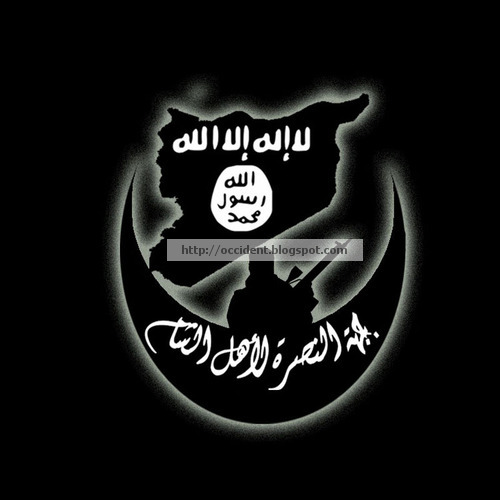
    Chris Anzalone keeps us all up to date on the videos, graphics and anasheed used by various jihadist movements in recruitment and rejoicing/mourning via his various Ibn Siqilli blogs. Yesterday, he featured the graphic above in a post on Jabha al-Nusra, and it caught my eye.

    The crescent moon (normally accompanied by a star) is a symbol of Islam. The man, Chris tells me, is “just the silhouette of a photo of a gunman from a photograph, which, if I remember correctly, isn’t from Syria”. The outline map, however, is of Syria. The black banner motif inside the map, reading “No god but God” and showing the Prophet’s seal, is now pretty widespread, but with some AQ and sometimes specifically Khorasan / Mahdist associations.

    **

    The man in the moon is a jihadist? Does NASA have drone capability? Is this what President Reagan‘s “Star Wars” Strategic Defense Initiative was all about?


    Switch to our mobile site