zenpundit.com » terrorism

Archive for the ‘terrorism’ Category

Glenn Greenwald misses target, hits good guys

Friday, August 17th, 2012

[ by Charles Cameron — I pretty much follow the people I follow because I learn from them, and that builds trust and friendship ]
.
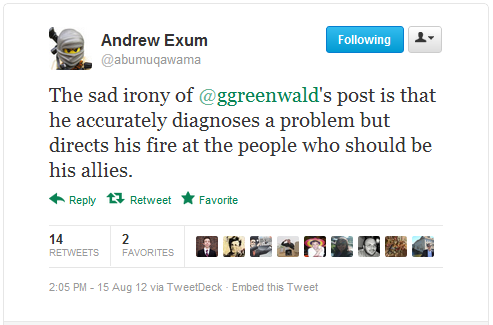
Exum nails it.

I mean, I can well imagine there are some phony “experts” on terrorism out there, but Glenn Greenwald hasn’t done his homework and misfires. Let me explain.

**

I don’t know about you, but I sometimes think the words that someone ends a book with are kinda significant. They’re the ones that give you the impression the author wants to leave you with. That’s partly why I go on and on at such length about the final hundred pages of Abu Musab al-Suri‘s Treatise being devoted to an exposition of apocalyptic hadith with strategic application.

So when Daveed Gartenstein-Ross writes an entire book arguing that al-Qaida’s strategy is to defeat the US by draining its economy – fair enough, given that bin Laden himself said he was continuing a policy of “bleeding America to the point of bankruptcy” – it should come as no surprise when Gartenstein-Ross closes his book with the following words:

When we are facing a crushing national debt, the interest payments for which are projected to eclipse our current defense budget by 2019, we cannot afford to overreact to every terrorist threat and to intervene in every conflict.

The course to maintaining American power in the twenty-first century begins with conserving our resources. And this must be as true of our counterterrorism and military efforts as it is of any other segment of the federal budget.

Likewise, when someone writes a 30-page analysis of the FBI’s infiltration of the Patriot movement, as JM Berger did in his report on PATCON for the New America Foundation, it’s hard to imagine that he’s solely concerned with Islamic terror. Indeed, Berger was researching the “Aryan Republican Army” at least as far back as 2006, when he posted Richard Guthrie’s Suicide: New Details Of ‘Aryan’ Bank Robber And OKBOMB Suspect’s Death In Prison; more recently, he published a piece about the Turner Diaries and today’s Patriot movement in the Daily Beast in June of this year.

**

It’s curious, then, and sad, that these are the two people that Glenn Greenwald specifically picks out by name and photograph to attack in his final, ill-informed piece for Salon, The sham “terrorism expert” industry, writing:

Gartenstein-Ross’ entire lucrative career as a “terrorism expert” desperately depends on the perpetuation of the Islamic Terror threat.

of the fellow who wrote:

we cannot afford to overreact to every terrorist threat

and similarly:

he spends his time doing things like shrieking about the Towering Menace of Anwar al-Awlaki and generally hopping on whatever Muslim-Terrorism-is-a-Grave-Danger train that comes along.

about the fellow who has been tracking many forms of US native terror – including all those mentioned in his piece, A Nation of Spies and Snitches in Foreign Policy in May of this year:

And it isn’t just about Muslims, or even terrorism. In recent months, informants and undercover agents have played a key role in criminal cases involving anarchists in Ohio associated with the Occupy movement and right-wing extremists in Georgia, Arizona, and Michigan

**

Greenwald has gotten this same sort of thing wrong at least once before, when he pilloried Will McCants. Greenwald had written:

I had a somewhat lengthy debate on Twitter last night about the Awlaki assassination with several people often identified as “Terrorism experts” — such as Will McCants and Aaron Zelin — and they and others (such as Andrew Exum and Robert Farley) objected rather vigorously when I said I found the entire concept of “Terrorism expert” to be invalid, as it is a honorific typically assigned due to ideology and interests served rather than actual expertise.

Ouch.

Exum neatly skewered him that time, too, albeit at greater length, writing:

Second, let me consider the case of my friend Will McCants, who Greenwald very much picked on in his Twitter feed along with Aaron Zelin (who I do not know well but who seems really smart in his own right). Greenwald is correct that the decade after the September 11th attacks created all kinds of incentives for self-proclaimed terrorism “experts” to rise to the fore, hawking their “expertise” and opinions on both the consulting market as well as in the mainstream media. Too often, this expertise has been ignorant or barely concealed Islamophobia. Ironically, though, one of the scholars who has done the most to condemn what he calls “CT hucksters” is Will McCants. Will is one of the more rigorously credentialed scholars studying violent Islamist extremist groups as well as being one of the most careful. Will fell into a study of terrorism after doing a Ph.D. in Near Eastern Studies at Princeton. He had no initial academic training in strategic studies or military affairs as far as I know, but his Arabic and understanding of the intellectual currents of political Islam made him ideal to work on al-Qaeda as a case study. And just like I started a dissertation on Hizballah with a background in Middle Eastern Studies and boned up on the theories related to small wars and insurgencies as I went along, so too did Will with respect to terrorism as a phenomenon. At the end of the day, Will is best described as an Arabist, perhaps, but if he is not a bona fide terrorism expert as well — again, no scare quotes necessary this time — I don’t know who is.

History may not repeat, but Greenwald seems to.

The equivalent skewering this time around can be found in Foreign Affairs — in Dan Trombly‘s What’s Glenn Greenwald’s Problem?

**

[ Saving grace note: I don’t think it quite admits me to the clique, but I’ve exchanged emails or tweets with all four of the people Greenwald mentioned with less than due diligence, and consider each of them “virtual acquaintances” and in some cases “friends” ]
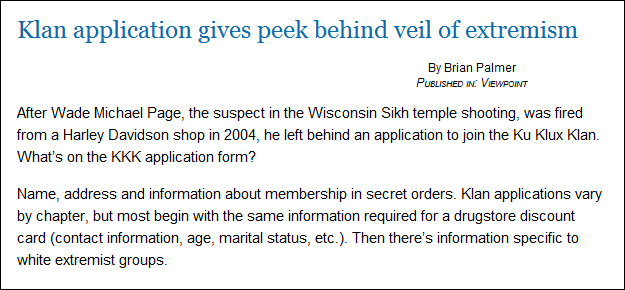
For Klan read Islam?

Tuesday, August 14th, 2012

[ by Charles Cameron — headlines, McVeigh, mea culpa, Breivik, media, guessing games and blame, puns, great tweet ]
.


.

That’s yesterday’s Charlotte Observer‘s headline and opening paras for an article they reposted from Slate, which had more cautiously titled it What’s on a Ku Klux Klan Membership Application?

We’ll come back to that headline later.

**

Okay, seriously.

Educated guesses can prove wrong in retrospect. Educated guesses can lay considerable blame. Educated guesses can have pernicious side effects.

When a bomb ripped through the Federal building in Oklahoma City, many people’s first reaction — including my own — was that it was probably the work of Al-Qaida “Muslim terrorists”.

The media initially broadcast the “Islamist” theory of the bombing quite extensively, and one of the results, according to Penny Bender Fuchs in an American Journalism Review piece titled Jumping to Conclusions in Oklahoma City? was:

A Muslim woman who suffered a miscarriage in her Oklahoma City home said she was afraid to seek medical attention because a crowd of people was throwing stones at her house.

Two more clips from that article:

Within hours of the bombing, most network news reports featured comments from experts on Middle Eastern terrorism who said the blast was similar to the World Trade Center explosion two years earlier. Newspapers relied on many of those same experts and stressed the possibility of a Middle East connection.

The Wall Street Journal, for example, called it a “Beirut-style car bombing” in the first sentence of its story. The New York Post quoted Israeli terrorism experts in its opening paragraph, saying the explosion “mimicked three recent attacks on targets abroad.”

“We were, as usual, following the lead of public officials, assuming that public officials are telling us the truth,” says John R. MacArthur, publisher of Harper’s magazine and author of a book on coverage of the Persian Gulf War. He believes the media overemphasized the possible Middle Eastern link and ignored domestic suspects because initially the police were not giving that angle much thought.

“Reporters can’t think without a cop telling them what to think,” MacArthur says. “If you are going to speculate wildly, why not say this is the anniversary of the Waco siege? Why isn’t that as plausible as bearded Arabs fleeing the scene?”

Most news organizations did mention other possible culprits. They noted the bombing took place on the second anniversary of the government raid on the Branch Davidians in Waco, Texas, suggesting that homegrown terrorists might be responsible. But that angle was buried in most stories.

And:

Jim Lobe, bureau chief for Inter Press Service, says tying the bombing solely to the Middle East “was in a sense a comforting story for Americans.”

Inter Press, a small wire service for papers in the Third World and development agencies in Europe and Canada, was perhaps the first news outlet to raise the possibility that domestic paramilitary fanatics carried out the bombing.

“Of course the Middle East has to be considered,” Lobe says. “But when you considered the weight of all the evidence, it takes you a different direction.”

Lobe, who is familar with militia groups, says many news organizations failed to notice a big clue: traffic on the Internet detailing bomb recipes and talking about the need to avenge the government’s attack on the Branch Davidians. He says the bombing coverage offers “a major lesson for the profession.”

Will that lesson be heeded? MacArthur doesn’t think so. The media are doing a poor job covering Timothy McVeigh and the militia groups around the country, he says. “They are going to turn them into oddball crazies, caricaturing McVeigh as a trailer park terrorist, which is no better than the caricature of the Arabs.”

**

Something similar happened in the immediate aftermath of the Oslo bombing, as this account from the media watch-dog group FAIR details:

On news of the first round of attacks–the bombs in Oslo–CNN’s Tom Lister (7/22/11) didn’t know who did it, but knew they were Muslims: “It could be a whole range of groups. But the point is that Al-Qaeda is not so much an organization now. It’s more a spirit for these people. It’s a mobilizing factor.” And he speculated confidently about their motives:

You’ve only got to look at the target–prime minister’s office, the headquarters of the major newspaper group next door. Why would that be relevant? Because the Norwegian newspapers republished the cartoons of Prophet Mohammad that caused such offense in the Muslim world…. That is an issue that still rankles amongst Islamist militants the world over.

CNN terrorism analyst Paul Cruickshank (7/22/11) took to the airwaves to declare that “Norway has been in Al-Qaeda’s crosshairs for quite some time.” He added that the bombing “bears all the hallmarks of the Al-Qaeda terrorist organization at the moment,” before adding, almost as an afterthought, that “we don’t know at this point who was responsible.”

On Fox News Channel’s O’Reilly Factor (7/22/11), guest host Laura Ingraham declared, “Deadly terror attacks in Norway, in what appears to be the work, once again, of Muslim extremists.” Even after Norwegian authorities arrested Breivik, former Bush administration U.N. ambassador John Bolton was in disbelief. “There is a kind of political correctness that comes up when these tragic events occur,” he explained on Fox’s On the Record (7/22/11). “This kind of behavior is very un-Norwegian. The speculation that it is part of right-wing extremism, I think that has less of a foundation at this point than the concern that there’s a broader political threat here.”

**

Peter Bergen, who wrote the book more than once on Bin Laden and his demise, recently discusses the topic, Right-wing extremist terrorism as deadly a threat as al Qaeda? for CNN — some key findings for perspective:

The word “terrorism” in the United States usually brings to mind plots linked in some way to al Qaeda, while the danger posed to the public by white supremacists, anti-abortion extremists and other right-wing militants is often overlooked.

Militants linked to al Qaeda or inspired by jihadist ideology have carried out four terrorist attacks in the United States since September 11, which have resulted in 17 deaths. Thirteen of them were in a shooting incident at Fort Hood, Texas, in November 2009.

By contrast, right-wing extremists have committed at least eight lethal terrorist attacks in the United States that have resulted in the deaths of nine people since 9/11, according to data compiled by the New America Foundation.

And if, after investigation, Sunday’s attack on the Sikh temple in Wisconsin is included in this count, the death toll from right-wing terrorism in the U.S. over the past decade rises to 15.

The shooting suspect, Wade Michael Page, posed with a Nazi flag on his Facebook page and has played a prominent role in “white power” music groups. The FBI is investigating the case as a “domestic terrorist-type incident.”

Here’s a link to the SPLC’s updated roster: Terror From the Right: Plots, Conspiracies and Racist Rampages Since Oklahoma City.

And there are no doubt other threats, some from potential left wing sources — and some from other half-crazed wingless entities who roam among us on two legs.

**

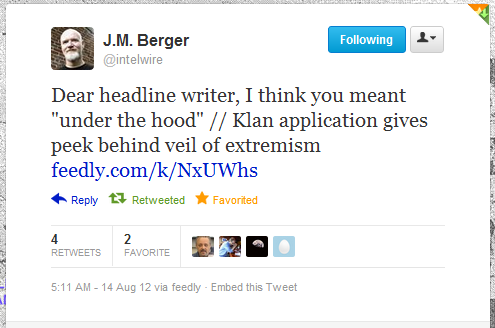
I said we’d come back to that Charlotte Observer headline later. Here we are:

.

That tweet from friend JM Berger — think about it, “veil” suggests “Muslim”, doesn’t it? — and “hood” means “KKK”? — that’s really quite a double-barreled pun — and, given the context, it makes so much more sense!

JM gets my Tweet of the Month award.

My early “close reading” of Nidal Hasan’s .ppt reposted

Monday, August 13th, 2012

[ by Charles Cameron — my original SWJ post featuring my attempt at interpreting Nidal Hasan’s powerpoint slide show when it was first published, plus more recent links ]
.


.

At Zen‘s suggestion, and since it’s no longer accessible on the revamped SWJ site, I’m posting here a link to my 2009 piece, The Hasan Slide Presentation: A Preliminary Commentary, as it originally appeared in .pdf in the Small Wars Journal.

My attempt then was to avoid, if possible, back-reading the facts of the Ft Hood shooting into the Hasan slide presentation — noting that at the time we lacked a clear sense of the verbal commentary with which Hasan had presented the slides.

Avoiding “projective hindsight” remains an interest of mine.

**

More recently, I raised a related question about Maj. Hasan here on Zenpundit, and received first rate answers from:

Daveed Gartenstein-Ross and Lauren Morgan, Nidal Hasan’s “Fairly Benign” Correspondence with Anwar al Awlaki
JM Berger, The Content and Context of Anwar Awlaki’s emails with Fort Hood Shooter Nidal Hasan

with indirect follow-ups from:

emptywheel, It’s Not Just Whether Nidal Hasan’s Emails Stuck Out, It’s Whether Abdulmutallab’s Did, and
Bernard Finel, Was Ft. Hood (or Aurora) Preventable?

**

I’m still in the relatively early throes of learning my new job at UrbIm, but hope to respond to these good folks once I’m a bit more settled in…

But I’ve noticed, I don’t always manage to get to everything… : (

Who among us can comprehend religion? — recent shootings

Wednesday, August 8th, 2012

[ by Charles Cameron — slaughters of Sikhs and Christians and questions of nomenclature: second addendum to my post responding to Scott Atran ]
.

Scott Atran recently argued that it is imperative that we understand religions, and in my post Landmines in Paradise Garden I agreed, while differing with Atran on what kinds of people are best suited to the task.

Here I would like to offer a second addendum to that post of mine, this time inviting ZP’s readers to compare and contrast the two quotes above, and likewise the two tweets below:

using them as, in effect, verbal Rorschach blots — allowing each of us individually to see something of our own ways of comparing and contrasting the two situations, their respective contexts and the ways in which we feel they have been treated by the media — and the two ways of “accurately” describing the tragic event in Oak Creek, Wisconsin.

We can see religion — we can see politics — we can see our own — we can see the other — the possible views and manners of relating to these events are many and varied, but the untimely deaths remain.

It is imperative for us to begin to get a better understanding of religion, in all its shadows and its lights. A little discussion might help.

**

Sources:

Shooting at the Wisconsin Gurudwara
Shooting at the Nigerian Church

Accuracy Org tweet
Chip Berlet tweet

For a chilling account of the Nigerian shooting, see this Christian Science Monitor piece (h/t Daveed Gartenstein-Ross)

Warlords Revisited

Monday, July 23rd, 2012

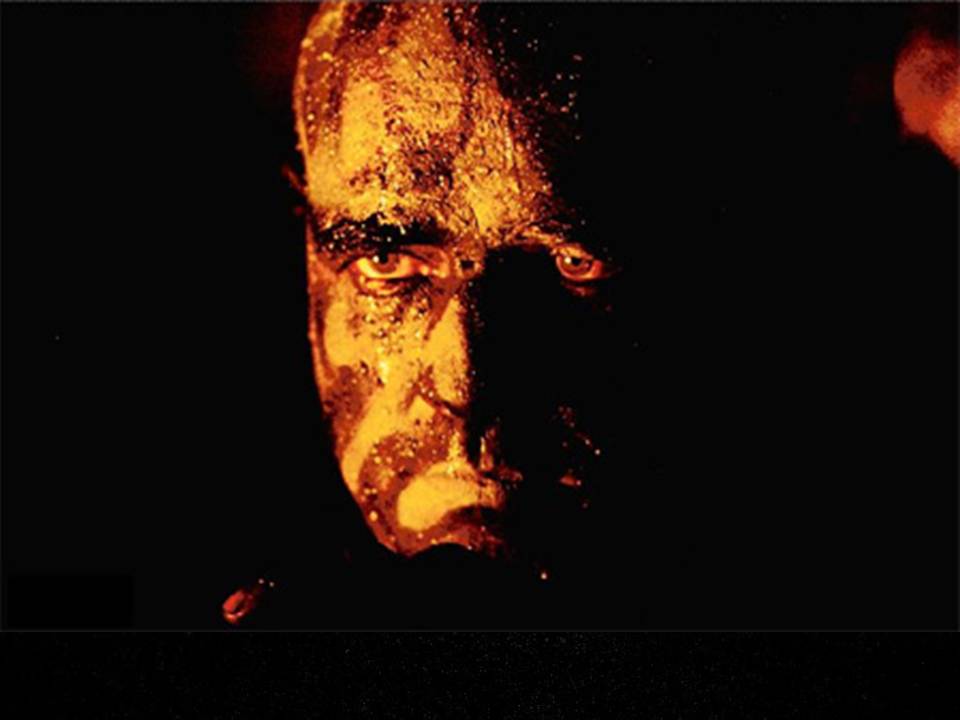
“The horror! The horror!

Charles Cameron sparked a discussion with his doublequotes post on two colonels, the late strategist John Boyd and the fictional monster,  Walter Kurtz from Francis Ford Coppola’s classic Vietnam War film homage to Joseph Conrad Apocalypse Now.  Kurtz is a disturbing figure, one who is recurrent in literature and history going back to Homer’s Iliad. A superlative warrior who excels above all others who nonetheless sheds all trace of civilization in his descent into barbarism. While the fall of a heroic individual can take many narrative forms, Kurtz is of a particular and dreaded kind of fallen man, the warlord.

Warlords are fascinating and repellent figures who seem to thrive best when the normal order of a society is breaking down, permitting the strong and ruthless to carve out their reputations in blood and infamy. As I have written previously:

Kent’s Imperative had a post up that would have been worthy of Coming Anarchy:

Enigmatic biographies of the damned 

“….Via the Economist this week, we learn of the death of an adversary whose kind has nearly been forgotten. Khun Sa was a warlord who amassed a private army and smuggling operation which dominated Asian heroin trafficking from remotest Burma over the course of nearly two decades. In the end, despite indictment in US courts, the politics of a failed state permitted him to retire as an investor and business figure, and to die peacefully in his own bed.

The stories of men such as these however shaped more than a region. They are the defining features of the flow of events in a world of dark globalization. Yet these are not the biographies that are taught in international relations academia, nor even in their counterpart intelligence studies classrooms. The psychology of such men, and the personal and organizational decision-making processes of the non-state groups which amassed power to rival a princeling of Renaissance Europe, are equally as worthy of study both for historical reasons as well as for the lessons they teach about the nature of empowered individuals.

….There are no shortage of warlords for such a study. Among the living we have Walid Jumblatt, the crafty chief of the Druze during the 1980’s civil war in Lebanon, the egomaniacal and democidal Charles Taylor of Liberia, Gulbuddin Hekmatyar the Islamist mujahedin commander and a large assortment of Somali, Colombian, Indonesian and El Salvadoran militiamen and paramilitaries. The history of the twentieth century alone offers up such colorful characters as “The Dogmeat General“, the ghoulishly brutal Ta Mok of the Khmer Rouge, “The Mad Baron” Ungern von SternbergCaptain Hermann Ehrhardt and Pancho Villa among many others.

What would such a historical/cross-cultural/psychological “warlord study” reveal ? Primarily the type of man that the German journalist Konrad Heiden termed “armed bohemians”. Men who are ill-suited to achieving success in an orderly society but are acutely sensitive to minute shifts that they can exploit during times of uncertainty, coupled with an amoral sociopathology to do so ruthlessly. Paranoid and vindictive, they also frequently possess a recklessness akin to bravery and a dramatic sentimentality that charms followers and naive observers alike. Some warlords can manifest a manic energy or regularly display great administrative talents while a minority are little better than half-mad gangsters getting by, for a time, on easy violence, low cunning and lady luck.

Every society, no matter how civilized or polite on the surface, harbors many such men within it. They are like ancient seeds waiting for the drought-breaking rains.

There are occasionally positive portrayals of warlords. Ahmed Shah Massoud, “the Lion of Panjshir” who fought tenaciously first against the Soviets, then later against the murderous Gulbuddin Hekmatyar’s army of thugs and the Taliban’s fanatics, providing a modicum of civilized governance to ordinary Afghans wherever his power ran, until his assassination by al Qaida. The cagey and mercurial Walid Jumblatt, made the transition from Druze warlord in the 1980’s to Lebanese politician and something of an elder statesman.

In literature, Xenophon was the de facto strategos of the retreating Greek mercenaries in The Anabasis of Cyrus, cut a noble example, but like Massoud, this is a rarity. In recent fiction, Stephen Pressfield created as an antagonist in The Profession, General James Salter, a totemic and caesarian figure who takes on the great powers with his PMC forces with impressive ruthlessness. In the popular fantasy series of George R.R. Martin that began with The Game of Thrones, the notable warlord is the outlandish, cruel and somewhat demented Vargo Hoat, who leads a freebooting company of misfit brigands “The Brave Companions“, whose nonstop atrocities and ludicrous pretensions lead all the other characters to call them “the Bloody Mummers“.

Given the world’s recent experiences with the Lord’s Resistance Army, General Butt Naked and the uprisings in Syria and Libya, I think Martin and Coppola have captured warlordism in it’s most frequent incarnation.


Switch to our mobile site