zenpundit.com » warriors

Archive for the ‘warriors’ Category

Now John Robb is in the House!

Thursday, April 2nd, 2009

John Robb is testified today before the House Armed Services Subcommittee on Terrorism, Unconventional Threats and Capability on Terrorism and the New Age of Irregular Warfare: Challenges and Opportunities. John put up a PDF of his testimony at Global Guerillas, here is a snippet but you should read John’s text in full:

MY TESTIMONY

….Against this dark picture, a combination of assault by a global economic system running amok and organic insurgency by superempowered small groups, there are few hard and fast recommendations I can provide. It’s complex. However, it is clear:

  • We will need to become more efficient. Force structure will shrink. Most of the major weapons systems we currently maintain will become too expensive to maintain, particularly given their limited utility against the emerging threat. Current efforts from the F-22 and the Future Combat System appear to be particularly out of step with the evolving environment. Smaller and more efficient systems such as unmanned aerial vehicles and coordination systems built on open platforms (as in a Intranet) that alloworganic growth in complexity make much more sense.
  • We should focus on the local. In almost all of these future conflicts, our ability to manage local conditions is paramount. Soldiers should be trained to operate in uncertain environments (the work of Don Vandergriff is important here) so they can deal with local chaos. Packages of technologies and methodologies should be developed to enable communities in distressed areas to become resilient – as in, they are able to produce the food, energy, defense, water, etc. they need to prosper without reference to a dysfunction regional or national situation. Finally, we need to get build systematic methods formanaging large numbers of militias that are nominally allied with us (like Anbar Awakening, Pakistan’s Frontier Corps, etc.). Even a simple conversion of a commercial “customer relationship management” system would provide better institutional memory and oversight than we currently have.
  • We need to get better at thinking about military theory. Military theory is rapidly evolving due to globalization. It’s amazing to me that the structures and organizations tasked with this role don’t provide this. We are likely in the same situation as we wereprior to WW2, where innovative thinking by JFC Fuller and Liddell Hart on armored warfare didn’t find a home in allied militaries, but was read feverishly by innovators in the German army like Guderian and Manstein. Unfortunately, in the current environment, most of the best thinking on military theory is now only tangentially associated with the DoD (worse, it’s done, as in my situation, on a part time basis).

A classy move on John’s part to take the time during his testimony highlight Don Vandergriff’s program of adaptive leadership ( another guy whom Congress should be hearing from)!

 Chairman Ike Skelton (D -Mo), judging by his impressive reading list in military affairs, is a Member of Congress who would seem to be keen to hear what John had to say. I’m very pleased to see Congress drawing upon the insights of strategic thinkers like John Robb and Tom Barnett, instead of the usual parade of niche specialists from the Beltway tanks.

Go Robo or Go Home

Friday, February 20th, 2009

Shortly after my previous post on the subject, the concept of warrior robots has picked up steam.

Office of Naval Research – “Autonomous Military Robotics: Risk, Ethics and Design” (PDF)

The Times of London –  “Military’s Killer Robots must Learn Warrior Code

FOXnews – “Expert: Robots Will Fight Wars of Future

Israel’s Half-Mad Genius of Mil-Theory

Saturday, February 14th, 2009

Just read this profile of Dr. (Gen.) Shimon Naveh, via Soob via Ubiwar.

….Naveh describes his last and perhaps most important military-academic project, OTRI, as a chronicle of failure. “It was a failure of the group and also my personal failure, but in a far deeper sense it was the IDF’s failure. The IDF has not recovered because it doesn’t have the ability, unless it undergoes a revolution.”Naveh, who established OTRI together with Brigadier General (res.) Dov Tamari, draws on imagery from the world of construction to explain the project. “We wanted to create an intermediate level between the master craftsman, the tiling artisan or the electrician, who is the equivalent of the battalion or brigade commander, and the entrepreneur or the strategist, the counterpart of the high commander, who wants to change the world, but lacks knowledge in construction.”Between the two levels, he continues, is the architect/commander-in-chief, whose role is “to enable the system to understand what the problem is, define it and interpret it through engineers.” In the absence of this link, he maintains, armies find themselves unable to implement their strategic planning by tactical means. “Entrepreneurs and master craftsmen cannot communicate,” he says.Already in his first book, “The Operational Art,” published in 2001 and based on his doctoral dissertation, he described the level of the military architect: “The intermediate level is the great invention of the Russians. [The military architects] occupy the middle, and make it possible for the other fields, from politics to the killers, to understand, plan and learn.”
An interesting and to me well constructed analogy by General Naveh that rings true to me from what I know of the Soviet history. Naveh perfectly describes the peculair adaptive requirements forced on the Red Army by the nature of the Soviet political system, especially as it existed under Stalin from the time of the Great Terror forward ( 1936 -1953). Stalin wiped out much of his senior military leadership of the Red Army during the Yezhovschina in 1937 and decimated the junior officer corps to boot, leaving it thoroughly demoralized and rigidly shackled to political comissars who were, like the military commanders, completely paralyzed with fear ( the Red Navy officer corps was basically exterminated en masse).

When Operation Barbarossa commenced in June, 1941, the dramatic Soviet collapse in the face of the Nazi onslaught was due in part to Stalin’s maniacal insistence that Germany was not going to attack and that assertions to the contrary were evidence of “wrecking” and “provocation” – crimes liable to get one immediately shot. Even a high ranking NKVD official, Dekanazov, whom Stalin made ambassador to Berlin, was personally threatened by Stalin for daring to warn the Soviet dictator about Hitler’s imminent attack.

That being said, Stalin quickly realized during the 1941 retreat that he had debilitated his own army by decapitating it and his own judgment as supreme warlord was no substitute at the front lines for what Naveh terms “operational art”. Stalin the entrepreneur-grand strategist needed competent military architects like Zhukov and Rossokovsky to plug the gap with the craftsmen and Stalin not only promoted and protected them, he tolerated their dissent from his own military judgment and sometimes yielded to their concerns. Very much unlike Hitler who could seldom abide criticism or deviation from his general officers or learn from them. Stalin improved as a war leader from interaction with his generals; Hitler did not and if anything grew worse over time – as did the Wehrmacht’s tactical-strategic disconnect.

The above anecdote represents the rich level of depth behind Naveh’s offhand and seemingly disjointed references. There’s a lot of meat there behind the dots Naveh is connecting but the uninitiated will have to be willing to dig deep. I’m cool toward Naveh’s reliance upon French postmodernism but I admire the breadth of his capability as a horizontal thinker and theorist. However, Naveh needs an “architect” of his own to translate for him and make his complex ideas more readily comprehensible to the mainstream. I will wager that few Majors or Lt. Colonels, be they U.S. Army, IDF or Russian, read much Focault these days.

ADDENDUM:

The SWJ had an interview with Dr. Naveh on his theory of Systematic Operational Design in 2007

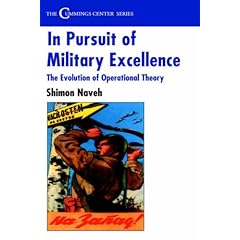
Dr. Naveh’s book is In Pursuit of Military Excellence: The Evolution of Operational Theory (Cummings Center Series)

Joint Force Quarterly (via Findarticle) -“Operational art

Jerusalem Post – “Column One: Halutz’s Stalinist moment

Eeben Barlow’s Military & Security Blog

Tuesday, February 3rd, 2009

The founder of the famous but now defunct PMC Executive OutcomesEeben Barlow has a blog and it will be interesting to most readers here ( major hat tip to Lexington Green but more to Adam Elkus). The link and some samples from Barlow’s posts:

Eeben Barlow’s Military and Security Blog

Putting an End to Piracy – The Only Way

…Surely, someone somewhere must have realised by now that using political correctness as a method of countering piracy has failed – and can never succeed. Water cannons and bean bags have never been a real deterrent – except maybe to ill-prepared rioters. Sending naval task forces into the pirate-infested areas is likewise a hollow threat. Yet, the taxpayers have to fund these navies in order to protect the shipping companies who don’t repay the costs of the naval task forces. In short, it is a great business deal for the shipping companies.Whereas many PMCs and individuals – myself included – have written concepts, plans, proposals and more on how to counter this menace, no one has yet had the courage to implement these plans for fear of international condemnation. International law is in this instance also a prohibiting factor as there is great uncertainty as regards the legalities of having weapons on-board a ship, something that is in reality very simple. But, it seems, no one likes a simple plan. The more complicated it is, the more people like it.

…Even more astonishing is that everyone is keen to give an excuse why the pirates are operating – from the failed-state theory to great poverty. That is, in a sense, much like condoning a bank robber and then making excuses for his criminal behaviour. As long as no one gets seriously hurt, it must be okay…

International Law activists attempting to enforce international law (more of a slippery concept than the MSM presents) are much like the drunkard looking for his car keys under the lamp post. It’s not terrorists, pirates, warlords, genocidaires or dictators or other dangerous and lawless men with guns who consume the attention, time and energy of these generally left-wing intellectuals but instead Western armies, intelligence agents and police who might try to fight stateless brigands. The light is better there, you see.

Fighting Organized Crime

….In South Africa, those that are supposed to police crime are very seldom keen to do their duty. Many of them are, indeed, part of the problem and not part of the solution. Whereas there are police officers trying to make an impact on crime, they are few and far between. Sadly though, success is not something that is evident in these counter-crime actions. Public regard for crime scene investigators and detectives is reaching an all-time low. Their lack of interest in attending to crime scenes is well documented with excuses as feeble as “we don’t have a vehicle…” Visible policing is seen by many to simply be a reconnaissance operation by men in police uniforms before they strike

A worthy add to your RSS feeder or blogroll.

D’Este on Churchill at HNN

Saturday, January 31st, 2009

Military historian Carlo D’Este had an inspiring piece up at HNN last week on Sir Winston Churchill, drawn from his book Warlord: A Life of Winston Churchill at War, 1874-1945:

The Power of Oratory: Why Churchill is Still Relevant

….From the time he became prime minister, until December 1941, when Pearl Harbor brought the United States into the war, Churchill’s strongest weapon was oratory. As a young army officer stationed in India in 1897 he wrote that: “Of all the talents bestowed upon men, none is so precious as the gift of oratory.”

His speeches of 1940 become legendary, not only for their magnetism but more importantly for their effect on public morale. To counter both the disastrous news in France and to put to rest any notion that Britain might capitulate, Churchill delivered one of his many patriotic speeches to Parliament on June 18 that was also broadcast by the BBC. He made no effort to sugarcoat the extent of the dire situation Britain faced. The struggle that lay ahead from the air and likely from invasion would be met with every means and would be rebuffed. Of Hitler and the nations now under the Nazi jackboot, he said, “If we can stand up to him, all Europe may be free . . . But if we fail, then the whole world, including the United States . . . will sink into the abyss of a new Dark Age … Let us therefore brace ourselves to our duties, and so bear ourselves that, if the British Empire and Commonwealth last for a thousand years, men will say, ‘This was their finest hour.’

Read the rest here.

Churchill was an inordinately creative military leader, deeply interested in all facets of warfare from intelligence to technological innovations in armaments ( famously a proponent of the development of the tank in WWI) to military tactics. The amphibious landing at Gallipoli was a disaster but Normandy a generation later, despite Churchill’s misgivings, was a providential success. When in political disgrace – mostly undeserved – as a result of Gallipoli, Churchill did not retire to the shadows but donned a uniform and went to the Western Front ! Moreover he demonstrated there exemplary bravery under fire.

Can anyone imagine a politician doing that today? Or the public expecting him to do so ?

In the Second World War, in 1940 -1941, Churchill was the  indomitible rock upon which Western civilization rested. A lesser man as Prime Minister would have taken easy terms from Hitler and made Great Britain a satellite empire of the Greater German Reich, akin to the Phonecians’ relationship to ancient Persia. Few people alive today realize how dire the situation was in the Spring of 1941 and how close liberal democracy came to vanishing from history. 

Thanks to Churchill and the bravery of the RAF, the West had a chance to catch it’s breath.


Switch to our mobile site

