zenpundit.com » America

Archive for the ‘America’ Category

US Defense Budget, Fear and Interest

Wednesday, March 23rd, 2011


Major Chris, a ZP reader, wrote in today to draw my attention to an item at NRO and I promised a comment:

From Reihan Salam at The Agenda:

Matt Frost and Jim Manzi on US Military Expenditures

Matt Frost (you can find him on Twitter: @mattfrost) copied me on an email earlier today, and he’s kindly given me permission to share his thoughts with all of you:

Comparing the US’s military expenditures against the next three or five potential competitors doesn’t have much analytical value as such, because there are thresholds of capability that you can only cross at some absolute level of cost. Let $x be how much the US spends on the military.

Let $y be how much China spends. The difference between $xand $y, whether in terms of ratio or absolute dollars, doesn’t tell you much, because what matters is value $z, which is how much it costs to field a carrier battle group and maintain bases for air tankers and launch a constellation of GPS satellites and have all your planes be all-weather capable etc etc. Once you get to point $z+1, your capabilities are categorically different from those of a country at $z-1.

Sure, the US spends over $600 billion while the Chinese only spend $98 billion. That difference looks absurd in comparative terms. But between $98 billion and $600 billion there’s a threshold below which you just can’t project power globally. If we think that #winning means global power projection, then cutting to $200 billion won’t work, since it’s not a matter of keeping a 100% lead over the Chinese, or 150% or whatever. Superpower status does not depend on a proportional lead over our competitors; our place at the head of the pack requires staying above that magic increment while everyone else stays below it.

I don’t know what the magic number really is. If it’s $599 billion, then we’re spending the exact amount that our global strategy insists we spend. If it’s $300 billion, then we’re wasting half of every dollar. My hunch is that the real value is closer to the top than the bottom of this range. [Emphasis added]

Hmmm. My two cents:

Comparing the ostensible dollar figures of the Chinese and US defense budgets is a relatively meaningless exercise.

First, like the old Soviet Union, you are not dealing with honest budget figures in regard to Chinese military power. Many military expenditures in China are subsumed by other state agencies, such as for internal security paramilitary troops which even China admits to being slightly over 100% of the PLA budget. This alone would make China’s defense budget twice as large as admitted and we can reckon these figures as being a) underestimates and b) not comprehensive, failing to count military expenditures billed to scientific, industrial, intelligence, nuclear and space related entities. The official published statistics for these items could also be outright lies. Their system is as opaque as it chooses to be. If China’s real national security and defense budget is a cent under $ 300 billion I’d be very surprised.

Then there are the technical economic questions of converting their currency into dollars and whether that accurately reflects the purchasing power of the Chinese government on national security items. Hint: It doesn’t.

It turned out during the Cold War our best analytical efforts grossly overestimated the true size of the GDP of the USSR while vastly underestimating the astronomical percentage of GDP the Soviets devoted to national security and defense. What makes anyone think we are any more accurate today with China when so few of our analysts are expert Sinologists compared to the large number of Soviet specialists during the Cold War?

If you want to understand Chinese power projection capabilities, you have to count the verifiable assets and boots that give them the ability to project power and estimate the degree to which their known logistical capability can support “x” forces at “y” distance for “z” period of time. That will be about as accurate a guess as can be made, along with qualitative assessments of Chinese personnel and equipment and the most probable areas of operation for them. I don’t expect a Chinese Armada off the coast of Uruguay any time soon.

Chinese military power is growing, just ask India or Vietnam, but we need to be realistic about where the PLA is in terms of military power vis-a-vis the United States. We can put an enormously powerful military force on their front porch at will. If it was a contest today of the entire nation of China vs. just PACOM, my money is on PACOM.

That will change in time but how fast and to what degree of adversariality between our two countries depends on far more than just military spending.
Variations on a theme

Tuesday, March 15th, 2011

[ by Charles Cameron ]

*

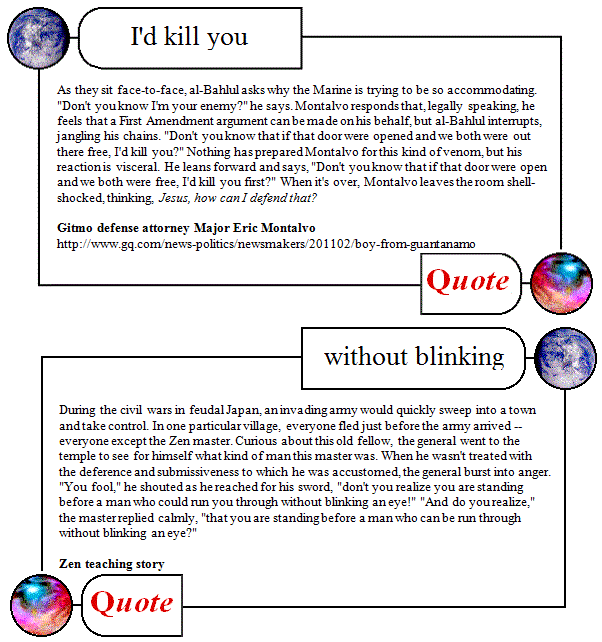
Two stories — continents, centuries and cultures apart — yet as remarkable for their similarities as for their differences. The first concerns a US military defense attorney’s first meeting with a defendant at Gitmo, the second a zen monk…

quokiller-repartee.gif

I already knew the zen story, so the Gitmo version positively flew off the page at me.

I suppose some people will prefer one story, some will prefer the other: for me it’s the almost stereophonic effect of knowing the pair of them that I find more interesting than knowing either one of them separately.

Either one is impressive — together, they dance.

The Oligarchs and Public Debt

Sunday, March 13th, 2011

Shlok hits it on the head:

The Rise of the Corporate State

In order to preserve the portfolios of bondholders, Michigan is ramrodding this legislation:

The new law would allow emergency managers to terminate labor contracts, strip local ordinances, hold millage elections, dissolve a government with the governor’s approval, and merge school districts.

It would allow managers to remove pension fund trustees or become a sole trustee if a pension fund is less than 80% funded. It allows managers to recommend that a local government file for Chapter 9 bankruptcy, but leaves the final decision to the governor.

State legislatures, the bush leagues of American politics, can often be bought up by a special interest for less than one million dollars in campaign contributions. Governors are slightly to moderately more expensive ( a good bit more expensive in large states). A fantastic ROI when it yields control of billions of tax dollars. Better than anything comparable in the private sector except, perhaps, the illegal drug trade.

Acquisition and divestmentment of public debt under what terms by municipalities, counties and local government entities are political decisions. The Republican governor of Michigan, Rick Snyder, has whored himself out to the oligarchy to thwart the ability of local, elected, governments from making smart and perfectly legal business decisions – as contracting parties in a bond market – regarding their public debt so that the taxpayers of Michigan can be farmed as long as possible and at the highest rates, for the benefit of the financial oligarchy. No risk for them but serfdom for you.

This is about as anti-democratic, pro-big government,  pro-high taxes and anti-free market as it gets and it is being promoted by a Republican. 

We need a new major political party if liberty and democracy are to have anyone to speak for them.

Systemic Curricular Choices Shape National Cognitive Traits

Thursday, March 10th, 2011

A brief point.

AFJ has a feature article by General Martin Dempsey on the need for the Army in it’s professional military education system to build future leaders who are critical thinkers:

Building Critical Thinkers

….The Army Leader Development Strategy identifies three critical leadership attributes for all Army leaders: character, presence and intellect. In addition to those three foundational attributes, we assert that strategic leaders must be inquisitive and open-minded. They must be able to think critically and be capable of developing creative solutions to complex problems. They must be historically minded; that is, they must be able to see and articulate issues in historical context. Possessed of a strong personal and professional ethic, strategic leaders must be able to navigate successfully in ethical “gray zones,” where absolutes may be elusive. Similarly, they must be comfortable with ambiguity and able to provide advice and make decisions with less, not more, information. While all leaders need these qualities, the complexity of problems will increase over the course of an officer’s career and require strategic leaders to develop greater sophistication of thought….

Read the rest here.

The nation is currently undergoing a debate about public education, of sorts. I say “of sorts” because the debate has largely been very dishonest on the part of proponents of certain kinds of “reforms” in which they hope to have a future financial interest, if radical changes can be legislatively imposed that will a) drastically lower labor costs and b) permit a “scalable” curriculum, to use the grammar of certain equity investor CEOs and lobbyists. The former does not concern this topic as much as the second, though the two will work in unison to create a profitable business model for a for-profit management company desiring to contract with local and state governments to run school systems.

“Scalability” builds upon Bush era NCLB legislation that emphasized standardized testing in basic math and reading skills, with punitive accountability measures for schools and districts failing to make “adequate yearly progress”. Due to the penalties and escalating standards, public schools have frequently narrowed their curriculums considerably, reducing instructional time for history, science, complex literature and the arts to put greater emphasis on basic skill drill instruction in just two subjects.

The net effect is that American public school students, roughly 88 % of all school children, spend a greater proportion of their day at concrete level cognitive activities than they did five or ten years ago and far less time on higher-level “critical thinking” like analysis or synthesis, making evaluative judgments, inquiry based learning or problem solving.

 “Scalability” means expanding on this dreary and unstimulating paradigm with digitally delivered, worksheet-like exercises to comprise the largest percentage of the instructional time for the largest number of children possible. It will be a low-cost, high-profit system of remedial education for would-be contractors, provided students are not able to “opt out”, except by leaving the public system entirely.

But only if their parents can afford it.

The US military relies upon the public schools to deliver the initial k-12 education of the overwhelming majority of their officer corps, to say nothing of the enlisted ranks. The soldiers, sailors, marines and airmen who went to Andover or similar private institutions before enlisting are very, very few. Today some public schools are excellent, some are failing and the rest are in-between. Most make an effort to challenge students of all ability levels, from those needing extra help to those in AP courses and gifted programs. There is systemic resiliency in a diversity of experiences.

What will be the effect on  the military leadership in the future if critical thought is methodically removed from public education by a nationally imposed, remedially oriented, uniform, “scalable” curriculum that is effectively free of science, history, literature and the arts? What kind of cognitive culture will we be creating primarily to financially benefit a small cadre of highly politically connected, billionaire-backed, would-be contractors?

Can inculcating critical thinking really be left entirely to universities and, in the case of the military, mid-career education?

What kind of thinkers will that system produce?

Better?

Or worse?

“What we think, we become” – Buddha

Government by Assassination

Monday, March 7th, 2011

Pakistani Islamist militants, with the political support of the ISI and some of Pakistan’s higher military leadership, are trodding down a path we have seen before. Assassinations of democratic or tolerant political figures at odds with Islamist extremists and the military elite has become de facto “normalized” in Pakistan.

And popular among many Pakistanis.

Bhatti Killing Should Alarm Pakistan’s Minorities

The murder last week of Shahbaz Bhatti, Pakistan’s minority affairs minister and the only Christian in the cabinet, is a reminder of how dangerous it can be to voice one’s opinion in violence-riddled Pakistan. Bhatti was a liberal who spoke often against Pakistan’s blasphemy laws and their narrow-minded application.

His murder comes just weeks after the assassination of Punjab Governor Salman Taseer, another prominent moderate. Both men were targeted by Islamic extremists because of their calls to reform the blasphemy laws. The purpose of their murders — besides depriving moderates of some of their most courageous leaders — is to frighten moderates and minorities into silence and submission.

What Salman Taseer’s assassination could mean for Pakistan

Experts believe the outpouring of praise for the killer of Salman Taseer, the former governor of Punjab who was slain by his own security detail in Islamabad on Tuesday, reflects deep support for religious intolerance and will have a chilling effect on reform-minded public figures.

“It’s highly dangerous for these religious scholars to say things that do not fit into the legal context of [an] issue. Are they saying Taseer was guilty of blasphemy simply by criticizing a law? In that case, hundreds of thousands are guilty. This is a clear incitement to violence,” says Badar Alam, editor of Pakistan’s Herald magazine and an expert on Islamist groups.

Pakistan’s Bhutto assassinated – World news – South and Central …

NAUDERO, Pakistan – The body of Pakistan opposition leader Benazir Bhutto arrived in her family village for burial on Friday, hours after her assassination plunged the nuclear-armed country into one of the worst crises in its 60-year history.

Enraged crowds rioted across Pakistan and hopes for democracy hung by a thread after the former prime minister was gunned down as she waved to supporters from the sunroof of her armored vehicle.

The death of President Pervez Musharraf’s most powerful opponent threw the nation into chaos just 12 days before elections and threatened its already unsteady role as a key fighter against Islamic terror.

A cadre of military leaders manipulate and orchestrate civilian fanatics to methodically murder and intimidate civilian officials and radicalize the larger society, where have we seen this before? Oh, yes:

Pakistan is a Muslim version of 1930’s Japan.

US policy has hitched itself to a dangerously evolving and increasingly Fascist leadership class in Pakistan that is steadily veering away from any pretense of civilized conduct or partnership with the US, reifying a witch’s brew of Islamist extremism, militarism and anti-Indian and anti-American nationalism.  We need to disengage from and de-fund this monstrosity that bends most of it’s efforts against our interests and values. 

Pakistan is a strategic black hole of an “ally” that is going to blow up in our face someday.


Switch to our mobile site

