zenpundit.com » humor

Archive for the ‘humor’ Category

Grand Blog Tarkin’s Hoth Symposium

Wednesday, February 20th, 2013
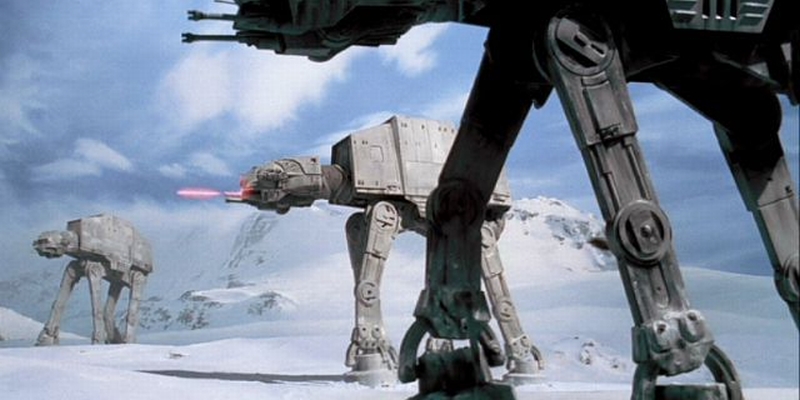
Grand Blog Tarkin is hosting a symposium on the Battle of Hoth. Sparked by WIRED magazine’s original debate begun by Spencer Ackerman, Grand blog Tarkin’s Symposium features some of the finest sci-fi war nerd speculation from keen strategic thinkers from the blogosphere and Twitter.  Oh, yeah, I am participating as well, thanks to Kelsey Atherton.

Here are some excerpts and their authors:

Hoth Symposium Comes Home 

Dunkirk-on-Ice by Graham Jenkins

In 1940, French historian Marcel Bloch wrote a slim volume entitled Strange Defeat, on the incomprehensible defeat of the superior French Army at the hands of the Wehrmacht. 60 years later, Ernest May wrote the complementary version in Strange Victory, an account of the improbable German success in defeating France. Many have written on the utter failure of the Imperial Navy to successfully crush the Rebellion once and for all at the Battle of Hoth, but few have bothered to explore the rather unlikely escape the Rebels made from their icy fortress. “How did they not lose?” Contrary to Spencer Ackerman’s view, the Alliance was faced with dire options and chose mostly the best available.

Ackerman critiques the Alliance for keeping virtually all of their key military players in the same location at Echo Base, but ignores the value of face-to-face, instantaneous communication among Rebel leaders. Collaboration is key to any successful insurgency, and while distributed cells might have a better chance of survival, they still require a core group to perform key coordination and planning functions. This is most effectively provided through close, personal cooperation…. 

The Battle of Hoth and Grand Strategy by Mark Safranski

The key to understanding the Battle of Hoth is not in tactical minutia on the icy surface of the planet, nor in confused imperial strategic objectives or even in the quixotic leadership of Lord Vader, but in grand strategy. As a self-contained polity facing no external foes and only a scattered and poorly armed insurgency, the greatest potential threat to the Empire’s two-man Sith regime would likely emerge from the ranks of the imperial military itself. It was not that the Galactic Empire could not have fielded a vast, overwhelmingly powerful and incomparably competent armada against the Rebellion, it was that Darth Sidious did not dare to do so…..

May the Tech Be With You by Shlok Vaidya

The Star Wars world is a bleak one. Aside from the standard strata of humans, the aristocrats like Leia to the paupers like Solo, there exists a more distinct separation. The Force-enabled and the not. Able to summon electricity from thin air, jump great heights, wield weapons of light, it is no surprise that the Empire is run by those able to use the Force. Or that the Rebel Alliance, filled with battle-hardened veterans who fought day in and day out, for days, months, years in some of the most challenging environments the universe has to offer, suddenly promote the Force-empowered Luke Skywalker despite his lack of combat experience.

In a world where a wave of a hand can change minds, it is hard to say technology matters. But as the Battle of Hoth demonstrates, it invariably does. That particular engagement was an exercise in terrible technology decision making. Tanks with weapons that don’t rotate, raised onto legs reminiscent of ostriches, and move with all the finesse of an overweight wampa. Laser blasts that detonate on impact without consistent grouping. A lack of even basic infrared overlays on a ice-covered planet. The Empire’s foot-soldiers, otherwise decent men pulled from their homes and families to wage war in forsaken lands, were abandoned to the tools provided by the lowest bidder. Minor modifications could have addressed a vulnerability to harpoons. Major platform changes could have wiped out the rebel force in minutes…..

Hoth Symposium Comes Home 2: Late Registration

Let’s Cut the Imperial Fleet Some Slack by Brett Friedman

It’s difficult to tell from the original three movies, but the Imperial Fleet is a very new organization. Their operational and strategic missteps make much more sense in this light. A galactic fleet cannot be built in a day. Although we see a Star Destroyer at the end Revenge of the Sith, a fleet is comprised of more than just ships. Doctrine, tradition, staff work, planning processes, and institutional experience are just as important as the ships themselves. Even though decades elapse between Revenge of the Sith and The Empire Strikes Back, it was just not enough time for the Imperial Fleet to become an elite force.

The Battle of Hoth occurs twenty-two years after Palpatine seized power.The first expeditionary operation conducted by the US Navy after their formative battles during the American Revolution occurred between 1801-1805, twenty six years after its formation. Both of these conflicts were waged against non-state actors by very new nations. Although the First Barbary War was successful for the American Fleet(thanks to a few Marines) there was an embarrassing mistake. The USS Philadelphia was run aground and captured, along with its entire crew, without a fight. Additionally the expeditionary force had to depend on third party support from the Kingdom of the Two Sicilies. Presuming that years in the Star Wars galaxy are identical to our own, the two young fleets had a similar amount of time to develop. The Imperial Fleet that we see in Empire, while presumably leavened with clone-veterans from its formative battles, just did not have the know-how to conduct counterinsurgency on a galactic scale. The tactical and strategic situation that the fleet faced at Hoth was, to them, a new one…..

Missed Opportunity: Rieekan’s Failure at Hoth by Mike Forbes

The conventional wisdom regarding the Battle of Hoth is that it was a major Imperial victory, described in terms of the Rebels as the massively overmatched ragtag band scattering before the unstoppable Imperial juggernaut. Thecontrary wisdom of sci-fi strategists focuses both on the tactical blunders made by the Imperial force, and thestrategic factors that influenced the decision-making of key leaders. Both narratives are wrong. The Rebel Alliance was anything but a ragged insurgent mob; they were a well-equipped and well-organized hybrid threat# at the time. The Battle of Hoth should have been a decisive victory for the Rebels, perhaps even as significant as the Battle of Yavin had been. The Imperial forces bungled what should have been a fairly simple HVT capture or kill mission, their staggering incompetence playing right to the Rebels’ strengths. However, the Alliance only managed to scrape by with a strategic draw due to their failure to take advantage of key opportunities during the battle to strike a massive blow to the Imperial fleet and the Empire’s key leadership. Hoth was also not a total tactical failure for the Empire; in fact they managed to pull off a partial victory, since Echo Base was indeed reduced to rubble, and the Rebels lost a large amount of materiel in the process of their hasty withdrawal under fire. The Imperial forces managed to salvage a partial success out of what by all rights should have been a crushing defeat, thanks to the even greater failures of their Rebel opponents, in particular the criminal negligence of General Rieekan….


 

At first glance, I thought it was Santa

Monday, January 21st, 2013

[ by Charles Cameron — lightweight, feel free to ignore ]
.


.

It isn’t Santa. It’s the image from Raffaello Pantucci‘s piece, Islamists in Africa emerge as threat to West, for the BBC. Raff’s a recently-minted Senior Research Fellow of the Royal United Services Institute.

Cognitive #FAIL on my part. Wishful thinking, perhaps?

Profiling Baader-Meinhof

Tuesday, January 15th, 2013

[ by Charles Cameron — fast cars, bumper stickers — and no mention of loose women ]
.

-- I'm not a member of the Baader-Mainhof gang

.
The sentence that drives my title is this one, from How BMW Became A Terrorist Icon In The 1970s (And How It Made Them Cool) on Jalopnik:

police would set up roadblocks and stop only BMWs in an attempt to root out the gang members from the general population.

That’s profiling for you, eh?

**

Here’s a longer excerpt, so you see where this comes from — and how it turned out, at least for as the makers of BMWs:

In the early 1970s, the extreme left wing Baader-Meinhof Gang terrorized the people of West Germany with a campaign of bombings and assassinations aimed at dismantling a capitalist system they considered no better than the Third Reich.

The terrorists’ ride of choice? BMW New Class sedans and coupes, according to this documentary from historian Richard Huffman, an expert on the Baader-Meinhof Gang.

Huffman says cars became so strongly associated with the group’s acts of terror that police would set up roadblocks and stop only BMWs in an attempt to root out the gang members from the general population.

People even started saying that “Bavarian Motor Works” actually stood for “Baader-Meinhof Wagen.” Some BMW drivers even had to slap bumper stickers on their cars specifying that they weren’t terrorists.

You might expect this to have been a major PR crisis for BMW, then a small and nascent regional automaker nowhere near as prominent as it is today. But it wasn’t. That’s because the Baader-Meinhof Gang, later known as the Red Army Faction, enjoyed a surprising amount of support from people in West Germany, especially among young people and members of the left-leaning counterculture. This went a long way toward making the car seem hip in German youth culture.

Then the gang stopped being theoretical revolutionaries and actually started murdering Germans and U.S. soldiers. When the body count began to rise, public support evaporated. As for BMW, they emerged unscathed from the crisis, and started growing into the luxury giant they are today.

**

Now, what kind of analytic model would predict a series of twists and turns and hairpin bends like that?

Gaming Gandhi

Saturday, November 17th, 2012

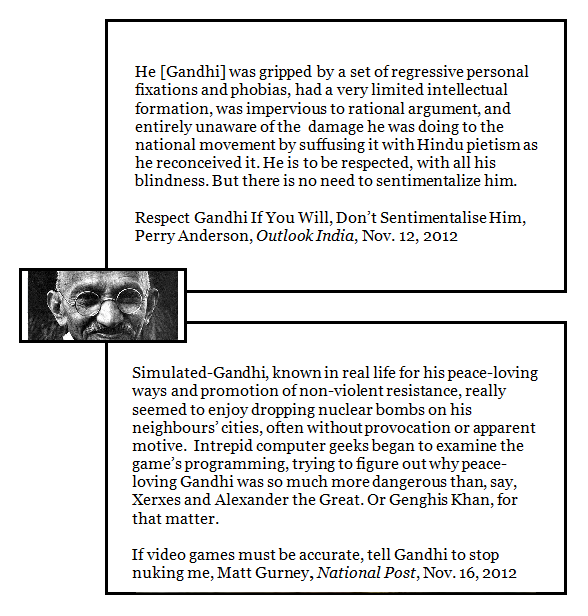
[ by Charles Cameron — two clashing quotes about Gandhi that followed one another in my RSS feed today, funny & strange ]
.


.

Strange, to say the least.

Gandhi was a strategist — as a friend of mine once wrote, “he achieved self determination for the largest number of individuals with the lowest cost in human life” of any rebel known to history —

He managed this feat by holding a position of non-violent non-cooperation, while showing that the ‘civilized’ opponent of the United Kingdom could not live up to its own imposed standards of conduct or law.

And at least some of the time, he was notably unwilling to romanticize himself — he once said:

My nonviolence does not admit of running away from danger and leaving dear ones unprotected. Between violence and cowardly flight, I can only prefer violence to cowardice. I can no more preach nonviolence to a coward than I can tempt a blind man to enjoy healthy scenes. Nonviolence is the summit of bravery. And in my own experience, I have had no difficulty in demonstrating to men trained in the school of violence the superiority of nonviolence. As a coward, which I was for years, I harbored violence. I began to prize nonviolence only when I shed cowardice.

So he’s not the total pacifist he’s sometimes portrayed as.

But nuclear weapons? “Much more dangerous than, say, Xerxes and Alexander the Great. Or Genghis Khan, for that matter”?

Not in India, not back then. In one of Hugh Everett‘s “many worlds”? — perhaps. And in Civ2, the game? — apparently, yes.

**

Quote sources: Outlook India and National Post, with a tip of the hat to Rex Brynen at PAXSims.

Reading a partisan cartoon: the parable of a dog’s ears and teeth

Friday, November 16th, 2012

[ by Charles Cameron — on the difficulties that may be posed when “reading” graphics ]
.

**

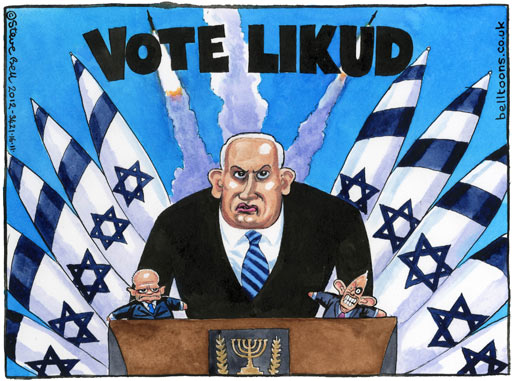
The question I want to ask in this post is: how much can you safely read into a political cartoon?

Here is the particular cartoon I have in mind:

It was published in The Guardian (UK) yesterday, and as you may be able to see, it portrays Israeli PM Benjamin Netanyahu as a puppet-master, with British politicians Tony Blair and William Hague as his puppets, and was published to illustrate the cartoonist’s view of British reaction to the Gaza situation.

How much can we read into it?

**

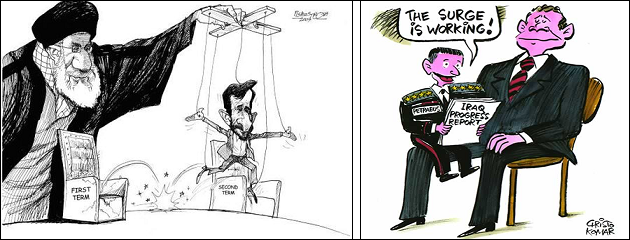
If you are used to seeing cartoons such as these —

showing Khamenei pulling Ahmadinejad‘s strings and Petraeus as a puppet of GW Bush, when you come across the Netanyahu cartoon in the Guardian, you may well view it as another in a long series of political cartoons suggesting that someone is running someone else’s show behind the scenes. It’s the old idea of the eminence grise, in other words, expressed in cartoon form.

**

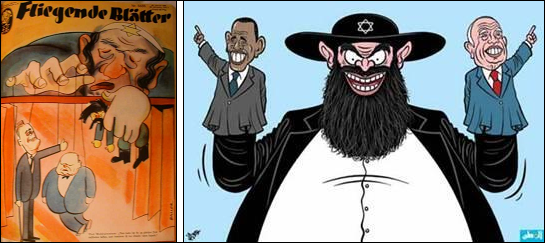
If, on the other hand, you’ve been exposed way too often to cartoons like these —

the one portraying Churchill, FDR and Stalin as Jewish puppets, taken from a 1942 issue of the Nazi paper, Fliegende Blätter, or the one depicting McCain and Obama as Israeli puppets, taken from a 2008 issue of the Saudi paper, Al-Watan… you may well see the same cartoon in a very different — and distinctly antisemitic — light.

**

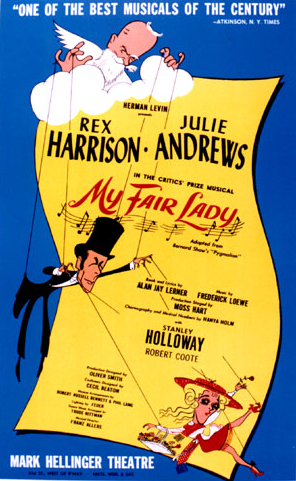
The last two graphics, at least, are extremely offensive, and I would like to offer another graphic here — one which also uses our “puppet master” theme — as a visual equivalent of offering a glass of water to cleanse the palate:

I’ll be addressing this My Fair Lady poster from a very different angle, in a later post in my “form is insight” series — this one on “dolls within dolls”, the “world stage which we have dotted with stages of our own devising” and “turtles all the way down”…

**

Having hopefully reduced the emotional freight which some of the cartoons above must surely have carried with them, I would now like to offer you some background which seems relevant to me. Characteristically, perhaps, it comes from a very different field of knowledge.

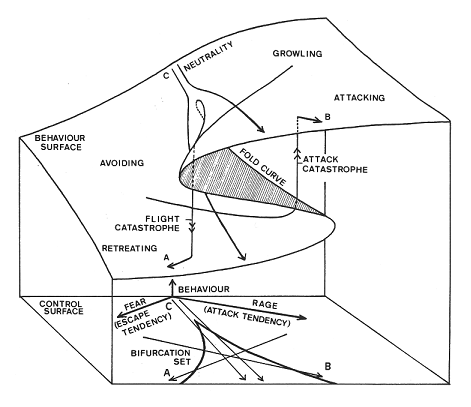
EC Zeeman‘s April 1976 article Catastrophe Theory in the Scientific American was my introduction to the mathematician Rene Thom’s remarkable body of work, an introduction which sailed mostly over my head — but one of Zeeman’s points, which he illustrated with the graphic below, made perfect sense to me.

The annotation to this illustration read in part:

If an angry dog is made more fearful, its mood follow* the trajectory ‘A’ on the control surface. The corresponding path on the behaviour surface moves to the left on the top sheet until it reaches the fold curve; the top sheet then vanishes, and the path must jump abruptly to the bottom sheet. Thus the dog abandons its attack and suddenly flees. Similarly, a frightened dog that is angered followes the trajectory ‘B’. The dog remains on the bottom sheet until that sheet disappears, then as it jumps to the top sheet it stops cowering and suddenly attacks.

My translation:

A dog that reaches the point where its ears are fully pinned back, indicating full-on fear, and its teeth are also fully bared, indicating full on rage, will behave differently depending on whether its fear level or its rage level was the first to be raised to “full”.

Just as a dog’s reaction to a full on mix of rage and fear may depend on which stimulus came first, so — I am suggesting — our own reaction to the cartoon in question — inherently antisemitic, or merely critical of a particular Israeli operation — may depend on our previous exposure to cartoons, politics, the Israeli-Palestinian conflict, or antisemitism.

**

We now have several levels of ease or difficulty in reading graphics. The Zeeman graphics are hard to read because they’re too small to be legible — but put them in the context of Zeeman’s article, and view them full size as originally published, and the only problem might be in following Zeeman’s text, itself a popularization and simplification of Rene Thom‘s work.

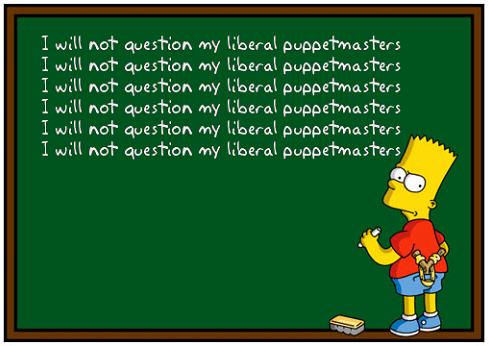
The Bart Simpson graphic is fairly straight forward, and regular viewers of the show would “read” it in line with hundreds of similar frames in which Bart writes repeated lines on a classroom chalkboard, from Season 1 episode 2’s “I will not waste chalk” to Season 23’s “There’s no proven link between raisins and boogers”.

And then there’s the disputed Netanyahu graphic… which can be “read” differently, depending on what previous “puppet master” associations the viewer beings to the task. Here, it seems to me, the task of interpretation can be viewed in one of two ways: (i) as an exploration of how it is likely to be read, which I’m suggesting will depend on previous association, and (ii) as an exploration of what “must have been” in the cartoonist’s heart.

**

Assessing the cartoon’s probable impact on segments of the public is one thing — knowing what the cartoonist intended, even though we tend to conflate the two, is quite another. Not for nothing does St Paul in I Corinthians 2.11 ask (in my own translation)

Who knows the qualities of a man but the spirit of that man within him?


Switch to our mobile site