zenpundit.com » humor

Archive for the ‘humor’ Category

Cross-grain thinking, 2: mapping the jihadist mind & AQ’s #3 spot

Sunday, November 11th, 2012

[ by Charles Cameron — the different types of “leaders” should give us an idea of the different mental operations in play in the individual minds of the led, as well as the “mind” of the organization — plus fun ]
.

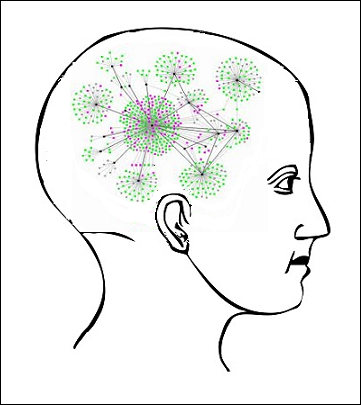
credit for mind map aspect of composite image to valdis krebs
.

Okay, I made my basic point here quite nicely in that little tag-line that gives you the brief overview of each of my posts right next to my name, so I’ll just repeat it here, very slightly amplified for focus:

The different types of “leaders” we identify in AQ should give us an idea of the different mental operations usually in play in the individual minds of jihadists, as well as within the “mind” of the organization itself.

I tried to show how cross-grain thinking in general, and thinking that includes both “subjective” and “objective” realities specifically, might play a considerable role in understanding some pressing contemporary issues in my recent post on Mozart — a figure so removed from those problems that some of you may have skipped it. Here’s my ending, with the Mozart details safely removed:

I think we should track that pattern, know as much as we can of that pattern, write the biography of the way in which some piece of music weaves between inspiration and thought, composer and instrument, mind and matter, performer and audience, studio and home digital music center…

Then, perhaps, we could begin to map other patterns – in some ways simpler and more urgent ones.

The sorts of “simpler and more urgent” patterns I was thinking of there include:

  • how discussions become deliberations and deliberations decisions
  • how scenarios are built and understood and sometimes poorly configured to our later detriment
  • how foreign policy plus feedback loops can create blowback and how to minimize it..
  • and specifically,

  • how the “jihadist” radicalization process moves from floating frustration and shame, via identification of a plausible “other” to rage against, to commitment, then via theology (!!) (for divine sanction of otherwise unpalatable acts) to the recognition of a binding moral obligation (fard ‘ayn in AQ terms) — and thence to camps for training in weaponry and the requirements and subtle limitations on Quranically sanctioned war…
  • **

    That last one has been an interest of mine, sitting in the back of my mind as an unanswered problem, quietly gathering data and forming insights for a while now, under a rubric along the lines of the question:

    Can we figure out a rough map of the workings of the “typical” mind of a potential jihadist as it radicalizes?

    It occurs to me that the leadership of an organization likely maps well to the organization’s functions, and those functions to the thought processes in which members are involved so a map of the aspects of leadership may well give us a rough draft of a mind-map for the individual member, including the passage from uninvolved observer to active participant: the process of radicalization.

    This may seem pretty obvious to some of you, but it’s a fresh idea for me, and to me it’s important because we already map communications networks and organizational flows, but the mind — the individual mind is one place we don’t seem to go.

    So I’m thinking in terms of sketching the mind of a “person” who is in some ways AQ as a whole, considered as if it were one sensate human-like being, filled with the usual variety of thoughts and emotions, ideals and pragmatisms, hopes and fears, hunches and hard data, clarities and confusions.. And I’m thinking of doing this by treating “leaders” as though they were distinct but coordinated processes in a single mind.

    We track and map people and their connections, we track and map groups and their connections, we track and map communications and their connections — are we tracking and mapping memes as such? ideas and their connections? minds?

    If we are already tracking ideas and minds — or if we aren’t doing that yet, but could — I’d be on the lookout for possible positive and negative feedback loops within the system, some that enhance the overall operation and could be disrupted, and some that fragment and damage it and could be amplified.

    So that, among other things, God willing, we could learn better ways to dampen some of the oscillations of hate…

    **

    I was looking at a comment in the recent ICSR report, Al-Qaeda at the Crossroads [h/t @azelin], and ran across this quote which struck me from an oblique angle:

    About ten core leaders have been subsequently killed, including Atiyah Abd al-Rahman, Abu Hafs al-Shahri, Samir Khan, Anwar al-Awlaki, and Abu Yahya al-Libi.

    Let’s take a look at these folk: Atiyah Abd al-Rahman was reported via Bill Roggio at Long War Journal as al Qaeda’s “operations chief” and a major planning a major attack on the US for the tenth anniverary of 9/11, as AQ’s “general manager” and bin Laden‘s “chief of staff”. Abu Hafs al-Shahri was another “operations chief”. Samir Khan was a publicist, the editor of the English-language magazine Inspire. Anwar al-Awlaki was a minor theologian with a talent for publicity and a decent understanding of his American audience…

    And as for Abu Yahya al-Libi, here’s an excerpt from an NYT piece about him:”I call him a man for all seasons for A.Q.,” said Jarret Brachman, a former analyst for the Central Intelligence Agency who is now research director of the Combating Terrorism Center at West Point. “He’s a warrior. He’s a poet. He’s a scholar. He’s a pundit. He’s a military commander. And he’s a very charismatic, young, brash rising star within A.Q., and I think he has become the heir apparent to Osama bin Laden in terms of taking over the entire global jihadist movement.”

    On that telling, al-Libi alone would be almost enough for my purposes — but let’s go with the whole list. The AQ mindset involves courage, poetry, scholarship, punditry and command and control. Specify that the scholarship needs to include theology (AQ at one point sent al-Libi to Mauretania for advanced Islamic studies) as well as strategy and guerrilla warfare (think Abu Mus’ab al-Suri, who was well-read in Taber’s The War of the Flea, Chairman Mao, Che Guevara, and Vo Nguyen Giap), and the significant influences on the jihadist mind begin to swim into focus.

    **

    See, I’m nudging my way to something fairly close to the Lincoln mention in Fred Kaplan‘s Slate piece about Petraeus the other day:

    Toward the end of the war, as the senior planning aide to Army Chief of Staff Gen. George Marshall, Lincoln realized that the Army needed to breed a new type of officer to help the nation meet its new global responsibilities in the postwar era. This new officer, he wrote to a colleague, should have “at least three heads—one political, one economic, and one military.” He took a demotion, from brigadier general to colonel, so he could return to West Point and create a curriculum “to improve the so-called Army mind” in just this way: a social science department, encouraging critical thinking, even occasionally dissent.

    How would we map these mental processes? How would we map the jihadist’s equivalent?

    **

    While I was fishing around for AQ leadership lists in search of an education, I ran across Robert Mackey‘s amusing piece on his NYT blog back in 2010, titled Eliminating Al Qaeda’s No. 3, Again, in which he mentioned as killed or captured claimants to the #3 spot Mustafa Abu al-Yazid, described as “a top financial chief for Al Qaeda” and quotes a colleague as saying “many of Mr. Yazid’s predecessors in Al Qaeda’s No. 3 slot” – from the Bush years alone, he lists Abu Zubaydah, Khalid Shaikh Mohammed, Abu Faraj al-Libbi, Hamza Rabia and Saif al-Adel.

    Okay, we should definitely add “financial chief” to my list above.

    The humorist and the artist in me often lead the more serious analyst in me to insights I’d not otherwise have access to, and since I’m worrying away at the notion that analysis needs to feature both “interior” (mind, heart) and “external” (world) realities, I keep the artistry and humor in my analyses, and hope that makes them more rather than less accessible — so let’s run with the AQ#3 nonsense for a bit.

    Mackey’s is a slightly tongue in cheek treatment of a reasonably serious topic. On Twitter the humor gets more incisive, with Andy Borowitz claiming 9,000 AQ#3s have been killed, and AQ#3 in person setting up a twitter account and tweeting merrily away for a while, see the two sample tweets in this SPECS graphic:
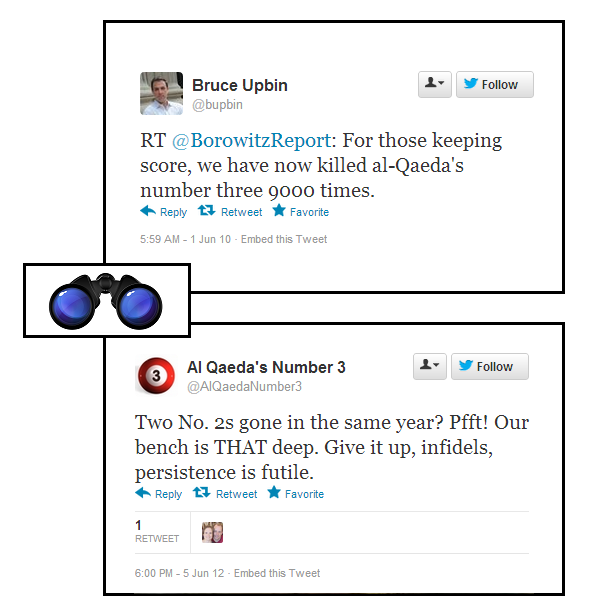
    My sources for those two tweets were Bupbin and AlQaedaNumber3.

    To be honest, I find the AQ#3 business both irritating — since it shows how little depth our popular understanding of who we’re dealing with really has — and amusing — because it’s so very ripe for satire…

    **

    I’ve been working at this post so long I’m mentally cross-eyed, so feel free to fill me in or chew me out…

    Some interesting pre-debate readings, left and right

    Monday, October 22nd, 2012

    [ by Charles Cameron — first, the humor, then the serious stuff — including insider and outsider claims as to who belongs with what religious grouping ]
    .

    Two items from my inbox on this day of the Presidential Foreign Policy debate play humorously with the, for want of a better term, issue of Muslims and Mormons:

    On the top, Tim Furnish, author of the book Holiest Wars and an expert on Mahdism, heads up a brief post on his MadhiWatch blog with an image out of South Park and the caption: The quintessential Mormon v. the original Mahdi! It’s ON! That’s from the right.

    From the left, Frank Schaeffer, who “left” the movement his influential “right” father, the evangelical theologian Francis Schaeffer, helped found, and is now an Orthodox Christian of a more sacramental and liberal stripe, plays a rather different game in his Huffington Post piece, posted under their Comedy header, and purportedly describing an “alternative USA somewhere on a planet far away and not so long ago…”

    Okay, that’s the fun. The serious part, for me, boils down to these two things:

    **

    Schaeffer has a point, I think, in mocking the Billy Graham organization’s sudden and opportunistic dropping of Mormonism from the list of cults on their My Answer page.

    I support the right of Latter-day Saints to call themselves Christians, since they follow the teachings of Jesus Christ as they understand them.

    I support the right of other Christians to view them as non-Christian, should they feel obliged in good conscience to do so, since Mormons consider the revelations of Joseph Smith on a par with the canonical gospels, much as Moslems consider the revelation to Muhammad as a completion of the Towrat and Injil (Jewish and Christian revelations).

    And I don’t much like the term “cult” as applied to people whose beliefs differ from one’s own in any case, since it tends to dehumanize those to whom it is applied, as witness the tragedy of the Branch Davidians in Waco not too many years ago.

    I am not entirely opposed to the idea of adjusting religion to suit a changing world, but I have to say this move on the part of the Graham organization appears to be a totally inauthentic PR move, made for political and not theological reasons, and wide open to the appearance of hypocrisy. If, on the other hand, it leaves all concerned more willing to respect each other as individuals across theological borders, that’s something I can readily applaud.

    As usual, there are nuances within nuances to be considered.

    **

    And Tim Furnish’s use of an image from South Park (I imagine it’s from their Super Best Friends episode) is pure eye-candy. It’s an attention grabber, all right, and it’s function is to point you to Furnish’s recent piece on History News Network, titled What Would a Mitt Romney Foreign Policy Look Like? We’ll learn more about that tonight, I imagine, but Furnish’s column makes interesting preparatory reading:

    Ironically, rather like Obama, Romney sees the events of the “Arab Spring” and the abortive “Green Revolution” in Iran through neo-Wilsonian lenses, as evidence of Middle Eastern masses yearning to breathe free — a “struggle between liberty and tyranny, justice and oppression, hope and despair.”

    Interestingly enough, the question of who can or should not be tagged with a particular label is central to Furnish’s post. Discussing Romney’s use of the term “extremism” seven times in his Virginia Military Institute [VMI] addresss, he writes:

    Only once, note, did he preface the term with the adjective “Islamic.” However, by that one example of intellectual honesty, Romney locates himself light-years ahead of the Obama administration, which actively discourages honest discussion of the fact that 61 percent — 31 of 51 — of the foreign terrorist organizations on the State Depatment’s list thereof are Islamic and which, further, sanctions counter-terrorist trainers who dare to utter words such as “jihad.” One wishes he would simply call an Islamic extremist spade a spade — but Romney is allowing himself to be constrained by his stable of advisors, as well as, perhaps, the pro-Islamic tendencies inherent in the Church of Jesus Christ of Latter Day Saints. Someone needs to tell the Governor that naming Islamic extremism in the defense of Western civilization is no vice.

    FWIW, I am in favor of recognizing that jihadists are influenced by their own versions of Islamic doctrine, within widely varying degrees of flexibility, so the phrase “Islamist extremists” makes some sense to me. And I am equally in favor of allowing those Muslims who see the jihadist’s theology as alien and contrary to their own Muslim tradition to make it clear that in their understanding of Islam, the “jihadists” represent an aberration from the faith. Nuance again, nuance.

    Okay, that reference above to the “pro-Islamic tendencies inherent in the Church of Jesus Christ of Latter Day Saints” is linked to another of Furnish’s pieces for HNN, in which he asks Has Mitt Romney’s Mormonism Influenced His Views on Islam? — in which Furnish quotes Romney thus:

    I spoke about three major threats America faces on a long term basis. Jihadism is one of them, and that is not Islam. If you want my views on Islam, it’s quite straightforward. Islam is one of the world’s great religions and the great majority of people in Islam want peace for themselves and peace with their maker. They want to raise families and have a bright future. There is, however, a movement in the world known as jihadism. They call themselves jihadists and I use the same term. And this jihadist movement is intent on causing the collapse of moderate Muslim states and the assassination of moderate Muslim leaders. It is also intent on causing collapse of other nations in the world. It’s by no means a branch of Islam. It is instead an entirely different entity. In no way do I suggest it is a part of Islam [emphasis added].

    Here’s where the delicate balance is required.

    On the one hand, we need to be clear — especially on the analytic and policy-making levels — on the ways in which Islam can be and is being interpreted as providing divine sanction for sustained campaigns of terroristic violence.

    And on the other, we should in no way encourage — particularly at the level of popular public opinion — the idea that we are “at war with Islam”, an idea which leads to such things as the dehumanizing and killing of American (not necessarily even Muslims) citizens within our own shores, and an increasing sense that America is in fact at war with Islam in the minds of some few Muslims here and many more abroad — who then become prey for further radicalization, as rage on each extreme fuels the other in the multiple echo-chambers and feedback loops of YouTube and the net.

    **

    And for what it’s worth, Tim F and Frank S — you should both talk to your editors about proof-reading. Tim, the Mormon church is the Church of Jesus Christ of Latter-day Saints if I’m not mistaken, with a hyphen and lower-case “d” in “Latter-day” — strictly FTR. And Frank — you get Dinesh D’Souza‘s first name right on two occasions — why spell it Dnish and Dinish on two others?

    Oh well, we all make mistakes. I tried to type the word “to” the other day. You might think that’s simple enough, but I spelled it “typo”. Oops!

    Feel free, y’all, to let me know what I’ve mis-spelled, misunderstood, or just plain missed, okay?

    Why do people cover their mouths?

    Thursday, October 4th, 2012

    [ by Charles Cameron — mostly amused, a little curious ]
    .


    .

    The image is from Vanity Fair‘s Exclusive: President Obama Considered Putting Osama bin Laden on Trial if Taken Alive, teaser for a forthcoming article, which includes this intriguing Obama quote:

    I mean, we had worked through a whole bunch of those scenarios. But, frankly, my belief was if we had captured him, that I would be in a pretty strong position, politically, here, to argue that displaying due process and rule of law would be our best weapon against al-Qaeda, in preventing him from appearing as a martyr.

    That — the quote itself, the Vanity Fair piece I grabbed it from, their upcoming full article by Mark Bowden, and or Bowden’s own book The Finish, plus any and all ramifications and queries relating thereto — strikes me as the sort of thing we might like to discuss here.

    Not that I personally have any competence in such matters.

    **

    What I want to know, just out of idle curiosity, is this: why do so many of the people in the photo want to keep their thoughts to themselves?

    A slight change of ideology at the Kremlin?

    Monday, September 10th, 2012

    [ by Charles Cameron — with irony, skepticism, and just a dash of dry humor ]
    .

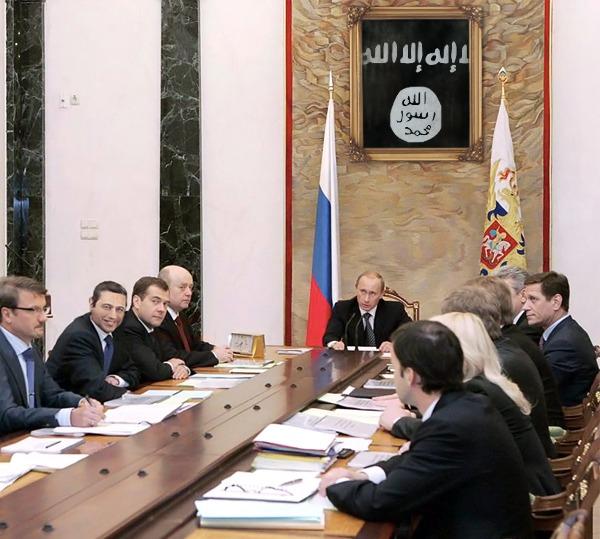
    image from the Ansar forum, h/t to Aaron Zelin

    **

    You’re probably familiar with the idea of a jihadist flag flying over the White House. Anjem Choudry, the British radical Islamist preacher told Christiane Amanpour on ABC This Week a while back:

    Indeed, we believe that one day the flag of Islam will fly over the White House. Indeed, there’s even a narration of the prophet where he said that ‘the Judgment will not come until a group of my Ummah conquered the White House’.

    I’ve dealt with this hadith before as it happens, and pointed out that in one telling the Prophet is asked which “white palace” he’s referring to and replies that he’s referring to the palace of Khosrau (Chosroes) I of Persia:

    Jabir b. Samura said:

    I heard the Messenger of Allah (may peace be upon him) say on Friday evening, the day on which Ma’ez al-Aslami was stoned to death (for committing adultery): A small force of the Muslims will capture the white house. I said: Kisra? he replied Kisra.

    **

    Never mind, Choudary thinks the jihadist flag will fly over the White House on Pennsylvania Avenue — and like-minded protesters in New York even carried a photoshopped image of the concept (below) as a placard at a 2006 rally in New York.

    **

    Hey! Put those two ideas together — a little “more of the same” photoshopping should do the trick — and you’d have a magnificent end to the Cold War, eh?

    Maybe that’s what Choudary meant when he said, earlier in the same conversation with Amanpour:

    Well, just let me say that Islam has a solution for all of the problems that mankind faces.

    I suppose that’s one way to avoid a clash of civilizations — have just one guy holding both cymbals, right?

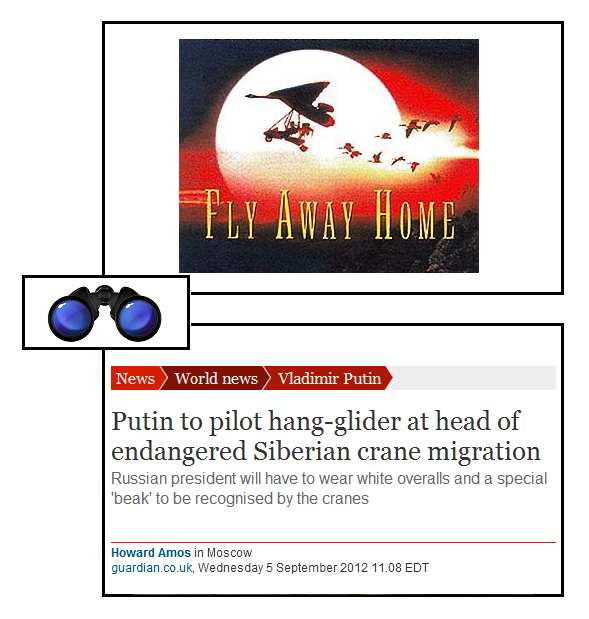
    Fly away home, 007

    Thursday, September 6th, 2012

    [ by Charles Cameron — Putin the Magnificent and his gaggle of geese ]
    .

    --- upper image from the motion picture soundtrack album

    In the film version, according to Wikipedia, there’s “an emergency landing at a U.S. Air Force base on Lake Ontario”

    **

    [ nothing too original here, the Guardian story mentioned the film ]


    Switch to our mobile site