zenpundit.com » twitter

Archive for the ‘twitter’ Category

Three from the avatar… Aaron Zelin

Friday, November 16th, 2012

[ by Charles Cameron — keeping up with Aaron Zelin on a good day can be quite a feat — this post has taken me a few days to write! ]
.

Let’s start with this avatar business. I picked it up from Gregory Johnsen, who applied the term in a tweet a few days ago to Aaron Zelin:

I chuckled at the description and RT’d Johnsen’s tweet at the time — but a day later the full force of the words “more than just a high producing avatar” came back to me, when I took a look at the things I wanted to pass along here on Zenpundit from that day’s haul, and found that three of them came via Aaron.

**

First up on the 14th: Aaron’s own post on Foreign Policy‘s Middle East Channel, Maqdisi’s disciples in Libya and Tunisia.

This featured the Benghazi and Tunisian groups that share the name Ansar al-Sharia (ASB and AST), and points to the idea that:

much of the scope of their activities lies outside violence. A large-portion of the activities of these groups is local social service provision under their particular dawa (missionary) offices. This broader picture is crucial to better understanding emerging trends in societies transitioning from authoritarian to democratic rule.

This emphasis, Aaron suggests, derives from the writings of Sheikh Abu Muhammad al-Maqdisi:

One of the main critiques Maqdisi presents, and hopes to create a course correction within the jihadi movement, is his differentiation between the idea of qital al-nikayya (fighting to hurt or damage the enemy) and qital al-tamkin (fighting to consolidate ones power), which he expounds upon in his book Waqafat ma’ Thamrat al-Jihad (Stances on the Fruit of Jihad) in 2004. Maqdisi argues the former provides only short-term tactical victories that in many cases do not amount to much in the long-term whereas the latter provides a framework for consolidating an Islamic state. In this way, Maqdisi highlights the importance of planning, organization, education, as well as dawa (calling individuals to Islam) activities.

Finally, Aaron places ASB (Benghazi) and AST (Tunisia) in the wider context of Islamist movements, both Sunni and Shia, writing:

By providing charity, care, and aid ASB and AST are acting similarly in their operations (though should not be confused for allies with or having ideological connections) to the Muslim Brotherhood, Hamas, and Hezbollah. Providing social services has provided leverage for these groups to gain wider popularity and support within the local community.

For more detailed discussion of Maqdisi, Aaron points us to Joas Wagemaker‘s essay, Protecting Jihad: The Sharia Council of the Minbar al-Tawhid wa-l-Jihad.

By my count, therefore, we now have at least five tendencies to think about: (i) politically engaged Islamists, such as the Brotherhood and the Ennahda movement, (ii) jihadists who hope to topple the “near” enemy, ie local despotic rulers of Muslim-majority states, (iii) jihadists who hope first to cripple the “far” enemy, following bin Laden‘s doctrine, (iv) jihadists in the wake of Abu Musab al-Suri‘s nizam, la tanzim (system, not organization), with its implication of decentralized jihad and leaderless resistance, and (v) the distinctive approach to jihad that Aaron discusses, in which al-Maqdisi’s theories are implemented:

ASB and AST do not buy into the democratic process and in spite of it are attempting to consolidate their future Islamic State one small act of charity at a time.

**

Second, Aaron’s Jihadology blog the same day hosted a fascinating piece by Jack Roche, a former member of Jama’ah Islamiyyah, titled The Indonesian Jama’ah Islamiyyah’s Constitution (PUPJI).

One point of interest to me here was a version of the well-known “saved sect” hadith, which has been specifically viewed as referring to al-Qaida on occasion:

It was narrated from ‘Awf bin Malik that the Messenger of Allah said: “The Jews split into seventy-one sects, one of which will be in Paradise and seventy in Hell. The Christians split into seventy-two sects, seventy-one of which will be in Hell and one in Paradise. I swear by the One in Whose Hand is the soul of Muhammad, my nation will split into seventy-three sects, one of which will be in Paradise and seventy-two in Hell.” It was said: “O Messenger of Allah who are they?” He said: “Al Jama‘ah – The main body.” (Sunan Ibnu Majah 3992).

I’d seen versions of the hadith in which it is promised that one Islamic sect will endure to the end and be worthy of paradise, but I’m not sure I’d ever seen this version, with one Jewish and one Christian sect similarly treated.

I imagine the “three” sects are in fact the “one” sect of those who, in the different Abrahamic traditions, have remained faithful to the one truth taught by all the prophets from Moses via Jesus to Muhammad — but might there be some Christians faithful to this day, as is perhaps suggested by Qur’an 5.82 —

The nearest to the faithful are those who say “We are Christians.” That is because there are priests and monks among them and because they are free of pride.

The first part of that verse, be it noted, is less than flattering regarding the Jews…

Again, this post of Roche’s lead me to another source, in this case Nasir Abas‘ book, Exposing Jama’ah Islamiyah. This presumably belongs on the mental shelkf next to Muhammad Haniff Hassan‘s Unlicensed to Kill: Countering Imam Samudra’s Justification for the Bali Bombing [both links are to free, downloadable e-books].

There is much reading to be done…

**

Last, to return to the matter of Twitter, there was Aaron’s response to an FBI announcement —

The FBI tweet actually came after they had made the announcement Aaron was responding to, but his critique still stands…

**

There may be some flattery in this post, but if so, it’s not Aaron’s fault; there’s certainly a sincere compliment intended from my side. But what this post really is — and the length of time it’s taken me to write this has made the timing right — is a “Follow Friday” #FF for @azelin on Twitter, and the articles and resources his twitter feed will lead you to.

consider Aaron a friend in the digital way of things, but my point here is point you towards him if you do not already follow him, and to raise just a few of the issues that struck me in reading just one day’s worth of his output.

From Nicholae Carpathia to the Mahdi: a significant shift

Friday, November 9th, 2012

[ by Charles Cameron — a notable shift in the portrayal of Antichrist, from European politician to Islamic savior ]
.

I have written before about the clash of eschatologies, and today I want to note what appears to me to be a significant turning point in popular Christian end-times thinking. Joel Richardson today posted this endorsement:


.

IMO, that’s huge.

[ edited to add: BTW, LaHaye seems to be thinking in terms of the Shia Mahdi, the Twelfth Imam — the Sunni al-Mahdi would not be “the Imam of the Twelfth century”. Richardson’s view encompasses both. ]

**

Nicholae Carpathia is the Antichrist figure in the best-selling 1995-2007 Left Behind series of books, films and games, in which pastor Tim LaHaye presents his vision of the end times in fictional form, with the help of co-writer Jerry Jenkins.

Here’s how Wikipedia sums up Carpathia as he features in the series:

Former president of Romania, former Secretary General of the United Nations, self-appointed Global Community Potentate, assassinated in Jerusalem, resurrected at GC complex and possessed by Satan. Within the series, Carpathia is the Antichrist, and leader of the Global Community, a world government which he ultimately marshals against the followers of Jesus Christ.

LaHaye, in other terms, was working on the European Antichrist model that has been the staple of “soon coming” eschatology for decades. Indeed, in Revelation Unveiled (p 209) he wrote of the Antichrist:

Daniel 9:26 refers to him as the ruler of the people that will come, meaning that he will be of the royal lineage of the race that destroyed Jerusalem. Historically this was the Roman Empire; therefore he will be predominantly Roman.”

From Joel Richardson’s point of view, LaHaye’s endorsement is pretty strong evidence of the tide turning from the European to the Islamic model of the Antichrist. From my point of view, too, it’s a significant marker of that turning of the tide — but I also fear lest the rival messianisms of Christianity and Islam set up a howling feedback loop and polarize a situation where calmer minds…

**

Well, let me just point you — with a hat-tip to my friend Damian Thompson of the Telegraph — to this statement on the possibility of “reconciliation with Islam” by Justin Welby, the newly-announced next Archbishop of Canterbury and head of the world-wide Anglican Communion:

The confrontation between the different traditions of thought and forms of society that are represented by the Christian tradition and the Islamic world is one of the two most important issues of our age. It has the potential for endless conflict, vast loss of life, immeasurable cruelty, and even nuclear war. More than that, in the secularised North, all religious conflict is seen as justifying attacks on religion, including Christianity.

In addition, there is a growing tendency in political thought to see confrontation with Islam as inevitable, not as facing a religious system, but as facing a perceived mediaeval religious ideology. The Church can too easily be drawn into this, as a sort of partner, unwilling or even critical, but not providing an alternative to the tendency to say: “The great questions of the day will not be settled by resolutions or the votes of majorities in assemblies… but by Blood & Iron.” The costs of that error and sin are borne afresh every day by another soldier’s family in this country.

The formative influence in this pattern of thought in the last 20 years, and especially since 2001, has been Samuel Huntington’s Clash of Civilisations in which he argues that wars between civilisation groups rather than nation states are inevitable. This approach, which is followed by many other political scientists, has been taken up especially with regard to Islam, based on the long history of conflict between Christendom and Islam, going back to the 7th century.

Many Christian groups have almost welcomed this analysis, and seen in it the justification required to excuse many of the actions of “Christian” countries towards the world of Islam. Other have welcomed it as explaining the perceived and experienced threat. Within Protestant circles, revisionist theology has called for a syncretistic approach, in which the common values of the faiths are emphasised to the point where no distinctions can be recognised. This is also true amongst Anglo Saxon secular thinking, where it is not overtly atheist.

And yet, as I want to suggest, the Church has both the understanding and the means to face this great issue with tools and opportunities that can offer a genuine solution.

The understanding comes first. Christians understand the importance of the spiritual life, and thus should be able to relate to Islam in a way that the secular may find more difficult…

The Messianic Mahdist Moebius strip — or maybe Maze?

Monday, October 29th, 2012

[ by Charles Cameron — a quick look at some confusing clashes between messianisms, with specific reference to the MUJAO — also the late Ayatollah Baqir al-Sadr sounding an ecumenical note ]
.

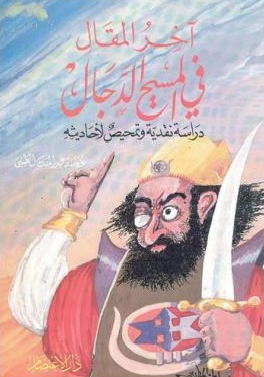
image: Dajjal, from Okasha Abdelmannan al-Tibi's The Whole Truth about the Antichrist

.

Tim Furnish opens his book Holiest Wars: Islamic Mahdis, their Jihads and Osama bin Laden, with the words:

One man’s messiah is another man’s heretic.

What he doesn’t state outright, which is also true, is that all too often that heretic is the anti-Messiah.

**

I use that term “anti-Messiah” deliberately, because in discussing Islamic end times beliefs, the term “Antichrist” is frequently used by both Christians and Muslims to refer to the Muslim “equivalent” of the Christian Antichrist — ie the “deceiving messiah” or Masih al-Dajjal, whose coming at the end of days is predicted in Islamic apocalyptic narratives in negative counterpoint to the coming of the Mahdi, in much the same way that some Christian apocalyptic narratives predict the coming of the Antichrist in negative counterpoint to the return of the Christ.

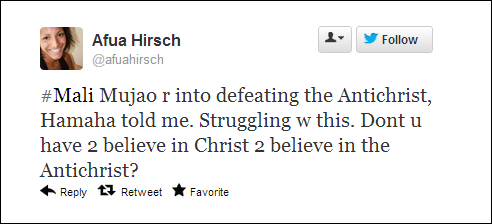
This issue was brought home to me once again today when Aaron Zelin pointed me to this tweet from Afua Hirsch [ @afuahirsch ], West Africa Correspondent for the Guardian:

Frankly, I think that’s a very natural question to raise, and one that has an even more intriguing answer.

**

One other note, which I’ve separated out between asterisks here because I think it’s a crucial one at that:

by Afua Hirsch’s account, Mali’s Movement for Unity and Jihad in West Africa (MUJAO) has the apocalyptic fever…

**

Strange things happen when different views of the end times, as prophesied one way or another in various branches of all three Abrahamic religions, clash.

Here’s where I see the moebius strip effect, whereby apocalyptic figures are turned into their opposites by rival sets of beliefs:

Some Muslims call the Dajjal (literally, “the deceiver”) the Antichrist — here, for instance, is a video clip of Sheikh Imran Hosein, whom I have discussed on Zenpundit before, quoting a hadith or tradition of the Prophet from the Sahih Muslim collection, and using the term “Antichrist” without further comment in his translation of the term Dajjal —

While some Christians call the Mahdi the Antichrist — as does Joel Richardson in his book currently issued under the title The Islamic Antichrist: The Shocking Truth about the Real Nature of the Beast. Reviewing the book in its first edition under its earlier title, Dr David R. Reagan sums Joel’s basic points succinctly:

Joel Richardson in his book Antichrist: Islam’s Awaited Messiah argues that the Mahdi will be the Antichrist of the Bible and that the Muslim Jesus will be be the False Prophet of the Bible who serves the Antichrist and his purposes. Both will be destroyed when the true Jesus returns at the end of the Tribulation.

We were talking about the Sufyani just the other day, right? Here’s a stunner to spin your head a further 180 degrees — the Sufyani as a second (and more dangerous) Dajjal than the Dajjal:

While the great Dajjal focuses on atheism and fights Christianity, the Islam Dajjal, Sufyan, fights Islam, which is the only true religion before Allah, openly. Therefore he is regarded as more frightening.

There’s also a question of one and / or many Antichrists in Christianity, of course — see 1 John 2:18:

Little children, it is the last time: and as ye have heard that antichrist shall come, even now are there many antichrists; whereby we know that it is the last time.

And hey, bear with me, I’m not done yet: members of the Ahmadi school quote a hadith from the Sunan Ibn Majah collection which says:

There is no Mahdi but Jesus son of Mary.

Ibn Majah, however, also has a hadith in which it is stated that at the time of the Mahdi’s advent he will invite the returning Jesus to lead the evening dawn prayer [as quoted here]:

…while their Imaam will have advanced to pray the Fajr prayer with them, Eesa, the son of Mary will descend [at the time of the Fajr prayer]. The Imaam will draw backward so that ‘Eesa would go forward and lead the people in prayer. However, ‘Eesa would put his hand between his shoulders and say to him: “Go forward and pray, as it is for you that the call for the prayer was called, so their Imaam would lead them in prayer.”

**

Confusing?

I think so, unless you are paying close attention.

My own recommendation would be that the phrase “the Islamic Antichrist” should be replaced by “the Islamic equivalent of an Antichrist” when referring to the Dajjal, and “the Mahdi viewed as Antichrist” when referring to the Mahdi.

I know, I know — the chances of changing people’s verbal habits across the board are pretty slender.

But have I made things seem complicated enough?

**

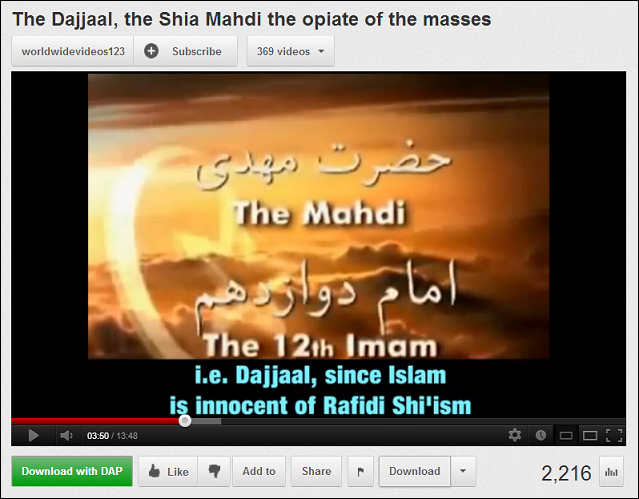
This whose business naturally gets just a tad more complicated once one adds in the Sunni concept — I am not sure how widespread it is, but it would make a fascinating topic for research for someone with the requisite language skills — that the Mahdi of the Shiites will be the Dajjal of the Sunni… as shown in this screen cap of a YouTube video.

[Rafidi means one who has deserted the truth, and is a derogatory term, in this case used by Sunnis to disparage the Shiites.]

Or this one — with its equation of the Shiites with the Jews:

Of course, Christianity too has its share of internecine apocalyptic mud-slinging: Rev. Ian Paisley (long-time leader of the Ulster Unionists and Moderator of the Free Presbyterian Church of Ulster) interrupted Pope John Paul II‘s speech at the European Parliament to denounce him as the Antichrist — while Rev. JD Manning gives Oprah Winfrey that title

**

Everything I have described above is dualistic in nature and sectarian in its specifics. It comes as something of a surprise, then, to find the late Ayatollah Muhammad Baqir al-Sadr quoted as writing:

The Mahdi is not an embodiment of the Islamic belief but he is also the symbol of an aspiration cherished by mankind irrespective of its divergent religious doctrines. He is also the crystallization of an instructive inspiration through which all people, regardless of their religious affiliations, have learnt to await a day when heavenly missions, with all their implications, will achieve their final goal and the tiring march of humanity across history will culminate satisfactory in peace and tranquility. This consciousness of the expected future has not been confined to those who believe in the supernatural phenomenon but has also been reflected in the ideologies and cult which totally deny the existence of what is imperceptible. For example, the dialectical materialism which interprets history on the basis of contradiction believes that a day will come when all contradictions will disappear and complete peace and tranquility will prevail.

The point is made even more clearly in a speech given by the Iranian scholar Muhammad Ali Shumali:

So, our own camp comprises of people who have this understanding: First of all, they are the people who believe in the Ahl al-Bayt. Yet, in our camp it is possible for there to be people who work for the Ahl al-Bayt without knowing the Ahl al-Bayt. This is also something very important. You may have a non-Shia who works for the Ahl al-Bayt better than many Shias. Indeed, you have some Shias that work against the Ahl al-Bayt. You may even have non-Muslims who are working for Imam Mahdi—for the cause of Imam Mahdi, for justice, for many things—and they may not even know who Imam Mahdi is. So it is not that whoever is not a Shia is not in our camp.

and:

I believe that the majority of the people of the world are not against us; it is just our failure to present our ideas and to convince them that what we have is for all mankind. I think in particular, in the case of Imam Mahdi, we must do the same thing: we must not present Imam Mahdi as a saviour for the Shias. Imam Mahdi is not a saviour for [just] the Shias. Imam Mahdi is a saviour for all mankind…

**

And then you see what you yourself see, and believe what you yourself believe.

Of hot spots and feedback loops

Friday, October 26th, 2012

[ by Charles Cameron — with a pinch of humility which, if you ask me, burns hotter than any pepper ]
.


.

Micah Zenko at the Council on Foreign Relations‘ Politics, Power, and Preventive Action blog raised a question yesterday that I found irresistible:

Well…

To be more exact, and exercise just a little humility, the question I found so exciting was really the one Crispin Burke posed, in a tweet pointing to Zenko’s piece:

**

So I read Zenko’s post with Burke’s term “hot spot” in the back of my head, and when I responded to Zenko, did so in terms of hot spots. Which because they’re like the celebrated “dots” we’re often told we’ve failed to connect, triggered some thoughts that I think are worth repeating, even if the phrasing is a little off from Zenko’s own.

And the only real benefit I can see from my carrying Burke’s “hot spots” over into Zenko’s post is that it raised the issue of peppers, which adds a little spice to my response, and gave me a great graphic to go at the top of this post.

Okay, here’s the key sentence that frames Zenko’s post:

If you ask ten forecasters to predict the next conflict, you’ll likely get ten very different answers. But, they will agree on one thing: it is impossible to know for sure where and when the next conflict will emerge.

Zenko may not mention hot spots as such, but already two things stand out for me: he uses the words “where and when” and “the next” — so he’s thinking in geographic terms and short timelines. In his title, he asks about 2013, which is almost in the greetings card section of my local Safeway by now. And he sees trouble in terms of places, not systems.

**

Here’s the response I posted at his CFR blog:

A given hot spot may only be hot when coupled with another spot in a feedback loop – and the two spots may be widely separated geographically.

To my way of thinking, an assessment of incipient troubles needs to look for feedback loops, blowback systems, echo chambers – all of them patterned phenomena that are likely to feature both sides of a potential or ongoing conflict from a systems analytic point of view. A microphone isn’t a hot spot, a loudspeaker isn’t a hot spot, but put the two of them in the same acoustic system and you can generate an ear-shattering howl…

I’d look at “strong” versions of Islamophobic rhetoric and “strong” versions of Islamist rhetoric as a single system transglobally, for example, and I’d want to figure out what would cause dampening effects on both sides.

Another tack I’d take is to ask questions like “what’s in our blind spots” and “what’s under the radar” – I vividly recall hearing Ali Allawi tell a session at the Jamestown Foundation that within Iraq, “most of the dissident Shi’a movements not within the ambit of the political process have very strong Madhist tendencies” and that they were “flying under our radar” — despite the fact that US forces had been involved in a major battle with one such group outside Najaf.

I’ll post a more extended response on Zenpundit – but for now, I’d just like to throw in one additional question: is there a Scoville Scale for the “hotness of spots” as there is for peppers? It’s hard to know how to think through potential vulnerabilities without some sense of both intensity and probability of risk…

**

Forget Scoville and his habaneros — let’s get to the meat and potatoes.

I’ll be straightforward about this. I suspect we’re doing our intelligence analysis and decision-making with only one cerebral hemisphere fully functioning — ie with only half a brain — like halfwits one might almost say, but in a strictly metaphorical manner — without benefit of corpus callosum.

We don’t have the leaf > twig > branch > limb > tree > forest > watershed > continent > world zoom down yet.

We don’t think in systems, we think in data points.

Blecch, or d’oh! — your choice.

**

So my questions — and I don’t claim by any means to have an exhaustive list, that’s why we have many and varied bright people instead of just one or two — would be along the lines of:

  • how many kinds of metaphorical dry kindling are there in the world, which could turn into metaphorical wildfires?
  • and what sorts of metaphorical sparks could trigger them?
  • where are the rumblings?
  • what are the undercurrents of strong emotion running in different sociological slices of the world, that can be discerned from open sources such as the comments sections of online news media, conspiracy sites, religious group and subgroup (sect/cult) teachings, eccentric political movements, strands of pop culture — fanfic, comics, graffiti — single issue blocs?
  • where are the feedback loops, the parallelisms and oppositions, the halls of mirrors, the paradoxes, the koans, the antitheses, the conceptual antipodes?
  • where does energy drain from the system, and where does it collect, pool, and stagnate?
  • and perhaps most of all, what do we do, ourselves, wittingly or unwittingly, that tends to irritate others enough that they do unto us?
  • and do we consciously want to keep doing those things, and the blowback be damned?
  • **

    Where do we go from here. I think Zen (the Zen of Zenpundit, not the Zen of Zenko in this case) is right: we need to cross-weave our “vertical thinking” tendencies with “horizontal thinking” — see Zen’s posts on understanding cognition 1 and 2, which I take to be foundational for this blog.

    It’s the horizontal part that I’m trying to develop here, in my series of posts under the rubric of “form is insight” — because I think we have the other half of the equation, or the other cerebral hemisphere if you prefer, fairly well in hand.

    As always, it’s our vulnerabilities, dependencies, deficits and blind-spots we should be paying most attention to.

    Quick update / pointer: GR & AZ on prisoner release

    Friday, October 12th, 2012

    [ by Charles Cameron — prisoner releases in Arab springtime, abu Musab and Dr Fadl; Daveed G-R and Aaron Z; two major rules of expertise: detail and humility ]
    .

    video edit-bay photo credit http://www.cdmastercopy.com

    .

    When you watch a well edited movie, the experience is seamless — despite the fact that the film itself was made with hundreds of cuts and splices. Film critics, mavens and the director’s fellow auteurs who make close readings and detailed studies of the film will see and appreciate the juxtapositions and graphic matches, the fine-tuned timing of the edits and the rhythm they give the film — but for the regular viewer, one continuous fabric of story unspools from opening to final credits. The editor’s skill lies in getting the splices right to a degree beyond the perceptual acuity of the audience.

    Similarly, a fine carpenter will often want to make joints that are imperceptible to the client, seeking a sensitivity to changes in height that is an order of magnitude greater than that required for the quick, cheap performance of the same task.

    True expertise is at least one order of magnitude deeper and more self-critical than it needs to be to satisfy a cursory examination.

    **

    Thus when Daveed Gartenstein-Ross and Aaron Zelin tackle the important — and easily overlooked — question of How the Arab Spring’s Prisoner Releases Have Helped the Jihadi Cause in the Atlantic, they offer us both far more than we knew we needed to know, and yet less than they themselves know about the topic, let alone the broader current of jihadist movements of which this particular topic is a single strand.

    It’s a significant topic, though, as their opening paragraphs neatly show:

    The investigation of the devastating Sept. 11 attack on the U.S. consulate in Benghazi, Libya, that killed American ambassador Christopher Stevens — limited as it is by security concerns that hampered the FBI’s access to the site –has begun to focus on a Libya-based Egyptian, Muhammad Jamal (a.k.a. Abu Ahmad al Masri). As a detailed Wall Street Journal report explains, Jamal is notable not only for having fighters under his command and operating militant training camps in the Libyan desert, but also for having recently gotten out of Egyptian prison.

    This latter fact makes Jamal part of a trend that has gone largely unremarked upon in the public sphere since the beginning of the “Arab Spring” uprisings: prisons in affected countries have been emptied, inmates scattering after being released or breaking free. In many cases, it is a good thing that prisoners have gone free: the Arab dictatorships were notorious for unjustly incarcerating political prisoners, and abusing them in captivity. But jihadists have also been part of this wave of releases, and we are now beginning to see the fruits of the talent pool that is back on the streets.

    I recommend it highly, as does at least one other more knowledgeable than I.

    **

    A short piece in the Atlantic is just right for an overview, but not the place to lay out the next level of detail, though — and there are three people in particular whose names I am always on the lookout for, names of people who vanished from public view into some form of imprisonment, and who are of considerable interest to me personally — primarily for their theological significance.

    The first of these is the Imam Musa al-Sadr, whose “disappearance” in Gaddafi’s Libya at the age of 50 in 1978 deprived the Lebanon of an inspiring leader — in a manner that eerily paralleled the ghayba or “occultation” of the Twelfth Imam of the Ithna ‘ashariyah.

    The second would be Sayyed Imam Al-Sharif, aka Dr. Fadl, whose book The Essentials was one of the major works of AQ ideology and the #2 jihadist manual downloaded from the net according to the CTC Atlas (p.10), and who recanted it from Egyptian prison, writing his Rationalizing Jihad in Egypt and the World which so severely critiqued AQ-style jihad that al-Zawahiri felt obliged to pen a 200-page counter-argument. In Dr Fadl’s case, the interest would be to see what he would say if liberated now.

    And my third “person of interest”? That would be Mustafa Setmariam Nasar aka Abu Musab al-Suri, whose massive Call to Global Islamic Resistance is a key document that chides bin Laden for “leading them to the abyss”, says “Al Qaeda is not an organization, it is not a group, nor do we want it to be. It is a call, a reference, a methodology”, and calls for “terrorism created by individuals or small autonomous groups (see Lawrence Wright, The Master Plan). Abu Musab, who may have been released from prison in Syria recently, is of interest to others as potentially the jihadi’s foremost strategist — and to me chiefly because of his use of apocalyptic forecasting in his Call.

    **

    Since their Atlantic piece was a short context-setter rather than a longer analytic paper, I asked Gartenstein-Ross and Zelin — Daveed and Aaron — net acquaintance and friendship is a funny thing, we haven’t worked out the etiquette as yet — about Dr Fadl and Abu Musab, not mentioned in the piece itself but surely not far from their thoughts.

    Twitter, of course, is even more drastically reduced than a piece in the Atlantic, so you can think of their tweeted responses as something along the lines of snapshots of footnotes. Nevertheless, they give me, as an inquiring mind, a quick glimpse of what a couple of those at least an order of magnitude deeper into these things know or conjecture about two people whose names and potential activities we should all keep stashed quietly away on some easily accessible mental shelf.

    Three things emerge from these tweets — how little we actually know, how important what we don’t know may be, and how honest the best analysts are about the limits of their knowledge. I’d tweeted, congratulating them on their piece and saying:

    hipbonegamer: i note no mention of Musab a-S – any idea what’s up with Dr Fadl? Dead? Released? Still held?

    And they responded:

    Aaron Y. Zelin: Details still too murky on Abu Mus’ab and no info on Dr. Fadl.

    D. Gartenstein-Ross: However, I think the question “where is Dr. Fadl, and why haven’t we heard from him?” is important for many reasons.

    D. Gartenstein-Ross: But Aaron is right: I haven’t seen any open source info that speaks to his fate.

    That’s two things at once: not very much, and a great deal.

    **

    So if lesson #1 of this post is that True expertise is at least one order of magnitude deeper and more self-critical than it needs to be to satisfy a cursory examination, lesson #2 must be…

    True expertise never claims knowledge that is one order of magnitude deeper or more exact than is actually known.

    Putting that in other terms: having an accurate mapping of one’s archipelago of knowledges within one’s oceanic ignorance is a highly significant form of meta-knowledge, lacking which one’s knowledges have blurred edges and little definitional value.

    And that in turns means — especially in terms of human intelligence — humility.

    **

    It’s Follow Friday (#FF) on Twitter: @DaveedGR and @azelin are two folks you can follow and trust.


    Switch to our mobile site